
Electrical Installation And Wiring Regulations Explained
- 👤 Alex
- 👁️ 123 Views
- Last Updated: March 30, 2026
- 🏷️ Electricians
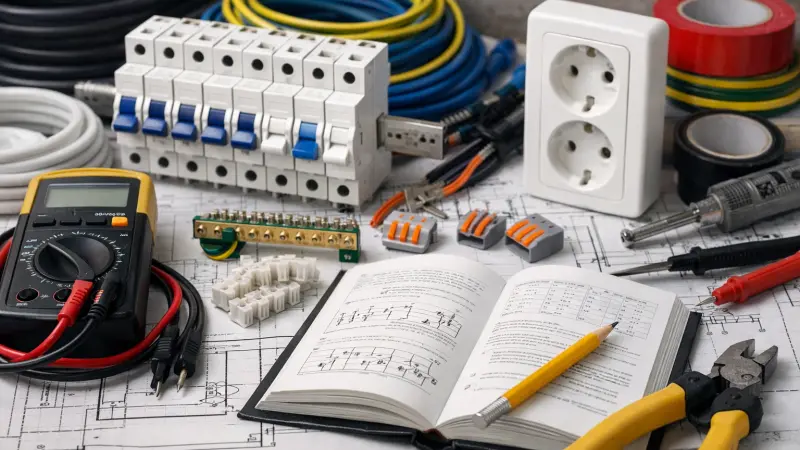
Every year, faulty electrical installations are responsible for thousands of fires and serious injuries across the United Kingdom. Understanding what constitutes a compliant electrical installation — and the regulations that govern it — is not merely a professional obligation; it is a matter of public safety. This guide explains the fundamentals clearly, from defining what an electrical installation is to the legal framework that underpins it.
1. What Is an Electrical Installation?
The term electrical installation is used so frequently in the construction and building services industries that its precise technical meaning is often taken for granted. Yet a clear understanding of the definition is the necessary starting point for anyone working with, commissioning, or maintaining electrical systems in the United Kingdom.
According to the IEE Wiring Regulations — now incorporated into British Standard BS 7671 — an electrical installation is defined as "an assembly of associated electrical equipment to fulfil a specific purpose and having certain co-ordinated characteristics." This compact definition carries considerable weight, and unpacking each element reveals why professional design and proper regulation are so important.
Breaking Down the Definition
Three concepts are central to the definition:
- Assembly: The equipment is not assessed in isolation. It is considered as a complete, integrated set of components working together.
- Specific purpose: The assembly exists to achieve a defined function — whether that is lighting a domestic dwelling, powering industrial machinery, or supplying a commercial premises.
- Co-ordinated characteristics: Each item of equipment within the installation must have electrical characteristics — voltage, current rating, fault capacity, and so forth — that are compatible and properly matched with every other item.
2. What Counts as Electrical Equipment?
The term electrical equipment within the context of an installation is defined very broadly. It encompasses any item used for the generation, conversion, transmission, distribution, or utilisation of electrical energy. This includes:
- Machines and motors
- Transformers and converters
- Switchgear, fuses, and circuit-breakers
- Measuring instruments and metering equipment
- Protective devices of all types
- Wiring materials: cables, conductors, trunking, conduit
- Accessories: socket-outlets, lighting points, consumer units
- Fixed appliances connected to the installation
The breadth of this definition underscores an important principle: electrical installation work is not simply about running cables and fitting socket-outlets. It involves the careful selection and co-ordination of every element in the electrical system to ensure safe and reliable operation.
Is an electric light bulb an electrical installation?
No. An electric light bulb is a single piece of electrical equipment. It has not been assembled with other equipment for a specific purpose in the sense the regulations require, and it lacks the co-ordinated characteristics that define an installation.
Is a light bulb, holder, switch, and associated wiring an electrical installation?
Not necessarily. Depending on context, this would typically constitute a single circuit of a larger installation — particularly if it terminates at a consumer's distribution board — or merely part of a single circuit. The presence of a complete, co-ordinated system with its own means of isolation and protection is required to qualify as a standalone installation.
3. Can a Single Circuit Be an Electrical Installation?
This question arises more often than one might expect, particularly in the context of outbuildings, temporary supplies, and standalone structures. The answer is yes — under specific conditions.
A single circuit may constitute an electrical installation provided it terminates in a main switch incorporating a fuse or equivalent protective device that is directly connected to the supply. Furthermore, the characteristics of every component — the cable, the switch, the luminaire, and the protective device — must be properly co-ordinated.
An Illustrative Example
Consider a single circuit supplying one or more electric lamps. The circuit is rated at 1 ampere. For this circuit to qualify as a compliant installation in its own right:
- The cable must be rated to carry 1 A continuously without overheating.
- The switch must be rated to safely make and break a 1 A load.
- The fuse or circuit-breaker must carry 1 A continuously without operating, yet respond promptly to fault currents that exceed the safe carrying capacity of the cable.
- All equipment must be selected and installed in accordance with the relevant wiring regulations.
In practice, most electrical installations — whether domestic, commercial, or industrial — consist of multiple circuits supplied from a common distribution board or consumer unit. A standard UK domestic property, for example, typically has separate circuits for lighting, ring final circuits for socket-outlets, dedicated circuits for cookers and electric showers, and increasingly, a circuit for electric vehicle charging equipment.
4. Why Professional Design of Electrical Installations Is Essential
A common misconception — particularly among those who have not worked in the industry — is that any competent electrician can simply be given a
list of socket-outlet and lighting positions and produce a satisfactory installation. This view fundamentally misunderstands what sound electrical installation work entails.
An electrician working without a proper design will typically replicate systems familiar to them from previous jobs, without reference to the specific requirements of the current project. In straightforward domestic work, this approach may occasionally produce an acceptable result. However, it offers no assurance of:
- Minimum material use: Efficient cable routing and circuit grouping reduce both material costs and future maintenance complexity.
- Adequate protection: Correct discrimination between protective devices ensures that a fault on one circuit does not cause unnecessary loss of supply to other circuits.
- Energy efficiency: A well-designed installation minimises resistive losses in conductors and supports the integration of energy metering and management systems.
- Safety: Proper earthing, bonding, fault protection, and shock protection measures can only be guaranteed through systematic design.
- Future flexibility: A designed installation anticipates future load growth and provides capacity for extension without costly remedial work.
Electrical fires and electrocutions attributed to faulty installations are not rare occurrences in the UK. The Health and Safety Executive and fire services consistently identify defective electrical systems as a leading cause of domestic and commercial fires. Professional design is the most effective safeguard against these hazards.
5. The Legal Framework Governing Electrical Installations in the UK
The regulation of electrical installations in the United Kingdom operates through a layered framework of primary legislation, statutory instruments, and technical standards. Understanding this framework is essential for contractors, building owners, and facilities managers who are responsible for ensuring compliance.
5.1 Primary Legislation
The principal Acts of Parliament that are relevant to electrical installations in the UK include:
- The Electricity Act 1989: Governs the generation, transmission, distribution, and supply of electricity by licensed operators in Great Britain. It established the framework for the privatised electricity industry and sets out the obligations of distribution network operators (DNOs) and suppliers.
- The Health and Safety at Work etc. Act 1974: Imposes general duties on employers and self-employed persons to ensure, so far as is reasonably practicable, the health and safety of employees and others affected by work activities — including electrical work.
- The Electricity at Work Regulations 1989: Made under the 1974 Act, these Regulations impose specific duties relating to the safe use of electrical systems at work. They require that all electrical systems are constructed, maintained, and used in a manner that prevents danger.
- The Building Regulations 2010 (England and Wales): Part P (Electrical Safety — Dwellings) requires that electrical installation work in dwelling houses and flats is designed and installed to protect persons from fire and injury. Equivalent provisions exist in the Building (Scotland) Regulations and in Northern Ireland.
5.2 Key Statutory Obligations
The Electricity at Work Regulations 1989 are of particular practical importance for anyone carrying out or managing electrical work. Key duties include:
- All electrical systems shall at all times be of such construction as to prevent danger, so far as is reasonably practicable.
- All work activities on or near electrical equipment shall be carried out in such a manner as not to give rise to danger.
- Adequate precautions shall be taken to prevent electrical equipment from becoming a source of danger.
- No person shall be engaged in any work activity where technical knowledge or experience is necessary to prevent danger unless they possess such knowledge or experience, or are under appropriate supervision.
6. Supply Authority Obligations and Consumer Rights
One aspect of electrical regulation that is frequently misunderstood by property owners and developers is the precise nature of the obligations that a licensed electricity supplier or distribution network operator (DNO) has towards consumers, and the conditions under which connection can be refused or required.
6.1 The Right to a Supply Connection
In the United Kingdom, distribution network operators are generally obliged to provide a connection to the electricity network when a premises owner or occupier makes a proper application and the connection point is within a reasonable distance of the existing network. However, this obligation is not unconditional.
The principle — established in earlier electricity legislation and preserved in subsequent enactments — is that a licensed supply authority is not compelled to connect a premises unless it is reasonably satisfied that the consumer's wiring, fittings, and apparatus are in good order, and are not likely to affect injuriously the use of electricity by other persons or the supply provided by the licensee.
This provision has practical implications for anyone undertaking a new electrical installation or significant rewire. The installation must be inspected, tested, and certified — typically by an Approved Inspector or a registered competent person — before the DNO or supplier will agree to connect or reconnect the supply.
6.2 The Condition of the Consumer's Installation
The obligations that flow from this principle work in both directions. The consumer has an obligation to maintain their installation in a safe condition. The supplier has the right — and indeed the duty — to refuse connection if the installation presents a risk. This is why periodic inspection and testing (commonly referred to as an Electrical Installation Condition Report, or EICR) is so important, particularly in rented properties.
6.3 Standby Supplies and Private Distribution Networks
The electricity legislation framework also addresses the circumstances under which an individual or organisation may generate their own electricity or operate a private distribution network. The general principle is:
- An individual may maintain a standby or private supply for their own use without a licence, provided they do not sell or supply that electricity to any third party — even at no charge.
- A large industrial or commercial site may operate its own internal distribution network at any voltage it chooses, provided the network supplies only equipment and facilities within its own premises.
- If employees or tenants who reside within the premises boundary are to be charged for electricity, the supply must be provided by a licensed authority.
These provisions are increasingly relevant in the context of on-site renewable energy generation, battery storage, and electric vehicle charging infrastructure, where the boundaries between private supply and licensable activities are not always immediately obvious.
7. The IEE Wiring Regulations and BS 7671
At the heart of electrical installation compliance in the United Kingdom is the technical standard known colloquially as the IEE Wiring Regulations and formally as BS 7671: Requirements for Electrical Installations. Published by the Institution of Engineering and Technology (IET) — formerly the Institution of Electrical Engineers (IEE) — this standard is the authoritative technical reference for the design, erection, and verification of electrical installations in the UK.
7.1 The History and Development of the Standard
The Wiring Regulations have a remarkably long history. The first edition was published by the IEE in 1882 — just a few years after the widespread introduction of electric lighting — making it one of the oldest continuously maintained electrical standards in the world. The standard has been revised numerous times to keep pace with technological developments, new materials, changing installation practices, and an increasingly sophisticated understanding of electrical safety.
The current edition is the 18th Edition (Amendment 2 published in 2022), which aligns closely with the CENELEC European standard HD 60364. Previous editions — including the 15th Edition, which was the applicable version for many years across various jurisdictions — have left a legacy of installations that may not fully comply with current requirements, underlining the importance of periodic inspection and updating.
7.2 What BS 7671 Covers
BS 7671 is structured as a comprehensive design manual. It addresses:
- Scope and fundamental principles: The general requirements and basic philosophy of electrical installation design, including protection against electric shock, thermal effects, overcurrent, overvoltage, and electromagnetic disturbances.
- Assessment of general characteristics: Determining the purpose, supply characteristics, and external influences that affect the installation design.
- Protection for safety: Detailed requirements for protection against electric shock (including the earthing and bonding arrangements), protection against thermal effects, and protection against overcurrent.
- Selection and erection of equipment: Requirements for cables, wiring systems, switchgear, distribution boards, socket-outlets, luminaires, and every other category of electrical equipment used in an installation.
- Inspection and testing: The procedures and tests required to verify that a completed installation meets the requirements of the standard before it is put into service.
- Special installations and locations: Additional requirements for locations presenting particular risks, including bathrooms and shower rooms, swimming pools, agricultural premises, caravan sites, medical locations, and many others.
7.3 The Legal Status of BS 7671
BS 7671 is not itself a piece of legislation. However, it occupies a quasi-statutory position in UK practice for two reasons. First, compliance with BS 7671 is widely accepted as demonstrating compliance with the Electricity at Work Regulations 1989 and Part P of the Building Regulations. Second, many supply licence conditions and network connection agreements require that consumer installations comply with the current edition of the standard.
In practice, departure from BS 7671 requires the designer to demonstrate by an alternative means that the requirements of the applicable legislation have been met — a burden that is rarely straightforward in regulatory or litigation contexts.
8. Standards Bodies and Codes of Practice
In addition to BS 7671, a number of other standards and codes of practice are relevant to electrical installation work in the United Kingdom. Understanding the role of these documents and how they relate to the Wiring Regulations is important for designers, contractors, and building owners alike.
8.1 British Standards Institution (BSI)
The British Standards Institution (BSI) is the national standards body of the United Kingdom, equivalent to the Sri Lanka Standards Institution (SLSI) described in the original source material. BSI publishes thousands of British Standards covering virtually every field of engineering and construction, including a large number directly relevant to electrical installations:
- BS EN 60898: Circuit-breakers for overcurrent protection in household and similar installations.
- BS EN 61008 and BS EN 61009: Residual current devices (RCDs) — both without (RCCB) and with integral overcurrent protection (RCBO).
- BS 6004, BS 6007, BS 7889: Various standards for electric cables and wiring systems.
- BS EN 60269: Low-voltage fuses.
- BS 7430: Code of practice for protective earthing of electrical installations.
8.2 Codes of Practice and Guidance Documents
The IET publishes a range of Guidance Notes to BS 7671 that provide detailed commentary and worked examples on specific aspects of the standard. These are not themselves mandatory documents, but they are highly authoritative and widely used by designers and inspectors. Current titles in the Guidance Notes series include:
- Guidance Note 1: Selection and Erection of Equipment
- Guidance Note 2: Isolation and Switching
- Guidance Note 3: Inspection and Testing
- Guidance Note 4: Protection Against Fire
- Guidance Note 5: Protection Against Electric Shock
- Guidance Note 6: Protection Against Overcurrent
- Guidance Note 7: Special Locations
- Guidance Note 8: Earthing and Bonding
8.3 Graphical Symbols and Installation Drawings
The use of standardised graphical symbols on installation drawings and schematic diagrams is an important aspect of communication between designers, installers, and inspection bodies. In the UK, BS EN 60617 provides the graphical symbols for electrotechnology. The use of consistent symbols ensures that installation drawings can be readily understood by all parties involved in the design, construction, and maintenance of an installation — reducing the risk of misinterpretation that could lead to errors during installation or difficulty during subsequent maintenance and inspection.
9. Achieving and Maintaining Electrical Installation Compliance
For UK property owners, facilities managers, and businesses, the practical question is not simply what the regulations say — it is what steps need to be taken to ensure that an installation is, and remains, compliant.
9.1 New Installations and Significant Alterations
For any new electrical installation or significant alteration to an existing installation, the following steps are generally required:
- Design by a competent person: The installation must be designed in accordance with BS 7671, taking into account the specific characteristics of the premises, the supply, and the intended loads.
- Installation by a qualified electrician: The work must be carried out by a person who possesses the technical knowledge and experience required by the Electricity at Work Regulations 1989.
- Inspection and testing: On completion, the installation must be inspected and tested in accordance with Part 6 of BS 7671 to verify that it meets the requirements of the standard.
- Certification: A completed installation must be accompanied by an Electrical Installation Certificate (EIC), signed by both the designer and the person responsible for inspection and testing. Where these are the same individual, a single signature is required.
- Notification to Building Control: In most cases involving domestic premises in England and Wales, the work must be notified to the local authority or carried out by a registered competent person who self-certifies the work.
9.2 Periodic Inspection and Testing
Electrical installations do not remain in their original condition indefinitely. Cables deteriorate, connections loosen, protective devices age, and the loads placed on the installation may change significantly over its lifetime. For this reason, BS 7671 recommends — and in many circumstances legislation requires — that installations are periodically inspected and tested.
Recommended maximum periods between inspections include:
- Domestic dwellings (owner-occupied): every 10 years or on change of occupancy
- Private rented accommodation: every 5 years (legally mandatory in England since 2020)
- Commercial premises: every 5 years
- Industrial premises: every 3 years
- Swimming pools: every year
- Agricultural and horticultural premises: every 3 years
A periodic inspection produces an Electrical Installation Condition Report (EICR), which records the condition of the installation, identifies any departures from the current edition of BS 7671, and assigns an overall condition code. Installations assessed as C1 (danger present) require immediate remedial action; C2 (potentially dangerous) requires urgent attention; C3 (improvement recommended) indicates that while the installation is safe, it does not fully meet current requirements.
9.3 Selecting a Competent Electrical Contractor
The quality of an electrical installation is only as good as the competence of the person who designs and installs it.
In the UK, several schemes exist to help property owners identify qualified contractors:
- NICEIC (National Inspection Council for Electrical Installation Contracting): One of the largest electrical contracting approval bodies in the UK.
- NAPIT (National Association of Professional Inspectors and Testers): A government-approved competent person scheme for the building services sector.
- SELECT: The electrical trade association for Scotland.
- ECA (Electrical Contractors' Association): A trade association representing electrical and electrotechnical contractors.
Engaging a contractor registered with one of these bodies provides assurance that the individual or firm has been assessed against the technical and competence requirements of the relevant scheme, and that their work will be subject to ongoing audit.
Key Compliance Checklist for UK Property Owners
- Ensure all new work is designed and installed by a qualified, registered electrician.
- Obtain an Electrical Installation Certificate for all new or significantly altered installations.
- Notify the local authority building control body (or use a competent person scheme) for notifiable work in domestic premises.
- Arrange periodic inspection and testing at the recommended intervals for the type of premises.
- Landlords: comply with the Electrical Safety Standards in the Private Rented Sector (England) Regulations 2020.
- Retain all certificates and EICR reports as part of the premises documentation.
- Address any C1 or C2 defects identified in an EICR without delay.
Frequently Asked Questions
What is an electrical installation in the context of UK wiring regulations?
An electrical installation is an assembly of associated electrical equipment assembled to fulfil a specific purpose, with co-ordinated characteristics. In UK practice, this definition is drawn from BS 7671 (the IEE Wiring Regulations) and encompasses everything from the consumer unit and wiring to socket-outlets, luminaires, and fixed appliances within a defined premises.
Why is professional design of electrical installations so important?
Professional design ensures that protective devices are correctly co-ordinated, cables are correctly sized, earthing and bonding arrangements are adequate, and the installation can be safely maintained and extended. Without design, there is no systematic assurance of safety. Faulty electrical installations are a leading cause of fires and electrocutions in UK premises.
What is BS 7671 and is compliance legally required in the UK?
BS 7671 is the British Standard for electrical installations, published by the IET. While it is not itself a statutory instrument, compliance with BS 7671 is the accepted means of demonstrating compliance with the Electricity at Work Regulations 1989 and Part P of the Building Regulations. In practical terms, deviation from BS 7671 requires the designer to demonstrate equivalence by other means — which is rarely achievable without considerable effort.
Can a supply authority refuse to connect a consumer's installation?
Yes. A licensed distribution network operator or supplier is not obliged to connect or reconnect an installation unless it is satisfied that the consumer's wiring, fittings, and apparatus are in good order and are not likely to cause harm to the network or other users. This is why an Electrical Installation Certificate or satisfactory EICR is typically required before a connection is made.
How often should an electrical installation be inspected and tested?
Recommended inspection intervals vary by premises type. Private rented properties in England must be inspected every five years by law. Owner-occupied homes should be inspected every ten years or on change of occupancy. Commercial premises every five years, industrial premises every three years, and swimming pools annually. More frequent inspection may be warranted where the installation is subject to heavy use or adverse conditions.
What is the difference between an EIC and an EICR?
An Electrical Installation Certificate (EIC) is issued for new installations or significant new work. It certifies that the work described has been designed, constructed, inspected, and tested in accordance with BS 7671. An Electrical Installation Condition Report (EICR) is the document produced following periodic inspection and testing of an existing installation. It records the condition of the installation and identifies any defects or departures from current standards.
Is it legal to carry out your own electrical installation work in the UK?
In the UK, there is no general prohibition on homeowners carrying out electrical work in their own homes. However, notifiable work — as defined by Part P of the Building Regulations — must either be carried out by a registered competent person or be notified to the local authority building control body. From a safety and insurance perspective, it is strongly advisable to engage a qualified and registered electrician for all but the most minor tasks.
Conclusion
Electrical installation is a discipline that sits at the intersection of engineering, safety, and law. Whether you are a UK contractor seeking to deliver compliant work, a business owner responsible for premises safety, or a landlord navigating a growing body of statutory obligations, a sound understanding of what constitutes an electrical installation — and the regulatory framework that governs it — is not merely useful. It is essential.
The IEE Wiring Regulations, now enshrined as BS 7671, provide a comprehensive and systematically structured framework for the design, installation, and verification of electrical systems.
They exist not as bureaucratic obstacles, but as a codified body of knowledge accumulated over more than 140 years, designed to protect people and property from the very real hazards of electrical energy.
By engaging qualified designers and installers, maintaining regular inspection regimes, and treating electrical safety as an ongoing obligation rather than a one-off exercise, UK property owners, businesses, and contractors can ensure that their electrical installations serve their intended purpose safely, reliably, and in full compliance with the law.
Disclaimer: The information provided in this article is for general informational and research purposes only. Company details, features, services, and market positions may change over time. Readers are advised to visit official company websites and conduct independent research before making any business decisions or purchasing services.
Most Searchable Keywords
Recent Blogs


Related Listings



Categories
- Accountants (295)
- Advertising Agencies (559)
- Architects (149)
- Automobiles (377)
- Beauty (300)
- Carpenters (146)
- Cleaning Services (387)
- Dentists (189)
- Driving (62)
- Electricians (215)
- Energy (8)
- Event Organiser (686)
- Finance (602)
- Guide (3372)
- Health (2207)
- Information technology (206)
- Legal Services (353)
- Logistics (6)
- Maintenance (65)
- Manufacturing (35)
Sponsored Listings in Electricians


Related Blogs

How Much Do UK Actors Really Earn Full Indust...
Read this insightful article "How Much Do UK Actors Really Earn Full Industry Breakdown" to expand your knowledge!

Blue Light Card UK 2026 Check Eligibility and...
Read this insightful article "Blue Light Card UK 2026 Check Eligibility and Claim" to expand your knowledge!

BBC Radio 1 DJs Net Worth Ranking Revealed
Read this insightful article "BBC Radio 1 DJs Net Worth Ranking Revealed" to expand your knowledge!
Questions & Answers – Find What
You Need, Instantly!
How can I update my business listing?
Is it free to manage my business listing?
How long does it take for my updates to reflect?
Why is it important to keep my listing updated?
