
ETIAS Start Date Cost and UK Application Guide
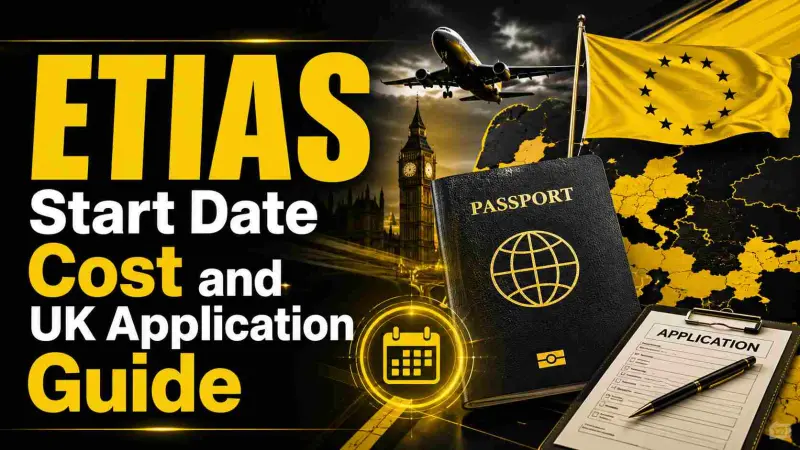
For UK citizens planning holidays, business trips or short visits to Europe, ETIAS is set to become another important travel requirement. The European Travel Information and Authorisation System is the EU’s electronic travel authorisation for visa-exempt travellers, including UK nationals visiting participating European countries for short stays.
The key point right now is that ETIAS is not yet operational. The European Union says it will start in the last quarter of 2026, but the precise launch date has not yet been announced. Once the system goes live, eligible UK passport holders will need a valid ETIAS travel authorisation before travelling to the 30 European countries covered by the scheme.
The planned application fee is €20, although applicants under 18 and those over 70 will generally be exempt from paying it. An approved ETIAS will normally be valid for up to three years, or until the passport used in the application expires, whichever happens first.
This guide explains the ETIAS start date, cost, eligibility, application process, passport requirements, processing times, travel limits, exemptions and what UK citizens should do before their next European trip.
ETIAS Travel Permit Start Date, Cost and How UK Citizens Will Apply
What is ETIAS?
ETIAS stands for the European Travel Information and Authorisation System. It is an electronic travel authorisation designed for nationals of countries whose citizens can currently travel to participating European countries without obtaining a visa for short stays.
UK citizens are included in the system.
ETIAS is not a visa. Instead, it is a pre-travel authorisation connected electronically to the passport used in the application. A valid authorisation allows an eligible traveller to travel towards participating European countries, but it does not provide an automatic right of entry. Border authorities can still check whether the traveller satisfies all applicable entry conditions.
The system covers 30 European countries, including France, Spain, Germany, Italy, Greece, Portugal, Austria, Belgium, the Netherlands, Switzerland, Norway and Iceland.
For most UK visitors, the existing short-stay rule remains relevant: ETIAS is designed for visits of up to 90 days in any 180-day period.
That means ETIAS does not change the basic nature of a short European visit. It adds an electronic authorisation requirement before travel.
When will ETIAS start?
ETIAS is expected to start in the last quarter of 2026. The exact launch date has not yet been announced.
This distinction matters because some websites and social media posts may publish a specific date before the European Union officially confirms one.
The official EU ETIAS website currently states that the system will start operations during the last quarter of 2026 and that the European Union will announce the specific date several months before launch. At present, applications are not being collected.
So, if you are a UK citizen planning a trip in late 2026, it is better not to rely on an unofficial launch date.
The implementation is also expected to include transitional and grace periods lasting at least 12 months after the start of ETIAS.
These arrangements are intended to give travellers and transport operators time to adjust to the new requirement.
Do UK citizens need ETIAS?
Yes, most UK nationals travelling to participating European countries for a short stay will need ETIAS once the system becomes operational.
The official EU guidance specifically states that UK nationals will need a valid ETIAS travel authorisation for short-term travel to the European countries covered by ETIAS, normally for up to 90 days in any 180-day period.
This applies to ordinary UK passport holders who are travelling under visa-free conditions.
For example, imagine a UK passport holder planning a two-week holiday in France and Spain after ETIAS becomes operational. If they are travelling under the standard visa-free rules, they will generally need to obtain ETIAS before starting the journey.
The same principle can apply whether the journey is by air, sea, rail or another permitted route.
Which European countries require ETIAS?
ETIAS applies to 30 European countries:
| Country | Country | Country |
|---|---|---|
| Austria | Belgium | Bulgaria |
| Croatia | Cyprus | Czechia |
| Denmark | Estonia | Finland |
| France | Germany | Greece |
| Hungary | Iceland | Italy |
| Latvia | Liechtenstein | Lithuania |
| Luxembourg | Malta | Netherlands |
| Norway | Poland | Portugal |
| Romania | Slovakia | Slovenia |
| Spain | Sweden | Switzerland |
These are the countries currently identified by the EU as requiring ETIAS for eligible visa-exempt travellers.
It is worth remembering that ETIAS is separate from the immigration and entry rules of individual countries. A travel authorisation does not replace a visa where a visa is required.
How much will ETIAS cost?
The ETIAS application fee will be €20.
The fee was increased from the previously planned €7 following an adjustment adopted by the European Commission. The EU says the change is intended to cover the operational costs of the system and bring the charge closer to comparable travel authorisation schemes.
Some travellers will not have to pay the fee.
Applicants who are:
- Under 18 years old
- Over 70 years old
are exempt from the ETIAS application charge.
Certain qualifying family members of EU nationals can also be exempt where they meet the relevant conditions.
For a typical UK adult traveller aged 18 to 70, however, the expected charge is €20.
Is ETIAS a visa?
No. ETIAS is a travel authorisation, not a visa.
That difference is important.
A visa is generally associated with a formal application process involving specific immigration requirements. ETIAS is intended for travellers who are already visa-exempt for short stays.
A successful ETIAS application therefore does not give someone permission to live, work or study long-term in Europe.
UK citizens planning to stay beyond the applicable short-stay limit must comply with the immigration rules of the country or countries concerned and may need an appropriate visa or residence permit.
How will UK citizens apply for ETIAS?
The application will be completed online through the official ETIAS website or the official ETIAS mobile application.
The application process is expected to be straightforward, but travellers should enter their information carefully because the authorisation is linked to the passport used during the application.
Step 1: Prepare your passport
Before beginning the application, have the passport you intend to use for the journey available.
The travel document needs to satisfy the relevant ETIAS requirements. The official guidance states that the document should not expire within three months and should not have been issued more than 10 years ago, subject to applicable exceptions.
Step 2: Enter your personal information
The application will require information such as:
- Full name
- Date and place of birth
- Nationality
- Home address
- Parents' first names
- Email address
- Phone number
You will also provide details from your travel document.
Step 3: Provide background information
Applicants will also be asked questions relating to areas such as education and occupation, intended travel and stay, certain criminal convictions, previous travel to war or conflict zones and certain decisions requiring a person to leave a country.
The questions are part of the automated screening process.
Applicants should answer accurately rather than guessing what they think the system wants to hear.
Step 4: Pay the application fee
Where the €20 fee applies, payment will be made online.
The official guidance says applicants should have a payment card available, along with the required travel and personal information.
Step 5: Submit the application
After submitting the form, you will receive an email confirming the application and providing a unique application number.
Keep that information somewhere accessible until the application has been processed and your journey is complete.
How long does an ETIAS application take?
Most applications are expected to be processed within minutes.
However, travellers should not assume every application will receive an immediate decision.
According to the official EU guidance, if additional processing is necessary, the decision can take up to four days. If additional information or documentation is requested, the period can be extended by up to 14 days. If an applicant is invited to an interview, the process can take up to 30 days.
This is why applying shortly before departure is not a sensible strategy.
A traveller may have an application that is completed within minutes, but another application may require further checks.
What information do you need for an ETIAS application?
A UK applicant should be prepared to provide their passport and personal information.
The official application guidance indicates that travellers will need:
| Information | Why it matters |
| Passport/travel document | Links the authorisation to the document |
| Full name | Must correspond correctly with travel documentation |
| Date and place of birth | Used for identity and screening |
| Nationality | Establishes eligibility |
| Home address | Required application information |
| Email address | Used for application communication |
| Phone number | Contact information |
| Occupation and education | Part of the application questions |
| Travel information | Helps establish intended trip details |
| Certain background information | Used for screening |
The precise application interface may change before the system becomes operational, so travellers should follow the instructions displayed on the official ETIAS platform when applying.
Do you need fingerprints or health information for ETIAS?
No biometric data such as fingerprints is requested as part of the ETIAS application, and travellers are not required to provide health or vaccination information through the ETIAS application.
This is one reason ETIAS should not be confused with a traditional visa application.
The system instead uses the information provided by the traveller and automated checks against relevant European databases.
How long is an ETIAS travel authorisation valid?
A successful ETIAS travel authorisation is generally valid for up to three years, or until the passport used for the application expires, whichever happens first.
This means you do not normally need to submit a completely new application for every holiday during that period.
There is, however, an important catch.
What happens if you get a new passport?
Your ETIAS is linked to your travel document.
If you obtain a new passport, you will need a new ETIAS travel authorisation, even if your previous ETIAS would otherwise still be within its three-year validity period.
This makes it particularly important to check your passport before applying.
Can you travel to multiple European countries with one ETIAS?
Yes, where the countries are within the ETIAS system and you satisfy the relevant entry requirements.
A valid ETIAS allows repeated travel to the participating European countries for short stays, subject to the applicable 90 days in any 180-day period rule.
For example, a traveller could visit France, travel onwards to Belgium and the Netherlands, and then return to the UK, provided the journey complies with all applicable entry and stay rules.
The ETIAS itself does not give unlimited European travel.
Does ETIAS guarantee entry into Europe?
No.
This is one of the most important points for UK travellers to understand.
Having a valid ETIAS does not automatically mean that a border officer must admit you.
At the border, authorities can still check your passport, ETIAS status and other conditions of entry. A traveller must continue to meet the requirements for visa-free entry.
In practical terms, think of ETIAS as permission to travel under the relevant system, not as a guarantee of admission.
What happens at the airport, ferry port or train station?
Your ETIAS will be electronically associated with the passport used for the application.
Transport operators and border authorities can check whether the required authorisation exists.
The EU specifically explains that ETIAS may be checked before boarding flights, cruises and trains departing from the UK.
This means checking your ETIAS should become part of the normal pre-travel routine, alongside checking your passport validity and travel documents.
What if the passport number is entered incorrectly?
This can cause serious problems.
Because the ETIAS is connected to the passport used in the application, the details in the authorisation need to match the document you present when travelling.
The official EU guidance warns that travellers may be refused boarding or entry if their passport details do not correspond with the ETIAS authorisation.
For that reason, do not rush through the application.
Check:
- Your name.
- Your date of birth.
- Your passport number.
- Your passport expiry date.
- Your nationality.
- Other information before submitting.
Are there exemptions for UK citizens?
Yes. Not every UK national will necessarily need ETIAS.
One significant exemption concerns UK nationals and family members who are beneficiaries of the EU-UK Withdrawal Agreement and hold the relevant uniform-format residence document issued by an eligible European country.
There are special rules involving residence documents issued by Ireland and Cyprus, so travellers in these categories should check the official EU requirements rather than assuming an exemption applies.
Other exemptions can also apply to certain categories of travellers, including holders of relevant visas, residence documents and diplomatic, service or special passports.
ETIAS vs UK ETA: are they the same?
No.
The two systems have a similar basic concept but operate in different jurisdictions.
ETIAS applies to eligible visa-exempt travellers visiting participating European countries.
The UK ETA, meanwhile, concerns eligible travellers entering the United Kingdom.
A British citizen travelling from the UK to France, for example, should think about the European entry requirements separately from the UK's own requirements for foreign visitors.
Having one authorisation does not automatically provide the other.
What about travelling by ferry or Eurostar?
ETIAS is not limited to air travel.
UK citizens travelling to participating European countries by ferry, cruise ship or train can also be subject to ETIAS requirements.
The EU has specifically explained that ETIAS may be checked before boarding trains departing from the UK, as well as other transport.
For example, someone travelling from London to Paris by train should not assume that avoiding an airport means avoiding ETIAS.
The relevant issue is the destination and travel status, not simply the mode of transport.
What about airport transit?
Transit rules can depend on what happens during the connection.
The official EU guidance explains that if a traveller is simply changing flights in the international transit area of one of the participating countries, ETIAS may not be required in certain circumstances. However, if the traveller must pass through passport control to change terminals or airports, an ETIAS authorisation may be required.
Because transit arrangements vary, travellers with complicated connections should check the current requirements before travelling.
What should UK travellers do before ETIAS launches?
There is currently no need to submit an ETIAS application, because the system is not yet operational.
Instead, travellers can prepare by taking a few sensible steps.
Check your passport
Make sure the passport you expect to use for your European trip meets the applicable validity and issue-date requirements.
Monitor the official ETIAS website
The EU will publish the specific launch date when it is confirmed.
This is safer than relying on travel blogs, social media posts or third-party application websites.
Be careful with unofficial websites
When ETIAS applications open, travellers should be cautious about websites that look official but charge additional service fees.
The EU states that applications can be submitted through the official ETIAS website or official mobile application.
Apply before your journey
Even though most applications should be processed quickly, some can take considerably longer if further information, documentation or an interview is required.
Applying in advance gives you time to deal with a problem rather than discovering one at the airport or ferry terminal.
What happens during the ETIAS transition period?
The introduction of ETIAS will not necessarily mean that every traveller encounters an immediate hard stop on the first day.
The EU has stated that the launch will be followed by transitional and grace periods lasting at least 12 months.
The practical purpose is to give travellers, carriers and border authorities time to adapt.
However, travellers should not interpret a transition period as permission to ignore the new requirement. The precise operational rules will need to be checked once the European Union publishes the final launch arrangements.
Future outlook for UK travellers
The introduction of ETIAS represents a broader move towards electronic travel screening.
The UK already operates its own electronic travel authorisation system for eligible overseas visitors, while the United States, Canada and other countries have comparable pre-travel authorisation arrangements. The EU's ETIAS system brings a similar model to participating European destinations.
For British travellers, the biggest change will be administrative rather than a fundamental change to short European holidays.
Instead of simply checking a passport before a trip, travellers will increasingly need to check whether their passport is linked to the correct electronic travel authorisation.
The most useful habit will therefore be simple: check entry requirements before every European journey, especially if you have recently renewed your passport or your travel plans involve several countries.
Because the precise ETIAS launch date remains unannounced, travellers should treat the final implementation timetable as subject to official confirmation.
Key Insights
- ETIAS is expected to launch in the last quarter of 2026, but the EU has not yet published the exact start date.
- UK nationals will generally need ETIAS for short stays in the 30 participating European countries once the system becomes operational.
- The planned standard application fee is €20.
- Applicants under 18 and over 70 are exempt from the fee, subject to the applicable rules.
- ETIAS is normally valid for up to three years or until the linked passport expires, whichever comes first.
- Most applications should be processed within minutes, but additional checks can extend the process to several days or, in some circumstances, up to 30 days.
- A new passport normally means you need a new ETIAS authorisation.
- ETIAS is not a visa and does not guarantee entry. Travellers must still satisfy border-entry requirements.
FAQ
1. When does ETIAS start for UK citizens?
ETIAS is expected to begin in the last quarter of 2026. The European Union has not yet announced the precise launch date and says it will provide that date several months before implementation.
2. How much will ETIAS cost for UK citizens?
The standard ETIAS application fee will be €20. Applicants under 18 and over 70 are exempt from paying the fee, while certain qualifying family members of EU nationals may also be exempt.
3. Can UK citizens apply for ETIAS now?
No. ETIAS is not currently operational and applications are not being accepted. Travellers should wait for the official launch announcement and use the official EU ETIAS website or application when the system opens.
4. Is ETIAS a visa?
No. ETIAS is an electronic travel authorisation for visa-exempt travellers. It does not replace a visa where one is required and does not provide permission for long-term residence or other activities requiring immigration authorisation.
5. Which countries will UK citizens need ETIAS for?
ETIAS will apply to 30 participating European countries, including France, Spain, Germany, Italy, Greece, Portugal, Switzerland, Norway and Iceland.
6. How long can I stay in Europe with ETIAS?
ETIAS supports short-term travel of up to 90 days within any 180-day period in the participating European countries, subject to the applicable rules and exceptions.
7. How long is ETIAS valid?
An ETIAS travel authorisation is generally valid for three years or until the passport used in the application expires, whichever occurs first. A new passport requires a new ETIAS.
8. How quickly is ETIAS approved?
Most applications are expected to be processed within minutes. Some may take up to four days, while requests for additional information or an interview can extend processing to 14 or 30 days respectively.
9. Do I need ETIAS if I travel to Europe by train?
Yes, the requirement is not limited to flights. UK nationals travelling by train to participating European countries can also need a valid ETIAS, with checks potentially taking place before boarding.
10. Do I need ETIAS for a ferry from the UK to France?
Generally, UK nationals travelling to a participating European country for a short stay will need ETIAS once the system applies to their journey. The EU specifically gives a UK-to-France ferry journey as an example of ETIAS being checked before boarding.
11. Do children need ETIAS?
Children who fall within the ETIAS requirement will generally need their own travel authorisation. However, applicants under 18 are exempt from paying the application fee.
12. Do UK citizens with EU residence rights need ETIAS?
Some UK nationals protected by the EU-UK Withdrawal Agreement are exempt if they hold the relevant residence document. Special rules apply to documents issued by Ireland and Cyprus, so affected travellers should verify their exact status.
13. Does ETIAS guarantee entry into Europe?
No. ETIAS is a travel authorisation, not a guarantee of admission. Border authorities can still check your passport, travel purpose, length of stay and other entry conditions before allowing you to enter.
14. What happens if my passport expires after I receive ETIAS?
Your ETIAS is tied to the passport used during the application. It is valid only until that passport expires if the passport expires before the three-year ETIAS validity period. A new passport requires a new ETIAS.
15. Where should UK citizens apply for ETIAS?
When applications open, UK citizens should use the official ETIAS website or official ETIAS mobile application. Travellers should be cautious about third-party websites that may charge additional service fees.
Final Thoughts
ETIAS will add a new pre-travel step for many UK citizens visiting Europe, but it should not be confused with a visa or viewed as a replacement for normal border requirements.
The most important information at present is straightforward: ETIAS is expected to start in the last quarter of 2026, the standard fee is €20, and UK nationals travelling to the 30 participating European countries for short stays will generally need an authorisation once the system becomes operational.
The exact start date has not yet been announced, so there is no reason to apply today.
Instead, check your passport, understand the 90-day rule, and monitor the official EU ETIAS website for the confirmed launch date.
Once applications open, use the official application channel, enter your passport information carefully and apply well ahead of your journey. That small amount of preparation can help prevent an avoidable problem when you are ready to travel.
Disclaimer: The information provided in this article is for general informational and research purposes only. Company details, features, services, and market positions may change over time. Readers are advised to visit official company websites and conduct independent research before making any business decisions or purchasing services.
Most Searchable Keywords
Recent Blogs


Related Listings


Categories
- Accountants (295)
- Advertising Agencies (559)
- Architects (149)
- Automobiles (377)
- Beauty (300)
- Carpenters (146)
- Cleaning Services (387)
- Dentists (189)
- Driving (62)
- Education (1)
- Electricians (215)
- Energy (8)
- Event Organiser (687)
- Finance (602)
- Guide (3465)
- Health (2207)
- Information technology (206)
- Legal Services (361)
- Logistics (6)
- Maintenance (65)
Sponsored Listings in Legal Services
Related Blogs
October Half Term Dates Across England Scotla...
Read this insightful article "October Half Term Dates Across England Scotland Wales and Northern Ireland" to expand your knowledge!

School Uniform Grants Up to £200 Council Help
Read this insightful article "School Uniform Grants Up to £200 Council Help" to expand your knowledge!

Freshers Week What Happens and What It Costs
Read this insightful article "Freshers Week What Happens and What It Costs" to expand your knowledge!
Questions & Answers – Find What
You Need, Instantly!
How can I update my business listing?
Is it free to manage my business listing?
How long does it take for my updates to reflect?
Why is it important to keep my listing updated?
