
EV Fire Safety UK Expert Guide to Lithium-Ion Battery Fires
- 👤 Alex
- 👁️ 136 Views
- Last Updated: April 2, 2026
- 🏷️ Electricians
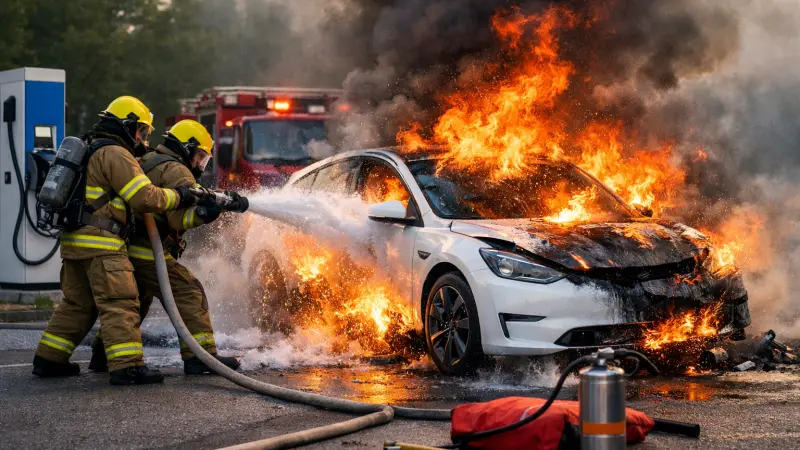
Did you know that a typical petrol vehicle fire can be extinguished with approximately 2,000 litres of water, whereas an Electric Vehicle (EV) fire may require upwards of 11,000 to 30,000 litres and several hours of sustained effort? As the United Kingdom transitions toward a net-zero future, the prevalence of EVs on British roads—from London’s bustling streets to the rural lanes of the Cotswolds—is increasing exponentially. However, this shift brings a unique set of challenges for first responders, fleet operators, and private owners. Lithium-ion batteries, while highly efficient for energy storage, present a chemical fire risk that behaves fundamentally differently from traditional internal combustion engine (ICE) fires.

The Growing Challenge of EV Fire Incidents in the UK
The rise of electric mobility is an essential pillar of the UK Government’s environmental strategy. With the impending 2035 ban on the sale of new petrol and diesel cars, the infrastructure and safety protocols surrounding high-voltage vehicles must evolve at the same pace as sales figures. Current data from UK Fire and Rescue Services suggests that while EVs are statistically less likely to catch fire than their fossil-fuel counterparts, the intensity and complexity of an EV blaze are significantly higher.
For UK SMEs and logistics providers, understanding these risks is not merely a matter of safety—it is a regulatory requirement under the Regulatory Reform (Fire Safety) Order 2005. Business owners are responsible for conducting thorough fire risk assessments, which now must account for EV charging points in underground car parks, depots, and multi-storey structures. The primary concern is that the guidelines provided by some manufacturers remain insufficient for the specific "high-stakes" environments that UK emergency services often face.
What is Thermal Runaway? Understanding the Chemistry
To appreciate why electric vehicle fire safety is so complex, one must understand the internal mechanics of a lithium-ion battery. These batteries consist of thousands of individual cells packed tightly into modules. Thermal runaway occurs when a cell is damaged—either through physical impact, overcharging, or a manufacturing defect—leading to an internal short circuit.
This short circuit generates heat, which then causes the flammable electrolyte within the cell to break down, releasing oxygen and further heat. This creates a self-sustaining cycle where the heat from one cell triggers the next, leading to a chain reaction. Unlike a petrol fire, which requires external oxygen to burn, a lithium-ion battery fire produces its own oxygen internally through chemical decomposition. This is why traditional "smothering" techniques, such as using a standard fire blanket or CO2 extinguisher, are often unsuccessful in fully stopping a battery blaze.
The Threat of "Venting" and Toxic Gases
Before an actual flame appears, an EV battery in distress will often "vent." This is the release of high-pressure gases, including hydrogen, carbon monoxide, and hydrogen fluoride. In the context of a UK car park or a
confined garage, these gases are not only highly toxic but also explosive. First responders must approach these incidents with specialized breathing apparatus (BA) and gas detection equipment to avoid severe respiratory injury.
Why Water is a Double-Edged Sword in EV Safety
One of the most persistent myths in automotive safety is that water should be avoided at all costs during an electrical fire. While it is true that you should never attempt to douse an EV fire yourself with a garden hose, Fire and Rescue Services do use water—but in massive, industrial quantities. The goal of using water on an EV fire is not to "extinguish" the flame in the traditional sense, but to provide "boundary cooling."
By spraying large volumes of water onto the battery casing, firefighters attempt to lower the temperature of adjacent cells to prevent them from entering thermal runaway. However, for the average driver or fleet manager, the presence of water is a major red flag. If a vehicle has been involved in a flood—a common occurrence in the UK during winter months—the battery pack can become compromised. Even after the car appears to have "dried out," residual moisture can lead to corrosion and internal short circuits weeks after the initial exposure.
Critical Post-Accident Protocols for UK Drivers
In the event of a collision on a UK motorway or a minor "fender-bender" in a residential area, the protocol for an EV is vastly different from a petrol car. Even if there is no visible smoke or fire, the structural integrity of the battery tray may have been compromised.
1. The Professional Inspection Mandate
As Brian O’Connor of the National Fire Protection Association emphasizes, it is impossible to judge battery damage from the exterior. A minor impact to the underside of the vehicle—perhaps from a high kerb or road debris—could deform a battery module. In the UK, it is highly recommended that any EV involved in an accident be quarantined at least 15 metres away from buildings and other vehicles until it can be inspected by a certified high-voltage technician.
2. Submergence and Flooding Risks
With the UK experiencing more frequent extreme weather events, "water entry" has become a significant catalyst for EV fires. If your vehicle has navigated through deep standing water or has been partially submerged, it must be treated as a potential fire hazard. Do not attempt to start the vehicle. The electrical architecture may be compromised, and the act of engaging the high-voltage contactors could trigger an immediate thermal event.
Informing the Emergency Services: The "Golden Hour" of Information
When calling 999 to report an EV-related incident, the quality of information provided to the dispatcher can save lives. UK emergency services have access to "Rescue
Sheets"—digital databases that show the exact location of high-voltage cables and battery disconnect points for every make and model sold in the UK.
- Vehicle Identification: Clearly state the make, model, and year. If it is a hybrid (PHEV) or a full battery electric vehicle (BEV), specify this immediately.
- Fire Characteristics: Describe the smoke. Is it thick and black, or is there a "jet-flame" whistling sound? This helps firefighters identify if thermal runaway is already in progress.
- Location Hazards: If the vehicle is near a charging station or inside a structure, this information is vital for tactical planning.
Advanced Fire Suppression: The Role of Encapsulators and Blankets
For UK businesses and parking operators, relying solely on the Fire Brigade is not a complete safety strategy. Many sites are now investing in specialized EV fire blankets. These are large, high-temperature resistant covers designed to contain the flames and toxic smoke, preventing the fire from spreading to nearby vehicles. While they do not "put out" the battery fire, they are a critical tool for "damage limitation," especially in multi-storey car parks where the heat could otherwise compromise the building's concrete structure.
The Rise of F-500 Encapsulator Agents
Newer technology, such as F-500 Encapsulator Agents, is being trialled by various UK fire authorities. These agents are added to the water supply to reduce surface tension and penetrate the battery cells more effectively, cooling the chemistry at a molecular level. This represents the future of EV fire suppression, moving away from "brute force" water usage toward more intelligent chemical intervention.
Guidance for Fleet Managers and UK SMEs
If your business operates a fleet of electric vans or cars, your Health and Safety policy must be updated to reflect the 2025 landscape. This includes:
- Charging Protocols: Ensure all charging is done via dedicated, professionally installed wall boxes rather than domestic "three-pin" plugs, which are prone to overheating during long charging cycles.
- Staff Training: Employees should know the "Signs of Stress" in an EV, such as unusual smells, hissing sounds, or "Warning: Electrical System Fault" messages on the dashboard.
- Isolation Zones: Designate a "Quarantine Zone" in your depot where damaged or suspected faulty EVs can be parked safely away from the main building.
Frequently Asked Questions (FAQ)
Statistically, no. Data suggests that EVs are significantly less prone to fires per mile driven.
However, when they do catch fire, the blaze is much more difficult to extinguish and requires specialized equipment.
No. Standard ABC powder or CO2 extinguishers will not stop a thermal runaway event because the fire is chemical and self-oxygenating. They may put out a small fire in the car's interior trim, but they will not stop a battery fire.
Immediately press the emergency stop button on the charger if safe to do so, evacuate the area, and call 999. Inform them specifically that it is an "EV fire at a charging station."
In some cases, if the vehicle is in a safe, open area, the "controlled burn" method is safer and more environmentally friendly than using 30,000 litres of water which would then become contaminated runoff.
Yes, provided the car park has a modern fire risk assessment and adequate ventilation. However, many UK car parks are currently upgrading their sprinkler systems and installing EV fire blankets to manage the higher heat load of a battery fire.

Disclaimer: The information provided in this article is for general informational and research purposes only. Company details, features, services, and market positions may change over time. Readers are advised to visit official company websites and conduct independent research before making any business decisions or purchasing services.
Most Searchable Keywords

Recent Blogs
-

Explore Supermarkets in Chepstow and the Surrounding Wye Valley
-
Elite Guide to Taxi and Private Hire Services in Hereford
-
Explore Fuel and Roadside Convenience Across Beckington Today
-
Explore Abergavenny Tyre Services with Expert Local Fitters
-
Claim Your HMRC UK Tax Refund Before Application Deadlines


Related Listings
-
Welton Renewables and Electrical
-
EV Home Charger UK
-
A1 Gas Force Nuneaton
-
A1 Gas Force Warwick
-
A1 Gas Force Solihull




Categories
- Accountants (295)
- Advertising Agencies (559)
- Architects (149)
- Automobiles (376)
- Beauty (300)
- Carpenters (146)
- Cleaning Services (386)
- Dentists (189)
- Driving (61)
- Electricians (215)
- Energy (7)
- Event Organiser (683)
- Finance (597)
- Guide (3358)
- Health (2205)
- Information technology (206)
- Legal Services (352)
- Logistics (6)
- Maintenance (65)
- Manufacturing (35)

Sponsored Listings in Electricians

Related Blogs

Explore Supermarkets in Chepstow and the Surr...
Read this insightful article "Explore Supermarkets in Chepstow and the Surrounding Wye Valley" to expand your knowledge!
Elite Guide to Taxi and Private Hire Services...
Read this insightful article "Elite Guide to Taxi and Private Hire Services in Hereford" to expand your knowledge!
Explore Fuel and Roadside Convenience Across...
Read this insightful article "Explore Fuel and Roadside Convenience Across Beckington Today" to expand your knowledge!
Questions & Answers – Find What
You Need, Instantly!
How can I update my business listing?
Is it free to manage my business listing?
How long does it take for my updates to reflect?
Why is it important to keep my listing updated?
