
GHIC Card How to Apply Cover and Exclusions
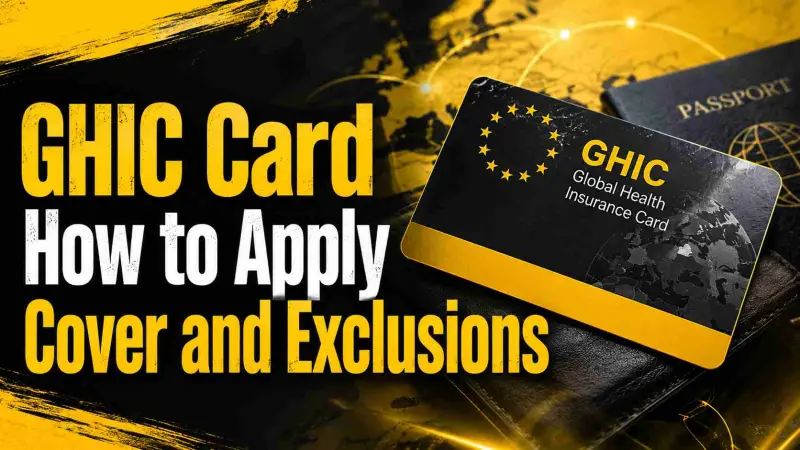
A GHIC can be one of the most useful documents to carry when travelling from the UK to countries where it is accepted, yet it is often misunderstood as a form of travel insurance. It is not. The UK Global Health Insurance Card gives eligible travellers access to medically necessary state healthcare on terms set by the country they are visiting, which can mean free treatment or treatment at a reduced cost.
The card itself is free when you apply through the official NHS service. The bigger issue is understanding what the card actually protects you against—and what it does not. A GHIC does not normally cover private healthcare, medical repatriation to the UK, or services such as ski and mountain rescue.
This guide explains how to apply for a GHIC, who may be eligible, where it can be used, what “medically necessary” means, how the card works alongside travel insurance, and what to do if you need treatment but do not have your card with you.
What Is a GHIC, How Do You Apply for One, and What Does It Actually Cover?
What is a GHIC?
The UK Global Health Insurance Card, commonly called a GHIC, is a healthcare entitlement card for eligible people travelling temporarily to certain countries.
Its purpose is to provide access to medically necessary, state-provided healthcare during a temporary stay. The treatment is generally provided on the same basis as it would be for people covered by the public healthcare system in the country being visited. Depending on the country's healthcare rules, this can mean treatment is free or available at a reduced cost.
A GHIC is therefore best understood as a way of accessing reciprocal state healthcare arrangements—not as a conventional insurance policy.
That distinction matters.
For example, if you become ill while visiting France and need medically necessary treatment through the state healthcare system, your GHIC can help you access that care under the applicable French rules. However, it does not automatically pay for a private clinic, transport back to the UK or every expense associated with becoming ill abroad.
Is a GHIC really free?
Yes. An eligible applicant can apply for a UK GHIC free of charge through the official NHS service.
The UK Government has specifically warned travellers about websites that charge people to apply for a GHIC. A fee-paying application service is not the official NHS GHIC service.
This is one of the easiest ways to avoid an unnecessary expense: use the official NHS application route rather than paying a third-party website simply to submit an application.
How do you apply for a GHIC?
The application process is designed to be completed online through the NHS service.
A sensible approach is:
- Go to the official NHS GHIC application service.
- Check whether you are eligible for a UK GHIC or another form of healthcare card.
- Provide the information requested during the application.
- Submit the application.
- Keep your details and application information available until the card arrives.
- Take the physical card with you when travelling.
The NHS recommends checking the healthcare guidance for the specific country you are visiting because the way healthcare is accessed varies between countries.
Do not rely on a generic assumption that every country treats the GHIC in exactly the same way.
How long before travelling should you apply?
It is sensible to apply well before your departure rather than leaving it until the day before you travel.
Earlier UK Government guidance recommended applying at least two weeks before travel so there was enough time for the card to arrive.
Even if your trip is several weeks away, applying early removes one avoidable problem from your travel checklist.
You should also check that an existing EHIC has not already given you the cover you need. A valid UK-issued EHIC can remain usable in situations where it is still valid, and certain people may qualify for a UK EHIC rather than a standard GHIC depending on their circumstances.
Who can get a GHIC?
Eligibility depends on your circumstances, including your UK residency and, in some situations, your nationality or healthcare status.
The official NHS guidance should always be used to determine whether you qualify because there are different arrangements for people such as certain students, pensioners, people living abroad and individuals covered by specific reciprocal healthcare agreements.
For example, people who have rights under the Withdrawal Agreement may have circumstances in which a UK EHIC is more appropriate than a standard GHIC.
This is why it is better not to rely on a simple rule such as “every British citizen gets a GHIC”. Eligibility can be more nuanced.
Where can you use a UK GHIC?
A UK GHIC can be used in a range of destinations covered by UK healthcare arrangements.
Current NHS guidance says a UK GHIC can be used when visiting countries in the European Economic Area, as well as Montenegro, Australia, Jersey, Guernsey, the Isle of Man, St Helena, Tristan and Ascension. There are also specific eligibility conditions for using a GHIC in Switzerland.
The exact rules can differ between countries.
For that reason, check the country-specific GOV.UK travel healthcare guidance before departure rather than assuming that a GHIC works identically everywhere.
What does “medically necessary treatment” mean?
This is one of the most important phrases to understand.
A GHIC is designed for treatment that is medically necessary during your temporary stay and cannot reasonably wait until you return home.
That does not mean every medical service you might want while abroad is automatically covered.
Consider two scenarios.
Example one: You develop a serious infection during a two-week holiday and need treatment before you can safely travel home. This could fall within medically necessary healthcare.
Example two: You travel abroad specifically to have a planned procedure that could wait until you return to the UK. That is a different situation and may not be covered by the GHIC.
The distinction is between healthcare that becomes necessary during your temporary stay and treatment that is planned or non-urgent.
The official guidance for individual countries should be checked if you are uncertain.
Does a GHIC cover pre-existing medical conditions?
A GHIC can cover medically necessary treatment related to a pre-existing or chronic condition during a temporary stay, subject to the healthcare arrangements of the country concerned.
The UK Government specifically explained when the GHIC was introduced that medically necessary treatment could include treatment for a pre-existing or chronic condition.
However, that does not mean a GHIC replaces travel insurance.
If you have a medical condition, your travel insurance should also be appropriate for that condition. A travel insurer may require you to disclose relevant medical circumstances when purchasing cover.
Does a GHIC cover private healthcare?
No.
A UK GHIC covers state healthcare, not private treatment.
This distinction can become particularly important in countries where private healthcare providers are common or where tourists are directed towards private medical facilities.
If you choose or are treated by a private doctor or private clinic that is outside the applicable state healthcare arrangement, you may have to pay the cost yourself. GOV.UK country guidance repeatedly highlights that GHIC and EHIC cards do not provide access to private treatment.
Before accepting treatment, ask whether the provider is part of the public/state healthcare system and whether your GHIC can be used there.
What does a GHIC not cover?
The simplest way to understand the limitation is this: a GHIC is not comprehensive travel insurance.
The NHS states that a UK GHIC does not replace travel and medical insurance and does not cover services such as medical repatriation, treatment in private medical facilities, or ski and mountain rescue.
Other costs can also fall outside the card's protection depending on the circumstances and country.
| Cost or service | GHIC position |
|---|---|
| Medically necessary state healthcare | Generally covered under applicable rules |
| Private medical treatment | Not covered |
| Medical repatriation to the UK | Not covered |
| Ski or mountain rescue | Not covered |
| Travel disruption caused by illness | Not a GHIC benefit |
| Planned non-urgent treatment | Generally outside ordinary temporary-stay cover |
| Private clinic treatment | Not covered |
The exact treatment and charging rules still depend on the country you are visiting.
Does a GHIC mean healthcare will always be free?
No.
This is a common misconception.
A GHIC gives access to healthcare on the same basis as people covered by the public healthcare system in the country you are visiting. If local residents have to pay a standard charge for a particular service, a visitor using a GHIC may also have to pay it.
For example, GOV.UK guidance for France states that state healthcare is not always free and that treatment is provided on the same basis as for French citizens.
So “free GHIC” refers to the fact that the card application is free—not a guarantee that every medical treatment abroad will cost nothing.
Why should you still buy travel insurance?
The best approach is to use a GHIC and travel insurance together.
Think of the two as solving different problems.
The GHIC helps you access eligible state healthcare under reciprocal healthcare arrangements.
Travel insurance can provide protection for costs that sit outside those arrangements, depending on the policy. These can include medical repatriation, private healthcare, certain emergency assistance services and other travel-related losses.
Imagine breaking your leg while skiing abroad. You might require hospital treatment, but you could also need mountain rescue, ambulance transport or eventually transportation back to the UK.
The GHIC is not designed to cover all of those expenses.
The NHS therefore advises travellers to have both a UK GHIC or EHIC and private travel and medical insurance.
What should you do if you need treatment without your GHIC?
Do not assume that you are automatically without any healthcare rights simply because you forgot your physical card.
If you need treatment while abroad and do not have your GHIC, there may be a way to obtain a Provisional Replacement Certificate, commonly called a PRC, when treatment is required.
The PRC is intended for situations where you need medically necessary treatment but do not have your card available, including circumstances where your card has been lost or stolen.
It is not something you normally arrange in advance simply because you might need it. It is requested when healthcare is required.
The NHS Business Services Authority's Overseas Healthcare Services can assist with this process.
What if your GHIC is lost or stolen abroad?
Treat a lost GHIC as a practical problem to solve quickly, particularly if you need medical treatment.
If you are healthy and do not need healthcare, you should still make arrangements for a replacement where appropriate.
If you require medically necessary treatment while abroad and no longer have the card, contact the relevant NHS Overseas Healthcare service to discuss a Provisional Replacement Certificate.
The important point is not to delay necessary medical care simply because you cannot find your physical card.
Can you use a GHIC for planned treatment abroad?
A GHIC is primarily intended to provide access to medically necessary state healthcare during a temporary stay.
It should not be treated as a general method of funding treatment you deliberately arrange overseas.
Planned treatment can involve different healthcare agreements and may require separate authorisation or documentation. If you are travelling abroad specifically to receive treatment, check the relevant NHS and GOV.UK guidance before booking the procedure.
This is particularly important because “I need treatment” and “I travelled abroad to receive planned treatment” are not necessarily treated in the same way.
GHIC versus travel insurance: what is the difference?
The easiest comparison is to think of the GHIC as a healthcare access document and travel insurance as broader financial protection.
| Feature | GHIC | Travel insurance |
| Application | Free | Usually paid |
| State healthcare | Yes, where applicable | Depends on policy |
| Private healthcare | No | May be covered, subject to policy |
| Medical repatriation | No | Often covered if included |
| Mountain/ski rescue | No | May be covered depending on policy |
| Travel cancellation | No | May be covered |
| Lost baggage | No | May be covered |
| Country-specific healthcare access | Yes, where reciprocal arrangements apply | Depends on policy |
Neither should automatically be viewed as a replacement for the other.
What should you check before travelling?
A few minutes of preparation can prevent a major problem later.
Before departure:
- Check that your GHIC or applicable EHIC is valid.
- Confirm that the destination accepts your particular card.
- Read the country's healthcare guidance on GOV.UK.
- Buy suitable travel insurance.
- Check whether your insurance covers relevant pre-existing medical conditions.
- Save your insurer's emergency contact details.
- Carry your GHIC with your travel documents.
- Know how to contact NHS Overseas Healthcare Services if you need assistance.
- Find out whether local healthcare providers expect payment upfront.
- Keep receipts and medical documents if you do have to pay for treatment.
Country-specific guidance matters because healthcare systems do not operate identically across Europe or elsewhere.
A practical example: a family holiday in Spain
Suppose a UK family travels to Spain for ten days.
On day four, one family member develops severe symptoms and needs to see a doctor.
If they use an appropriate state healthcare provider and the treatment is medically necessary, their GHIC can help them receive treatment under the Spanish healthcare system on the applicable terms.
But if the family instead chooses a private clinic, the GHIC cannot simply be presented as a private medical insurance policy.
Now imagine the illness becomes serious enough that the traveller needs to be transported back to the UK.
That repatriation is outside the GHIC's scope.
This example shows why carrying both documents is sensible: the GHIC can help with eligible state healthcare, while travel insurance can address risks the GHIC does not cover.
Common GHIC mistakes to avoid
Paying a website to apply for a free card
The official application is free. Be cautious about websites asking for a fee merely to process the GHIC application.
Assuming GHIC means all healthcare is free
It does not. You may have to pay local charges that residents also pay.
Using the card at a private clinic
A GHIC does not provide private healthcare cover.
Travelling without insurance
A GHIC does not cover every medical or travel-related expense.
Waiting until the airport to check your documents
Healthcare arrangements are easier to understand before you leave the UK.
Assuming every destination has identical rules
Always check the country-specific guidance.
What is the future of the GHIC?
The future of reciprocal healthcare arrangements is tied to international agreements between the UK and other countries.
The current NHS guidance already shows that GHIC coverage extends beyond a simple “EU-only” understanding, with specific arrangements involving destinations such as Australia, Montenegro, the Channel Islands, the Isle of Man and certain other locations. Switzerland also has specific eligibility rules.
The NHS says the UK Government is negotiating with other countries about expanding the use of the UK GHIC.
That means travellers should not rely on old travel articles or social media posts when planning a future trip. The destination-specific government guidance is the safer source to check before travelling.
Why the GHIC remains useful even with travel insurance
It can be tempting to think that travel insurance makes a GHIC unnecessary.
That is not the best approach.
A GHIC can make it easier to access eligible state healthcare under the local system. Travel insurance then provides a separate layer of financial protection for risks the GHIC does not cover.
The two documents have different jobs.
A traveller who carries both is generally better prepared than someone who assumes a single card or policy will cover every possible medical situation.
Key Insights
- A GHIC application is free when completed through the official NHS service.
- GHIC is not travel insurance and should not be treated as a substitute for a comprehensive travel policy.
- The card mainly provides access to medically necessary state healthcare under the healthcare arrangements applying in the destination country.
- Private healthcare is not covered by a standard UK GHIC.
- Medical repatriation to the UK is not covered by the GHIC.
- Healthcare may not be completely free, because visitors can be charged in line with local rules.
- Check destination-specific guidance before travelling, because arrangements and eligibility can vary.
- If your card is unavailable when treatment is needed, contact NHS Overseas Healthcare Services about a Provisional Replacement Certificate.
FAQ
Is the GHIC card completely free?
Yes. The official UK GHIC application is free. You should apply through the NHS service and be cautious of third-party websites that charge an application fee simply to submit the form.
How do I apply for a GHIC?
You can apply through the official NHS GHIC service. Check your eligibility, provide the requested information and submit the application. It is best to apply before travelling rather than waiting until shortly before departure.
Does a GHIC replace travel insurance?
No. A GHIC and travel insurance provide different types of protection. A GHIC does not cover medical repatriation, private healthcare or services such as ski and mountain rescue. The NHS recommends having both.
Does GHIC cover private hospitals?
No. A standard UK GHIC covers eligible state healthcare, not private medical treatment. If you choose a private doctor, clinic or hospital, you may have to pay the full cost yourself.
Does a GHIC cover emergency treatment?
It can provide access to medically necessary state healthcare during a temporary stay, subject to the healthcare arrangements in the country you are visiting. Always check the destination-specific guidance before travelling.
Does GHIC cover pre-existing conditions?
Medically necessary treatment connected with a pre-existing or chronic condition can be covered during a temporary stay under applicable arrangements. However, you should still purchase suitable travel insurance and disclose relevant medical conditions to your insurer.
Is healthcare free with a GHIC?
Not necessarily. The card gives access to healthcare under the same applicable terms as the country's public healthcare system. If local patients have to pay a standard charge, you may also have to pay it.
Can I use a GHIC in Spain?
Yes. A UK-issued GHIC can be used for eligible state healthcare during temporary visits to Spain. Treatment is provided according to the Spanish healthcare system's applicable rules.
Can I use a GHIC in France?
Yes, where the applicable UK-France healthcare arrangements allow it. In France, state healthcare is not necessarily free, so travellers may still have costs even when using a GHIC.
What happens if I lose my GHIC abroad?
If you need medically necessary healthcare and do not have your card, you can contact NHS Overseas Healthcare Services about obtaining a Provisional Replacement Certificate. This can provide temporary evidence of entitlement where appropriate.
Does GHIC cover medical repatriation?
No. Returning a traveller to the UK for medical reasons is outside the standard GHIC cover. This is one of the reasons comprehensive travel insurance is recommended alongside the card.
Does GHIC cover mountain rescue?
No. The NHS specifically lists ski and mountain rescue among services not covered by a UK GHIC. Travellers taking part in activities where rescue may be required should check their travel insurance carefully.
Can I use a GHIC for planned treatment abroad?
A standard GHIC should not be treated as a general funding mechanism for planned medical treatment abroad. Planned healthcare can be subject to different rules and may require separate arrangements or authorisation.
How is GHIC different from EHIC?
The GHIC replaced the EHIC for many UK travellers following changes to UK-EU healthcare arrangements. However, valid UK EHICs can remain usable in applicable circumstances, and some people qualify for a UK EHIC rather than a standard GHIC.
Should I carry my GHIC when travelling?
Yes. Carrying the physical card can make it easier to demonstrate your entitlement to applicable healthcare. You should also carry your travel insurance information and check the healthcare rules for your destination before departure.
Final Thoughts
A GHIC is worth having if you are eligible and travelling to a destination where it applies, but its value comes from understanding its limits.
The application itself is free through the official NHS service, and the card can provide access to medically necessary state healthcare during a temporary stay.
However, it does not turn every medical bill into a free service, does not provide private healthcare cover and does not pay for medical repatriation or every emergency service abroad.
The safest approach is straightforward: check your GHIC eligibility, apply through the official NHS route, read the healthcare guidance for your destination, and take out appropriate travel insurance.
Disclaimer: The information provided in this article is for general informational and research purposes only. Company details, features, services, and market positions may change over time. Readers are advised to visit official company websites and conduct independent research before making any business decisions or purchasing services.
Most Searchable Keywords
Recent Blogs

Related Listings

Categories
- Accountants (295)
- Advertising Agencies (559)
- Architects (149)
- Automobiles (377)
- Beauty (300)
- Carpenters (146)
- Cleaning Services (387)
- Dentists (189)
- Driving (62)
- Education (1)
- Electricians (215)
- Energy (8)
- Event Organiser (687)
- Finance (602)
- Guide (3464)
- Health (2207)
- Information technology (206)
- Legal Services (361)
- Logistics (6)
- Maintenance (65)
Sponsored Listings in Legal Services

Related Blogs

School Uniform Grants Up to £200 Council Help
Read this insightful article "School Uniform Grants Up to £200 Council Help" to expand your knowledge!

Freshers Week What Happens and What It Costs
Read this insightful article "Freshers Week What Happens and What It Costs" to expand your knowledge!

UCAS Personal Statement New Three Questions
Read this insightful article "UCAS Personal Statement New Three Questions" to expand your knowledge!
Questions & Answers – Find What
You Need, Instantly!
How can I update my business listing?
Is it free to manage my business listing?
How long does it take for my updates to reflect?
Why is it important to keep my listing updated?
