
Guide to the UK Disqualified Directors Register
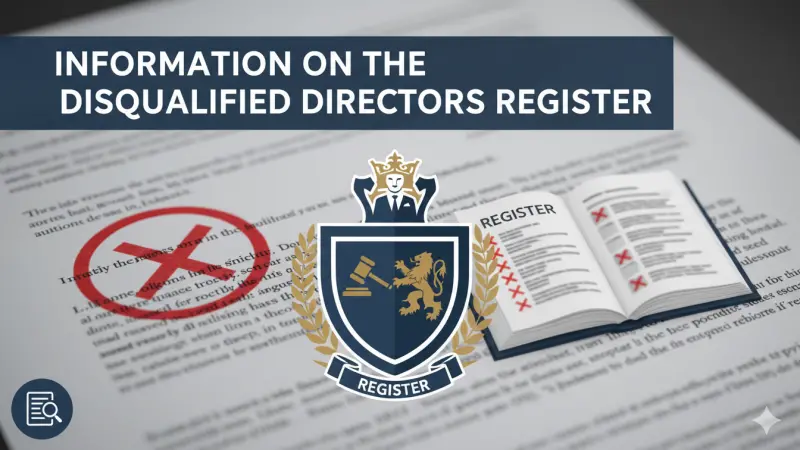
In the UK, maintaining the integrity of corporate leadership is a priority for government regulators. The Disqualified Directors Register is a public database managed by Companies House that lists individuals who have been banned from acting as directors of limited companies. This register serves as a critical transparency tool for investors, creditors, and the general public to identify individuals whose past conduct has been deemed "unfit" for the responsibilities of company management.

1. What Information is in the Register?
The register provides a detailed profile of each disqualified individual. When you search for an officer, the database typically reveals:
Personal Details: The full name, last known address, and date of birth of the disqualified person.
Duration of the Ban: The exact start and end dates of the disqualification period.
The Legal Grounds: The specific section of the Company Directors Disqualification Act 1986 under which the order was made.
Case Specifics: The reason for the disqualification (e.g., fraudulent trading or failure to
maintain records) and how many disqualifications the individual has previously received.
2. Where to Search the Register
There are two primary ways to access this information, depending on when the disqualification occurred:
Companies House Register: This is the permanent public record for all currently disqualified directors. Once a ban expires, the individual's name is automatically removed from this database.
The Insolvency Service Register: This provides a more detailed summary of "unfit conduct" for directors who have been disqualified within the last three months. This is particularly useful for finding the specific narrative of what the director did wrong before the record moves to the standard Companies House list.
3. Common Reasons for Disqualification
An individual is not added to the register simply because their business failed. Disqualification is reserved for "unfit conduct," which includes:
Trading While Insolvent: Continuing to run a company and taking credit when
the director knew it could not pay its debts.
Failure to Keep Records: Neglecting the legal duty to maintain accurate accounting books and file annual returns.
Non-Payment of Tax: Deliberately failing to pay VAT, PAYE, or Corporation Tax while prioritizing other payments.
Misuse of Company Assets: Using business funds for personal expenses or removing assets from a company to prevent creditors from accessing them.
4. The Consequences of Being on the Register
A disqualification order typically lasts between 2 and 15 years. While on
the register, an individual is legally prohibited from:
Being a director of any UK-registered company or an overseas company with UK connections.
Being involved in the formation, promotion, or management of a company.
Acting as a receiver or liquidator of a company.
Breaching these terms is a criminal offense that can lead to a fine, a prison sentence of up to two years, and personal liability for the company's debts. Furthermore, disqualified directors are often barred from other positions of trust, such as acting as a charity trustee, a school governor, or a member of a health board.
5. Seeking Permission to Act
In rare circumstances, a disqualified director may apply to the court for "leave" (permission) to act as a director of a specific company despite their ban. This is usually only granted if the individual can prove that the company’s operations are vital and that there are enough safeguards in place to protect the public and creditors. If granted, this permission will be noted on the public register.
The Bottom Line
The Disqualified Directors Register is a vital safeguard for the UK’s business environment. It ensures that those who have abused the privilege of limited liability are held accountable and prevented from repeating their actions. For anyone entering into a high-value business partnership, checking this register is an essential part of due diligence.

Disclaimer: The information provided in this article is for general informational and research purposes only. Company details, features, services, and market positions may change over time. Readers are advised to visit official company websites and conduct independent research before making any business decisions or purchasing services.
Most Searchable Keywords

Recent Blogs

Related Listings


Categories
- Accountants (295)
- Advertising Agencies (559)
- Architects (149)
- Automobiles (377)
- Beauty (300)
- Carpenters (146)
- Cleaning Services (386)
- Dentists (189)
- Driving (62)
- Electricians (215)
- Energy (8)
- Event Organiser (685)
- Finance (599)
- Guide (3365)
- Health (2207)
- Information technology (206)
- Legal Services (353)
- Logistics (6)
- Maintenance (65)
- Manufacturing (35)

Sponsored Listings in Locksmith Services


Related Blogs

Gen Z Political Reporters and News Creators i...
Read this insightful article "Gen Z Political Reporters and News Creators in the UK" to expand your knowledge!

Famous Female Social Media Influencers Across...
Read this insightful article "Famous Female Social Media Influencers Across the UK" to expand your knowledge!

Your UK Sponsor Licence 2026 Step by Step Gui...
Read this insightful article "Your UK Sponsor Licence 2026 Step by Step Guide" to expand your knowledge!
Questions & Answers – Find What
You Need, Instantly!
How can I update my business listing?
Is it free to manage my business listing?
How long does it take for my updates to reflect?
Why is it important to keep my listing updated?
