
House Cleaning UK DIY vs Professional Services The Ultimate Guide
- 👤 Alex
- 👁️ 256 Views
- Last Updated: March 20, 2026
- 🏷️ Cleaning Services
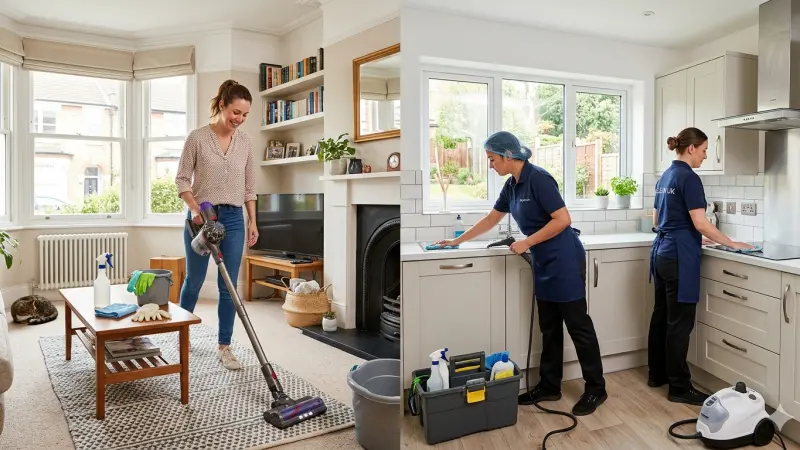
A comprehensive analysis of domestic maintenance, time valuation, and home hygiene standards in the United Kingdom.

In the modern United Kingdom, the concept of the "home" has evolved. It is no longer merely a place of residence but has become a multi-functional space serving as an office, a gym, and a sanctuary. Consequently, the standards for cleanliness have risen significantly. Maintaining a home to a high standard is essential for the longevity of the property and the mental wellbeing of its inhabitants. However, the perennial debate remains: is the traditional DIY (Do-It-Yourself) approach superior, or should households transition to professional management?
Comprehensive Guide Overview
The Philosophy of Domestic Maintenance
Before addressing the practicalities, one must understand the emotional and physical impact of our surroundings. Environmental psychology suggests that "visual noise"—clutter, dust, and disorganisation—competes for our neural resources, leading to increased stress and decreased focus. In a UK context, where Victorian and Edwardian architecture often features intricate details that trap dust, the effort required to maintain a "minimalist" standard is substantial.
The choice between DIY and professional help is ultimately a question of resource allocation. Do you spend your "human capital" on maintenance, or do you trade financial capital to reclaim that time?
DIY House Cleaning: A Technical Deep Dive
Cleaning your own home is the default for millions of UK residents. It is often perceived as a basic life skill, yet the technical requirements for a truly hygienic home are often underestimated.
Pros of the DIY Approach
1. Total Financial Sovereignty
In an era of fluctuating living costs, DIY cleaning offers immediate fiscal relief. Beyond the avoidance of labour costs, the DIY cleaner can curate a "cleaning kit" that fits their budget. From "white vinegar and bicarbonate of soda" traditional methods to high-end supermarket brands, the costs are entirely transparent and controllable.
2. Unmatched Personal Detail
A professional cleaner, no matter how skilled, operates on a clock. They have a "scope of work" to complete within a set timeframe. Conversely, the homeowner can spend forty minutes focusing exclusively on the grout lines in the utility room or polishing a specific heirloom. This "obsessive" level of detail is only possible through DIY.
3. The Therapeutic Aspect
Many find the rhythmic nature of cleaning to be meditative. It provides a "digital detox"—a time away from screens where physical progress is visible. In a world of abstract professional work, seeing a dirty floor become clean provides a dopamine hit that should not be undervalued.
Cons of the DIY Approach
1. The 'Clean-Blindness' Trap
Psychologically, we become "blind" to the dirt in our own environments. We stop noticing the dust on the picture frames or the cobwebs in the high corners of the hallway. Because we live in the space, our brains filter out gradual accumulations of grime. A professional brings "fresh eyes" to the property, identifying areas the homeowner has ignored for years.
2. Surface Mismanagement and Material Damage
UK homes often feature a mix of materials: Amtico flooring, quartz worktops, solid oak, and ceramic tiles. Using a generic "All-Purpose Cleaner" (which often contains high pH levels) can strip the finish off wood or dull the shine of natural stone.
DIYers frequently cause "micro-scratching" by using the wrong scourers, leading to surfaces that actually attract dirt faster over time.
The UK Hard Water Factor
Geographically, much of the UK (particularly the South and East of England) suffers from "hard water"—water high in mineral content, specifically calcium and magnesium carbonates. This presents a unique cleaning challenge that most DIYers fail to manage effectively.
Limescale buildup on taps, showerheads, and inside kettles isn't just an aesthetic issue; it can reduce the efficiency of appliances and provide a porous surface where bacteria can thrive. Professionals understand the "acid-base" chemistry required to dissolve these minerals without eroding the chrome plating of expensive UK bathroom fixtures.
Professional Services: Agency vs Independent
If you decide to hire, the UK market offers two primary models, each with distinct pros and cons.
1. The Independent Cleaner
Usually a local individual found through word-of-mouth or platforms like Nextdoor. Pros: Usually cheaper (£12–£17/hour); you build a personal relationship; consistency of the same person. Cons: No backup if they are ill; you are responsible for checking their right to work; you may technically be an "employer" under certain UK tax/insurance laws if the relationship is long-term.
2. The Managed Agency
Companies that employ or contract multiple cleaners. Pros: Guaranteed service (if your cleaner is ill, a replacement is sent); high levels of insurance (often up to £2m public liability); rigorous background checks and training. Cons: More expensive (£20–£35/hour); higher staff turnover can mean different people in your home.
The Economics of Outsourcing
To truly evaluate whether professional cleaning is "worth it," one must perform a cost-benefit analysis based on "Internal Rate of Return."
Consider a professional earning £40 per hour in their day job. If they spend 4 hours on a Saturday cleaning, they have "spent" £160 of their time. Hiring a cleaner for £60 for those 4 hours results in a "net gain" of £100 in time-value. This calculation is the primary reason for the growth of the domestic cleaning sector in the UK over the last decade.
The "Deep Clean" Premium
It is important to distinguish between "Maintenance Cleaning" and "Restorative Cleaning" (Deep Cleaning). A deep clean usually involves:
- Oven degreasing (using specialised caustic chemicals or high-heat steam).
- Carpet extraction (not just vacuuming, but pulling dirt from the pile).
- Internal window cleaning and track scrubbing.
- Emptying and sanitising the inside of cupboards and appliances.
For most, DIY is sufficient for maintenance, but a professional deep clean once every six months is recommended to prevent the "grime floor" of a property from rising too high.
Health, Allergens, and Microbiology
A clean home is a healthier home. In the UK, indoor air quality is often poorer than outdoor
air due to the use of gas hobs, wood burners, and the accumulation of pet dander.
Dust Mites: These microscopic organisms thrive in the humid UK climate. They live in mattresses, carpets, and curtains. DIY vacuuming often just recirculates their droppings (the actual allergen) back into the air. Professional vacuums with "S-Class" or HEPA filtration are designed to trap particles as small as 0.3 microns, significantly improving life for allergy sufferers.
Mould and Damp: A common UK issue due to older building stock and high humidity. Professionals are trained to identify the early signs of "black mould" (Aspergillus niger) and use fungicidal washes that kill the spores, rather than just wiping away the visible stain.
Sustainability and Chemical Impact
As the UK moves toward "Net Zero" and consumers become more eco-conscious, the chemicals we use in our homes are under scrutiny.
DIY Eco-Cleaning: The advantage here is transparency. You can use lemon, salt, and vinegar—the safest possible ingredients.
Professional Eco-Cleaning: Many UK agencies now specialise in "Green Cleaning." They use enzyme-based cleaners that "eat" organic matter. These are often more effective than home remedies but safer for the environment than traditional bleach-based products.
The UK Seasonal Cleaning Calendar
To help you decide when to DIY and when to call in the pros, follow this seasonal guide:
Spring (March - May)
Focus: The "Big Clean." Re-opening the house. Pro-tip: This is the time to hire a professional for a "Full Property Deep Clean."
Summer (June - August)
Focus: Dust and Pollen management. DIY-tip: Increase vacuuming frequency and keep window tracks clear of debris.
Autumn (September - November)
Focus: External-Internal transitions. Professional-tip: Get the gutters cleared and the carpets cleaned before the damp winter sets in.
Winter (December - February)
Focus: Disinfection. DIY-tip: Focus on "high-touch" points (door handles, light switches) to prevent the spread of seasonal flu and colds.
Final Decision Matrix
Use the following criteria to make your final decision:
- ✓ Choose DIY if: You have a small living space, a limited budget, find cleaning relaxing, and have a high trust requirement regarding your personal belongings.
- ✓ Choose Professional if: You work 40+ hours a week, have a family with young children, suffer from severe allergies, live in a large multi-story property, or are moving into/out of a rented property (End of Tenancy cleaning).
Expert Frequently Asked Questions
1. Is it common to tip house cleaners in the UK?
Unlike the US, tipping is not mandatory or expected as part of the service in the UK. However, for independent cleaners, a small "Christmas bonus" or rounding up the final bill is seen as a kind gesture for exceptional service.
2. How can I ensure my cleaner is legally allowed to work?
If hiring through an agency, they carry this responsibility. If hiring an independent, you should ideally ask for a "Right to Work" check or see their passport/visa. This is particularly important for your own liability.
3. What should I do if my property is damaged during a clean?
If you have hired a professional, document the damage with photos immediately. Contact the agency or individual within 24 hours. Reputable agencies will have insurance to cover the repair or replacement of items. If it was a DIY accident, check your home insurance policy for "Accidental Damage" cover.
4. Can professional cleaning increase the value of my home?
While it doesn't add "structural" value, it significantly impacts "perceived" value. For those selling a property, a professionally cleaned home appears better maintained, which can lead to higher offers and a faster sale. In the rental market, a professional clean is often a contractual requirement.
5. Are steam mops better than traditional mops for DIY?
Steam mops are excellent for sanitising tiles and stone, but they can be disastrous for laminate or real wood floors as the moisture can get into the joints and cause warping. For most UK hardwood floors, a slightly damp microfibre mop is safer for DIY use.
6. What is the difference between 'Sanitising' and 'Disinfecting'?
Sanitising reduces the number of bacteria on a surface to a "safe" level (usually 99.9%). Disinfecting involves using stronger chemicals to kill virtually everything on a surface. Professionals understand when to use each; for example, food prep areas need sanitising, while bathrooms may require disinfecting.
Conclusion
Ultimately, the "better" option is the one that facilitates a higher quality of life. For some, that is the pride and thrift of DIY maintenance.
For others, it is the luxury of walking into a pristine home at the end of a long work week without having lifted a finger.
The most balanced approach for many modern UK households is a "Hybrid Model": performing light DIY cleaning throughout the week to maintain order, while hiring a professional service for a few hours fortnightly or monthly to tackle the high-skill, high-intensity tasks. This ensures your home remains a healthy, pleasant environment while protecting your most valuable asset: your time.

Disclaimer: The information provided in this article is for general informational and research purposes only. Company details, features, services, and market positions may change over time. Readers are advised to visit official company websites and conduct independent research before making any business decisions or purchasing services.
Most Searchable Keywords

Recent Blogs
-

Explore Supermarkets in Chepstow and the Surrounding Wye Valley
-
Elite Guide to Taxi and Private Hire Services in Hereford
-
Explore Fuel and Roadside Convenience Across Beckington Today
-
Explore Abergavenny Tyre Services with Expert Local Fitters
-
Claim Your HMRC UK Tax Refund Before Application Deadlines



Related Listings
-
Platinum Exterior Cleaning
-
End of Tenancy Cleaning Agency
-
Royal Cleaning
-
FastKlean
-
Fantastic Services



Categories
- Accountants (295)
- Advertising Agencies (559)
- Architects (149)
- Automobiles (376)
- Beauty (300)
- Carpenters (146)
- Cleaning Services (386)
- Dentists (189)
- Driving (61)
- Electricians (215)
- Energy (7)
- Event Organiser (683)
- Finance (597)
- Guide (3358)
- Health (2205)
- Information technology (206)
- Legal Services (352)
- Logistics (6)
- Maintenance (65)
- Manufacturing (35)

Sponsored Listings in Cleaning Services

Related Blogs

Explore Supermarkets in Chepstow and the Surr...
Read this insightful article "Explore Supermarkets in Chepstow and the Surrounding Wye Valley" to expand your knowledge!

Elite Guide to Taxi and Private Hire Services...
Read this insightful article "Elite Guide to Taxi and Private Hire Services in Hereford" to expand your knowledge!

Explore Fuel and Roadside Convenience Across...
Read this insightful article "Explore Fuel and Roadside Convenience Across Beckington Today" to expand your knowledge!
Questions & Answers – Find What
You Need, Instantly!
How can I update my business listing?
Is it free to manage my business listing?
How long does it take for my updates to reflect?
Why is it important to keep my listing updated?
