
How are Dividends Taxed?
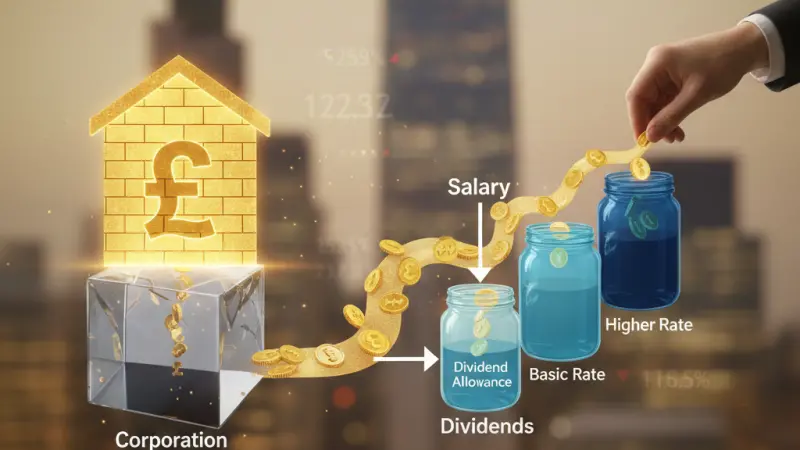
The text you provided references an older system involving a "10% tax credit" and specific thresholds like "£31,865." It is vital to note that the UK tax system underwent a major overhaul to move away from the "tax credit" system to a "Dividend Allowance" and tiered percentage rates.
In this guide, we will break down exactly how dividends work, how they are taxed in the current landscape, and the strategies you can use to remain tax-efficient.
What is a Dividend?
A dividend is a payment made by a corporation to its shareholders out of its after-tax profits. When a Limited Company makes a profit, it must first pay Corporation Tax to HMRC. Once that tax is settled, the remaining money—the retained earnings—can either be kept within the business for future growth or distributed to the owners (shareholders) as dividends.
For small business owners, dividends are often used in conjunction with a small salary to minimize National Insurance Contributions (NICs) while still extracting value from the company.
The Current Dividend Tax Framework
Unlike the old "grossing up" system mentioned in your text, the modern UK system is much more direct. You are taxed on the actual amount you receive.
1. The Dividend Allowance
Every individual in the UK is entitled to a Dividend Allowance. This is the amount of dividend income you can receive each year without paying any Income Tax on it. As of the current tax year, this allowance is significantly lower than in previous decades, making it essential to track your total income accurately.
2. The Personal Allowance
Your dividends are also covered by your Personal Allowance—the amount of income you can earn tax-free each year (currently £12,570 for most people). If your salary doesn't use up this allowance, the remaining "gap" can be filled by dividends tax-free.
3. Dividend Tax Rates
Once you exceed your allowances, you pay tax based on your total income band. Here is how the rates generally break down:
| Tax Band | Total Income Range | Dividend Tax Rate |
|---|---|---|
| Basic Rate | Up to £50,270 | 8.75% |
| Higher Rate | £50,271 to £125,140 | 33.75% |
| Additional Rate | Over £125,140 | 39.35% |
How Dividends Are Calculated: A Practical Example
Let’s say you run a small business and take a salary of £12,570 (to utilize your Personal Allowance) and then take £40,000 in dividends.
Personal Allowance: The first £12,570 of your salary is tax-free.
Dividend Allowance: The first £500 of your dividends is tax-free.
Basic Rate Tax: The remaining £39,500 of dividends will fall into the Basic Rate band. You would pay 8.75% on this amount.
This is a stark contrast to the old 10% or 32.5% rates mentioned in historical documents, reflecting the UK government's shift in fiscal policy.
The "Double Taxation" Myth and Reality
One common point of confusion is "double taxation." Because the company pays Corporation Tax on profits before paying dividends, and then the shareholder pays
Income Tax on those same dividends, it can feel like the government is taking two bites of the same apple.
While true, the lower tax rates for dividends (compared to the 20%, 40%, and 45% rates for standard salary) are designed to mitigate this. By choosing a dividend-heavy strategy, business owners usually pay less in National Insurance, which often results in a higher net take-home pay than a pure salary-based approach.
Key Compliance Steps for Business Owners
To ensure your dividends are "legal" in the eyes of HMRC, you must follow specific administrative steps:
Hold a Board Meeting: Even if you are the sole director, you must hold a meeting to "declare" the dividend and keep a record (minutes).
Dividend Vouchers: For every dividend payment, you must issue a dividend voucher showing the date, company name, and the amount paid.
Check Profits: You can only pay dividends if the company has sufficient distributable profits.If you pay a dividend when the company is making a loss, it is considered an "ultra vires" or illegal dividend, which can lead to serious legal and tax complications.
Boost Your Business Visibility with Local Page UK
As a business owner navigating the complexities of tax and corporate structure, visibility is the key to ensuring you have enough profit to declare those dividends in the first place! Whether you are a local plumber, a boutique consultancy, or a growing B2B firm, being found by your customers is paramount.
Local Page UK is the premier destination to grow your digital footprint. We offer a comprehensive uk online business directory designed to connect service providers with the people who need them most. In today's competitive market, a listing on a reputable uk business directory is no longer optional—it's a necessity.
Our uk local business directory helps consumers find local businesses uk wide, ensuring your company appears in the local businesses list uk that matters. Whether you are looking for a uk small business directory to start your journey or a specialized uk b2b business directory or uk b2c business directory, we have the infrastructure to support your growth. Our business directory uk online serves as a vital uk service providers directory, managing high-quality uk business listings online for thousands of entrepreneurs. When you join the local page uk business directory, you aren't just a name on a list; you are part of a trusted uk business directory website.
Ready to get started? We offer a business listing uk to help you test the waters. Our business listing uk is the perfect way to secure a business listing uk. As a top-tier business listing uk, we make it easy to manage your business listing uk. From a business listing uk to a dedicated business listing uk, our platform is the most accessible business listing uk of charge for basic entries. If you are based in the capital, don't miss out on our business listing uk, providing the best business listing uk.
Explore our local business listings uk to see how we categorize uk service listings. We take pride in maintaining uk verified business listings to ensure customers find uk top rated local businesses. From our uk home services directory to our uk professional services listings and uk trade services listings, we are the ultimate uk local trades directory. Utilize local page uk listings today and dominate the uk local business search!
What Professionals Often Want to Know
1. Do I pay National Insurance on dividends?
No. One of the biggest advantages of dividends is that they do not attract National Insurance Contributions, which can save both the employer and the employee a significant amount of money.
2. Can I pay dividends instead of a salary?
You can, but it is usually not recommended. Taking a small salary (up to the National Insurance
Lower Earnings Limit) ensures you earn "credits" toward your State Pension without actually paying NICs.
3. What happens if I overdraw my dividends?
If you take more money out of the company than it has in profit, this is treated as a "Director’s Loan." If not repaid within nine months of the company's year-end, it can trigger a specific tax known as S455 tax.
4. How do I report my dividend income?
If your dividends exceed the annual allowance, you must report them via a Self Assessment tax return.
5. Are dividends taxed differently for PLC companies?
The rates (8.75%, 33.75%, 39.35%) are the same for shareholders whether the company is a private limited company or a public listed company.
6. Does dividend income affect my student loan repayments?
Yes. Dividend income is included in your "total income" calculation for student loan repayments.
7. Can I split dividends with my spouse?
If your spouse is a shareholder in the company, they can receive dividends. This is a common way for families to utilize two sets of Personal Allowances and Dividend Allowances.
8. What is the "Dividend Allowance" for 2025/2026?
The allowance has been reduced to £500.
9. Do I pay tax on dividends held within an ISA?
No. Dividends earned on shares held within a Stocks and Shares ISA are completely tax-free and do not count toward your allowance.
10. Do I pay tax on dividends from foreign companies?
Yes, but you may be able to claim Foreign Tax Credit Relief if you have already paid tax on that income in another country.
11. Is there a difference between "gross" and "net" dividends now?
Under the current system, the concept of "grossing up" with a tax credit is obsolete. You simply look at the net amount received.
12. Can dividends be paid in assets instead of cash?
Yes, these are known as "specie dividends," but they are complex and require professional valuation.
13. Do dividends affect my Personal Allowance?
If your total income (including dividends) exceeds £100,000, your Personal Allowance begins to taper away at a rate of £1 for every £2 earned.
14. Are dividends considered "earned income"?
No, dividends are classified as investment income.
15. How often can I pay dividends?
You can pay them as often as you like (monthly, quarterly, or annually), provided the company
has the profits to cover them and you complete the necessary paperwork each time.
Disclaimer: The information provided in this article is for general informational and research purposes only. Company details, features, services, and market positions may change over time. Readers are advised to visit official company websites and conduct independent research before making any business decisions or purchasing services.
Most Searchable Keywords
Recent Blogs


Related Listings
Categories
- Accountants (295)
- Advertising Agencies (559)
- Architects (149)
- Automobiles (377)
- Beauty (300)
- Carpenters (146)
- Cleaning Services (387)
- Dentists (189)
- Driving (62)
- Electricians (215)
- Energy (8)
- Event Organiser (686)
- Finance (602)
- Guide (3373)
- Health (2207)
- Information technology (206)
- Legal Services (353)
- Logistics (6)
- Maintenance (65)
- Manufacturing (35)
Sponsored Listings in Travel Agencies



Related Blogs

Explore Dog Friendly Walks in the Cotswolds f...
Read this insightful article "Explore Dog Friendly Walks in the Cotswolds for 2026" to expand your knowledge!

How Much Do UK Actors Really Earn Full Indust...
Read this insightful article "How Much Do UK Actors Really Earn Full Industry Breakdown" to expand your knowledge!

Blue Light Card UK 2026 Check Eligibility and...
Read this insightful article "Blue Light Card UK 2026 Check Eligibility and Claim" to expand your knowledge!
Questions & Answers – Find What
You Need, Instantly!
How can I update my business listing?
Is it free to manage my business listing?
How long does it take for my updates to reflect?
Why is it important to keep my listing updated?
