
How to Become an Electrician UK
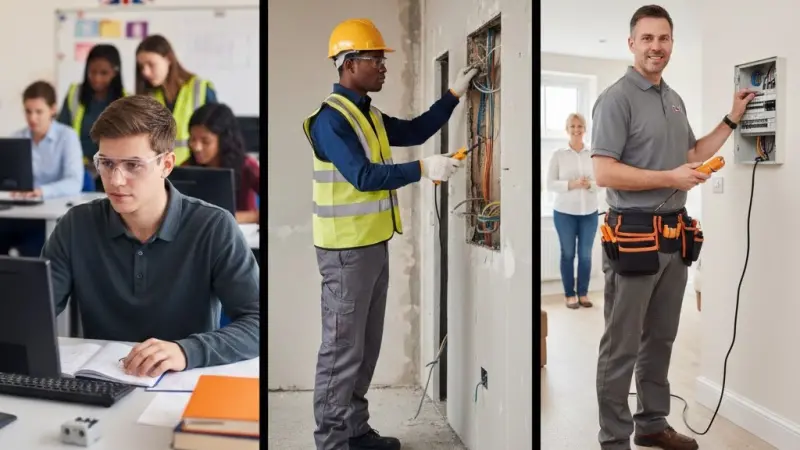
How to Become an Electrician in the UK: The 2026 Definitive Path to Qualification
Published by LocalPage.uk Senior Content Architecture Team • Last Updated: February 2026 Targeted at: Prospective Tradespeople, Career Changers, and Small Business Entrants
The role of an electrician has evolved significantly as the UK transitions towards a greener, more electrified economy. In 2026, becoming a qualified electrician is no longer just about residential wiring; it is a gateway to high-technology sectors including Electric Vehicle (EV) infrastructure, renewable energy systems, and smart-home automation. With over 385,000 trade businesses operating across the British Isles, the demand for competent, registered electrical professionals remains at a historic high.
385,000+
Active construction and trade businesses in the UK, contributing nearly 7% of the total workforce in 2025. Employment in the electrical sub-sector specifically is projected to grow by 12% by 2028.
Identifying the Correct Entry Route for Your Career Goals
Choosing the right path depends heavily on your current age, existing qualifications, and whether you are looking to earn while you learn or fast-track through intensive study. The UK electrical industry is heavily regulated, and "short courses" that promise "full qualification" in weeks are often misleading. To be recognised as a "Gold Card" electrician, you must complete a formalised training structure recognised by the Electrotechnical Certification Scheme (ECS).
The Apprenticeship Trailblazer Standard
Apprenticeships remain the gold standard for entry into the industry. Usually lasting between three and four years, they combine on-the-job training with a participating employer and classroom learning at a local college or private provider. In England, the Installation and Maintenance Electrician Standard is the primary route. In Scotland, the Scottish Joint Industry Board (SJIB) oversees a similar apprenticeship framework that is highly regarded for its rigorous standards.
Fast-Track Diploma Routes for Adult Learners
For those making a career change later in life, the City & Guilds 2365 Level 2 and Level 3 Diplomas offer a technical foundation. Whilst these do not make you a "qualified electrician" on their own, they provide the theoretical knowledge required to find work as an electrician's mate or improver, allowing you to eventually complete your NVQ Level 3 and the AM2 assessment whilst working in the field.
Practical Insight: The Reality of "Domestic Installer" Status
Many entrants begin as Domestic Installers (Part P). While this allows you to perform and certify work in homes, it is more restrictive than being a fully qualified electrician. If you endeavour to work on commercial sites or industrial installations, you will eventually need to complete the full NVQ Level 3.
Essential Qualifications and Regulatory Compliance in 2026
The regulatory landscape for UK electricians is governed by the IET Wiring Regulations, currently in their 18th Edition (BS 7671:2018+A2:2022), though updates are frequently discussed for 2027. Compliance with these regulations is not optional; it is a legal requirement under the Electricity at Work Regulations 1989.
The NVQ Level 3 and the AM2 Assessment
Regardless of your chosen training route, the NVQ Level 3 in Electrotechnical Services is the essential benchmark. This is a performance-based qualification where an assessor visits your workplace to verify that you can perform tasks safely and competently. Following the NVQ, you must pass the AM2 (Achievement Measurement 2) assessment—a three-day practical and theoretical exam that acts as the final gatekeeper to the profession.
Understanding the ECS Gold Card System
The Electrotechnical Certification Scheme (ECS) card is your "license to trade" on most UK construction sites. To obtain the prestigious Gold Card (Electrician status), you must prove you hold a Level 3 NVQ, have passed the AM2, and hold a valid Health, Safety and Environmental awareness certificate. Without this card, your access to major projects in London, Manchester, or Birmingham will be severely restricted.
Regulatory Focus: The Role of the JIB
The Joint Industry Board (JIB) sets the bar for employment standards and grading in the UK. Many of the most lucrative contracts require JIB-graded electricians, ensuring that the worker is paid a fair wage commensurate with their proven skill level.
UK-Wide Variance: While the core principles of BS 7671 apply across the UK, Scotland operates under the Building Standards (Scotland) Regulations. Scottish electricians often register through SELECT, Scotland’s largest construction trade association, rather than the NICEIC or NAPIT which are more prevalent in England and Wales.
Navigating Training Providers and Funding Opportunities
The cost of training can be a significant barrier. However, the UK government has introduced several initiatives to offset these costs, particularly for sectors deemed critical to the "Net Zero" strategy.
Small businesses and sole traders should look into local authority grants and Skills Bootcamps which are often 70-90% funded.
Leveraging Government Grants and Levies
If you are an employer looking to train a new electrician, the Apprenticeship Levy (for larger firms) or co-investment (for smaller firms) can cover almost all training costs. In Wales, the "Personal Learning Accounts" (PLA) scheme offered through Business Wales has helped thousands of tradespeople upskill into green technologies without the burden of tuition fees.
Choosing Accredited Training Centres
Ensure any provider you use is accredited by City & Guilds, EAL, or BPEC. Always check the physical facilities of a training centre before paying a deposit. A reputable centre will have dedicated booths for practical wiring and testing, reflecting real-world scenarios you will encounter in Northern Ireland, England, or Wales.
Warning: Verify Your Provider
Check the National Careers Service or GOV.UK to ensure your training provider is on the Register of Apprenticeship Training Providers (RoATP). Unregistered providers cannot access government funding, and their certificates may not be recognised for ECS card applications.
Specialising in 2026: Green Tech and Smart Systems
In 2026, the "generalist" electrician is increasingly being replaced by specialists. Specialising not only allows you to charge higher day rates but also insulates you from the fluctuations of the general construction market.
EV Charge Point Installation (C&G 2921)
With the UK's mandate for zero-emission vehicles, the installation of EV charging points in domestic and commercial settings is a booming sub-sector. Qualifications like the City & Guilds 2921 are now almost essential for any modern electrician. Currently, Northern Ireland is seeing a 15% year-on-year increase in public charging infrastructure investment.
Solar PV and Battery Storage Systems
The energy crisis has driven a surge in domestic solar adoption. Being qualified to install and maintain Microgeneration Certification Scheme (MCS) compliant systems allows you to tap into a market where 76% of UK consumers research sustainable home upgrades online before purchasing. This requires additional training in DC (Direct Current) systems and roof-work safety.
Success Factor: Smart Home Integration
The integration of IoT (Internet of Things) devices—from smart lighting to intelligent heating controls—requires an electrician who understands data cabling as well as power cabling. Professionals who can bridge the gap between traditional electrical work and IT networking are in high demand in the South East and London's luxury residential markets.
Regional Considerations for Electricians Across the UK
While the technical standards are unified, the business and legal environment varies between the home nations. A successful electrical business must adapt to these regional nuances.
England: The Dominance of Competent Person Schemes
In England, most domestic work falls under "Part P" of the Building Regulations. Joining a Competent Person Scheme (CPS) like NICEIC, NAPIT, or Stroma is the most efficient way to self-certify your work without involving local authority building control for every job. This is vital for maintaining speed and profitability for SMEs.
Scotland and Northern Ireland: Unique Systems
In Scotland, the SJIB (Scottish Joint Industry Board) plays a much more central role in grading and industrial relations. Northern Ireland, meanwhile, has unique cross-border trade considerations. Electricians in NI often find themselves working on projects on both sides of the border; understanding the subtle differences between UK regulations and the Irish ETCI rules can be a distinct competitive advantage.
Regional Tip: Business Wales Support
Welsh micro-businesses (which make up 94% of the Welsh business population) can access bilingual support and free mentorship through Business Wales. This is particularly helpful for navigating the specific Welsh procurement rules for public sector contracts.
"What is the quickest way to become an electrician in the UK?"
The most efficient path for adults is the Level 2 and 3 Diploma route followed by an NVQ. However, "quick" is relative; expect a minimum of 2-3 years to reach full qualification. Avoid 5-week "intensive" courses that do not include the NVQ.
"Do I need a license to be an electrician in England?"
Technically, no, but practically, yes. While there is no mandatory individual license like in the US, you cannot certify domestic work without being in a Competent Person Scheme, and you cannot enter commercial sites without an ECS Gold Card.
Setting Up Your Own Electrical Business
Once qualified, many electricians endeavour to work for themselves. In 2025, 75% of retail and service-based trade operations in the UK are single-person operations. Moving from "Sparky" to "Business Owner" requires a shift in mindset.
Legal Structure and HMRC Compliance
Most start as sole traders due to the simplicity of the setup. However, as your turnover approaches the VAT threshold (currently £90,000 for 2025-26), registering as a Limited Company through Companies House may offer tax efficiencies and limited liability protection. You must also register for the Construction Industry Scheme (CIS) if you intend to work as a sub-contractor for other firms.
Insurance and Professional Liability
Professional Indemnity and Public Liability insurance are non-negotiable. Public Liability should be a minimum of £2 million, though many local authorities and the FCA (for finance-related projects) require £5 million or more. This protects you against claims of property damage or personal injury resulting from your work.
Administrative Duty: Data Protection
As you will be collecting customer names, addresses, and contact details, you must comply with the Data Protection Act 2018 and potentially register with the Information Commissioner's Office (ICO). Failure to handle customer data securely can lead to significant fines.
Building a Local Reputation and Finding Customers
In 2026, word-of-mouth is supplemented by digital presence. With 82% of UK adults owning a smartphone, your business must be discoverable where they are searching.
Digital Marketing for Tradespeople
A "Google Business Profile" is essential. 76% of consumers research local businesses online before committing to a service. Ensure your profile has high-quality photos of your consumer unit upgrades or EV installations and actively encourage satisfied clients to leave reviews. 68% of customers trust these as much as a personal recommendation.
Strategic Partnerships and Networking
Join your local British Chamber of Commerce or the Federation of Small Businesses (FSB). Networking with local builders, kitchen fitters, and plumbers can create a steady stream of referral work. In rural areas of the North East or South West, these community ties are often more valuable than any paid advertising.
Marketing Tip: Focus on "Near Me" Searches
Voice search for "electrician near me" has increased by 43% since last year. Ensure your website and local listings explicitly mention the towns and postcodes you cover to capture this high-intent traffic.
Financial Management and Profitability in 2026
Staying profitable in 2026 requires careful management of material costs and labour rates.
Inflation in electrical components has stabilised but remains a factor to monitor.
Estimating and Quoting Strategies
Never give a quote over the phone for complex work. Always visit the site to assess the existing installation (the "ears" of the house). Include a 10% contingency for unforeseen issues, especially in older Victorian properties prevalent in London and the Midlands where wiring may be non-compliant or dangerous.
Managing Cash Flow and Payments
Use mobile invoicing software to send quotes and invoices on the spot. Requesting a deposit for materials (especially for expensive items like battery storage or high-end lighting) is standard practice and protects your cash flow. Ensure your terms and conditions are clear regarding payment deadlines to avoid the "late payment" culture that affects many SMEs.
Financial Insight: Tax Deductible Expenses
Keep meticulous records of your tools, van maintenance, and even a portion of your home office costs. These are all tax-deductible. In 2026, the transition to "Making Tax Digital" (MTD) means you should be using HMRC-compliant software to track your finances in real-time.
The Future: Maintaining Your Professional Edge
The electrical industry is not a "once qualified, always qualified" profession. Continuous Professional Development (CPD) is required to stay relevant and safe.
Mandatory Refresher Courses
Every time the Wiring Regulations (BS 7671) are updated, you will need to sit a "bridging" exam or a full 18th/19th Edition course. Membership in professional bodies like the IET (Institution of Engineering and Technology) provides access to the latest technical papers and safety alerts.
Upskilling into Automation
As AI begins to manage home energy usage, the role of the electrician will increasingly involve software configuration. Learning about KNX, Lutron, or other automation protocols will position you at the top tier of the market, where project values are significantly higher than standard residential work.
Frequently Asked Questions
I'm 35 - am I too old to start training as an electrician?
Absolutely not. Career changers are highly valued in the industry for their maturity and soft skills. While you might not find a traditional "youth" apprenticeship, the adult trainee route via Level 2 and 3 Diplomas is very popular. Many employers in the UK prefer older trainees who have previous professional experience and a proven work ethic.
How much does a qualified electrician earn in the UK in 2026?
Salaries vary by region and specialism. A newly qualified electrician can expect £32,000 - £38,000. Experienced JIB Gold Card holders in London or those specialising in EV/Solar can easily earn £45,000 - £55,000. Self-employed electricians can gross significantly more, though they must account for overheads, insurance, and tax.
What is the difference between an apprentice and an 'improver'?
An apprentice is on a formal, government-recognised training program combining college and work. An improver has usually finished their classroom training but hasn't yet completed their NVQ or AM2 assessment. Improvers are "semi-skilled" and work under supervision to gain the site experience needed for their final practical exams.
Can I work as an electrician in Scotland with English qualifications?
Yes, the core qualifications (NVQ Level 3 and AM2) and the Wiring Regulations (BS 7671) are recognised across the UK. However, to work on most Scottish sites, you will need to swap your ECS card for an SJIB card. You should also familiarise yourself with the Scottish Building Standards, which have slight differences regarding domestic documentation.
How much does it cost to get fully qualified?
If you don't get an apprenticeship, expect to pay between £5,000 and £8,000 in total for your Level 2/3 diplomas, NVQ assessment, and AM2 exam. Many students pay this in installments over 2-3 years. Look for government-funded "Skills Bootcamps" which can reduce these costs by up to 90% for eligible UK residents.
Do I need to be good at maths to be an electrician?
You don't need to be a mathematician, but you do need a solid grasp of GCSE-level maths. You will use algebra to calculate voltage drop, cable sizing, and circuit impedance. Most training providers require a Grade 4 (C) or above in GCSE Maths and English as an entry requirement for Level 3 courses.
Is the AM2 exam really as hard as people say?
The AM2 is rigorous because it ensures safety. It has a high standards-based failure rate, often due to small errors in "testing and inspection" or "fault finding." However, if you have had good site experience during your NVQ and attend a pre-AM2 prep course, the pass rate is significantly higher.
Should I join NICEIC or NAPIT?
Both are excellent Competent Person Schemes. NICEIC is perhaps the most widely recognised by consumers and architects, while NAPIT is often praised for its technical support and is popular with multi-trade firms. Compare their membership fees and the specific benefits they offer for your region before deciding.
Can I run an electrical business from my home?
Yes, many sole traders operate from a home office and keep their stock in a van or garage. You must notify your mortgage provider or landlord and ensure your home insurance covers business equipment.
You will also need to be mindful of "business rates" if you convert a significant part of your home into a workshop.
What tools do I need to buy first?
Start with high-quality hand tools: VDE insulated screwdrivers, side cutters, and wire strippers. As you progress, your most expensive and vital purchase will be a Multifunction Tester (MFT) for certifying your work. Expect to spend £600-£1,200 on a reputable MFT from brands like Megger, Fluke, or Kewtech.
Disclaimer: The information provided in this article is for general informational and research purposes only. Company details, features, services, and market positions may change over time. Readers are advised to visit official company websites and conduct independent research before making any business decisions or purchasing services.
Most Searchable Keywords
Recent Blogs
-

Pavel Durov — The Visionary Founder Behind Telegram Messenger
-
UK Exam Calendar 2026–2027: The Complete Guide to Every Upcoming Exam, Deadline & Results Day
-
How Much BBC Radio 4 Today Programme Hosts Really Earn
-
New UK Trade Union Access Rules for Employers in 2026
-
Winter Fuel Payment Eligibility and How Much You Could Get

Related Listings

Categories
- Accountants (295)
- Advertising Agencies (559)
- Architects (149)
- Automobiles (377)
- Beauty (300)
- Carpenters (146)
- Cleaning Services (387)
- Dentists (189)
- Driving (62)
- Education (1)
- Electricians (215)
- Energy (8)
- Event Organiser (686)
- Finance (602)
- Guide (3377)
- Health (2207)
- Information technology (206)
- Legal Services (357)
- Logistics (6)
- Maintenance (65)
Sponsored Listings in Travel Agencies

Related Blogs

Pavel Durov — The Visionary Founder Behind Te...
Read this insightful article "Pavel Durov — The Visionary Founder Behind Telegram Messenger" to expand your knowledge!
UK Exam Calendar 2026–2027: The Complete Guid...
Read this insightful article "UK Exam Calendar 2026–2027: The Complete Guide to Every Upcoming Exam, Deadline & Results Day" to expand your...

How Much BBC Radio 4 Today Programme Hosts Re...
Read this insightful article "How Much BBC Radio 4 Today Programme Hosts Really Earn" to expand your knowledge!
Questions & Answers – Find What
You Need, Instantly!
How can I update my business listing?
Is it free to manage my business listing?
How long does it take for my updates to reflect?
Why is it important to keep my listing updated?
