
How to Choose a Photographer for a Wedding or Business Event
- 👤 Ryan Reynolds
- 👁️ 13 Views
- Last Updated: August 25, 2026
- 🏷️ Event Organiser
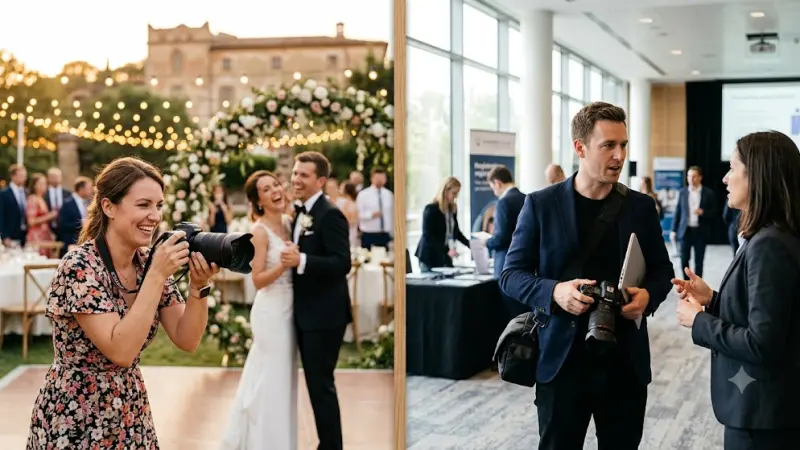
Whether you are a corporate event planner seeking coverage for an annual stakeholder summit or a couple curating the visual legacy of your marriage, discovering exactly How to Choose a Photographer for a Wedding or Business Event is a high-stakes procurement decision. For UK businesses in particular, high-quality imagery is no longer merely a nice-to-have; it is a critical commercial asset that drives PR, internal communications, and marketing collateral.
A poorly executed shoot can result in unusable assets, missed moments, and complex legal disputes over intellectual property. This comprehensive, research-driven B2B guide provides UK businesses, event organisers, and discerning couples with an authoritative framework to thoroughly audit, benchmark, and secure a highly competent professional photographer.
Why Knowing How to Choose a Photographer for a Wedding or Business Event is a Commercial Imperative
In the UK, the professional photography market is largely unregulated. Anyone can purchase high-end camera equipment and advertise their services online. Therefore, understanding exactly How to Choose a Photographer for a Wedding or Business Event empowers you to pierce through glossy Instagram feeds and interrogate the fundamental commercial and technical viability of the provider.
Whether you are booking a corporate shoot or a high-end wedding, failing to scrutinise a photographer’s historical performance, legal frameworks, and backup protocols frequently results in clients signing highly restrictive contracts that fail to deliver the expected return on investment (ROI).
The Business Impact of Rigorous Procurement
-
Asset Protection: Professional, properly lit images enhance brand credibility in case studies, annual reports, and social proof.
-
Risk Mitigation: Securing a photographer with proper liability insurance and contingency plans prevents total loss in the event of equipment failure.
-
Yield Optimisation: Ensures that the contractual licensing and usage rights align with your long-term commercial or personal needs without unexpected ongoing fees.
Step 1: Interrogating Portfolios and commercial photography package Offerings
Before discussing dates and fees, you must validate the photographer's technical competence and stylistic consistency. A strong single image does not automatically equate to a structurally sound event operation.
Assessing Technical Consistency
You must conduct a forensic review of the photographer’s extended portfolio. Do not rely solely on the "highlights" featured on their homepage.
-
Request Full Galleries: Ask to see a complete gallery from a single recent event. This reveals their ability to maintain quality throughout an 8-to-10 hour day, rather than just capturing one lucky shot in perfect lighting.
-
Evaluate Lighting Competency: In the UK, winter weddings and poorly lit corporate conference halls are standard. Check their portfolio for events held in challenging conditions. Do the images look grainy and poorly focused, or crisp and professionally lit?
-
Analyse the Style: Are you looking for traditional posed shots, or natural, documentary-style reportage? Ensure their established style matches your specific brief.
Evaluating the commercial photography package
The core of any B2B photography transaction is understanding exactly what deliverables are included. A comprehensive analysis of a commercial photography package (or wedding package) is vital to protect your budget.
Ensure you identify and calculate:
-
Hours of Coverage: Does the package include half-day (typically 4 hours) or full-day (typically 8-10 hours) coverage?
-
Deliverable Volume: Is there a cap on the number of edited images provided?
-
Turnaround Times: Standard delivery is often 2 to 6 weeks. If you require same-day or next-day delivery
for a PR launch or social media campaign, this usually incurs a premium surcharge.
-
Retouching Services: Does the package include basic colour correction, or does it cover advanced retouching (e.g., removing background distractions or skin smoothing)?
Step 2: Demystifying Pricing and commercial photography day rate UK
Understanding pricing structures is crucial to avoid hidden costs. Photographers operate on various models depending on the sector.
The commercial photography day rate UK
For corporate and B2B events, you will typically encounter the commercial photography day rate UK. According to 2026 market data, you can expect the following benchmarks:
-
Half-Day Rate (up to 4 hours): Generally ranges from £400 to £650+ VAT for a standard professional.
-
Full-Day Rate (up to 8 hours): Typically ranges from £700 to £1,500+ VAT.
-
Experienced Specialists/Blue-Chip Photographers: Rates frequently start from £1,200+ VAT per day.
Understanding corporate event photography pricing UK 2025 and 2026 Trends
When budgeting for corporate event photography pricing UK 2025 and heading into 2026, it is vital to factor in the complexity of your event.
A four-hour event in a single conference room requires a different level of logistical planning than a four-hour programme featuring simultaneous panel discussions across multiple rooms. If your event has concurrent sessions that must be documented, you will need to budget for a second shooter (an additional photographer), which will increase the overall cost.
Analysing wedding photography packages UK
For private clients, wedding photography packages UK usually bundle time, deliverables, and sometimes physical products. In 2026, the national average for a full day of professional UK wedding coverage sits between £1,400 and £2,000.
When reviewing these packages, confirm if travel expenses and accommodation are included, or if they will be added to the final invoice.
Step 3: Assessing the Contract and Legal Framework
The photography contract is the legally binding document that governs your commercial relationship with the provider. Never hire a professional without a signed agreement.
Essential Contract Clauses
A specialist B2B photography contract must clearly outline the scope of services to prevent costly misunderstandings.
Ensure the contract transparently details:
-
The exact date, location, and start/finish times.
-
The payment schedule (including non-refundable deposit amounts and final balance due dates).
-
Contingency plans for illness or equipment failure (e.g., do they guarantee a replacement photographer of equal skill?).
Navigating Copyright and commercial photography contract UK clauses
This is the most critical area of dispute in professional photography. By default, under the UK Copyright, Designs and Patents Act 1988, the photographer owns the copyright to the images they take, even after you have paid them.
You must heavily scrutinise the commercial photography contract UK clauses regarding usage and licensing:
-
Licensing vs. Assignment: Most photographers will grant you a "licence to use" the images, rather than assigning (giving) you the full copyright.
-
Usage Restrictions: Does the licence permit you to use the images for worldwide commercial advertising, or is it restricted to internal corporate communications and social media?
-
Third-Party Rights: Are you allowed to share the images with third-party sponsors or vendors for their own marketing? (Often, this requires an extended licence fee).
Image Storage and GDPR Compliance
Particularly for corporate events featuring staff and clients, ensure the contract addresses data protection. How will the images be securely delivered? How long will the photographer retain the RAW files as a backup? If employees request the "right to be forgotten," how is this managed?
Step 4: Operational Logistics and Timelines
The logistical execution of the shoot is where top-tier photographers distinguish themselves. You are hiring a professional to manage a critical element of your event, and that requires rigorous planning.
Crafting a wedding photography timeline
For private events, structuring the day is vital. A professional will assist you in building a comprehensive wedding photography timeline.
A typical UK timeline requires:
-
2 to 3 hours for morning preparation photos.
-
15 to 30 minutes immediately post-ceremony for a relaxed couple portrait session.
-
20 to 30 minutes for formal group shots.
-
10 to 15 minutes during "Golden Hour" (just before sunset) for cinematic portraits.
Allowing your photographer to dictate the necessary time allocations ensures you receive the gallery you expect without feeling rushed on the day.
The Role of the Corporate Brief
For business events, a detailed brief is non-negotiable. Do not assume the photographer knows who your CEO is.
Provide a clear "shot list" that includes:
-
Key VIPs, keynote speakers, and stakeholders who must be photographed.
-
Specific branding elements (e.g., wide shots showing stage signage, close-ups of sponsored lanyards).
-
The desired ratio of candid networking shots versus formal stage presentations.
Red Flags: What to Watch Out For During Procurement
Even with meticulous research, certain warning signs should prompt an immediate halt to negotiations. Spotting these red flags is the final layer of your risk mitigation strategy.
Lack of Professional Insurance
A genuine professional will hold both Public Liability Insurance (essential if someone trips over their lighting stand) and Professional Indemnity Insurance. If a photographer cannot immediately produce these certificates upon request, walk away.
Pressurised Sales Tactics and Vague Deliverables
If a photographer is applying high-pressure tactics such as demanding a 100% upfront payment months in advance, or refusing to put the exact number of deliverable images into a written contract this is a severe red flag. Premium providers rely on the quality of their portfolio, transparent terms, and a fair deposit schedule (typically 20% to 50% upfront).
Frequently Asked Questions
1. How far in advance should we book a photographer?
For popular summer weddings and major corporate Q4 events, top-tier photographers in the UK are often booked 12 to 18 months in advance. For standard corporate headshots or smaller mid-week events, a lead time of 4 to 8 weeks is usually sufficient.
2. Should we ask for the RAW (unedited) files?
Most professional photographers will refuse to hand over RAW files. Editing is a fundamental part of their artistic style and brand quality. Asking for RAW files is akin to asking a Michelin-star chef for the raw ingredients instead of the finished meal. You are paying for their post-production expertise.
3. What happens if the photographer is ill on the day?
A professional contract will include a sickness or force majeure clause. Established photographers usually belong to extensive professional networks and will arrange a competent substitute to cover your event at no extra cost to you.
4. Do we need to feed the photographer?
For any event lasting longer than 5 hours (such as a full-day conference or a wedding), it is standard industry practice in the UK to provide a hot meal for the photographer and their assistants. A fed crew is an energetic crew.
5. Are drone shots included in standard packages?
Usually, no. Operating a drone commercially in the UK requires specific CAA (Civil Aviation Authority) qualifications, specialised insurance, and venue permissions. If you require aerial photography, this will almost always be an add-on service.
Disclaimer: The information provided in this article is for general informational and research purposes only. Company details, features, services, and market positions may change over time. Readers are advised to visit official company websites and conduct independent research before making any business decisions or purchasing services.
Most Searchable Keywords
Recent Blogs


Related Listings


Categories
- Accountants (295)
- Advertising Agencies (559)
- Architects (149)
- Automobiles (377)
- Beauty (300)
- Carpenters (146)
- Cleaning Services (387)
- Dentists (189)
- Driving (62)
- Education (1)
- Electricians (215)
- Energy (8)
- Event Organiser (688)
- Finance (602)
- Guide (3487)
- Health (2207)
- Information technology (207)
- Legal Services (361)
- Logistics (6)
- Maintenance (65)
Sponsored Listings in Event Organiser
Related Blogs

How Small Businesses Can Use AI Without Losin...
Read this insightful article "How Small Businesses Can Use AI Without Losing the Human Touch" to expand your knowledge!

How to Find a Good Web Design Company for a S...
Read this insightful article "How to Find a Good Web Design Company for a Small Business" to expand your knowledge!
How to Choose a Photographer for a Wedding or...
Read this insightful article "How to Choose a Photographer for a Wedding or Business Event" to expand your knowledge!
Questions & Answers – Find What You Need, Instantly!
Connect with local business experts, share verified insights, and find trusted answers across the Local Page UK network.
Ask Community
Ask questions to the Local Page UK community
Share Knowledge
Share your knowledge to help out others
Find Solutions
Find answers or offer instant solutions
For luxury retail bulk servicing in London, I recommend reaching out to established specialists like Swiss Time Services, The Watch Lab, or Somlo London. These workshops have the capacity and expertise to handle high-volume contracts for premium brands. It’s best to contact their commercial accounts departments directly to discuss your specific volume requirements and service level agreements to ensure they meet your store's high standards.
Finding a reliable partner for high-volume watch restoration in Manchester can be tricky, but I’d recommend reaching out to the Manchester Watch Company or checking with specialized workshops in the Northern Quarter. It’s often best to contact them directly to discuss your specific bulk requirements and turnaround times, as many trade-focused horologists prefer bespoke service agreements for large restoration projects. Good luck with your search!
Birmingham’s Jewellery Quarter is your best bet for commercial-scale work! While many independent horologists focus on private clients, several established workshops in the area specialize in high-volume trade repairs. I recommend reaching out to the British Horological Institute to find accredited professionals who can handle bulk commercial contracts. Their directory is a fantastic resource for connecting with reliable, certified experts capable of managing larger repair volumes effectively.
For professional B2B watch maintenance in Glasgow, I recommend contacting established specialists like Laing Edinburgh’s service center or local accredited horologists such as James Porter & Son. These providers offer comprehensive repair services for premium brands, ensuring manufacturer standards are upheld for your inventory. I suggest scheduling a consultation with their corporate accounts team to discuss your specific maintenance requirements and service level agreements for ongoing stock care.
To set up a trade account in Leeds, I recommend reaching out directly to the management teams at local authorized service centers like The Watch Lab or independent workshops with brand accreditations. Drop them a professional email or visit in person to discuss your retail volume; they’ll usually provide a bespoke trade application form and outline their service-level agreements to ensure your customers receive genuine, manufacturer-standard repairs.
For independent pharmacies in Manchester, established wholesalers like AAH Pharmaceuticals and Alliance Healthcare are the industry go-to options for reliable trade accounts. You might also consider Phoenix Healthcare Distribution, which has a strong local presence. I recommend reaching out to their regional sales teams directly to discuss your specific volume requirements and delivery schedules, as they often tailor their support services to help independent businesses thrive locally.
Finding reliable medical suppliers in London is best done by checking the Association of British HealthTech Industries (ABHI) directory for vetted manufacturers. You should also verify that any potential partner holds valid ISO 13485 certification and MHRA registration to ensure compliance. Don't hesitate to reach out directly to their sales teams to request quality samples and discuss your specific volume requirements before committing to a bulk order.
Hi there! Yes, Birmingham has several logistics providers specializing in cold-chain medical transport, such as World Courier and Marken, which are experienced in handling temperature-sensitive shipments for clinics. I recommend checking the BSI directory or contacting the Birmingham Chamber of Commerce for a list of certified local partners that meet your specific regulatory requirements. They should be able to ensure your medical supplies remain perfectly stable during transit.