
How to Price Products UK
How to Price Products in the UK: A Strategic Business Guide
Published: February 2026 | Industry: UK SME & Retail Strategy | Reading Time: 15 minutes
In the evolving economic landscape of 2026, pricing products correctly is no longer just about covering costs; it is about survival, brand positioning, and consumer psychology. For the 5.6 million private sector businesses operating across England, Scotland, Wales, and Northern Ireland, the pressure to balance profitability with affordability has never been more acute. Whilst the Department for Business and Trade reports that small businesses contribute £2.3 trillion to the UK’s annual turnover, the margin for error in pricing remains incredibly thin.
This guide explores the multifaceted nature of product pricing specifically for the UK market. We examine how to navigate the complexities of HMRC regulations, VAT thresholds, and regional consumer variations to ensure your pricing model is robust, compliant, and positioned for growth in the 2025-2026 fiscal cycle.
99.3% of UK businesses are SMEs, where precise pricing often dictates the ability to scale amidst rising operational overheads.
Essential Foundations of Your UK Pricing Strategy
Before selecting a number, one must understand the foundation. In the UK, pricing is influenced by transparency laws and consumer protection regulations. Failure to provide clear pricing can lead to intervention from the Competition and Markets Authority (CMA) or local Trading Standards.
Identifying Every Component of Your Cost Base
Many UK startups fail because they underestimate the "hidden" costs of doing business. You must calculate your Cost of Goods Sold (COGS), which includes raw materials, labour, and packaging. However, you must also factor in overheads such as business rates, energy costs (which remain a significant concern in 2026), and insurance. For businesses in Scotland, non-domestic rates may differ significantly from those in the Midlands or the South West of England.
Calculating Sustainable Profit Margins
A profit margin is not a "bonus"; it is the fuel for your business's future. Whilst a 20% margin might suffice for high-volume retail, bespoke professional services often require 50% or more to account for the time and expertise involved. When calculating margins, always endeavour to account for the "cost of capital"—the interest you pay on business loans or the opportunity cost of your own investment.
The Hidden Impact of Delivery and Logistics
Post-2024 logistics shifts mean that shipping to Northern Ireland or the Scottish Highlands often incurs surcharges. If you offer "Free UK Delivery," ensure your core product price absorbs these variances to maintain a uniform national brand image without eroding your profit in specific regions.
Navigating the VAT Threshold and Tax Implications
For many small businesses, the decision to cross the VAT registration threshold is the single most significant pricing event they will face. As of 2026, the threshold remains a critical pivot point for growth strategy.
The Strategic Impact of Becoming VAT Registered
If your taxable turnover exceeds the threshold set by HMRC, you must register for VAT. This means adding 20% (standard rate) to your prices. If your customers are B2B, they can often reclaim this, making the increase neutral. However, if you are a B2C business—such as a local artisan or a boutique retailer in Wales—a sudden 20% price hike can alienate customers. Strategic businesses often "bake in" a portion of this future cost early to smooth the transition.
Utilising the Flat Rate Scheme for Small Businesses
The VAT Flat Rate Scheme can simplify your record-keeping and, in some instances, improve your margin. By paying a fixed percentage of your VAT-inclusive turnover to HMRC, you keep the difference between what you charge customers and what you pay the government. This is particularly popular amongst UK professional services firms where input VAT is low.
Regional Variation in Business Support
Enterprises in Northern Ireland can access specific guidance from Invest Northern Ireland regarding the unique VAT treatments associated with the Windsor Framework. Meanwhile, Scottish Enterprise provides grants that can sometimes offset the initial administrative costs of tax compliance for high-growth startups.
76% of UK consumers research local businesses online before purchasing, with price comparison being the primary driver for 62% of those searches (Ofcom, 2025).
Competitive Benchmarking Within the UK Marketplace
You do not operate in a vacuum. Your prices are constantly compared against local competitors and national
giants like Amazon or John Lewis. Understanding your "competitive set" is vital for local visibility.
Analysing Local and National Competitor Pricing
In 2026, digital tools allow for real-time price monitoring. However, you should not simply mirror your competitors. A tradesperson in London faces significantly higher operational costs than one in Blackpool. Benchmarking should be regional. Look at the British Chambers of Commerce reports for your specific area to understand the "going rate" for your sector.
Avoiding the "Race to the Bottom" Trap
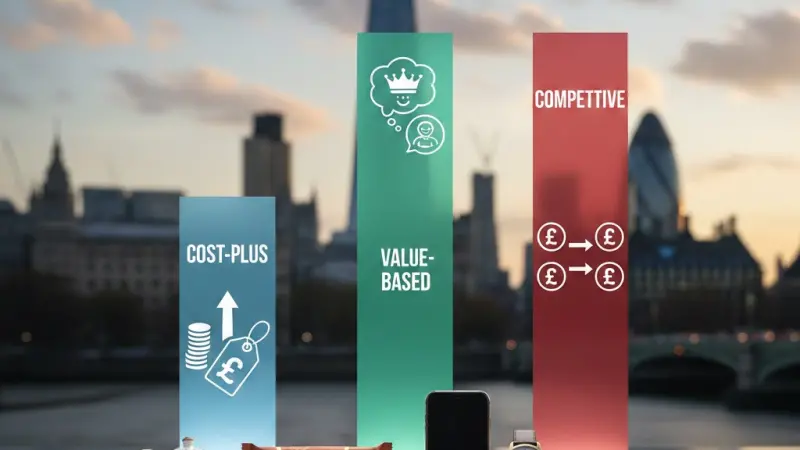
Competing solely on price is a dangerous strategy for SMEs. Large corporations have economies of scale that you cannot match. Instead, focus on "Value-Based Pricing." If your product is more durable, ethically sourced (certified by the UK B-Corp movement), or comes with superior local support, UK consumers are often willing to pay a premium.
Differentiating Through British Heritage
There is a documented "provenance premium" in the UK. Labelling products as "Made in Britain," "Welsh-grown," or "Scottish-crafted" can justify a 10-15% higher price point than generic imports, particularly in the gift and food sectors.
Psychological Pricing Tactics for British Consumers
The way a price is presented is often as important as the number itself. British consumer psychology has specific quirks that can be leveraged to increase conversion rates.
The Power of Charm Pricing and Thresholds
The "£9.99" effect remains potent. Even in 2026, consumers perceive a significant gap between £19.99 and £20.00. Use these thresholds to keep your product within specific search filters on UK marketplaces like Etsy, eBay, or your own Shopify store.
Tiered Pricing and the Decoy Effect
Providing three options—Basic, Standard, and Premium—is a proven method to guide customers toward your most profitable "Standard" option. By introducing a "Premium" tier that is significantly more expensive, the middle tier appears much more reasonable. This is highly effective for UK subscription services and professional consultancies.
Transparency and the "No Hidden Costs" Mandate
UK shoppers are increasingly sensitive to "drip pricing"—where fees are added at the end of the checkout process. Following updated ICO and CMA guidelines, businesses should endeavour to show the total price, including mandatory taxes and standard delivery, as early as possible to build trust.
Architect's Insight: In 2026, transparency is your best marketing tool. 68% of UK customers trust online reviews as much as personal recommendations; being honest about price increases caused by inflation or supply chain shifts actually builds brand loyalty amongst 54% of British consumers.
Regional Pricing Adjustments and Purchasing Power
The "United" Kingdom is an economy of many parts. A uniform pricing strategy may not be the most effective way to capture the entire market.
Adjusting for the North-South Divide
Disposable income levels vary. Whilst London and the South East account for 34% of the UK business population and have higher average salaries, operational costs are also peaked. Some businesses implement "Geographic Pricing," where services are priced differently based on the client's location. If you choose this, ensure your terms and conditions are clear to avoid appearing discriminatory.
Capitalising on Devolved Incentives
Wales and Scotland often offer specific incentives for businesses that contribute to the local economy. For instance, Business Wales provides mentorship for companies looking to export, which can help you price your products more competitively for international markets by reducing your local overheads through government-backed support.
Cross-Border Trade with Northern Ireland
If you are based in Great Britain and selling to Northern Ireland, you must navigate the evolving logistics of the Windsor Framework. Your pricing should reflect the administrative time required for declarations, even if the actual tariffs are avoided. Cross-border trade in NI is up 12% since 2024, representing a lucrative but complex opportunity.
Dynamic Pricing and Inflationary Pressures
Static pricing is a relic of the past. In the current era, your
ability to adjust prices in response to market shifts is essential.
Responding to 2025-2026 Inflation Trends
Whilst inflation has stabilised compared to the early 2020s, specific sectors—especially those reliant on imported components or high energy usage—still face volatility. Incorporate "Price Review" clauses in your long-term contracts. This is standard practice in the UK construction and trades sectors, which comprise over 385,000 businesses.
Using Technology for Dynamic Adjustments
Hospitality and retail premises (of which there are over 490,000 in the UK) are increasingly using dynamic pricing based on time of day or demand levels. Whilst common in travel, "Happy Hour" pricing or seasonal discounts in the hospitality sector must be handled carefully to maintain brand integrity.
Ethical Considerations in Dynamic Pricing
Avoid "surge pricing" during crises. British consumers have a strong sense of "fair play," and price-gouging during extreme weather or local emergencies can result in irreparable reputational damage and potential investigation by the FCA if financial services are involved.
Pricing for Digital and Physical Multi-Channel Retail
Most UK businesses now operate both online and in physical locations. Harmonising these prices is a significant challenge.
Bridging the Gap Between Online and In-Store
71% of UK adults use smartphones for local business searches. Often, a customer will stand in your shop in Edinburgh or Cardiff and check your website for a different price. Unless you have a compelling reason (like "Web-Only Specials"), keeping prices consistent across channels prevents customer frustration.
Factoring in Marketplace Commissions
If you sell through Amazon UK, Etsy, or Deliveroo, their commission (often 15-35%) must be factored in. Many UK businesses choose to price products slightly higher on these platforms while offering the "Best Price Guaranteed" on their own website to encourage direct sales and data ownership.
The Rise of Voice Search Pricing Queries
Voice search for "near me" and price-related queries increased by 43% last year. Ensure your website's meta descriptions and schema markup clearly state your price range or starting prices to capture this growing segment of the market.
Optimising for UK Voice Search
"Hey Siri, what's the average price for a plumber in Manchester?"
Answer: For trades in Northern England, transparency is key. Most professional plumbers now list their 'call-out' and 'hourly rates' clearly on their websites to ensure they appear in voice search results for local pricing queries.
"Alexa, how much should I pay for a custom wedding cake in Glasgow?"
Answer: High-end bakeries in Scotland often use 'Starting from' pricing in their meta tags, which
helps voice assistants provide an immediate answer while allowing for bespoke quotes later.
Building a Long-Term Pricing Roadmap
Pricing is not a "set and forget" task. It requires annual, or even quarterly, reviews based on the health of the UK economy.
Reviewing Performance Against Key KPIs
Monitor your Gross Profit Margin and your Customer Acquisition Cost (CAC). If your CAC is rising—as it has for 22% of professional services firms recently—your prices may need to rise to maintain the same level of service quality.
Communicating Price Changes to Your Customers
When you must raise prices, do so with clarity. Explain the 'why'—whether it’s a commitment to paying the Real Living Wage or an investment in more sustainable British packaging. UK consumers generally respect honesty over silent, hidden increases.
The Role of the Federation of Small Businesses (FSB)
Membership bodies like the FSB or the British Chambers of Commerce offer resources and legal hubs that can help you benchmark your costs and ensure your pricing contracts are legally sound across all UK jurisdictions.
£2.3tn The total annual turnover contributed by small businesses to the UK economy, highlighting the aggregate power of correct pricing at the micro level.
Frequently Asked Questions
Should I include VAT in my advertised prices?
In the UK, if you are selling to individual consumers (B2C), you must legally show the price including VAT. However, if your primary audience is other businesses (B2B), it is standard practice to show prices excluding VAT, provided you clearly state 'plus VAT' alongside the figure. Always check the latest CMA guidelines to ensure your advertising is compliant.
Is it better to have a low price or a premium brand in the UK?
With 99.3% of UK businesses being SMEs, competing on 'lowest price' against global giants is rarely sustainable. In 2026, the trend is moving toward 'Value-Based Pricing'. UK consumers are increasingly prioritising quality, ethical sourcing, and local support over the absolute lowest price, provided the value is clearly communicated.
How do I handle shipping costs for the Highlands and Islands?
Standardizing 'UK-wide' delivery is a popular marketing tool, but it requires your product price to absorb higher costs for the Scottish Highlands and Northern Ireland. Alternatively, you can implement 'Zone-Based Shipping'. Transparency is vital; ensure any regional surcharges are clearly stated before the checkout stage to avoid 'cart abandonment' and potential Trading Standards issues.
Can I charge more in London than in the North of England?
Yes, 'Geographic Pricing' is legal and common for service-based businesses like trades and consulting. It reflects the higher cost of doing business (rents, wages, transport) in the capital. However, if you sell physical goods online, price discrepancies based on location can be harder to justify to consumers and may impact brand trust.
How often should I review my product prices?
In the current 2025-2026 economic climate, an annual review is the bare minimum. Many successful UK retailers now conduct quarterly 'health checks' to monitor raw material inflation and energy costs. If your margins drop by more than 5%, it is usually time to re-evaluate your pricing structure.
Do I need an accountant to set my prices?
While you can set prices yourself, an accountant can provide a 'break-even analysis' that is invaluable. They factor in corporation tax, capital allowances, and VAT implications that you might miss. For businesses in Wales or Scotland, local accountants may also be aware of specific regional grants that affect your overheads.
What is the 'Psychological Threshold' for UK shoppers?
British shoppers are highly sensitive to round numbers. Prices ending in .95 or .99 are perceived as significantly lower. Additionally, £10, £20, £50, and £100 are major psychological barriers. Keeping a product at £49.50 instead of £51.00 can often lead to a disproportionately higher volume of sales.
Are there specific rules for pricing 'Sales' and 'Discounts'?
Yes, the UK has strict 'Pricing Practices' guidelines. You cannot claim a 'discount' unless the product was sold at the higher price for a meaningful period (usually 28 consecutive days). Misleading consumers about savings can lead to heavy fines from Trading Standards or the CMA.
How does the Northern Ireland Protocol affect my pricing?
Under the Windsor Framework, goods moving from GB to NI may require additional paperwork and declarations. Even if no duty is paid, the administrative time (or the cost of a customs agent) increases your COGS.
Many UK businesses add a small 'administrative fee' or slightly higher base price for NI deliveries to cover these costs.
Should I show my prices on my website if I do bespoke work?
For professional services, 'Prices from £X' or 'Average project cost £Y' is highly recommended. 76% of UK consumers research online first; if your website has no pricing information at all, many will assume you are too expensive and move to a competitor who provides a ballpark figure.
Disclaimer: The information provided in this article is for general informational and research purposes only. Company details, features, services, and market positions may change over time. Readers are advised to visit official company websites and conduct independent research before making any business decisions or purchasing services.
Most Searchable Keywords
Recent Blogs


Related Listings
Categories
- Accountants (295)
- Advertising Agencies (559)
- Architects (149)
- Automobiles (377)
- Beauty (300)
- Carpenters (146)
- Cleaning Services (387)
- Dentists (189)
- Driving (62)
- Electricians (215)
- Energy (8)
- Event Organiser (686)
- Finance (602)
- Guide (3372)
- Health (2207)
- Information technology (206)
- Legal Services (353)
- Logistics (6)
- Maintenance (65)
- Manufacturing (35)
Sponsored Listings in Travel Agencies


Related Blogs

How Much Do UK Actors Really Earn Full Indust...
Read this insightful article "How Much Do UK Actors Really Earn Full Industry Breakdown" to expand your knowledge!

Blue Light Card UK 2026 Check Eligibility and...
Read this insightful article "Blue Light Card UK 2026 Check Eligibility and Claim" to expand your knowledge!

BBC Radio 1 DJs Net Worth Ranking Revealed
Read this insightful article "BBC Radio 1 DJs Net Worth Ranking Revealed" to expand your knowledge!
Questions & Answers – Find What
You Need, Instantly!
How can I update my business listing?
Is it free to manage my business listing?
How long does it take for my updates to reflect?
Why is it important to keep my listing updated?
