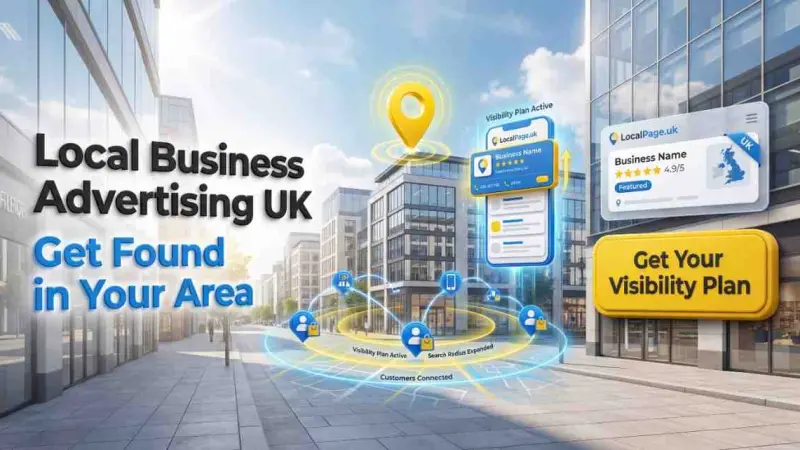
Local business advertising UK strategies have undergone a fundamental transformation over the last half-decade. What was once a landscape dominated by print directories and broad-spectrum radio spots has evolved into a precision-driven digital ecosystem. As we look towards the end of 2026, the imperative for small and medium-sized enterprises (SMEs) is not merely to exist online, but to dominate the specific geographies where they operate. This analysis explores the mechanics of modern local advertising, the behavioural shifts of UK consumers, and the structural frameworks required to achieve visibility.

The current UK market presents a paradox: consumers have more choices than ever, yet they increasingly rely on narrow search parameters to find them. When a resident of Manchester searches for "emergency plumbing," they are not browsing the internet at large; they are scanning a hyper-local radius. For businesses, this means that visibility is no longer about being everywhere—it is about being exactly where the customer is looking. This guide dissects the components of successful visibility, from the foundational UK Online Business Directory presence to sophisticated sponsored campaigns.
The Landscape of Local Business Advertising UK in 2026
To understand the current environment, one must recognise the decline of broad "interruption" advertising. The modern consumer filters out noise. They use ad-blockers, skip video pre-rolls, and ignore banner blindness. However, they welcome "discovery" advertising—information that arrives precisely when a need is identified. In the UK, the transition to mobile-first search has cemented this behaviour. Over 70% of local searches now result in a visit or a phone call within 24 hours.
This high-intent traffic is the holy grail of local business advertising UK. Unlike brand advertising, which builds affinity over years, local advertising seeks to capture immediate demand. The shift has forced a move away from generic listings towards verified, rich-media profiles. Today, a business without a verified digital footprint is functionally invisible to a significant portion of its potential market.
Search Behaviour Insights and Intent Classification
Understanding the "why" behind a search is as critical as the "what." Search engines have become adept at classifying intent into four primary buckets: informational, navigational, commercial investigation, and transactional. For local advertisers, the latter two are paramount.
When a user searches "best coffee shop near me," they are in the commercial investigation phase. They are weighing options. Here, factors like reviews, photos, and ratings become the deciding currency. Conversely, a search for "book table at Italian restaurant London" is transactional. The user has decided; they just need the mechanism to act. A robust Local Business Listings UK strategy addresses both stages: providing the social proof required for investigation and the direct contact details required for the transaction.
Voice search has further nuanced this landscape. Queries are becoming conversational and long-tail. "Where can I find a reliable locksmith in Leeds?" replaces the stilted "locksmith Leeds." This shift necessitates a content strategy that answers questions naturally, mirroring the human voice. Businesses that optimise for these conversational queries—often found in FAQ sections—are capturing a growing segment of the market.
- Local advertising has shifted from interruption-based to discovery-based models.
- High-intent mobile searches drive immediate offline actions.
- Understanding user intent (investigation vs. transaction) dictates the advertising approach.
- Voice search is changing keyword strategies towards natural, question-based phrases.
Why Many Online Directories Struggle to Deliver Value
Despite the clear need for digital visibility, many businesses report mixed results from online directories. An analysis of the sector reveals that not all platforms are created equal. A significant portion of lower-tier directories suffer from structural deficiencies that render them ineffective for local business advertising UK.
The primary failure point is User Experience (UX). Many directories are cluttered, outdated, or difficult to navigate on mobile devices. If a potential customer clicks a link and encounters a slow-loading site or a confusing layout, the bounce rate is almost instantaneous. Secondly, verification standards vary wildly. Directories that allow unverified listings to propagate often suffer from spam, which erodes user trust. If a consumer finds fake numbers or closed businesses, they abandon the platform entirely.
Furthermore, weak SEO structure limits the visibility of the directory itself. If the directory does not rank well on Google, the listings within it remain hidden. The most effective platforms are those that act as authority hubs, leveraging strong domain authority to push individual business profiles to the top of search results. Finally, a lack of trust signals—such as visible verification badges, review integration, and responsive customer support—creates a gap between the user and the business.
The Technical Framework of Visibility
Successful visibility is not accidental; it is engineered. The technical foundation of any local strategy is the "NAP" consistency: Name, Address, and Phone number.
Search engines cross-reference these data points across the web to verify legitimacy. Inconsistent data acts as a trust signal dampener, causing rankings to drop.
Beyond NAP, the modern framework requires structured data markup (Schema). This code helps search engines understand the context of a business—is it a bakery? A law firm? A retail store? Implementing LocalBusiness schema allows for rich snippets in search results, displaying hours of operation and pricing directly in the search results page. For those looking to secure a business listing uk, ensuring the underlying data is structured correctly is the difference between a passive listing and an active lead generator.
Another critical technical pillar is the citation ecosystem. A business must be listed across relevant industry-specific directories and general platforms. However, quality trumps quantity. Ten high-authority citations are worth significantly more than a hundred low-quality spam links. The algorithm prefers a natural link profile that suggests genuine community engagement.
Strategic Comparison: Organic vs. Sponsored
The debate between organic growth and paid placement is ongoing, but in the context of local business advertising UK, the two are symbiotic. Organic local SEO is the long game. It involves review acquisition, content creation, and citation building. It builds equity that persists even if ad spend is paused.
Sponsored visibility, conversely, is the accelerant. It bypasses the queue. Platforms offering Business advertising UK solutions allow businesses to secure premium placement—positions at the top of a category or a featured spot on a homepage. This is particularly effective for new businesses entering a competitive market or seasonal businesses (e.g., HVAC) that need to capture demand immediately.
If you’re wondering whether to invest in organic or sponsored, the answer is rarely binary. A strategic approach uses sponsored visibility to generate immediate cash flow while the organic profile matures. Over time, as the organic ranking improves, the reliance on paid spend can be scaled back, creating a more efficient cost-per-acquisition (CPA).
Case Study: The 'Service-First' Approach
Consider a mid-sized plumbing firm in Birmingham operating in a saturated market. Initially, they relied solely on word-of-mouth. While steady, this growth was slow and geographically limited. By shifting to a data-led strategy—optimising their UK Local Business Search profile with verified credentials and customer photos—they saw a 20% increase in inquiry calls within three months.
The turning point, however, was the integration of a targeted visibility campaign during the winter freeze. By positioning themselves as "Emergency Response Verified" in a prominent directory slot, they captured high-intent traffic that competitors missed. The key was not just the ad, but the reputation management that preceded it. The ad delivered the click; the reviews closed the sale. This illustrates that advertising cannot fix a bad reputation, but it can amplify a good one.
Implementation Guide for 2026
For businesses ready to implement these strategies, a systematic approach is required.
Step 1: Audit and Cleanse
Before building, one must repair. Conduct a full audit of existing listings. Ensure the
NAP is identical across every platform. Close down duplicate listings that fragment reviews.
Step 2: Claim and Verify
Claim the business profile on major high-authorinity sites. Verification is the gatekeeper to trust; it unlocks features like review management and post updates. Utilise a business listing uk where available to test the waters of a platform before committing to spend.
Step 3: Optimise for Conversion
A profile is a landing page. It must have high-resolution images, a detailed description with keywords, and direct action buttons (Call, Directions, Website). Incomplete profiles signal low effort to both users and algorithms.
Step 4: Layer Sponsored Visibility
Once the foundation is solid, introduce budgeted visibility. Start small, measure the click-through rate (CTR) and conversion rate. If the acquisition cost is viable, scale. For comprehensive Business advertising packages UK, look for options that offer both exposure and analytics.
- Technical foundations like NAP consistency and Schema are non-negotiable.
- Organic and Sponsored strategies work best when integrated, not isolated.
- Reputation management (reviews) is the fuel that makes advertising effective.
- Implementation requires a phased approach: Audit, Claim, Optimise, then Advertise.
Future Outlook: AI and Automation
Looking forward, artificial intelligence will play a larger role in local business advertising UK. AI-driven tools will likely automate bid management for local ads and even generate responses to reviews. Furthermore, the rise of "Generative Search" in engines means that businesses will need to be cited in the data sources that AI uses to answer questions.
The "near me" phenomenon will evolve into "for me" personalisation. Search results will increasingly be tailored not just by location, but by past behaviour and stated preferences. In this environment, the quality of data attached to a business listing will become the primary differentiator.
Sponsored Visibility Packages
Strategic visibility enhancement within the Business advertising UK ecosystem . Built to increase discovery, trust, and lead generation across UK business searches.
Monetisation and Value Expansion
While visibility is the primary goal, strategic advertising also opens avenues for brand positioning. By associating with high-quality platforms, a business borrows authority. This is particularly relevant for UK Verified Business Listings, where the verification badge acts as a trust signal similar to a "Check Mark" on social media.
For businesses looking to expand, advertising packages can often be scaled. If you're planning multi-channel visibility, combining structured listing with promotional positioning often produces stronger discoverability.
This might involve integrating press releases or event postings to capture seasonal traffic spikes. For example, a Event Posting strategy can drive local footfall during specific holiday periods, complementing the always-on nature of directory listings.
Final Thoughts
The era of passive local marketing is over. The UK market in 2026 demands active, data-informed participation. Local business advertising UK is no longer a choice of "if" but "how." The businesses that will thrive are those that view their digital presence not as a static brochure, but as a dynamic asset.
By building a foundation of accurate data, layering in social proof through reviews, and judiciously using sponsored visibility to cut through noise, SMEs can secure a defensive moat around their local market. The tools and platforms exist; the differentiator is the strategic rigour with which they are applied. As search algorithms become more sophisticated and user expectations rise, the gap between those who optimise and those who do not will widen significantly. The strategic imperative is clear: establish authority, ensure visibility, and maintain consistency.
Frequently Asked Questions
Q1: What is the primary goal of local business advertising UK?
Here’s the short answer: the primary goal is to capture high-intent customers searching for products or services within a specific geographic radius. Unlike brand advertising, which aims for broad awareness, local advertising focuses on immediate discovery and conversion. It bridges the gap between a user's query and a business's solution, driving foot traffic, phone calls, and website visits from the surrounding community. In the UK, this is increasingly vital as consumers rely on mobile searches to make immediate purchasing decisions.
Q2: How does a UK online business directory improve SEO?
In simple terms: it acts as a vote of confidence. When a business is listed in a reputable directory, it creates a "citation"—a mention of the business's Name, Address, and Phone number (NAP). Search engines like Google cross-reference these citations across the web to verify the legitimacy and accuracy of a business. If the information is consistent across multiple trusted platforms, the search engine gains confidence in the business's existence and location, which can positively improve its ranking in local search results (Map Pack). Furthermore, directories often provide backlinks, which pass authority (link equity) to the business's website.
Q3: Are free business listing sites in the UK effective?
The quick explanation is: they are effective for foundational visibility, but limited in reach. A business listing uk provides a necessary base level of presence, ensuring that a business can be found in basic searches. However, free listings often lack premium features such as priority placement, advanced analytics, or the ability to post rich media like videos and detailed photo galleries. For a new business with no budget, they are an excellent starting point. However, for businesses looking to outrank competitors in crowded sectors, free listings usually need to be supplemented with paid visibility strategies to achieve top-tier exposure.
Q4: What distinguishes sponsored visibility from standard listings?
If you’re wondering whether to pay for placement, consider the mechanics of visibility. A standard listing relies on the user finding it through organic search or category browsing; its position is determined by algorithms or alphabetical order. Sponsored visibility, such as Sponsored business advertising UK, guarantees placement. It ensures that a business appears at the top of relevant searches, on homepages, or in prominent "featured" slots. This paid priority is crucial for new entrants in a market or for seasonal campaigns where immediate visibility is more valuable than organic growth. It buys the traffic that organic SEO might take months to build.
Q5: How can I measure the ROI of local advertising?
Measurement in the modern era is highly precise. Unlike print ads, where attribution is guesswork, digital local advertising offers granular data. Metrics to watch include: Click-Through Rate (CTR), which measures how often people see the ad and click; Call Tracking, which records the number of calls generated from a specific listing; and Website Referral Traffic, which shows how many visitors arrived via the directory. For physical stores, unique coupon codes or "mention this ad" promotions can track in-store conversions. By comparing the cost of the advertising package against the lifetime value of the customers acquired, businesses can calculate a clear Return on Investment.
Q6: Why is verification important for local business listings?
Verification is the digital equivalent of checking an ID. It proves to the platform and its users that the business is legitimate, operational, and located where it claims to be. UK Verified Business Listings are prioritized by algorithms because they reduce the risk of spam and fraud. For users, seeing a "Verified" badge increases trust, making them significantly more likely to click or contact the business. Unverified listings are often viewed with skepticism, as they could be outdated or even fraudulent. Therefore, completing the verification process (usually via phone or postcard) is a critical step for any serious advertising strategy.
Q7: Can local advertising help with national brand awareness?
While the primary function of local advertising is geographic targeting, it does contribute to broader brand equity. A business that consistently appears in local searches across multiple regions (e.g., London, Manchester, Birmingham) builds a pervasive brand presence. This "ubiquity effect" creates a sense of scale and reliability. When a consumer encounters the brand repeatedly in different trusted contexts, brand recognition increases. Furthermore, local listings often rank very highly for specific service terms, meaning a national brand can dominate the search results page through a network of strong local profiles rather than just a single corporate website.