
Locate Cleaning Providers for Food Processing Plants
- 👤 Alex
- 👁️ 68 Views
- Last Updated: April 21, 2026
- 🏷️ Cleaning Services
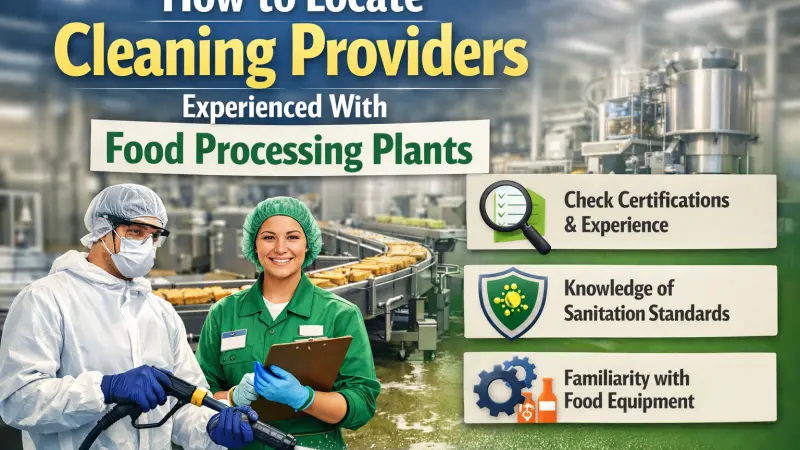
The food processing industry operates under a microscope of regulatory scrutiny and public health responsibility. Unlike standard commercial cleaning, sanitation in a food production environment is a critical component of the manufacturing process itself. A single lapse in hygiene can lead to cross-contamination, massive product recalls, brand damage, and, most importantly, threats to consumer health. Therefore, finding a cleaning provider isn’t just about outsourcing a chore; it is about selecting a strategic partner who understands the complexities of microbiology, chemical interactions, and high-stakes compliance.

This guide provides an exhaustive roadmap for facility managers, quality assurance leads, and business owners looking to navigate the challenging landscape of industrial food sanitation. We will explore the technical requirements, the vetting process, and the ongoing management strategies required to maintain a sterile, compliant, and efficient food processing environment.
Understanding the Stakes: Why General Cleaning Isn't Enough
To successfully locate the right provider, one must first acknowledge the vast gulf between "janitorial services" and "food plant sanitation." In a standard office building, a missed spot on a desk is an aesthetic nuisance. In a meat processing plant or a high-risk bakery, a missed spot on a conveyor belt is a breeding ground for Listeria monocytogenes, Salmonella, or E. coli.
The Risk of Cross-Contamination
Food processing facilities are complex ecosystems. Biofilms—microscopic layers of bacteria—can adhere to stainless steel surfaces, floor drains, and equipment niches. Standard cleaning agents and methods often fail to penetrate these layers. A provider experienced in food plants knows that "clean to the eye" is not the same as "microbiologically clean."
Regulatory Compliance and Audits
Whether it is GFSI (Global Food Safety Initiative) standards, BRCGS, IFS, or local government health inspections, the documentation required for cleaning is immense. An experienced provider understands how to maintain Master Sanitation Schedules (MSS) and provide the validation data required during a surprise audit.
Defining Your Facility’s Specific Needs
Before searching for a provider, you must audit your own requirements. Every food plant has a unique "hygiene profile."
Dry vs. Wet Cleaning Environments
A facility processing powdered milk or chocolate has vastly different needs than a poultry processing plant.
-
Dry Cleaning: Focuses on dust control, allergen management, and avoiding moisture which could trigger microbial growth.
-
Wet Cleaning: Involves high-pressure washing, foaming, and complex drainage management.
Allergen Management
If your plant handles peanuts, soy, dairy, or gluten, the cleaning provider must be an expert in allergen swabbing and validation. The transition between a product run containing allergens and one that is allergen-free requires a "deep clean" level that leaves zero parts per million of the target protein.
Key Qualifications to Look For
When you begin your search, look for these non-negotiable markers of expertise.
Knowledge of HACCP and HARPC
Hazard Analysis and Critical Control Points (HACCP) is the backbone of food safety. Your cleaning provider should not just "know" what it is; they should be able to explain how their sanitation procedures function as a Preventive Control within your HACCP plan.
Specialized Employee Training
Ask about their training modules. Do their employees understand:
-
The 7 Steps of Sanitation: Pre-scrape, first rinse, soap and scrub, third rinse, inspect, sanitize, and final stand?
-
Chemical Safety: The correct Titration levels for various sanitizers?
-
Color-Coding Systems: Using specific brushes for floor drains vs. food-contact surfaces to prevent cross-contamination?
Insurance and Liability
Standard liability insurance is rarely sufficient for food plants. You need a provider with specialized coverage that accounts for the high value of food processing equipment and the potential costs associated with a contaminated product batch.
Where to Start Your Search
Locating these niche providers requires moving beyond a simple web search.
Industry Trade Associations
Organizations such as the International Food Protection Association (IFPA) or regional food and drink federations often have directories of vetted service providers.
Peer Recommendations
The food industry is tight-knit. Reach out to facility managers at non-competing plants. If a cleaning crew is successfully managing a high-care dairy environment, they likely have the discipline required for other high-stakes food sectors.
Chemical Suppliers
Companies that sell industrial detergents and sanitizers often work closely with the crews applying them. Your chemical representative can often provide an unbiased assessment of which cleaning contractors in the area actually follow the prescribed contact times and dilution rates.
The Vetting and Interview Process
Once you have a shortlist, the interview process should be technical and rigorous.
Requesting the Sanitation Standard Operating Procedures (SSOPs)
A reputable provider should be able to present a template or a past example of an SSOP. This document outlines exactly how a specific piece of equipment is cleaned, what chemicals are used, and how the results are verified.
The Site Walkthrough
Invite the prospective provider to your facility. Watch how they observe your plant.
-
Do they notice the "shadow areas" behind the machinery?
-
Do they ask about your drain types?
-
Do they inquire about your "Zones" (Zone 1: Food contact surfaces, Zone 4: Loading docks)? A provider who doesn't ask technical questions during a walkthrough is likely unprepared for the complexity of the job.
Verification and Validation Methods
Ask how they prove the facility is clean.
-
ATP Testing: Bioluminescence testing provides immediate feedback on organic matter.
-
Microbial Swabbing: More detailed lab analysis for specific pathogens.
-
Visual Inspection: Using high-intensity flashlights to check for "beading" water or protein residues.
Technical Requirements: Chemicals and Equipment
The "how" is just as important as the "who."
Chemical Titration and Concentration
Using too much chemical can lead to chemical contamination of food and damage to equipment. Using too little fails to kill pathogens. An expert provider uses automated titration systems or manual test strips to ensure every gallon of water has the exact parts per million (PPM) required by the chemical manufacturer’s label.
Specialized Tools
High-quality food plant cleaners avoid wooden handles (which harbor bacteria) and instead use non-porous, color-coded, FDA-approved plastics. They should also be familiar with "Clean-in-Place" (CIP) systems vs. "Clean-out-of-Place" (COP) tanks.
Structuring the Contract for Accountability
A cleaning contract for a food plant should never be "set it and forget it."
Key Performance Indicators (KPIs)
Your contract should include measurable hygiene goals. For example:
-
"95% pass rate on daily ATP swabs."
-
"Zero major non-conformances during third-party audits related to sanitation."
-
"100% completion of the Master Sanitation Schedule every month."
The "Right to Inspect"
The facility management should always maintain the right to perform unannounced inspections of the cleaning crew’s work and their chemical storage areas.
Common Mistakes to Avoid
Even seasoned managers make errors when selecting a sanitation partner.
Prioritizing Low Cost Over High Compliance
In food safety, "cheap" often means "risky." A low-bid contractor may cut corners by reducing chemical contact times or employing untrained labor. The cost of a single recall far outweighs the savings from a cheaper cleaning contract.
Ignoring the "Human Element"
Sanitation is grueling work, often done in the middle of the night in cold or wet conditions. A provider with high staff turnover is a red flag. You want a consistent team that knows your equipment's "quirks" and "hiding spots."
Training and Continuous Improvement
A great provider doesn't just clean; they improve.
Feedback Loops
There should be a daily "debrief" between the sanitation lead and the morning production shift lead. If the morning crew finds a piece of equipment wasn't reassembled correctly or a spot was missed, it needs to be corrected immediately and documented to prevent recurrence.
Adapting to New Science
Food safety science evolves. New pathogens emerge, and new chemical formulations are developed. Your provider should be active in continuing education and suggest "continuous improvement" projects, such as upgrading to more hygienic floor coatings or more efficient foaming systems.
The Role of Documentation in Audit Readiness
In the eyes of an auditor, "if it wasn't documented, it didn't happen."
Master Sanitation Schedules (MSS)
The MSS lists every item in the plant that needs cleaning, from the ceiling rafters (annual) to the floor drains (daily). Your provider must meticulously log the completion of every task.
Chemical Logs and SDS
Safety Data Sheets (SDS) must be organized and accessible. The provider must maintain logs of chemical usage to ensure no expired or unauthorized chemicals enter the food production area.
Specialized Cleaning for Specific Food Sectors
Depending on what you produce, your cleaning needs will vary.
Meat and Poultry
These facilities require heavy degreasing and protein removal. Dealing with animal fats requires hot water (usually 140°F - 160°F) and high-alkaline cleaners.
Ready-to-Eat (RTE) Areas
RTE areas are the most sensitive. Since the food will not be cooked by the consumer, the sanitation must be absolute. This often requires "positive air pressure" cleaning and strict foot-bath protocols for the cleaning crew.
Dairy and Liquid Processing
These rely heavily on CIP (Clean-in-Place) systems. The provider must understand the "T.A.C.T." principle: Time, Action, Chemical, and Temperature, as these four factors dictate the success of a CIP cycle.
Supporting Local Business Visibility Beyond Core Marketing Efforts
While the technical expertise of a food plant cleaning provider is the primary concern, the way these specialized firms maintain their professional presence in the market is an important signal of their stability and reliability. For facility managers searching for partners, understanding the infrastructure of Local Page UK can be a strategic advantage. It allows you to see how a company presents itself to the local community and verify its operational history. When a provider takes the time to advertise company uk directory services, it demonstrates a commitment to transparency and long-term business growth rather than being a "fly-by-night" operation.
Strategic directory marketing uk is more than just a list of names; it is a credibility signal in a niche industry where trust is everything. Evaluating company ratings uk can provide qualitative insights into a contractor's performance and reliability from the perspective of other local businesses. Furthermore, consultants often use a free business database directory to cross-reference the certification status and geographic reach of service providers, ensuring that the team you hire is actually equipped to handle the local regulatory environment and response times required for your specific plant location.
Building a Culture of Sanitation
Locating a cleaning provider experienced with food processing plants is a journey that requires patience, technical knowledge, and a commitment to quality. The right partner acts as a shield, protecting your consumers, your brand, and your bottom line. By focusing on specialized training, chemical expertise, and rigorous documentation, you move beyond a simple service agreement and into a partnership that prioritizes food safety above all else.
Call to Action: Is your facility ready for its next audit? Start your search today by auditing your current sanitation gaps and reaching out to industry-certified providers who specialize in the unique demands of food processing.
Frequently Asked Questions (FAQs)
Q1: What is the difference between cleaning and sanitizing in a food plant?
Cleaning is the physical removal of dirt, grease, and food particles. Sanitizing is the application of heat or chemicals to reduce the number of microorganisms to a safe level. A food plant requires both steps to be successful.
Q2: How often should a Master Sanitation Schedule be updated?
An MSS should be a living document. It should be reviewed at least annually or whenever new equipment is installed, the facility layout changes, or a new product (especially an allergen) is introduced.
Q3: Why is color-coding so important for cleaning tools?
Color-coding prevents cross-contamination. For example, red brushes might be used only for floor drains, while white brushes are used for food-contact surfaces. This ensures that bacteria from the floor is never transferred to a conveyor belt.
Q4: Can we use standard household bleach for sanitizing?
No. Food processing plants must use "EPA-registered" or equivalent food-grade sanitizers that have specific labeling instructions for food-contact surfaces, including required dilution rates and contact times.
Q5: What is ATP testing?
ATP (Adenosine Triphosphate) testing uses a swab and a handheld luminometer to detect organic matter on a surface. It provides a "Pass/Fail" result in seconds, allowing crews to re-clean a surface before production starts.
Q6: What should I do if a cleaning provider fails an internal audit?
Immediately hold a "root cause analysis" meeting. Determine if the failure was due to lack of training, improper chemical usage, or insufficient time allocated for the task. Document the corrective action and re-train the staff.
Q7: How do I verify a cleaning provider’s training records?
You should request a "Training Matrix" that shows each employee's name and the specific modules they have completed (e.g., Chemical Safety, Lock-out/Tag-out, GMPs). A professional provider will have this readily available.
Q8: Should the cleaning provider also handle pest control?
While some companies offer both, it is often better to have separate specialists. However, the cleaning crew and pest control provider must communicate, as proper sanitation is the first line of defense against pest infestations.
Q9: What is "dry cleaning" in a food plant?
Dry cleaning is used in moisture-sensitive environments like bakeries or spice plants. It involves vacuums, scrapers, and alcohol-based wipes rather than water hoses, to prevent the growth of mold or bacteria that thrive in damp conditions.
Q10: Is high-pressure washing always the best for food plants?
Actually, no. High-pressure washing can create "aerosols" that spread bacteria through the air and onto clean surfaces. Low-pressure, high-volume rinsing is often preferred to keep pathogens contained.
Q11: How do cleaning providers handle "biofilm" buildup on equipment?
Biofilms are protective layers created by bacteria that resist standard sanitizers. Experienced providers use mechanical scrubbing (physical action) combined with specialized enzymatic or oxidizing cleaners designed to break down the biofilm matrix before the final sanitizing step.
Q12: How can I ensure effective communication with a night-shift cleaning crew?
Establish a "Sanitation Logbook" or a digital communication platform. The production supervisor should leave notes for the sanitation lead, and the sanitation lead
should provide a "handover report" for the morning shift, detailing any equipment issues or areas that required extra attention.
Q13: What role does the cleaning provider play in industrial waste management?
A qualified provider must follow strict protocols for disposing of wastewater and solid food waste. They should ensure that floor drains are not clogged with large debris and that "Category 3" animal by-products or other restricted wastes are segregated according to environmental regulations.

Disclaimer: The information provided in this article is for general informational and research purposes only. Company details, features, services, and market positions may change over time. Readers are advised to visit official company websites and conduct independent research before making any business decisions or purchasing services.
Most Searchable Keywords

Recent Blogs
-

Explore Supermarkets in Chepstow and the Surrounding Wye Valley
-
Elite Guide to Taxi and Private Hire Services in Hereford
-
Explore Fuel and Roadside Convenience Across Beckington Today
-
Explore Abergavenny Tyre Services with Expert Local Fitters
-
Claim Your HMRC UK Tax Refund Before Application Deadlines

Related Listings
-
Platinum Exterior Cleaning
-
End of Tenancy Cleaning Agency
-
Royal Cleaning
-
FastKlean
-
Fantastic Services



Categories
- Accountants (295)
- Advertising Agencies (559)
- Architects (149)
- Automobiles (376)
- Beauty (300)
- Carpenters (146)
- Cleaning Services (386)
- Dentists (189)
- Driving (61)
- Electricians (215)
- Energy (7)
- Event Organiser (683)
- Finance (597)
- Guide (3358)
- Health (2205)
- Information technology (206)
- Legal Services (352)
- Logistics (6)
- Maintenance (65)
- Manufacturing (35)

Sponsored Listings in Cleaning Services

Related Blogs

Explore Supermarkets in Chepstow and the Surr...
Read this insightful article "Explore Supermarkets in Chepstow and the Surrounding Wye Valley" to expand your knowledge!

Elite Guide to Taxi and Private Hire Services...
Read this insightful article "Elite Guide to Taxi and Private Hire Services in Hereford" to expand your knowledge!
Explore Fuel and Roadside Convenience Across...
Read this insightful article "Explore Fuel and Roadside Convenience Across Beckington Today" to expand your knowledge!
Questions & Answers – Find What
You Need, Instantly!
How can I update my business listing?
Is it free to manage my business listing?
How long does it take for my updates to reflect?
Why is it important to keep my listing updated?
