
Outcome Based Leadership Ditch Hours and Measure Real Results
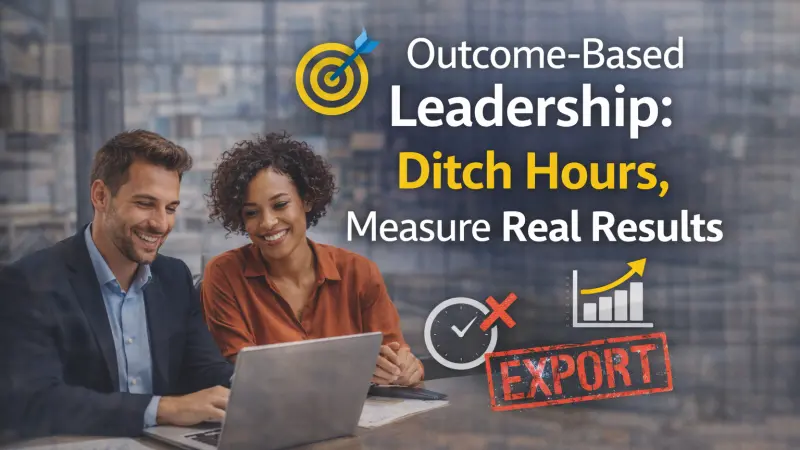
The traditional 40-hour workweek was designed for factory floors, not knowledge workers. Today, outcome based performance management is reshaping how forward-thinking leaders define success. Instead of tracking how long someone sits at a desk, it focuses on what they actually deliver. And that shift is changing everything — from how teams are managed to how businesses grow.
If you're still measuring performance by hours logged, you may be missing the full picture of your team's potential.
Why the 40-Hour Workweek No Longer Tells the Whole Story
For decades, time was the default metric for productivity. Show up, clock in, stay until 5 PM — that was "good work." But the modern workforce has outgrown this model.
According to a Microsoft Workplace Trends report, 87% of employees say they are productive at work, while only 12% of leaders feel confident their teams are actually delivering results. That gap is significant. It suggests that measuring time and measuring output are two entirely different things.
Remote work accelerated this problem. When employees moved home in 2020, managers could no longer see who was "at their desk." Businesses that had no outcome-based framework struggled to assess performance at all.
The bottom line: hours are an input. Results are the output. Outcome-based leadership focuses on what actually matters.
What Is Outcome-Based Performance Management?
Outcome based performance management is a strategic framework that evaluates employees based on the results they produce, not the time they spend producing them. It replaces vague metrics like "attendance" and "effort" with clear, measurable goals tied to business objectives.
Think of it this way: instead of asking "Did you work 8 hours today?" a results-driven manager asks "Did you complete the deliverable that moves our goal forward?"
Core components of this approach include:
- Clearly defined goals and key results (OKRs)
- Regular check-ins focused on progress, not presence
- Transparent performance benchmarks
- Continuous feedback loops rather than annual reviews
- Accountability tied to outcomes, not activities
This model draws from management frameworks like OKRs (Objectives and Key Results), popularized by Google, and MBO (Management by Objectives), introduced by Peter Drucker decades ago. Both share the same philosophy: align individual effort with organizational outcomes.
Why This Model Matters More Than Ever
The Remote and Hybrid Work Reality
Stanford economist Nicholas Bloom found that remote workers are 13% more productive than their office counterparts — but only when managed with clear expectations and outcome-based goals. Without that structure, productivity drops and disengagement rises.
With 58% of the American workforce now working remotely or in hybrid arrangements at least part of the week (Gallup, 2023), leaders need a management system that works regardless of location. Outcome-based performance management is built precisely for this reality.
The Engagement Crisis
Gallup's State of the Global Workplace report found that only 23% of employees worldwide are actively engaged at work. Disengagement costs the global economy an estimated $8.8 trillion annually. One of the top drivers of disengagement? Employees don't know what's expected of them.
Outcome-based models fix this by creating radical clarity. When people know exactly what they're working toward and how success is measured, motivation naturally improves.
The Talent Retention Factor
A 2023 LinkedIn Workforce Report found that employees who feel their work is meaningful and measured fairly are 3.5 times more likely to stay with their employer.
Outcome-based leadership creates the kind of environment where high performers thrive, because results — not office politics or face time — determine advancement.
Key Benefits of Outcome-Based Leadership
Switching to this model offers real advantages for both leaders and employees.
For organizations:
- Stronger alignment between individual work and company strategy
- Better resource allocation based on actual performance data
- Higher accountability across all levels of the business
- More agile teams that adapt to change without micromanagement
For employees:
- Greater autonomy and trust
- Clearer understanding of how their work contributes to the bigger picture
- More flexibility in how and when they work
- Recognition based on actual contribution, not visibility
Research from Deloitte shows that organizations with strong performance management systems are 1.5 times more likely to outperform their competitors. Outcome-based approaches are at the core of what makes those systems effective.
Common Challenges Leaders Face
The "But I Can't See Them Working" Problem
Many managers struggle with the shift away from presence-based oversight. This is sometimes called "productivity anxiety" — the discomfort of not seeing employees in action. It's a mindset issue more than a process one.
The fix is trust, built through transparency. When outcomes are clearly defined and regularly reviewed, leaders don't need to watch employees work — they can simply review progress.
Poorly Defined Goals
Outcome-based management only works when the outcomes are well-defined. Vague goals like "improve customer satisfaction" don't give employees anything concrete to aim for. The goal needs to be specific: "Increase Net Promoter Score from 42 to 55 by Q3."
Using the SMART framework (Specific, Measurable, Achievable, Relevant, Time-bound) helps set goals that are actually trackable.
Inconsistent Feedback Cycles
Annual performance reviews are too infrequent for an outcome-based model. If an employee is off-track, waiting 12 months to tell them creates compounding problems. Leaders need to build in regular touchpoints — weekly or bi-weekly check-ins focused on blockers, progress, and adjustments.
Resistance to Change
Both managers and employees can resist this model. Managers fear losing control; employees sometimes prefer the security of activity-based expectations ("just tell me what to do and for how long"). Overcoming this requires clear communication about why the change is happening and what's in it for everyone.
How to Implement Outcome-Based Performance Management: A Step-by-Step Guide
Step 1: Define What "Good" Looks Like
Start by identifying the key outcomes that matter most for each role. Work with team members to define what success looks like in concrete, measurable terms. Avoid activity-based definitions. Focus on results.
Step 2: Align Individual Goals to Organizational Objectives
Every team member's goals should ladder up to a broader business objective. Use OKRs or a similar framework to create this alignment. When employees see the direct line between their work and company success, engagement increases.
Step 3: Set Clear Timelines and Milestones
Break long-term goals into shorter milestone checkpoints. This makes progress visible and allows for course corrections before problems compound.
Step 4: Establish Regular Check-Ins
Replace annual reviews with frequent, structured conversations. A simple weekly format works well:
- What did you accomplish this week?
- What's blocking your progress?
- What do you need to move forward?
Step 5: Use Data to Track and Discuss Performance
Wherever possible, tie performance conversations to data. This removes subjectivity and makes feedback feel fairer and more credible.
Step 6: Recognize and Reward Outcomes
When employees hit their targets, acknowledge it meaningfully. Recognition tied to results reinforces the behaviors and efforts that drive those results.
Step 7: Iterate and Improve
No performance system is perfect from day one. Gather feedback from your team about what's working and what isn't. Treat the system itself as something to continuously improve.
Practical Tips for Outcome-Based Leaders
- Be specific from the start. Ambiguity kills momentum. Define expectations clearly before the work begins.
- Focus on outcomes in every meeting. Redirect conversations away from activity updates toward results and impact.
- Coach, don't control. Your job as a leader shifts from supervisor to enabler. Ask "What do you need?" more than "What did you do?"
- Make performance visible. Use shared dashboards or progress trackers so everyone can see how the team is doing.
- Celebrate progress, not just completion. Recognizing milestones keeps motivation high over longer goal cycles.
Real-World Example: How a Marketing Team Made the Shift
A mid-sized SaaS company noticed their marketing team was constantly busy but results were underwhelming. Campaigns launched late, leads were inconsistent, and team morale was low despite long working hours.
The marketing director implemented an outcome-based framework. Each team member received three clearly defined quarterly outcomes tied to revenue and pipeline goals. Weekly check-ins focused only on blockers and progress toward those outcomes.
Within one quarter, on-time campaign delivery improved by 40%, qualified leads increased by 27%, and team satisfaction scores jumped significantly. The hours hadn't changed — the focus had.
Future Trends in Performance Management
AI-Powered Performance Insights
Artificial intelligence is beginning to play a larger role in tracking and analyzing performance data. Tools that surface patterns in productivity, flag early signs of burnout, or suggest personalized coaching actions are becoming more accessible.
Skills-Based and Competency-Focused Models
Organizations are increasingly pairing outcome-based performance with skills development frameworks. The question is no longer just "Did you hit your targets?" but also "What capabilities did you build along the way?"
Continuous Performance Management Platforms
The annual review is giving way to real-time platforms that support ongoing feedback, goal tracking, and recognition. This shift makes outcome-based management more scalable and consistent across large organizations.
According to Gartner, by 2025, 70% of organizations planned to pilot or fully implement continuous performance management programs — a trend that has continued accelerating into 2026.
What Outcome-Based Leadership Gets Right
Outcome based performance management works because it aligns what leaders measure with what actually drives business value. It builds trust, creates clarity, increases engagement, and makes performance conversations more meaningful for everyone.
The 40-hour workweek isn't going away entirely — but the idea that hours equal productivity is fading fast. The leaders who will thrive in the next decade are those who focus relentlessly on results, invest in their people's growth, and build systems designed around outcomes, not optics.
People Also Ask
1. What is outcome based performance management? It is a management approach that evaluates employees based on the results and outcomes they deliver, rather than the time they spend working.
It emphasizes clear goals, measurable targets, and regular feedback tied to business objectives.
2. How is it different from traditional performance management? Traditional management often focuses on inputs like hours worked, tasks completed, or attendance. Outcome-based management focuses on outputs — the actual impact and results produced by an employee's work.
3. Does outcome-based management work for all job types? It works for most knowledge-based and professional roles. Some jobs with very defined processes (like manufacturing) may require hybrid approaches that balance outcomes with procedural compliance.
4. How do you set good outcome-based goals? Use the SMART framework: Specific, Measurable, Achievable, Relevant, and Time-bound. Goals should be clear enough that both the employee and manager agree on what success looks like before work begins.
5. How often should performance be reviewed in this model? Ideally, check-ins should happen weekly or bi-weekly, with a more comprehensive review at the end of each quarter. Frequent touchpoints allow for real-time adjustments rather than waiting for problems to compound.
6. What happens when employees miss their outcomes? A missed outcome should trigger a coaching conversation, not an immediate punitive response. Leaders should first explore whether the goal was realistic, what obstacles arose, and what support the employee needs moving forward.
7. How do managers maintain oversight without micromanaging? By using shared progress dashboards and structured check-ins, managers stay informed without hovering. Trust is built through transparent communication and consistent follow-through on both sides.
8. Can outcome-based management improve employee wellbeing? Yes. When employees have clear expectations and greater autonomy over how they achieve their goals, stress from ambiguity decreases. Many employees report higher satisfaction and motivation under outcome-based systems.
9. How do you handle roles where outcomes are hard to quantify? Even qualitative roles can have measurable outcomes. A customer support lead might track resolution quality scores; a creative director might track campaign performance metrics. The key is identifying the closest measurable proxy for the desired result.
10. What tools support outcome-based performance management? OKR platforms like Lattice, Leapsome, or 15Five help teams set, track, and review goals. Many organizations also use performance dashboards integrated into project management tools.
11. How does this model affect team culture? It typically creates a culture of accountability and trust. When results — not presence or politics — drive recognition and advancement, teams tend to become more collaborative and merit-driven.
12. Is outcome-based management suitable for remote teams? It is especially well-suited for remote and hybrid teams, where traditional presence-based oversight is impossible. Clear outcomes replace the need for constant visibility.
13. How do you get employee buy-in for this approach? Involve employees in setting their own goals, explain the reasoning behind the shift, and demonstrate that the model benefits them — through more flexibility, clearer expectations, and fairer recognition.
14. What are the biggest mistakes leaders make when implementing this model? The most common mistakes are setting vague goals, failing to provide regular feedback, not adjusting goals when circumstances change, and reverting to activity-based monitoring under stress.
15. How long does it take to see results from this approach? Most organizations begin to see measurable improvements in engagement and performance within one to two quarters of consistent implementation, provided goals are well-defined and check-ins are maintained.
Outcome based performance management isn't just a management trend — it's a fundamental rethinking of how work is valued and measured. Leaders who embrace this model build teams that are more engaged, more accountable, and more aligned with what the business actually needs to grow.
The shift from hours to outcomes is not always easy, but it is always worth it.
Start small if needed: define one clear outcome per team member, hold one structured check-in per week, and watch what changes.
Your team's potential isn't limited by the clock. It's unlocked by clarity, trust, and the right framework to measure what truly matters.
Disclaimer: The information provided in this article is for general informational and research purposes only. Company details, features, services, and market positions may change over time. Readers are advised to visit official company websites and conduct independent research before making any business decisions or purchasing services.
Most Searchable Keywords
Recent Blogs


Related Listings

Categories
- Accountants (295)
- Advertising Agencies (559)
- Architects (149)
- Automobiles (377)
- Beauty (300)
- Carpenters (146)
- Cleaning Services (387)
- Dentists (189)
- Driving (62)
- Electricians (215)
- Energy (8)
- Event Organiser (686)
- Finance (602)
- Guide (3372)
- Health (2207)
- Information technology (206)
- Legal Services (353)
- Logistics (6)
- Maintenance (65)
- Manufacturing (35)
Sponsored Listings in Travel Agencies


Related Blogs

How Much Do UK Actors Really Earn Full Indust...
Read this insightful article "How Much Do UK Actors Really Earn Full Industry Breakdown" to expand your knowledge!

Blue Light Card UK 2026 Check Eligibility and...
Read this insightful article "Blue Light Card UK 2026 Check Eligibility and Claim" to expand your knowledge!

BBC Radio 1 DJs Net Worth Ranking Revealed
Read this insightful article "BBC Radio 1 DJs Net Worth Ranking Revealed" to expand your knowledge!
Questions & Answers – Find What
You Need, Instantly!
How can I update my business listing?
Is it free to manage my business listing?
How long does it take for my updates to reflect?
Why is it important to keep my listing updated?
