
Stop Managing Time Start Managing Outcomes
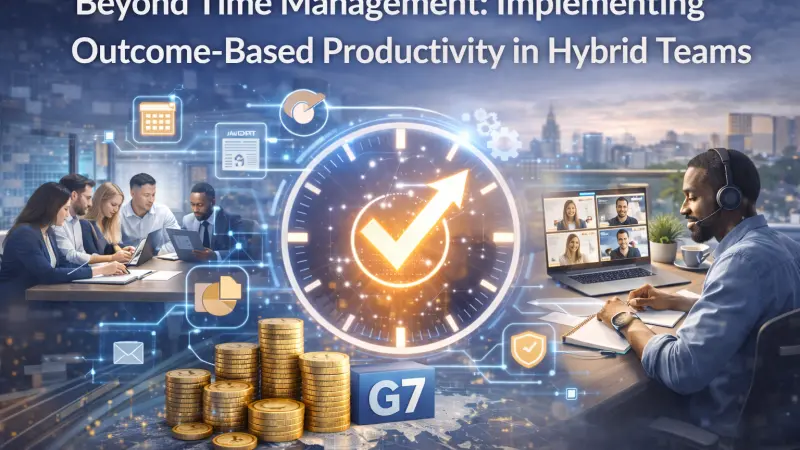
Most hybrid teams are drowning in calendar invites, status updates, and "quick syncs" — yet still missing deadlines. The problem isn't effort. It's the wrong measuring stick. Shifting to outcome-based productivity strategies changes everything: instead of tracking hours, you track results. This approach is reshaping how modern teams operate, and for good reason. A Gallup study found that only 23% of employees strongly agree their manager helps them set performance goals — meaning the majority are busy without direction. This article shows you exactly how to fix that.
Why Time Management Alone Is Failing Hybrid Teams
Time management made sense when work looked the same for everyone — same office, same hours, same visibility. Hybrid work blew that model apart.
When half your team is remote and the other half is on-site, measuring productivity by "hours at a desk" creates a two-tier culture. Remote workers feel they have to prove they're online; in-office workers get visibility simply by showing up. Neither of these things measures actual output.
According to Microsoft's Work Trend Index, 85% of leaders say the shift to hybrid work has made it harder to be confident employees are being productive. That lack of confidence leads to micromanagement — which in turn destroys trust and engagement.
The fix isn't better time-tracking software. It's a fundamentally different philosophy: define what success looks like, then let your team figure out how to get there.
What Outcome-Based Productivity Actually Means
Outcome-based productivity is a results-first approach where team members are evaluated on what they deliver, not when or where they work.
Instead of measuring inputs (hours logged, emails sent, meetings attended), you measure outputs: a feature shipped, a client retained, revenue generated, a campaign launched.
Three core principles underpin this model:
- Clarity of goals — Everyone knows exactly what they're working toward and why it matters.
- Autonomy with accountability — Teams have freedom in how they work, but they own their results.
- Continuous feedback — Progress is visible and discussed regularly, not just at annual reviews.
This isn't a radical new concept. It's borrowed from frameworks like OKRs (Objectives and Key Results), popularized by Google, and SMART goals, used across industries for decades. The difference now is urgency — hybrid work has made outcome-based thinking a survival skill, not a nice-to-have.
The Real Cost of Ignoring This Shift
Sticking with time-based productivity in a hybrid environment isn't just inefficient — it's expensive.
Research from Stanford economist Nicholas Bloom shows that poorly managed hybrid teams can see a 20% drop in productivity compared to teams with clear, outcome-oriented structures. Meanwhile, McKinsey data suggests that companies prioritizing employee autonomy and clear performance metrics see 25% higher profit margins than those relying on traditional oversight models.
The ripple effects of poor productivity management include:
- Higher employee burnout and turnover
- Misaligned team priorities
- Duplicated effort across departments
- Erosion of trust between managers and employees
- Slower innovation and decision-making
If your team is busy but not moving the needle, the structure — not the people — is likely the problem.
Building an Outcome-Based Culture: Step-by-Step
Step 1: Define What "Done" Looks Like
Before anything else, every project and role needs a clear definition of success. This sounds obvious but is routinely skipped.
Work with your team to answer: What does a great week look like?
What does success for this project mean in measurable terms? Document the answers. Vague goals produce vague results.
Step 2: Align Individual Goals to Team Objectives
Each team member's work should visibly connect to a larger team or organizational goal. When people see how their daily tasks contribute to something meaningful, engagement rises.
A practical method: use a simple one-page goal alignment map. List the company's top 3 priorities, the team's contribution to each, and each individual's role in that contribution.
Step 3: Set Clear Milestones, Not Just Deadlines
Deadlines tell you when. Milestones tell you how you're getting there. Break large outcomes into measurable checkpoints — weekly or bi-weekly — so issues surface early rather than at the final hour.
Step 4: Replace Status Meetings with Progress Signals
One of the biggest time-wasters in hybrid teams is the check-in meeting that exists purely to prove people are working. Replace these with asynchronous progress updates — a brief written or recorded summary of what was completed, what's next, and any blockers.
This alone can recover 4–6 hours per week per employee, according to estimates from productivity researchers at Atlassian who found that the average employee attends 62 meetings per month, half of which are considered unproductive.
Step 5: Build Trust Through Transparency, Not Surveillance
Productivity tracking tools that monitor keystrokes or take screenshots do more harm than good. They signal distrust, which damages morale and increases turnover.
Instead, make work visible through shared dashboards, project boards, or brief weekly standups. When everyone can see progress, accountability becomes a team behavior rather than a management function.
Step 6: Review Outcomes, Not Activity
Your performance conversations should center on results. Did the goal get met? What worked, what didn't, and what's the plan for next cycle? This reframes the manager's role from watchdog to coach — a far more effective dynamic.
Common Challenges and How to Solve Them
Challenge: Managers struggle to let go of oversight
This is perhaps the most common friction point. Many managers built their careers in environments where visibility meant control. Outcome-based management requires trusting a process they can't see.
Solution: Start small. Pilot outcome-based check-ins with one team for 30 days. Measure the results. The data almost always builds confidence faster than any training session.
Challenge: Goals keep shifting
In fast-moving organizations, priorities change. Outcome-based models can feel unstable when the target moves every two weeks.
Solution: Separate operational goals (which can flex) from strategic goals (which should be stable for at least a quarter).
Give your team a stable north star, even if the tactical path shifts.
Challenge: Not all roles have easily measurable outputs
Creative, strategic, and support roles don't always produce widgets you can count.
Solution: Focus on impact metrics rather than output metrics. Instead of "pages written," measure "qualified leads from content." Instead of "tickets resolved," measure "customer satisfaction score."
Practical Tools That Support Outcome-Based Work
You don't need a complex tech stack. A few well-chosen tools go a long way:
- Goal-tracking tools like Asana, Monday.com, or Notion let teams connect daily tasks to higher-level outcomes.
- Async communication tools like Loom or Slack reduce the need for meetings while keeping everyone aligned.
- OKR software like Lattice or Perdoo makes company-to-individual goal alignment visible across the organization.
- Team health dashboards give managers a real-time view of blockers, workload balance, and progress — without micromanagement.
The right tools reduce friction, not add it. If a tool takes more time to update than the work it tracks, it's the wrong tool.
What High-Performing Hybrid Teams Do Differently
Research from Deloitte found that 94% of executives and 88% of employees believe a distinct workplace culture is important to business success. High-performing hybrid teams build that culture around outcomes, not presence.
Here's what sets them apart:
- They write goals down and revisit them often — not just at annual reviews.
- They celebrate deliverables, not effort or hours worked.
- Their managers ask "What do you need to succeed?" more often than "What did you do today?"
- They build psychological safety — team members feel comfortable flagging problems early.
- They review team processes regularly and eliminate work that doesn't connect to outcomes.
One realistic example: a mid-sized marketing agency transitioned from weekly "what did you do" check-ins to bi-weekly outcome reviews. Within one quarter, project completion rates improved by 31%, and employee satisfaction scores rose across the board. No new hires, no new tools — just a clearer structure.
The Future of Productivity in Hybrid Work
The trajectory is clear. A 2023 report by the World Economic Forum predicted that outcome-based and skills-based work models will dominate by 2027, displacing traditional time-and-attendance frameworks across most knowledge-work industries.
AI tools are accelerating this shift. As automation handles more routine tasks, human value becomes concentrated in judgment, creativity, and problem-solving — none of which are well-measured by time logged.
Leaders who build outcome-oriented cultures now will have a significant head start. They'll attract top
talent (who increasingly demand autonomy), retain high performers longer, and build more adaptive organizations.
The question isn't whether to make this shift. It's how fast you can do it without disrupting the team you already have.
Quick-Reference Best Practices
Before wrapping up, here's a snapshot of the highest-impact practices:
- Define success metrics for every role and project — before work begins.
- Connect individual goals to team and organizational objectives.
- Replace activity-monitoring with progress visibility.
- Use asynchronous tools to reduce unnecessary meetings.
- Review outcomes in 1:1s, not activity logs.
- Celebrate what was delivered, not how long it took.
- Revisit and adjust goals at least quarterly.
Outcome-based productivity isn't about working less — it's about working with more clarity, purpose, and alignment. For hybrid teams navigating the complexity of distributed work, it's the single most powerful shift a leader can make. Track results, not time. Trust your team, then verify through outcomes. And build systems that make progress visible without creating surveillance culture.
People Also Ask
1. What are outcome-based productivity strategies? Outcome-based productivity strategies focus on measuring what employees deliver rather than how many hours they work. The goal is to align individual tasks with clear, measurable results that serve team and business objectives.
2. How do outcome-based strategies differ from traditional productivity methods? Traditional methods track inputs like time spent and tasks completed. Outcome-based methods track outputs — the actual impact and results of that work. It's a shift from activity to achievement.
3. Are outcome-based strategies suitable for all industries? They work across most knowledge-work industries, including tech, marketing, finance, and consulting. Roles with physical deliverables or compliance requirements may need adapted frameworks, but the core principles apply broadly.
4. How do I introduce this approach to a skeptical team? Start with a 30-day pilot on a low-risk project. Set clear goals together, check in on outcomes rather than activity, and share the results with the team. Evidence builds buy-in faster than top-down mandates.
5. What's the biggest mistake managers make when shifting to this model? Failing to define what success actually looks like before work begins. Without clear outcome metrics, teams default to measuring activity — which defeats the purpose of the shift.
6. How do you measure productivity for creative or strategic roles? Focus on impact metrics: audience engagement for content roles, strategic decisions influenced for senior roles, client retention for account roles. The key is linking output to business impact, not just deliverables.
7. Does this model work for fully remote teams too? Yes — in many ways, outcome-based productivity is even more effective for remote teams where physical presence can't substitute for results. Clear goals and async progress tracking work well in distributed environments.
8. How often should outcomes be reviewed? For most teams, bi-weekly or monthly outcome reviews strike the right balance. Quarterly goal reviews help assess whether the larger objectives still make sense.
9. Can small businesses implement outcome-based productivity? Absolutely. Small teams often have an advantage — fewer layers of hierarchy means goals can be set and aligned quickly. Even a simple shared document tracking weekly outcomes can make a significant difference.
10. What role does trust play in outcome-based management? Trust is foundational. Without trust, managers revert to micromanagement and employees feel surveilled. Outcome-based models work when there's mutual accountability — employees own their results, and managers support rather than oversee.
11. How do I handle underperformance in this model? Address it by reviewing whether goals were clear and achievable, whether the right support was in place, and whether the person has the right skills for the role. Outcome data makes performance conversations more objective and constructive.
12. What tools help implement outcome-based productivity in hybrid teams? Tools like Asana, Notion, Lattice, and Loom help teams track goals, communicate asynchronously, and make progress visible without requiring constant check-ins or unnecessary meetings.
13. How do you prevent goal-setting from becoming just another bureaucratic process? Keep it simple. Three to five clear goals per person per quarter is enough. Goals should be written in plain language, revisited regularly, and tied to something that actually matters to the business.
14. What's the difference between OKRs and outcome-based productivity? OKRs (Objectives and Key Results) are a specific framework for setting and tracking goals. Outcome-based productivity is the broader philosophy. OKRs are one popular tool for implementing that philosophy — but not the only one.
15. How long does it take to see results from this approach? Most teams notice improvements in clarity and alignment within the first 30 days. Measurable productivity and engagement gains typically appear within one to two quarters, depending on how consistently the model is applied.
The shift from time management to outcome-based productivity isn't just a trend — it's the natural response to how work has fundamentally changed. Hybrid teams that cling to presence-based productivity measures will continue to struggle with disengagement, misalignment, and burnout. Those that make the shift will unlock greater focus, stronger results, and teams that genuinely want to perform.
The steps are clear: define success, align goals, trust your people, make progress visible, and review what matters.
Start with one team, one quarter, one clear set of outcomes — and build from there.
Your next step is simple. Explore resources, tools, and frameworks at localpage.uk to help your hybrid team move from busy to genuinely productive. The future of work rewards outcomes. Make sure your team is ready to deliver them.
Disclaimer: The information provided in this article is for general informational and research purposes only. Company details, features, services, and market positions may change over time. Readers are advised to visit official company websites and conduct independent research before making any business decisions or purchasing services.
Most Searchable Keywords
Recent Blogs


Related Listings
Categories
- Accountants (295)
- Advertising Agencies (559)
- Architects (149)
- Automobiles (377)
- Beauty (300)
- Carpenters (146)
- Cleaning Services (387)
- Dentists (189)
- Driving (62)
- Electricians (215)
- Energy (8)
- Event Organiser (686)
- Finance (602)
- Guide (3372)
- Health (2207)
- Information technology (206)
- Legal Services (353)
- Logistics (6)
- Maintenance (65)
- Manufacturing (35)
Sponsored Listings in Travel Agencies



Related Blogs

How Much Do UK Actors Really Earn Full Indust...
Read this insightful article "How Much Do UK Actors Really Earn Full Industry Breakdown" to expand your knowledge!

Blue Light Card UK 2026 Check Eligibility and...
Read this insightful article "Blue Light Card UK 2026 Check Eligibility and Claim" to expand your knowledge!

BBC Radio 1 DJs Net Worth Ranking Revealed
Read this insightful article "BBC Radio 1 DJs Net Worth Ranking Revealed" to expand your knowledge!
Questions & Answers – Find What
You Need, Instantly!
How can I update my business listing?
Is it free to manage my business listing?
How long does it take for my updates to reflect?
Why is it important to keep my listing updated?
