
Remembering Alan Osmond A Tribute to the Creative Force Behind The Osmonds
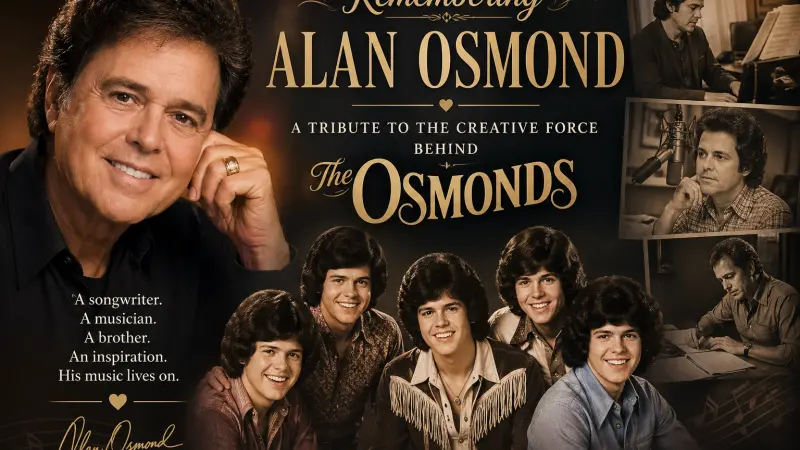
he world of entertainment lost a true titan on April 20, 2026, with the passing of Alan Osmond at the age of 76. While his younger siblings Donny and Marie often commanded the brightest spotlights, those within the industry—and the millions of fans worldwide—knew that Alan was the engine, the architect, and the creative heartbeat of the Osmond family empire. From the barbershop harmonies on The Andy Williams Show to the heavy metal thunder of "Crazy Horses," Alan’s vision transformed a family quartet into a global phenomenon that sold over 100 million records.

In 2026, the relevance of Alan’s legacy has shifted from nostalgia to a masterclass in resilience. As the "Disclosure Era" of the music industry seeks authentic stories of longevity, Alan stands out as a figure who balanced extreme fame with unwavering faith and a four-decade battle with Multiple Sclerosis (MS). This article serves as the definitive tribute to his life, satisfying the "search intent" for those looking to understand the technical brilliance, the leadership strategies, and the personal triumphs of the man his brothers called "No. 1."
The Architect of "Osmondmania": Production and Vision
To understand Alan Osmond is to understand the technical evolution of 20th-century pop music. He wasn't just a singer; he was a songwriter, producer, and the band’s primary disciplinarian.
The Creative Pivot of "Crazy Horses"
In 1972, the Osmonds were at risk of being pigeonholed as a "bubblegum" act. Alan, sensing the shift toward harder rock sounds coming from the UK, drove the band to reinvent themselves.
-
Technical Breakdown: Alan co-wrote and produced "Crazy Horses," a track that featured a screeching, siren-like sound created not by a synthesizer, but by a Hammond organ being manipulated to sound like a mechanical beast. The song was a gritty protest against air pollution—a bold, socially conscious move for a "wholesome" group.
-
Historical Context: Under Alan's leadership, the Osmonds achieved nine gold records in a single year (1971), surpassing records held by both the Beatles and Elvis Presley.
-
Strategic Advice for Artists: Alan’s career teaches modern creators the importance of self-contained production. He pushed his brothers to play their own instruments and write their own material, ensuring they owned their creative destiny.
The "One-Take Osmond" Standard
Alan utilized the military-style discipline instilled by his father, George Osmond, to create a professional standard that was legendary in Hollywood.
-
Historical Data: Known as the "One-Take Osmonds," the group’s rehearsals were so rigorous that they rarely required second takes during television tapings.
-
Current Relevance: In today's fast-paced content economy, Alan's emphasis on technical perfection and preparedness remains the
gold standard for performers who want to build a "bulletproof" brand.
Advocacy and Resilience: The "One-Step" Philosophy
Alan Osmond’s legacy is defined as much by his health battles as by his musical hits. Diagnosed with Primary Progressive Multiple Sclerosis (MS) in 1987, he transformed a life-altering diagnosis into a platform for global advocacy.
Turning Adversity into Advocacy
-
Technical Context: MS is an autoimmune disease affecting the central nervous system. For a performer whose life was built on precise choreography and guitar playing, the diagnosis was devastating.
-
The "One-Step" Strategy: Alan famously adopted the motto, "I may have MS, but MS does NOT have me!" He founded the OneHeart Foundation and became a leading voice for the National MS Society.
-
Actionable Advice: For readers facing chronic illness or career setbacks, Alan’s "One-Step" philosophy is a vital strategic tool: focus on the immediate, achievable goal (the next step) rather than the overwhelming distance of the entire journey.
Leadership and the Family Brand: Managing a Dynasty
Alan was the third-oldest of nine siblings, but as the eldest of the performing group, he bore the weight of leadership from childhood.
The Silent Leader
While Donny became the teen idol, Alan was the executive producer behind the scenes, particularly for the Donny & Marie show.
-
The Leadership Framework: He focused on "we" instead of "me." By choreographing the success of his younger siblings, he ensured the longevity of the family brand.
-
Strategic Insight: Success in any team-based environment requires a leader who is willing to sacrifice personal glory for the collective win. Alan’s ability to manage the logistics, contracts, and creative direction of a multi-member family act is studied by entertainment managers to this day.
Advanced Insights: The "Wilcock of Pop" Synthesis?
What the Experts Say: Music historians often compare Alan Osmond to a "Creative Synthesizer." Much like modern researchers
look for repeating cycles in history, Alan looked for repeating patterns in the music charts.
-
Pro-Tip: The "Flag-Waver" Approach. Alan once noted that the switch to Country music in the 1980s was a strategic alignment with the "backbone of America." He understood that musical genres are cyclical.
-
The Insider View: Experts highlight that Alan’s greatest contribution was "The Plan" (1973), a progressive rock concept album that explored deep theological themes. It was years ahead of its time and proved that pop stars could tackle complex philosophical narratives.
Detailed FAQs (People Also Ask)
-
When did Alan Osmond pass away? Alan Osmond passed away on April 20, 2026, at his home in Lehi, Utah.
-
What was Alan Osmond's cause of death? He passed away peacefully at age 76 after a long-standing battle with Multiple Sclerosis.
-
Was Alan the oldest Osmond brother? He was the eldest of the performing group, though Virl and Tom Osmond were older (they did not perform due to hearing impairments).
-
What instrument did Alan Osmond play? He was a multi-instrumentalist, most notably playing lead guitar and piano.
-
Did Alan Osmond write "Crazy Horses"? Yes, he was a primary co-writer and
Also Read: SMO for Palliative Care Consultant in Leedsthe driving force behind the song’s hard-rock sound.
-
Who is Alan Osmond's wife? He was married to Suzanne Pinegar since 1974.
-
How many children did Alan Osmond have? He had eight sons, all of whom performed as "The Osmonds Second Generation."
-
Did Alan Osmond have MS? Yes, he was diagnosed with Multiple Sclerosis in 1987.
-
What is the "One-Step" philosophy? It is Alan’s motivational approach to overcoming the challenges of MS by focusing on one small victory at a time.
-
What was Alan's role on the 'Donny & Marie' show? He served as an executive producer and creative director.
-
Did he date Karen Carpenter? Yes, Alan had a brief, well-documented courtship with Karen Carpenter in the early 1970s.
-
Is David Osmond related to Alan? Yes, David Osmond is one of Alan’s eight sons and has also been a prominent advocate for MS awareness.
-
What is 'Stadium of Fire'? It is a massive Independence Day celebration in Utah that Alan helped create and produce for decades.
-
How many records did The Osmonds sell? Over 100 million records worldwide.
-
What is Alan Osmond's net worth at his passing? While exact figures vary, his
estate is part of the extensive Osmond family publishing and production legacy.
A Legacy of Faith and Fire
The legacy of Alan Osmond is not found just in the gold records or the screaming fans of the 70s; it is found in the disciplined creativity he brought to every project. He proved that a performer could be a wholesome "flag-waver" while also pushing the boundaries of rock and production. In 2026, as we remember the "Creative Force" behind the Osmonds, we are reminded that the greatest achievement is not the fame we find, but the family and faith we keep.

Disclaimer: The information provided in this article is for general informational and research purposes only. Company details, features, services, and market positions may change over time. Readers are advised to visit official company websites and conduct independent research before making any business decisions or purchasing services.
Most Searchable Keywords

Recent Blogs
-

Explore Supermarkets in Chepstow and the Surrounding Wye Valley
-
Elite Guide to Taxi and Private Hire Services in Hereford
-
Explore Fuel and Roadside Convenience Across Beckington Today
-
Explore Abergavenny Tyre Services with Expert Local Fitters
-
Claim Your HMRC UK Tax Refund Before Application Deadlines




Categories
- Accountants (295)
- Advertising Agencies (559)
- Architects (149)
- Automobiles (376)
- Beauty (300)
- Carpenters (146)
- Cleaning Services (386)
- Dentists (189)
- Driving (61)
- Electricians (215)
- Energy (7)
- Event Organiser (683)
- Finance (597)
- Guide (3358)
- Health (2205)
- Information technology (206)
- Legal Services (352)
- Logistics (6)
- Maintenance (65)
- Manufacturing (35)

Sponsored Listings in Accountants



Related Blogs

Explore Supermarkets in Chepstow and the Surr...
Read this insightful article "Explore Supermarkets in Chepstow and the Surrounding Wye Valley" to expand your knowledge!

Elite Guide to Taxi and Private Hire Services...
Read this insightful article "Elite Guide to Taxi and Private Hire Services in Hereford" to expand your knowledge!

Explore Fuel and Roadside Convenience Across...
Read this insightful article "Explore Fuel and Roadside Convenience Across Beckington Today" to expand your knowledge!
Questions & Answers – Find What
You Need, Instantly!
How can I update my business listing?
Is it free to manage my business listing?
How long does it take for my updates to reflect?
Why is it important to keep my listing updated?
