
SCHOOL HOLIDAY BREAKS 2026 EASTER SUMMER FULL HOLIDAY CALENDAR DATES
MAPPING THE YEAR THROUGH SCHOOL HOLIDAYS
There's a particular rhythm to British life that, for parents with school-age children, is entirely determined by the school calendar. Holidays aren't moments of spontaneous freedom but carefully calculated waypoints in a year's architecture, reference points around which entire family lives are constructed. The question "When are the school holidays?" isn't casual small talk—it's the fundamental inquiry that shapes work arrangements, holiday bookings, and family planning for the entire year. And in 2026, understanding the full landscape of school breaks—from Easter through summer and everything in between—becomes essential logistical intelligence.
The contemporary school holiday calendar is far more complex than it appears. Unlike previous generations, where holidays were largely uniform across regions, contemporary UK schools operate within a bewilderingly varied system where dates differ significantly by nation (England, Scotland, Wales, Northern Ireland), by individual local authority, and by independent versus state school status. Add to this the emergence of staggered holidays in some regions (designed to reduce holiday crowding and travel chaos), and what once was a simple question—"When do children break up from school?"—has become genuinely complicated.
Yet this complexity is precisely why a comprehensive guide matters. In an era where entertainment news cycles around school holiday activity camps, streaming buzz encompasses educational content designed for holiday consumption, and new release schedules often include family-oriented films strategically timed for school breaks, understanding the full calendar isn't merely logistical—it's cultural. This guide maps the entire 2026 school holiday landscape, from Easter through summer and beyond, providing both the essential dates and the broader context that makes sense of them.
The stakes of understanding this calendar correctly are higher than they've ever been. Working parents face genuine challenges in navigating school breaks while maintaining employment. Single parents juggle even more complex logistics. The pressure to make holidays "enriching," to book activities strategically, and to manage the financial impact of childcare needs during these periods—all of this converges into a genuine planning challenge that deserves thoughtful, comprehensive guidance. This article provides exactly that: the dates, yes, but also the context, strategy, and cultural understanding that transforms raw scheduling information into genuine planning capability.
THE COMPLETE 2026 SCHOOL HOLIDAY CALENDAR: DATES BY REGION & TERM
Understanding the full 2026 school calendar requires parsing multiple overlapping systems. In England, the academic year runs from September 2025 through August 2026, structured around three formal terms with half-term breaks scattered throughout. For most English state schools, the breakdown looks like this:
Autumn Term 2025-2026:
- School begins: September 2, 2025
- Half-term break: October 27 - October 31, 2025 (approximately one week)
- Schools close: December 19, 2025
- Christmas holiday period: December 19, 2025 - January 5, 2026 (approximately three weeks)
- Schools reopen: January 6, 2026
Spring Term 2026:
- Schools close: February 13, 2026
- Spring half-term: February 16-20, 2026 (approximately one week)
- Schools reopen: February 23, 2026
- Schools close: April 10, 2026
- Easter holiday period: March 30 - April 10, 2026 (two weeks, though exact dates vary by school)
- Schools reopen: April 13, 2026
Summer Term 2026:
- Schools close: May 22, 2026
- May Day half-term/half-term break: May 25-29, 2026 (approximately one week, often incorporates bank holidays)
- Schools reopen: June 1, 2026
- Schools close for summer: July 17, 2026
- Summer holiday period: July 17 - September 1, 2026 (approximately six weeks)
- Schools reopen: September 1, 2026
Important variations: Scotland operates on a different calendar entirely, with summer holidays typically starting earlier (early July) and running through late August. Wales follows yet another calendar, with some variation from England. Northern Ireland operates independently. Additionally, some local authorities in England stagger holiday dates to reduce crowding—meaning children in different areas might break up on different weeks. And independent schools set their own dates entirely, though most cluster around the state school schedule.
The variability isn't bureaucratic chaos—it's actually purposeful. Staggered holidays reduce the pressure on tourist attractions, transport systems, and accommodation, theoretically making holidays more affordable and less crowded. However, for families with children in different schools or regions, this creates genuine complications. A parent with one child in a staggered-holiday area and another in standard dates faces the nightmare of coordinating separate childcare arrangements and potentially paying for extended camp periods.
THE EASTER PARADOX WHY SPRING IS THE COMPLICATED SEASON
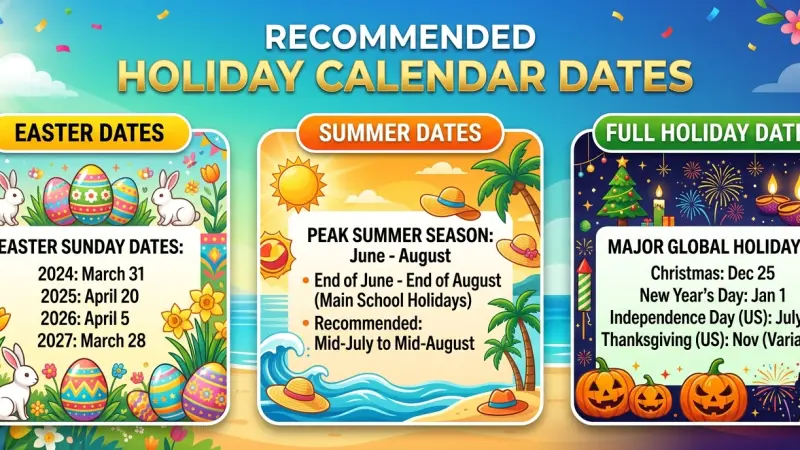
Easter holidays deserve particular attention because they're positioned in a genuinely vexing way in the calendar. Unlike summer holidays, which are long, expected, and relatively uniform, Easter holidays are shorter, staggered, and positioned at an unpredictable moment in spring. Easter Sunday in 2026 falls on April 5th, making this a relatively early Easter—meaning the school holidays cluster around the very end of March and beginning of April.
This timing creates several implications worth understanding. The weather is genuinely unpredictable—not quite spring yet, not quite winter either. This affects activity planning: outdoor adventures might be feasible, or they might be rained out. For families planning Easter holidays, this meteorological uncertainty requires flexible backup plans. The early Easter also means that holiday-adjacent weekends—Easter weekends in late March/early April—are part of the break, which affects how families can extend their time off.
Culturally, Easter holidays carry residual religious significance for some families, even in increasingly secular Britain. Easter egg hunts, special Easter services, and faith-based activities remain meaningful for some, though for others, Easter holidays are simply "the spring break." This variety of meaning means Easter holidays function differently in different families, and there's no universal approach to how they're spent.
The Easter holiday break presents the first genuine test case for parents managing 2026's calendar. It's long enough to require planning, short enough to create scheduling complications, and positioned at a moment in the year when both weather and parent energy levels are uncertain. For working parents, navigating Easter holidays while maintaining employment obligations is genuinely complex. For activities, the early spring timing means some outdoor options are available but not guaranteed.
SUMMER HOLIDAYS THE MARATHON, NOT THE SPRINT
If Easter holidays are the rehearsal, summer holidays are the full theatrical production. Running from July 17 through September 1, 2026, the British summer holiday represents six weeks of continuous childcare challenge, planning opportunity, and genuine family disruption. This is the longest continuous school break, the period that most profoundly disrupts work schedules, and the break around which most family travel and holiday planning revolves.
Understanding the full impact of six-week summer holidays requires acknowledging how they've fundamentally shaped British family life and work culture. Parents require childcare, activity camps, or personal schedule adjustment for six full weeks.
The financial impact is substantial—whether through holiday bookings, activity camps, or income loss from reduced working hours. The logistical complexity is genuine: schools close entirely, requiring backup childcare; activity camps fill months in advance; popular holiday destinations are crowded and expensive.
Yet the new release of various summer entertainment products—both streaming content strategically released for school holidays and theatrical releases timed for summer break audiences—shows how the entertainment industry has adapted to shape summer holidays. Films targeting children and families cluster in the July-August period. Streaming services launch educational content marketed as "summer-friendly learning." Television networks schedule holiday programming specifically designed for school-age audiences. This isn't accidental; it's industry recognition that summer holidays represent a distinct consumption pattern.
The six-week span also creates interesting psychological dynamics. Unlike shorter breaks where you're simply trying to survive, six weeks is long enough that genuine boredom kicks in around week three. This means successful summer holidays require both novelty (new activities, trips, experiences) and routine (regular structure, expected rhythms). Parents who attempt six weeks of continuous novelty often find themselves exhausted and financially depleted. Those who rely entirely on screen time without structure often find children genuinely miserable by late August. The sweet spot involves mixing structured activities with unstructured time, routine with novelty, engagement with rest.
For the 2026 summer holidays specifically, the July 17 start date means that mid-July is disrupted—something worth considering if you have summer events, exams, or work commitments clustered around that period. And the September 1 return means late August is genuinely constrained—you can't take the entire month off unless you plan very specifically. Understanding these boundaries helps in realistic planning.
HALF-TERMS AND THE HIDDEN CALENDAR: PLANNING BEYOND THE MAJOR BREAKS
While Easter and summer holidays capture attention, the school calendar is actually much more finely structured, with regular half-term breaks interspersed throughout the year. These week-long breaks—five or so throughout the year—are often overlooked in favor-focused planning but they're crucial for family rhythm and managing burnout.
The half-terms in 2026 are:
- Autumn half-term: October 27-31, 2025
- Spring half-term: February 16-20, 2026
- Easter holiday (which includes half-term): March 30 - April 10, 2026
- May half-term: May 25-29, 2026 (often overlapping with bank holidays)
- Summer half-term: This falls within the summer holiday period (July 17 - Sept 1), so it's less relevant as a distinct break
These half-terms serve multiple purposes. They provide brief pauses in otherwise intense term time, preventing burnout for both children and families. They're short enough to not require major travel or activity booking—a weekend trip or local activity often suffices. Yet they're long enough to genuinely provide rest and reset. For many families, half-terms are actually more enjoyable than longer holidays because they require less planning and create less pressure.
The entertainment news around half-term often focuses on immediate, local activities: attraction visits, activity camps designed specifically for week-long breaks, and screen time that doesn't require two-week entertainment planning. Understanding half-terms as distinct from major holidays helps in strategic activity planning. Some families deliberately keep half-terms low-key, viewing them as breathing spaces rather than adventure opportunities. This approach has genuine merit—it means major planning and financial expenditure is reserved for longer breaks.
THE WORK-LIFE INTEGRATION: HOW HOLIDAYS RESHAPE EMPLOYMENT
One of the least discussed but most significant aspects of the school calendar is how profoundly it shapes adult work patterns and family economics. Unlike previous generations where "someone stayed home," contemporary families navigate school breaks with complex work arrangements: two working parents, single working parents, remote workers, self-employed individuals, shift workers whose breaks don't align with school holidays. The calendar affects all of them differently.
The trend toward remote work, accelerated and then partially rolled back during the pandemic, has created complicated expectations around school holidays. Employers sometimes assume parents can work from home while supervising children—a mathematical impossibility that's repeatedly proven itself to fail in practice. Yet the perception persists, creating guilt for parents who can't achieve this fantasy balance.
Working parents navigate school holidays through various mechanisms: negotiating specific weeks off, using accumulated annual leave to cover breaks, arranging childcare through camps or family members, staggering their work arrangements with partners, or some combination thereof. The economic impact is real—childcare for school holidays can cost hundreds or thousands per year, significantly impacting family budgets. Single parents often face particular challenges, as they lack the option to stagger work arrangements with a partner.
Schools have become increasingly aware of this challenge, with many offering subsidized holiday clubs designed specifically for working parents. Some employers offer school holiday childcare support as a benefit. Some local authorities provide subsidized activity camps. Yet access to these solutions remains patchy and often requires awareness of their existence plus the ability to book far in advance. Parents for whom English isn't a first language, those in precarious employment, those without transport, or those in areas with limited provision often struggle significantly.
Understanding the full 2026 calendar helps with strategic planning. Parents can identify which breaks are absolutely essential to cover with formal childcare, which might be managed through family help or staggered work arrangements, and which might be covered through activity camps. Early planning—in fact, beginning to think about 2026 school holidays in late 2025—is genuinely essential for accessing the most affordable and desirable childcare options.
AN ANECDOTE WHEN THE CALENDAR BREAKS AND LIFE BECOMES ACTUAL
The author of this piece once experienced an unexpected illness that forced cancellation of carefully planned summer holiday childcare arrangements. Multiple activity camps were lost (deposits were non-refundable). A booked family trip was cancelled. Childcare arrangements fell apart. For one surreal week, there was no plan—a genuinely terrifying position for a parent who had structured the entire six-week summer around a detailed calendar.
What emerged was unexpected: those unplanned weeks, while initially chaotic, became some of the most genuinely restorative time. Without booked activities or required destinations, the family simply... existed together. Long days at local parks. Slow breakfasts. Reading under blankets on rainy days. Conversations that happened because there was nowhere else to be. By the time the crisis passed and normal childcare resumed, something had shifted about what "good holidays" meant.
This anecdote resonates because it highlights the difference between holidays as planned experiences and holidays as genuinely restorative periods. Contemporary parents often treat school holidays as opportunities to maximize achievement—educational visits, new experiences, documented moments—when what families often actually need is simply rest and time together without pressure.
This doesn't mean detailed planning is pointless; it simply means that the best-laid calendar plans should include space for genuine downtime. A summer that's entirely booked, dawn to dusk, might create impressive Instagram documentation but often leaves families exhausted.
A summer that includes structured activities mixed with significant unstructured time feels less impressive on social media but often feels better when actually lived.
CULTURAL SIGNIFICANCE HOW SCHOOL HOLIDAYS SHAPE BRITISH LIFE
The school calendar has fundamentally shaped British culture in ways that deserve examination. The predictable rhythm of term time and holidays structures not just family life but entire communities. Holidays drive tourism patterns, create employment in activity camp and tourism sectors, shape when construction and maintenance work happens (schools are often used for summer building projects), and determine when most British families experience vacation time.
The viral series of social media content around "school holiday survival" speaks to the genuine cultural weight of these breaks. Parents sharing activity ideas, commiserating about holiday chaos, showing their holiday setups—all of this reflects how significant these breaks are in contemporary parenting experience. The calendar is no longer a neutral administrative document; it's a cultural artifact that shapes behavior, expectations, and family dynamics.
The democratization of holiday activity information through social media and streaming platforms has also changed how families experience breaks. Where previous generations figured out holidays through word-of-mouth and local knowledge, contemporary families access curated lists of activities, book educational programming, document their holidays for online communities, and compare their holiday experiences against others' social media presentations. This has both benefits (access to more options, knowledge of different activity types) and drawbacks (pressure to perform holidays, guilt about "boring" breaks).
The emergence of hybrid activity models—where physical visits combine with virtual extensions, where streaming content supplements in-person experiences, where activity camps incorporate both traditional play and educational technology—reflects how holiday entertainment has evolved. The boundary between "holiday activities" and "educational content" has become genuinely blurred, with many families viewing screen time during holidays as potentially acceptable if it's educational or supplementary to other activities.
STRATEGIC PLANNING MAPPING YOUR 2026 HOLIDAYS
For parents beginning to think about 2026, a strategic approach helps navigate the year's complexity. Start by mapping all the school breaks on your personal calendar—not just the major ones (Easter, summer) but also the half-terms. This visual layout helps identify clusters (spring has multiple breaks relatively close together) and gaps (summer is one long continuous break, requiring different planning than shorter breaks).
Next, identify which breaks are genuinely essential to cover with formal childcare, based on your work obligations. For many parents, summer holidays require multiple weeks of formal childcare. Easter might require one or two weeks. Half-terms might be manageable through flexible working or family help. Early identification of these needs means you can begin researching and booking childcare in plenty of time.
Consider which breaks might involve family travel or special experiences. For many families, summer holidays are when longer trips or destination-based holidays happen. Easter might involve faith-based activities or family visits. Half-terms are often handled locally. Strategic thinking about timing helps optimize both finances and experiences—traveling during less crowded periods if possible, booking activities early, and identifying which breaks genuinely require extensive planning versus those that can be more relaxed.
Build flexibility into your plans. The 2026 calendar shows expected breaks, but school closures for weather, staff training days, or unexpected circumstances happen. Insurance (for holiday bookings), flexible activity camp options, and backup entertainment plans reduce stress when unexpected changes occur.
Finally, remember that successful holidays aren't necessarily elaborate ones. The planning, booking, and optimization matter less than the actual quality of time spent. Some of the most meaningful holidays happen with minimal planning, while some elaborately scheduled ones feel stressful throughout. Give yourself permission to adjust plans based on your family's actual needs and energy levels, rather than adhering to originally planned activities if they're not working.
THE CALENDAR AS PERMISSION STRUCTURE
The 2026 school holiday calendar—with its Easter break in late March/early April, its lengthy summer holiday from mid-July through early September, and its scattered half-terms throughout the year—represents something that often goes unexamined: permission. Permission to pause, to step outside normal routines, to prioritize family time, to be unavailable for work obligations (at least theoretically). In a world where constant availability and productivity are normalized, the school calendar remains one of the few structures that officially sanctions stepping out of normal patterns.
Understanding this full calendar—not just the dates but the structure, the implications, and the cultural weight—helps parents approach 2026 with greater intentionality. These aren't merely administrative breaks but genuine opportunities to reshape routine, to rest, to spend time differently than normal life allows. Whether those opportunities are spent in elaborately planned activities or in genuinely quiet togetherness, the permission matters.
The complexity of the 2026 calendar—with its regional variations, staggered dates, and multiple overlapping systems—might seem frustrating. Yet it reflects genuine attempts to meet diverse needs: staggered holidays reduce crowding, regional variation accommodates different communities' needs, the mix of terms and half-terms prevents extreme burnout while maintaining academic momentum. Understanding why the calendar is structured this way, not just what the dates are, helps in navigating it more effectively.
For parents embarking on 2026 planning, the dates are now known. Easter breaks March 30 through April 10. Summer breaks July 17 through September 1. Half-terms are scattered throughout.
Now comes the genuine work: deciding what these breaks mean for your family, what you actually want to do with them, how to balance planning with flexibility, and how to ensure that officially sanctioned time off actually feels restful rather than stressful.
The calendar is set. The year is mapped. The holidays are coming. Make them yours—whatever "yours" looks like.
FAQ: UK SCHOOL HOLIDAY CALENDAR 2026 - COMPLETE DATES & PLANNING GUIDE
1. Q: When exactly does Easter holiday break begin in 2026? A: Most English state schools break on March 30, 2026, for Easter holidays. However, check your specific school's calendar, as dates vary by region and individual institutions.
2. Q: When do schools return after Easter 2026? A: Most English state schools return on Monday, April 13, 2026, after the Easter break. Dates vary by school and region.
3. Q: When does summer holiday break start in 2026? A: Most English state schools break up for summer on Friday, July 17, 2026. This date varies by school, region, and local authority staggering.
4. Q: When do schools return after summer 2026? A: Most English state schools return on Tuesday, September 1, 2026. Some regions return slightly later. Check your specific school calendar.
5. Q: How long is the summer holiday 2026? A: Approximately six weeks, from July 17 through September 1, 2026.
6. Q: Are half-term dates different from main holidays? A: Yes. Half-terms are week-long breaks interspersed throughout term time (typically mid-October, mid-February, late May). Easter and summer are longer holidays.
7. Q: Do Scotland, Wales, and Northern Ireland have different holiday dates? A: Yes. Each nation operates its own school calendar system. Scotland's summer holidays typically start earlier (early July). Check your specific nation's education authority for precise dates.
8. Q: What are the half-term dates in 2026? A: Autumn half-term: late October (27-31, 2025); Spring half-term: mid-February (16-20, 2026); May half-term: late May (25-29, 2026).
9. Q: Are some schools staggered for different break dates? A: Yes, some local authorities stagger holiday dates to reduce crowding. This means schools in the same area might break on different weeks.
10. Q: Do independent schools follow the same holiday dates? A: No. Independent schools set their own holiday dates, though most cluster around state school dates. Check your specific school's calendar.
11. Q: When should I start booking summer childcare for 2026? A: As early as possible—ideally late 2025. Popular activity camps and holiday clubs fill months in advance, and early booking often yields better rates.
12. Q: Are there any bank holidays during 2026 school holidays? A: The May half-term often overlaps with bank holidays (May Day, Spring bank holiday). Check specific dates for your region.
13. Q: What's the earliest date schools might close in 2026? A: Autumn term doesn't close until mid-December 2025 (December 19). Spring term closes April 10 for Easter. Summer term closes July 17.
14. Q: How many school days are there with holidays in 2026? A: UK schools are typically open approximately 190 days per year, with the remainder being holidays and weekends. Exact numbers vary by school and region.
15. Q: Can I take additional unpaid leave during school holidays? A: This depends on your employer's policies. Some allow flexibility during school breaks; others don't. Discuss arrangements well in advance.
16. Q: Are there childcare subsidies for school holidays? A: Many councils offer subsidized holiday
activity camps, particularly for lower-income families. Contact your local authority for information.
17. Q: What's the weather typically like during Easter 2026? A: April weather in the UK is unpredictable—potentially mild spring weather or chilly rain. Plan flexible activities that work in various conditions.
Disclaimer: The information provided in this article is for general informational and research purposes only. Company details, features, services, and market positions may change over time. Readers are advised to visit official company websites and conduct independent research before making any business decisions or purchasing services.
Most Searchable Keywords
Recent Blogs


Related Listings
Categories
- Accountants (295)
- Advertising Agencies (559)
- Architects (149)
- Automobiles (377)
- Beauty (300)
- Carpenters (146)
- Cleaning Services (387)
- Dentists (189)
- Driving (62)
- Education (1)
- Electricians (215)
- Energy (8)
- Event Organiser (687)
- Finance (602)
- Guide (3482)
- Health (2207)
- Information technology (206)
- Legal Services (361)
- Logistics (6)
- Maintenance (65)
Sponsored Listings in Locksmith Services


Related Blogs

Ghost Brokers Fake Car Insurance Scam Explain...
Read this insightful article "Ghost Brokers Fake Car Insurance Scam Explained" to expand your knowledge!

UK Baby Names Fastest Rising and Falling Name...
Read this insightful article "UK Baby Names Fastest Rising and Falling Names" to expand your knowledge!

How to Claim for Pothole Damage From Your Cou...
Read this insightful article "How to Claim for Pothole Damage From Your Council" to expand your knowledge!
Questions & Answers – Find What
You Need, Instantly!
How can I update my business listing?
Is it free to manage my business listing?
How long does it take for my updates to reflect?
Why is it important to keep my listing updated?
