
Starting a Profitable Cleaning Business UK 2026 Startup Guide
- 👤 Alex
- 👁️ 186 Views
- Last Updated: March 25, 2026
- 🏷️ Cleaning Services
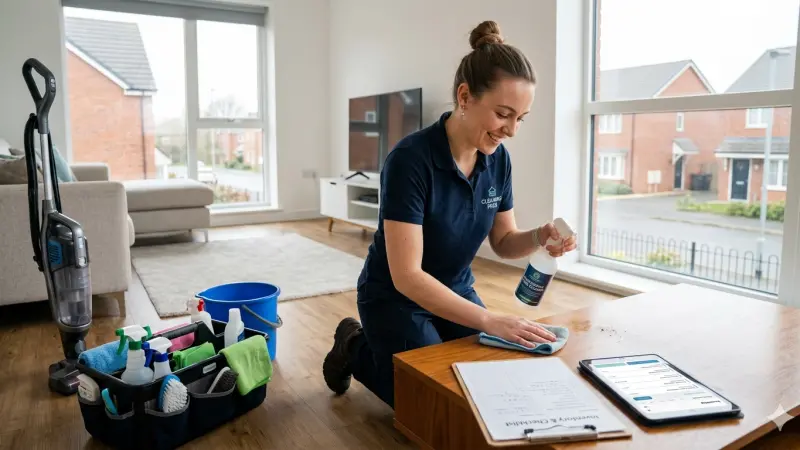
The definitive 2026 blueprint for domestic entrepreneurs: Master the economics, operations, and growth of a high-margin service business.

Executive Summary: The Low-Cost, High-Reward Venture
In the modern British economy, time has become one of the most valuable commodities. As household incomes in double-income families rise, the willingness to outsource "low-value" time tasks—specifically domestic cleaning—has reached an all-time high. Unlike many other sectors, the cleaning industry requires negligible startup capital, zero formal qualifications, and offers immediate cash flow. This guide provides a rigorous analysis of how to establish a service that isn't just a "job," but a profitable business entity.
Whether you are operating in the dense urban markets of London and Manchester or the affluent commuter belts of the Home Counties, the principles of profitability remain the same: limit your overheads, define your service parameters strictly, and build a brand based on radical reliability and trust.
The Economics of Cleaning: UK Market Rates & Profitability
To run a profitable business, you must move away from the mindset of "minimum wage." You are a professional service provider. In the UK, cleaning rates vary significantly by region, but the overheads remain consistently low. Understanding your "Net Margin" is the first step to success.
London & South East
£18 - £27Standard Hourly Rate
Higher demand, higher travel costs.Midlands & North
£15 - £20Standard Hourly Rate
Lower cost of living, steady demand.Specialised Deep Cleans
£30 - £50End of Tenancy / Post-Con
Requires heavy equipment and more time.The 90% Profit Margin Goal
In a typical UK cleaning business, if you charge £20 per hour, your actual "out of pocket" expenses (cleaning chemicals, microfibre cloths, and a portion of your fuel) should not exceed £1.50 to £2.00 per hour. This leaves a gross profit of 90%. In contrast, a restaurant or retail shop often struggles to maintain a 15% net profit margin. The efficiency of a one-to-two-person cleaning team is the reason why this business is so lucrative; you are essentially harvesting high-value hours with minimal resource depletion.
Legal, Tax, and HMRC Compliance
Professionalism starts with being "above board." In the UK, you have several options for business structure, but most startups begin as a Sole Trader due to its simplicity.
HMRC Registration and the £1,000 Rule
You must register for Self Assessment if your gross income from self-employment is over £1,000 in a tax year. Once registered, you will be responsible for Income Tax and Class 2/Class 4 National Insurance contributions. Pro-Tip: Set aside 25% of every payment you receive into a separate "Tax Savings" account. This prevents the common "January shock" when your Self Assessment bill arrives. Additionally, track every mile driven for work; you can currently claim 45p per mile for the first 10,000 miles as a business expense, which significantly reduces your taxable profit.
Insurance and Liability
In the UK, Public Liability Insurance is your shield. For roughly £12 a month, you can get £1 million to £2 million in cover. Without this, one accidental scratch on a client's Carrara marble worktop or an antique vase could end your business. Most premium clients in the UK will ask for proof of insurance during the initial "meet and greet."
COSHH and Safety Standards
Under the Control of Substances Hazardous to Health (COSHH) regulations, you have a duty to understand the chemicals you use. Ensure you carry "Safety Data Sheets" for your primary cleaners. This level of compliance allows you to pitch to high-end clients and small commercial offices who require a professional safety audit.
Defining Your Parameters: Residential vs. Commercial
As highlighted in the original text, "defining and limiting your parameters" is the secret to low stress and high profit. For a new UK business, the residential market is the most forgiving and offers the highest margins for solo operators.
The "Domestic Diamond" Strategy
Why choose residential? Homeowners pay on the day (or within 24 hours via BACS), whereas commercial contracts often have 30-day or even 60-day payment terms. In a domestic setting, you are also not competing against massive multinational cleaning firms who undercut prices through volume. You are selling a personal, trusted relationship.
Avoid the "Everything" Trap: Do not offer carpet steam cleaning, oven deep-cleaning, or external window washing in your first six months. These require expensive extraction machines (£2,000+), high-pressure washers, and specialised insurance riders. Stick to "Maintenance Cleaning" where your only equipment is a vacuum, a mop, and a caddy of sprays.
The Professional Workflow: Room-by-Room Strategy
Efficiency is the difference between earning £20/hour and £40/hour. If you can clean a standard 3-bedroom semi-detached house to a
professional standard in 2.5 hours instead of 4, your profitability skyrockets. This requires a "Top-Down, Left-to-Right" system.
The Kitchen & Bathroom Deep-Dive
These are the "high-value" rooms. A client will forgive a dusty shelf, but they will not forgive a dirty toilet or a greasy extractor fan.
- Spray First, Clean Later: Apply limescale remover to taps and degreaser to hobs as soon as you enter. Let the chemicals do the hard work for 10 minutes while you tidy other areas.
- The "Dry-Buff" Finish: Always follow a wet wipe with a dry microfibre buff. This creates the "sparkle" that UK homeowners associate with a professional job.
- High-Touch Points: Sanitise light switches, door handles, and the kettle handle. These are often missed by "budget" cleaners.
The Professional Toolkit: UK Essentials
Do not skimp on tools. A professional kit reduces physical strain and improves the quality of the finish. In the UK, certain brands have become industry standards for a reason.
Hardware Selection
- Numatic "Henry" Vacuum: The workhorse of the UK cleaning industry. Reliable, high-capacity, and easy to service.
- Telescopic Duster: For high-reaching Victorian cornices and chandeliers.
- Vileda Professional Mops: Flat-mop systems are superior for modern UK LVT (Luxury Vinyl Tile) and wood flooring.
- Colour-Coded Microfibre: Red (Toilets), Yellow (Kitchen), Blue (General/Dusting) to prevent cross-contamination.
Chemicals & Consumables
- Limescale Remover: Essential for UK hard-water areas (London/South East).
- Magic Erasers (Melamine Sponges): For scuffs on skirting boards and paintwork.
- Professional Glass Cleaner: For mirrors and window interiors.
- Microfibre Wash: Use a specific detergent to keep your cloths absorbent; never use fabric softener.
Customer Acquisition: The "Local Trust" Engine
Marketing a cleaning business in the UK has moved away from newspaper ads to digital "hyper-local" communities. Here is how to fill your diary in 14 days.
The Nextdoor & Facebook Loop
In the UK, the Nextdoor app is the premier platform for domestic services. The Strategy: Do not just post "I am a cleaner." Instead, post "I’ve just started my local domestic service and I'm looking for two more houses in [Village Name] to complete my Tuesday schedule. I offer a fully insured, DBS-checked service." Social Proof: Ask your first three clients for a Google Business or Facebook review. In the UK, homeowners are 70% more likely to hire a cleaner with local reviews than one who is slightly cheaper but unverified.
The "Golden Flyer" Tactic
Flyers are not dead. However, they must be targeted. Do not waste money on 5,000 flyers. Instead, print 200 high-quality, heavy-cardstock flyers and deliver them only to the streets you want to work on. Mentioning a specific local landmark on the flyer (e.g., "Serving the residents near Priory Park") increases response rates by up to 300%.
Client Retention: Winning for Life
As the original article noted, once you have someone's trust, they are a customer for life. The cost of acquiring a new client is 5x higher than the cost of keeping one.
The "One-Percent" Rule: On every visit, do one thing that wasn't on the checklist. Clean the inside of the microwave, polish the front door knocker, or organise the shoe rack.
These "extra mile" actions are what generate referrals. In the UK, a recommendation from one neighbour to another is the highest-converting lead you can receive.
Frequently Asked Questions (UK Specific)
While not a legal requirement for cleaning private homes, it is highly recommended. A Basic DBS check costs around £18 and provides peace of mind to clients who are handing over their house keys. It is a one-off cost that pays for itself in the trust it generates.
For regular maintenance cleans, start with an hourly rate (e.g., £18/hour). However, for "End of Tenancy" or "One-Off Deep Cleans," always quote a flat fee. These jobs always take longer than expected, and a flat fee protects your profit margin.
In the UK, BACS (Bank Transfer) is the standard. It is free and provides a clear audit trail. Avoid cash where possible as it is harder to track for HMRC purposes. For one-off jobs, consider a portable card reader like SumUp or Zettle.
This is the downside of being a solo operator. Transparency is key. Give your clients at least 2-4 weeks' notice for holidays. Most domestic clients are very understanding if they have a consistent, high-quality service the rest of the year.
Yes, if you want to be viewed as a professional service. Providing your own products ensures consistent results and allows you to use chemicals you are comfortable with. It also justifies a higher hourly rate.
Yes. If you manage your bookings and admin from home, you can claim a portion of your heating, electricity, and internet. HMRC offers a simplified "flat rate" for home office use that is very easy to claim on your tax return.
Use a coded key-tag system. Never put a name or address on the key tag. If you lose a set of keys, you should have insurance that covers "Loss of Keys" which pays for the client's locks to be changed.
For cleaners, these can be expensive and lead to "price-shopping" customers. It is usually better to build local authority through Nextdoor and Facebook groups for free before spending money on lead-generation sites.
Always ask about pets during the initial consultation. Ensure you have a vacuum with a HEPA filter (like the Henry Pet) to handle dander and hair.
Be clear about whether you are comfortable cleaning around larger dogs or nervous cats.
Only when you have a waiting list that could fill another 20 hours a week. Remember, hiring staff in the UK introduces Employers' National Insurance, pension contributions, and HR complexities. Many choose to stay as a solo or duo team to keep the maximum profit for themselves.

Disclaimer: The information provided in this article is for general informational and research purposes only. Company details, features, services, and market positions may change over time. Readers are advised to visit official company websites and conduct independent research before making any business decisions or purchasing services.
Most Searchable Keywords

Recent Blogs
-

Explore Supermarkets in Chepstow and the Surrounding Wye Valley
-
Elite Guide to Taxi and Private Hire Services in Hereford
-
Explore Fuel and Roadside Convenience Across Beckington Today
-
Explore Abergavenny Tyre Services with Expert Local Fitters
-
Claim Your HMRC UK Tax Refund Before Application Deadlines



Related Listings
-
Platinum Exterior Cleaning
-
End of Tenancy Cleaning Agency
-
Royal Cleaning
-
FastKlean
-
Fantastic Services


Categories
- Accountants (295)
- Advertising Agencies (559)
- Architects (149)
- Automobiles (376)
- Beauty (300)
- Carpenters (146)
- Cleaning Services (386)
- Dentists (189)
- Driving (61)
- Electricians (215)
- Energy (7)
- Event Organiser (683)
- Finance (597)
- Guide (3358)
- Health (2205)
- Information technology (206)
- Legal Services (352)
- Logistics (6)
- Maintenance (65)
- Manufacturing (35)

Sponsored Listings in Cleaning Services

Related Blogs

Explore Supermarkets in Chepstow and the Surr...
Read this insightful article "Explore Supermarkets in Chepstow and the Surrounding Wye Valley" to expand your knowledge!

Elite Guide to Taxi and Private Hire Services...
Read this insightful article "Elite Guide to Taxi and Private Hire Services in Hereford" to expand your knowledge!

Explore Fuel and Roadside Convenience Across...
Read this insightful article "Explore Fuel and Roadside Convenience Across Beckington Today" to expand your knowledge!
Questions & Answers – Find What
You Need, Instantly!
How can I update my business listing?
Is it free to manage my business listing?
How long does it take for my updates to reflect?
Why is it important to keep my listing updated?
