
Super Mario Galaxy Journey Beyond the Stars
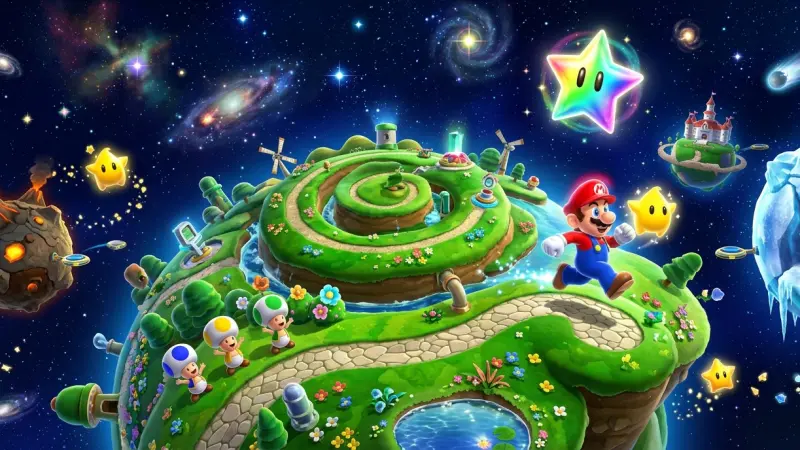
There is a specific, unmistakable sound that echoes through the minds of a certain generation of gamers: the gleeful, physics-defying stretch of a Launch Star. It begins as a low mechanical hum, builds into a frantic whirl of sparkling energy, and culminates in a euphoric burst of speed as a plumber in red overalls is hurled across the vacuum of space, arms outstretched, tumbling toward a tiny, glowing planetoid. If you have spent any time scrolling through entertainment news over the last few months, you might have noticed something fascinating happening beneath the surface of the usual blockbuster updates and award season chatter. A quiet but undeniable trend is taking root, one driven by a collective yearning for comfort, artistry, and unadulterated joy. We are living in an era defined by a relentless stream of content, where every week brings a new Netflix release demanding our immediate attention, and the streaming buzz cycles through viral series at a breakneck pace. Yet, amid this cacophony, audiences are consistently turning their eyes upward, revisiting a nearly two-decade-old masterpiece. Super Mario Galaxy is not just a game; it has become a cultural touchstone, a high quality benchmark of creativity that perfectly captures why we look to art for escape, and its resurgence says everything about where pop culture is right now.

To understand why this cosmic adventure is suddenly the focal point of so much pop-culture curiosity, you have to look at the current state of entertainment consumption. We are deeply fatigued by the endless grind of modern media. Open-world games have become bloated checklists, and prestige television often mistakes bleakness for depth. Sitting on my couch on a recent rainy Sunday, remote in hand, I found myself paralyzed by the infinite scroll of a streaming interface. I passed by a heavily marketed new Netflix release that promised gritty thrills, skimmed past the trailers for the latest viral series that everyone on social media was arguing about, and felt a sudden, overwhelming craving for pure, unpretentious magic. I booted up my Nintendo Switch, selected Super Mario Galaxy, and within minutes, the tension of the week melted away. There is a striking metaphor for what playing this game feels like: it is exactly like conducting a symphony inside a shattered snow globe. Every jump, every spin attack, every wandering bubble of light feels meticulously orchestrated yet beautifully fragile, existing in its own delicate, self-contained universe. The current trend of returning to retro and classic games is not just nostalgia; it is a conscious rejection of the idea that art must be exhausting to be worthwhile. Galaxy offers a high quality alternative—a world where the rules of gravity are merely suggestions, and the only objective is to experience wonder.
The sheer audacity of Super Mario Galaxy’s design remains unmatched, and it is precisely this structural brilliance that makes it feel so relevant to modern audiences who are currently binge-watching episodic storytelling. Think about how a truly great viral series operates. It gives you a complete, satisfying narrative bite in twenty to forty minutes before setting up the next hook. Galaxy operates on this exact same rhythm, disguised as a platformer. Instead of one massive, overwhelming map, the game presents you with a series of distinct, bite-sized galaxies. You might spend fifteen minutes navigating a glass-enclosed garden where you launch yourself from a giant spring flower, and the next, you are surfing on a manta ray across a turbulent, electric ocean. Each galaxy is its own perfectly paced episode. Consider the Good Egg Galaxy, the game’s introductory true challenge. It introduces you to the core mechanics not with a tedious tutorial, but by immediately asking you to wrap your brain around running upside down around a planet no bigger than a suburban house. You encounter the Lumas, those adorable, chirping star-shaped creatures, and you meet Rosalina, a figure of quiet, maternal melancholy who watches over the cosmos. The pacing is so remarkably tight that it feels like the work of showrunners who know exactly how to leave you wanting more. In an entertainment landscape where audiences are abandoning sprawling, hundred-hour epics in favor of tightly woven, focused experiences, Galaxy was prophetically ahead of its time.
Then there is the music, an element that single-handedly elevates the experience into something transcendent and deeply emotional. If you want to know why this game continues to generate streaming buzz and dominate conversations among gaming enthusiasts, look no further than its soundtrack, composed by Mahito Yokota and Koji Kondo. Before Galaxy, Mario games relied on bouncy, synthesized MIDI tracks that were catchy but technologically limited. This game threw that constraint out the airlock and brought in a full, live-recorded orchestra. When you step foot into the Gusty Garden Galaxy, a lush, string-heavy waltz begins to play. It swells and dips with the exact momentum of Mario’s jumps, creating a sensory feedback loop that is practically intoxicating. The brass section punches in when you defeat a boss, the piano notes trickle like stardust as you long-jump across a chasm, and the choir hums softly in the background as you drift through the observatory. It is a high quality artistic achievement that rivals any cinematic score you would hear in a blockbuster new Netflix release. The music does not just accompany the action; it validates your emotions. It makes you feel like a cosmic adventurer rather than a guy pressing buttons on a plastic controller. In today’s content-saturated world, where so much of what we consume feels algorithmically generated and sonically flat, the sheer human warmth of a live orchestra thundering through a space level is enough to make you put the controller down and just listen.
Beyond the mechanics and the music, there is a deeper, more poignant reason why Super Mario Galaxy resonates so strongly right now, and it lies in the unexpectedly profound story of Rosalina. Tucked away in the game’s hub world is a library where players can read a storybook. If you choose to ignore it, the game is still a masterpiece. But if you engage with it, you find a high quality piece of speculative fiction about grief, impermanence, and the cyclical nature of the universe. Rosalina recounts leaving her home planet, leaving her family behind, and watching as centuries pass while she remains unchanged, traveling the stars. It is a narrative about learning to let go of the past to embrace the infinite possibilities of the future. When you reach the game’s finale, and the universe quite literally collapses in on itself—a terrifying, beautiful sequence where the screen goes dark and the music fades into an eerie, ambient hum—there is a genuine sense of existential loss. When the game resets, born again from a big bang of light and orchestrated jubilation, it feels earned. This kind of mature, understated emotional storytelling is exactly what audiences are craving right now. We see this trend mirrored in the most successful television shows and films, where creators are realizing that audiences are smart enough to handle complex themes embedded within fantastical settings. Rosalina’s story is a masterclass in show-don’t-tell, providing a gravitational center to a game that could have otherwise been weightless.
The conversation around Super Mario Galaxy today is inevitably tangled up in the broader business of entertainment news, particularly the monumental success of the Super Mario Bros. Movie and the impending wave of Nintendo adaptations. As studios scramble to figure out the next step in this lucrative trend, the gaming community has made its voice clear: Galaxy is the undisputed crown jewel of the franchise, and it demands the big-screen treatment. Imagine the visual spectacle of a studio like Illumination—or perhaps a bolder auteur director—translating the shifting gravity, the vibrant color palettes, and the sheer scale of the cosmic observatory into a feature film.
The streaming buzz surrounding video game adaptations has reached a fever pitch, with every viral series and every successful movie spawning a dozen imitators. But the lesson of Super Mario Galaxy is not just that you can make anything into a movie; it is that art thrives on creative constraints and imaginative leaps. A movie based on Galaxy wouldn’t need to be a gritty reboot or a grounded origin story. It would need to embrace the surrealism. It would need to capture that snow-globe symphony feeling. As the industry looks toward the future, eyeing the next massive franchise to adapt, Galaxy stands as the ultimate blueprint for how to balance broad, four-quadrant appeal with genuine artistic ambition. It proves that you do not have to sacrifice wonder to make something widely accessible.
Ultimately, the journey beyond the stars that Super Mario Galaxy offers is a deeply personal one, even if millions of people have taken the exact same path. It reminds us of a time when the biggest trend in entertainment wasn't about how realistic the graphics were or how many hours of content were packed into a disc, but about how a piece of art could make you feel. In a media ecosystem driven by anxiety over what to watch next, what the next new Netflix release will be, or which viral series everyone will be memeing on Monday morning, returning to the Comet Observatory is a profound act of self-care. It is a reminder to look up. The game ends with Mario’s brother, Luigi, stepping out onto a grassy hill under a vast, starry sky, looking up at the cosmos with a sense of quiet awe. It is a fitting final image for a game that transcended its medium. Super Mario Galaxy is not just a high quality relic of the past; it is a living, breathing challenge to the present. It asks us, gently but firmly, to never stop seeking out the magic in the dark, to always be willing to launch ourselves into the unknown, and to remember that sometimes, the most powerful thing a story can do is simply help us float.
Frequently Asked Questions
What is Super Mario Galaxy? Super Mario Galaxy is a critically acclaimed 3D platformer developed by Nintendo for the Wii, first released in 2007. The game follows Mario as he journeys across various galaxies to rescue Princess Peach from Bowser, introducing innovative gravity-based gameplay mechanics.
Why is Super Mario Galaxy trending right now? The game is seeing renewed attention in entertainment and pop culture discussions due to growing fatigue with overly complex modern games, the success of recent Mario films, and a broader trend of players revisiting polished, tightly designed retro classics now available on the Nintendo Switch.
Is Super Mario Galaxy available on the Nintendo Switch? Yes, Super Mario Galaxy is available on the Nintendo Switch as part of the Super Mario 3D All-Stars collection. While the physical edition was limited, the digital version remains accessible for download.
How does the gravity mechanic work in the game? The game features dynamic gravity mechanics that allow Mario to walk around spherical planetoids. Gravity pulls him toward the center of each object, enabling full 360-degree movement and creative platforming challenges.
Who composed the music for Super Mario Galaxy? The soundtrack was composed by Mahito Yokota and Koji Kondo.
It is widely praised for being one of the first Mario titles to feature a fully orchestrated score, giving the game a cinematic and expansive feel.
Is there a connection between Super Mario Galaxy and the new Mario movie? While the recent Mario film focuses on the origins of the characters, its success has sparked fan interest in a sequel that could explore the cosmic themes and mechanics introduced in Super Mario Galaxy.
What is Rosalina’s Storybook? Rosalina’s Storybook is an optional narrative found in the game’s hub world. It explores Rosalina’s childhood, her loss, and her journey to becoming the guardian of the cosmos, adding emotional depth to the story.
Why do people compare the game’s structure to a viral series? The game is often compared to binge-worthy series because it is divided into short, self-contained galaxies. Each level delivers a complete and satisfying experience, making it highly engaging and easy to play in short sessions.
Does Super Mario Galaxy hold up graphically today? Yes, the game’s strong art direction ensures it still looks impressive. Its vibrant colors, imaginative designs, and effective lighting continue to feel modern despite its 2007 release.
What makes this game different from Mario 64 or Sunshine? Unlike the grounded worlds of Super Mario 64 or the tropical setting of Super Mario Sunshine, Galaxy embraces a space-based design.
This shift allows for greater verticality, unique physics interactions, and more surreal level design.
How long does it take to beat Super Mario Galaxy? A standard playthrough takes around 12–15 hours. Completionists aiming to collect all 121 Power Stars can expect 25–30 hours of gameplay.
Is there multiplayer in Super Mario Galaxy? Yes, the game includes a cooperative mode where a second player controls a Star Cursor. This player can assist by collecting Star Bits, stunning enemies, and helping Mario navigate levels.
What is the Comet Observatory? The Comet Observatory serves as the game’s central hub. It is a peaceful space station where Rosalina and the Lumas reside, and it provides access to the various galaxies.
Why is there so much interest in retro games right now? Retro games are gaining popularity due to “content fatigue” with modern titles. Players are drawn to their straightforward design, immediate enjoyment, and lack of microtransactions or excessive complexity.
Could Super Mario Galaxy be adapted into a Netflix series or show? While Nintendo carefully manages its intellectual properties, the success
of recent game adaptations suggests strong potential. A well-produced series based on Super Mario Galaxy could resonate strongly with audiences.
What is the “Luigi ending” in the game? After collecting all 121 Power Stars and completing the game as Luigi, players unlock a special ending. It features a quiet, reflective scene that reinforces the game’s themes of wonder and exploration.

Disclaimer: The information provided in this article is for general informational and research purposes only. Company details, features, services, and market positions may change over time. Readers are advised to visit official company websites and conduct independent research before making any business decisions or purchasing services.
Most Searchable Keywords

Recent Blogs



Related Listings


Categories
- Accountants (295)
- Advertising Agencies (559)
- Architects (149)
- Automobiles (377)
- Beauty (300)
- Carpenters (146)
- Cleaning Services (386)
- Dentists (189)
- Driving (62)
- Electricians (215)
- Energy (8)
- Event Organiser (685)
- Finance (598)
- Guide (3364)
- Health (2207)
- Information technology (206)
- Legal Services (353)
- Logistics (6)
- Maintenance (65)
- Manufacturing (35)

Sponsored Listings in Locksmith Services


Related Blogs

Where to Find the Best Summer Festivals in Br...
Read this insightful article "Where to Find the Best Summer Festivals in Bristol" to expand your knowledge!

Provisional Driving Licence UK Benefits and L...
Read this insightful article "Provisional Driving Licence UK Benefits and Limits Explained" to expand your knowledge!

Ross on Wye Minibus Hire for Group Travel Mad...
Read this insightful article "Ross on Wye Minibus Hire for Group Travel Made Simple" to expand your knowledge!
Questions & Answers – Find What
You Need, Instantly!
How can I update my business listing?
Is it free to manage my business listing?
How long does it take for my updates to reflect?
Why is it important to keep my listing updated?
