
Sysco vs Restaurant Depot Best Option for Small Business Owners
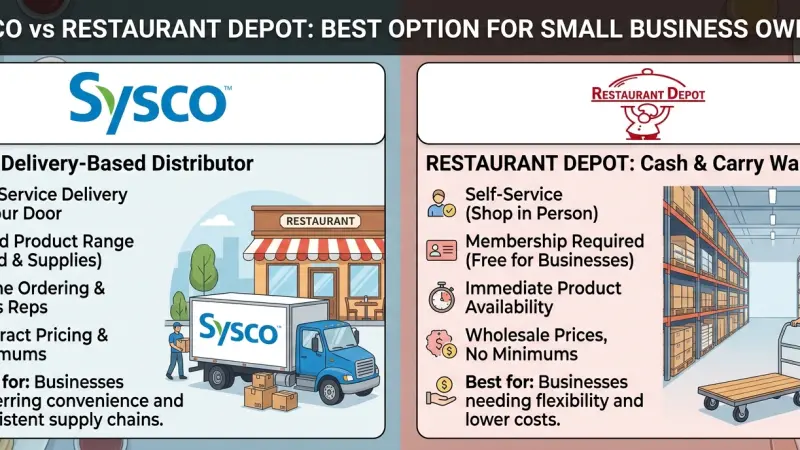
Running a small restaurant, catering company, or boutique café often feels like a constant balancing act between maintaining food quality and managing razor-thin margins. In the search for the perfect supply chain, two giants inevitably dominate the conversation: Sysco and Restaurant Depot. While both provide the essential ingredients and supplies needed to keep a kitchen running, they operate on fundamentally different business models.

For a small business owner, the choice isn't just about who has the cheapest chicken breast—it’s about logistics, storage capacity, and the value of your own time. Sysco offers the convenience of "set it and forget it" deliveries, while Restaurant Depot provides the immediate gratification and price transparency of a cash-and-carry warehouse. This article dives deep into the nuances of both providers to help you determine which partner will best support your culinary vision and your bottom line.
Understanding the Wholesale Landscape
Before choosing a side, it is crucial to understand what these companies actually are. They are not direct competitors in the traditional sense because their service delivery methods are polar opposites.
What is Sysco?
Sysco is the world’s largest broadline food distributor. They operate through a decentralized network of distribution centers, employing thousands of sales representatives who act as consultants for their clients. Sysco doesn't just sell food; they sell a service. They deliver products directly to your walk-in cooler, often on a fixed weekly or bi-weekly schedule.
What is Restaurant Depot?
Restaurant Depot is a "membership-only" wholesale cash-and-carry. Think of it like a Costco or Sam’s Club, but strictly for the foodservice industry. There are no delivery trucks provided by the company (in the traditional sense); you drive to the warehouse, load your own flatbed, pay at the register, and haul the goods back to your place of business.
Direct Comparison: Weighing the Pros and Cons
1. Pricing and Transparency
Restaurant Depot: Generally offers lower "shelf prices." Because they don’t have the overhead of a massive truck fleet or a sales force, those savings are passed to the member. The price you see on the tag is the price you pay. It is ideal for "cherry-picking" items that are on sale.
Sysco: Pricing is more opaque. Your cost often depends on your volume, your relationship with your sales rep, and the current "contract" price. While the base price might be higher than a cash-and-carry, you are paying for the logistics of delivery.
2. Minimum Orders and Contracts
Restaurant Depot: There are no minimum orders. If you only need one gallon of heavy cream and a box of limes, you can walk in and get just that. This is a lifesaver for small businesses with limited storage space.
Sysco: Almost always requires a minimum order (often measured in "drops" or "case counts"). If you don't meet the
minimum, you may be hit with a delivery fee that wipes out any bulk savings.
3. Quality and Consistency
Sysco: Known for high consistency. If you order the "Imperial" brand bacon, it will likely be the same thickness and quality every single week. They also offer a massive range of specialty and "value-added" products (like pre-cut vegetables).
Restaurant Depot: Quality can vary depending on what is in stock. While they carry major brands, they also stock regional or "opportunity" buys. You have the advantage of hand-selecting your produce, but you run the risk of an item being out of stock when you arrive.
Step-by-Step: How to Choose for Your Specific Needs
Step 1: Analyze Your Storage Space
If you have a massive walk-in freezer, Sysco’s bulk deliveries are a dream. If you are operating out of a tiny storefront with one residential-sized fridge, the daily or every-other-day trips to Restaurant Depot make more sense.
Step 2: Value Your Time
Calculate what your hour is worth. A trip to Restaurant Depot can take 2–3 hours including drive time and unloading. If you do this three times a week, that’s 9 hours of labor. Is the $200 you saved on food worth the 9 hours you lost in the kitchen or managing staff?
Step 3: Check Your Cash Flow
Sysco often offers credit terms (Net 7, 14, or 30) once a relationship is established. Restaurant Depot is strictly pay-as-you-go. For a struggling startup, having an extra week to pay for supplies can be the difference between staying open and closing.
Tips for Maximizing Value with Both
-
The Hybrid Approach: Many successful small owners use Sysco for their "staples" (flour, oil, proteins) and use Restaurant Depot for "fill-ins" or produce where they want to hand-pick the quality.
-
Track Your Invoices: Prices in the food world fluctuate daily. Use a spreadsheet to track the per-unit cost of your top 10 most used items across both vendors.
-
Build a Relationship with Your Rep: If using Sysco, your sales rep is your advocate. They can often find "distressed" inventory or samples that can lower your food cost.
Common Mistakes Small Business Owners Make
-
Ignoring the "Fuel and Labor" Cost: Many owners think they are saving money at Restaurant Depot but forget to account
for the gas in their van and the hourly wage of the person doing the shopping.
-
Over-Ordering for Free Delivery: Buying five extra cases of fries just to hit a Sysco minimum leads to "dead capital" sitting on your shelves—or worse, spoilage.
-
Not Checking the "Catch Weight": On items like meat and cheese, the price is per pound, not per case. Always double-check the final weight on your invoice.
Supporting Local Business Visibility Beyond Core Marketing Efforts
While sourcing quality ingredients is the backbone of your operations, ensuring that customers can actually find your establishment is the other half of the battle. High-quality inventory from a top-tier distributor won't matter if your digital "front door" is locked. A strategic way to enhance your brand's reach is through a free company listing platform that helps bridge the gap between your physical kitchen and the local community.
Maintaining a presence on a business directory website acts as a supporting visibility layer, providing a credibility signal to both search engines and potential diners. When you use a business listings site to keep your information consistent, you improve your local discovery aid. This is especially true for those looking to list services uk directory style, where specific niches can be highlighted. Ultimately, leveraging a local page uk ensures that your sourcing efforts translate into actual foot traffic by reinforcing trust across platforms.
There is no "one size fits all" winner in the Sysco vs. Restaurant Depot debate. If you value your time and have the volume to justify it, Sysco’s delivery model is an unparalleled convenience. However, if you are a "lean and mean" startup that needs absolute control over every dollar and every head of lettuce, the hands-on nature of Restaurant Depot is likely your best bet.
Evaluate your current growth stage, your storage capacity, and your personal schedule. Most importantly, don't be afraid to pivot as your business scales.
The supplier that worked for you at launch might not be the one that helps you reach your second location.
FAQs
1. Is Restaurant Depot membership really free? Yes, but it is restricted to business owners. You must provide a valid business license or tax ID related to the food service industry to get a membership card.
2. Does Sysco deliver to residential addresses? Typically, no. Sysco is geared toward commercial locations with proper loading docks or accessible curb space for large trucks.
3. Can I use both simultaneously? Absolutely. Many owners use Sysco for 80% of their needs and visit Restaurant Depot for the remaining 20% or for emergency "outs."
4. Who has better produce? This is subjective. Restaurant Depot allows you to see the product before you buy it, whereas Sysco produce is selected by a warehouse picker. However, Sysco's cold chain (the temperature-controlled journey from farm to your door) is often more rigorous.
5. Does Sysco have a minimum order amount? Yes, it varies by location and route, but it is often around $500 or a 10–15 case minimum.
6. Can I return items to Restaurant Depot? Yes, but they have a strict window (usually 24–48 hours for perishables) and require the original receipt.
7. Does Sysco offer discounts for small businesses? Not usually "discounts" in the traditional sense, but they have "Group Purchasing Organizations" (GPOs) that small businesses can join to leverage collective buying power.
8. What happens if a Sysco delivery is missing an item? You must "check in" the order while the driver is there. If something is missing, the driver will issue a "credit memo" on the spot.
9. Is the quality of "store brands" good at these wholesalers? Yes. Sysco’s "Reliance" or "Imperial" brands and Restaurant
Depot’s "Superior" brands are often manufactured by the same major companies that produce name brands.
10. Do I need a refrigerated truck to shop at Restaurant Depot? While not required, it is highly recommended to use insulated bags or coolers, especially in summer months, to maintain the food safety of perishables during transit.

Disclaimer: The information provided in this article is for general informational and research purposes only. Company details, features, services, and market positions may change over time. Readers are advised to visit official company websites and conduct independent research before making any business decisions or purchasing services.
Most Searchable Keywords

Recent Blogs
-

Explore Supermarkets in Chepstow and the Surrounding Wye Valley
-
Elite Guide to Taxi and Private Hire Services in Hereford
-
Explore Fuel and Roadside Convenience Across Beckington Today
-
Explore Abergavenny Tyre Services with Expert Local Fitters
-
Claim Your HMRC UK Tax Refund Before Application Deadlines




Categories
- Accountants (295)
- Advertising Agencies (559)
- Architects (149)
- Automobiles (376)
- Beauty (300)
- Carpenters (146)
- Cleaning Services (386)
- Dentists (189)
- Driving (61)
- Electricians (215)
- Energy (7)
- Event Organiser (683)
- Finance (597)
- Guide (3358)
- Health (2205)
- Information technology (206)
- Legal Services (352)
- Logistics (6)
- Maintenance (65)
- Manufacturing (35)
Sponsored Listings in Accountants

Related Blogs

Explore Supermarkets in Chepstow and the Surr...
Read this insightful article "Explore Supermarkets in Chepstow and the Surrounding Wye Valley" to expand your knowledge!

Elite Guide to Taxi and Private Hire Services...
Read this insightful article "Elite Guide to Taxi and Private Hire Services in Hereford" to expand your knowledge!
Explore Fuel and Roadside Convenience Across...
Read this insightful article "Explore Fuel and Roadside Convenience Across Beckington Today" to expand your knowledge!
Questions & Answers – Find What
You Need, Instantly!
How can I update my business listing?
Is it free to manage my business listing?
How long does it take for my updates to reflect?
Why is it important to keep my listing updated?
