
Tell Us Once What It Does After a Death
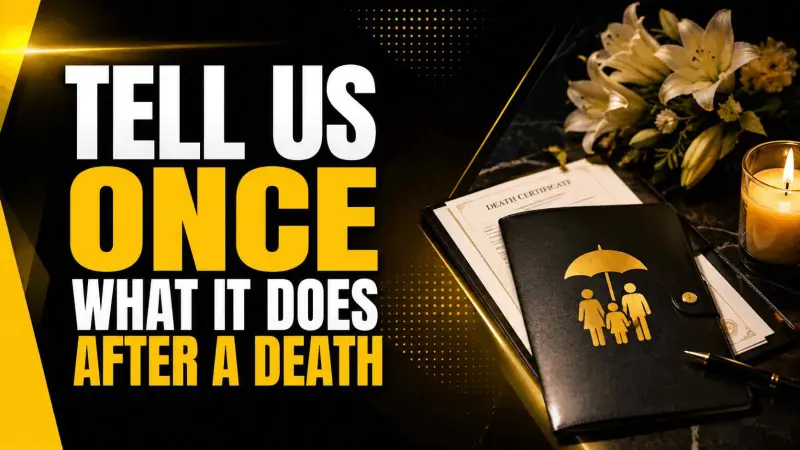
When someone dies, the practical tasks can feel almost impossible to face. Alongside arranging a funeral and dealing with grief, families may suddenly have to notify government departments, stop benefits, update council records, deal with passports and driving licences, and work out what happens to pensions and tax.
There is, however, a free UK government service designed to remove a significant part of that administrative burden: Tell Us Once.
Tell Us Once allows you to report a death to most relevant government organisations in one go rather than contacting many departments separately. Depending on the circumstances, it can notify organisations including HM Revenue and Customs (HMRC), the Department for Work and Pensions (DWP), the Driver and Vehicle Licensing Agency (DVLA), HM Passport Office, local council services and certain public-sector pension schemes.
The important limitation is that Tell Us Once does not deal with everything. Banks, mortgage companies, private pension providers, insurers, utility companies, employers and other private organisations normally still need to be contacted separately.
That distinction matters. Using Tell Us Once can save a grieving family from repeating the same information to multiple public bodies, but it is not a complete "notify everyone" service.
This guide explains exactly what Tell Us Once does, who can use it, what information you need, what happens afterwards, what it does not cover and what you should do next.
How Tell Us Once works after someone dies
What is Tell Us Once?
Tell Us Once is a free government service that lets you report a death to most central and local government organisations at the same time.
Instead of separately notifying several government departments, you provide the information once through the Tell Us Once process. The relevant organisations can then update their records, stop services or benefits where appropriate, and contact the bereaved family if further information or action is required.
It is a voluntary service. You do not have to use it, but without it you may have to contact the relevant government organisations individually.
The service is particularly useful because the same basic information about the deceased would otherwise have to be supplied repeatedly.
Who can use Tell Us Once?
Tell Us Once can generally be used when the person who died was living in England, Scotland or Wales. This also applies where someone normally lived in one of those countries but died temporarily abroad, such as while on holiday or a business trip.
The death must normally have been registered, or reported to a coroner with a final or interim death certificate.
Tell Us Once cannot be used where the person was living in Northern Ireland when they died, or where they were permanently living abroad.
There are also specific arrangements for some circumstances, including deaths involving children or babies. For example, if a child or baby has died, a parent or carer receiving benefits may still need to contact DWP separately about their own entitlement.
When do you use Tell Us Once?
The service normally comes into the process after the death has been registered.
The registrar should explain Tell Us Once and either complete the process with you or provide a unique reference number so that you can complete it yourself.
Depending on the registration arrangements, you may be able to provide the information during or after your appointment.
Some councils advise completing the process promptly and within the period specified for the reference number. For example, local authority guidance commonly states that the service should be used within 28 days of the reference being issued.
If you are given a Tell Us Once reference number, keep it somewhere secure until the process has been completed and you are satisfied that the relevant departments have received the notification.
What information do you need?
It helps to gather as much information as possible before using Tell Us Once.
You may need details about the person who died, including:
- Full name
- Date of birth
- Address
- National Insurance number
- Driving licence number
- Vehicle registration details
- Passport number
- Benefits or entitlements they received
- Local council services they used
- Public-sector or Armed Forces pension information
- Details of their next of kin
- Details of a surviving spouse or civil partner
- Details of the person dealing with the estate
You may also need information about the executor or administrator responsible for handling the deceased person's estate.
Having these details ready can make the process considerably easier.
Do not worry if you cannot immediately find every document. The purpose of the service is to make the administrative process easier, not to create another hurdle for someone who has just experienced a bereavement.
What government organisations does Tell Us Once notify?
The exact organisations and services can vary, but Tell Us Once can notify a range of major government bodies.
| Organisation or service | What notification may help with |
|---|---|
| HMRC | Personal tax, Child Benefit and certain tax credits |
| DWP | State Pension and other benefits or entitlements |
| DVLA | Driving licence and registered keeper information |
| HM Passport Office | Cancellation of a British passport |
| Local council | Council Tax, housing services, electoral registration and certain local benefits/services |
| Veterans UK | Relevant Armed Forces compensation or pension arrangements |
| Certain public-sector pension schemes | Updating records and stopping future payments |
GOV.UK confirms that Tell Us Once also contacts certain public-sector pension schemes, including the Armed Forces Pension Scheme, Civil Service Pension Scheme, Local Government Pension Schemes, NHS Pensions in England and Wales, and certain Scottish public pension schemes.
The list should not be treated as completely static. Always check the current GOV.UK guidance and the information provided by the registrar.
Does Tell Us Once stop benefits automatically?
It can notify DWP and other relevant government bodies that the person has died. Those departments then deal with the person's benefits and entitlements.
However, Tell Us Once is not itself a benefits claim service. If you or another surviving family member may be entitled to a benefit following the death, you may need to make a separate claim or contact the relevant department.
This distinction is easy to miss.
For example, a deceased person's State Pension may need to be stopped, while a surviving spouse or partner may separately need to investigate whether they qualify for bereavement-related financial support.
Does Tell Us Once deal with tax?
Tell Us Once can notify HMRC about the death so that HMRC can deal with the deceased person's personal tax position and relevant benefits or credits.
That does not mean every tax matter connected with the deceased automatically disappears.
If the person owned a business or had business tax obligations, for example, additional contact with HMRC may be required. Local guidance specifically warns that business taxes such as VAT may need to be dealt with separately.
The estate may also have tax responsibilities while assets are being administered.
This is one reason Tell Us Once should be viewed as the beginning of the government notification process rather than a replacement for dealing with the estate.
Does it cancel a passport?
Yes. Tell Us Once can notify HM Passport Office so that the deceased person's British passport can be cancelled.
That is one less government organisation the family normally needs to contact separately.
You should still follow any instructions you receive regarding the physical passport or other documentation.
Does it deal with a driving licence and vehicle?
Tell Us Once can notify the DVLA about the person's death.
This can help with cancellation of the driving licence and updating the registered keeper information for vehicles associated with the deceased. GOV.UK guidance states that Tell Us Once can notify DVLA and remove the deceased person as keeper for relevant vehicles.
However, this does not mean ownership of a vehicle has automatically been transferred to an heir.
If a vehicle forms part of the estate, the executor or administrator still needs to deal with ownership, insurance, sale or transfer arrangements as appropriate.
Does Tell Us Once notify the bank?
No.
This is one of the most important limitations to understand.
Tell Us Once is designed for government and certain public-sector organisations. It does not notify commercial organisations such as banks, mortgage providers, insurers, utility companies or private pension providers.
If the deceased had a current account, savings account, credit card, mortgage, personal pension or insurance policy, the relevant provider will normally need to be contacted separately.
The same applies to companies providing services such as broadband, mobile phone contracts or other subscriptions.
What organisations do you still need to contact?
A useful way to think about the process is to divide it into two groups.
Tell Us Once can cover many government-related notifications.
You still handle most private-sector notifications yourself.
You may need to contact:
- Banks and building societies
- Mortgage lenders
- Credit card companies
- Personal pension providers
- Private insurance companies
- Life insurance providers
- Employers
- Utility companies
- Mobile phone providers
- Internet providers
- Subscription services
- Landlords or housing associations
- Private investment platforms
- Professional memberships
- Charities receiving regular payments
- Clubs and organisations
- Social media or online account providers
GOV.UK specifically warns that organisations outside government, including employers, private pension providers, banks and utility companies, still need to be told.
What happens after you use Tell Us Once?
Once the relevant government organisations receive the notification, they may contact the family if further information is required.
HMRC and DWP may contact you about tax, benefits and entitlements.
You should therefore keep an eye on post and correspondence after completing Tell Us Once.
Do not assume that silence means everything has been finalised. If a department asks for evidence or information, respond according to its instructions.
At the same time, avoid unnecessarily sending sensitive documents to multiple departments unless requested.
What if you do not use Tell Us Once?
You can still notify the relevant government departments yourself.
GOV.UK provides separate guidance for situations where Tell Us Once is unavailable or you do not have a reference number. This includes information about contacting pension providers, DVLA, HM Passport Office, Social Security Scotland and other organisations.
The practical downside is that you may have to repeat information several times.
That can be particularly difficult during bereavement, when even straightforward administrative tasks can feel overwhelming.
What if you lose your Tell Us Once reference number?
Do not panic.
The correct procedure depends on how the death was registered and your local registration arrangements. If you cannot access the service using the reference number you were given, check the current GOV.UK instructions or contact the registration service that handled the death.
Avoid relying on an old telephone number or third-party website because procedures can change.
The official GOV.UK service remains the safest starting point.
Is Tell Us Once compulsory?
No. Tell Us Once is voluntary.
You can choose to contact government organisations individually instead.
In practice, however, most families who are eligible are likely to find it useful because it reduces duplication.
The decision may also depend on how complicated the deceased person's affairs are and whether someone else, such as a solicitor or professional executor, is handling the administration.
Does using Tell Us Once mean the estate is dealt with?
No.
This is perhaps the biggest misconception.
Tell Us Once is a notification service, not an estate-administration service.
It does not:
- Apply for probate
- Identify all assets
- Value the estate
- Pay debts
- Distribute inheritance
- Close bank accounts
- Sell property
- Deal with private pensions
- Complete every tax obligation
- Cancel every commercial contract
- Redirect post
- Arrange the funeral
The estate's executor or administrator remains responsible for dealing with the deceased person's property, money, debts and other affairs.
GOV.UK separately provides guidance on administering an estate and obtaining probate where necessary.
A practical order of tasks after a death
There is no single checklist that works perfectly for every family, but a sensible sequence can prevent important tasks from being overlooked.
Step 1: Register the death
Follow the applicable registration process and obtain the necessary documents.
The registrar should explain Tell Us Once as part of the process.
Step 2: Use Tell Us Once
Use the service as soon as reasonably practical once you have the reference and required information.
This deals with many government notifications in one process.
Step 3: Start contacting private organisations
Create a list of financial and commercial organisations.
Start with:
- Banks and building societies
- Mortgage providers
- Insurance companies
- Pension providers
- Employer
- Utility companies
- Investment providers
- Landlord or housing provider
- Subscription and telecom companies
Step 4: Secure important documents
Keep the will, death certificates, financial statements, insurance paperwork, property documents and other important records together.
The executor may need them later.
Step 5: Deal with the estate
Establish what the deceased owned and owed.
Depending on the circumstances, probate or another legal authority may be required before assets can be dealt with.
Step 6: Check whether anyone else is entitled to support
A surviving spouse, partner, child or other dependant may have separate entitlement to benefits, pensions or insurance payments.
Do not assume that Tell Us Once automatically makes those claims for you.
Why Tell Us Once is valuable during bereavement
The biggest advantage is not simply saving time.
It reduces the number of times a grieving person has to explain the same event.
Imagine someone has just lost a parent. Without a consolidated government notification service, they might have to contact several departments individually, provide the deceased person's details repeatedly and keep track of which organisations have been notified.
Tell Us Once removes much of that repetition.
It also creates a clearer division of responsibility: government bodies can be informed centrally, while the executor focuses on the separate task of administering the estate.
Common mistakes families make
Assuming Tell Us Once contacts everyone
It does not. Private companies generally remain your responsibility.
Treating Tell Us Once as a probate service
It is not. Probate and estate administration are separate processes.
Assuming benefits automatically transfer
They do not. A surviving person may need to make a separate claim.
Forgetting private pensions
Tell Us Once covers certain public-sector schemes, but personal and many workplace pensions need separate notification.
Ignoring business affairs
A deceased person who operated a business may have additional tax and legal obligations.
Keeping no record of notifications
Create a simple spreadsheet or notebook recording the organisation, date contacted, reference number and any action still outstanding.
That small step can prevent considerable confusion later.
How Tell Us Once fits into modern bereavement administration
The wider trend is toward reducing repetitive government administration through connected public services.
Tell Us Once is an example of this approach: rather than asking bereaved families to repeatedly
supply identical information, government services can share the relevant notification securely with participating organisations.
That does not eliminate the need for human involvement. Instead, it moves some of the repetitive work away from the family.
Future improvements could potentially make bereavement administration more integrated, particularly as digital identity, online government services and automated information exchange develop. However, any expansion would need to balance convenience with privacy, security, consent and the need to protect vulnerable families.
It would also be important to preserve alternatives for people who cannot easily use digital services.
For now, the safest approach is straightforward: use Tell Us Once for the government organisations it covers, then separately work through the financial, legal and commercial affairs of the deceased.
Where to find the official guidance
Because bereavement procedures can change, use the current GOV.UK information rather than relying on old checklists, social media posts or commercial websites.
The official guidance explains eligibility, how the service works and what to do if you cannot use Tell Us Once.
Your local registrar can also explain how Tell Us Once is handled in your area.
If the estate is complicated, professional advice from a solicitor, probate specialist, accountant or appropriately qualified adviser may also be worthwhile.
Key Insights
- Tell Us Once is free and voluntary, and can report a death to many government organisations in one process.
- It can notify bodies such as HMRC, DWP, DVLA, HM Passport Office and relevant local council services.
- It does not notify banks, private pension providers, insurers, utility companies or most other commercial organisations.
- Using Tell Us Once does not apply for benefits on behalf of surviving relatives.
- It is a notification service, not a probate or estate-administration service.
- Keep details such as the deceased person's National Insurance number, date of birth, passport and driving licence information available where possible.
- After using the service, watch for correspondence from HMRC, DWP and other notified organisations.
- Keep a separate checklist for banks, pensions, insurance, property, utilities and other private affairs.
FAQ
1. Is Tell Us Once really free?
Yes. Tell Us Once is a free government service. You do not pay to use it to notify participating government organisations about a death.
2. What does Tell Us Once actually do?
It allows you to report a death to most relevant government organisations in one process. Depending on the circumstances, this can include DWP, HMRC, DVLA, HM Passport Office, local councils and certain public-sector pension schemes.
3. Who is eligible to use Tell Us Once?
It is generally available where the deceased was living in England, Scotland or Wales. It cannot normally be used where the person was living in Northern Ireland or permanently abroad when they died.
4. Do I have to use Tell Us Once?
No. The service is voluntary. If you choose not to use it, you will generally need to contact the relevant government organisations yourself.
5. Does Tell Us Once contact banks?
No. Banks and building societies are commercial organisations and are not generally notified through Tell Us Once. The executor or appropriate person needs to contact them separately.
6. Does Tell Us Once cancel a passport?
It can notify HM Passport Office about the death so that the deceased person's British passport can be cancelled.
7. Does Tell Us Once deal with the deceased person's pension?
It can notify certain public-sector and Armed Forces pension schemes. Personal pensions and many private or workplace pension arrangements normally require separate notification.
8. Does Tell Us Once apply for bereavement benefits?
No. Tell Us Once reports the death but is not itself a benefits claim. A surviving spouse, partner, parent or other eligible person may need to make a separate claim.
9. Does Tell Us Once deal with probate?
No. Probate and estate administration are separate. The executor may still need to identify assets, pay debts and taxes, obtain the necessary legal authority and distribute the estate.
10. Does Tell Us Once redirect post?
No. Tell Us Once does not arrange mail redirection. That needs to be handled separately, normally through the relevant postal service.
11. Can Tell Us Once notify the council?
Yes. Tell Us Once can notify relevant local council services, which may include Council Tax, housing-related services, electoral registration and certain local benefits or services. The exact services depend on the local authority.
12. What information do I need for Tell Us Once?
Useful information includes the deceased person's date of birth, address, National Insurance number, driving licence details, vehicle registration, passport information, benefits and local services, together with details of the next of kin and person handling the estate.
13. What if I cannot find all the deceased person's documents?
Gather as much information as you reasonably can and follow the instructions from the registrar or GOV.UK. Do not delay necessary bereavement administration simply because one document is temporarily missing.
14. What happens after Tell Us Once is completed?
The notified organisations update their records and may contact the bereaved family if additional information or action is required. HMRC and DWP may contact you regarding tax, benefits or entitlements.
15. What should I do after using Tell Us Once?
Work through the private organisations that Tell Us Once does not cover. This usually includes banks, insurers, mortgage providers, private pension schemes, utilities, employers and other companies. Then continue with the legal and financial administration of the estate.
Final Thoughts
Tell Us Once cannot remove every administrative task that follows a death, but it can remove a substantial amount of repetitive government paperwork at a time when families are already under enormous emotional pressure.
The key is knowing exactly what the service does — and what it does not.
Use it to notify the participating government organisations, but do not assume that banks, insurers, private pension providers or other companies have been told. Likewise, remember that notifying the government is not the same thing as administering the estate or claiming benefits for surviving relatives.
A simple approach works best: register the death, use Tell Us Once, keep a record of what has
been dealt with, then work through the deceased person's private financial and legal affairs separately.
For the latest eligibility rules and official instructions, start with the GOV.UK Tell Us Once guidance rather than relying on an older checklist.
Disclaimer: The information provided in this article is for general informational and research purposes only. Company details, features, services, and market positions may change over time. Readers are advised to visit official company websites and conduct independent research before making any business decisions or purchasing services.
Most Searchable Keywords
Recent Blogs


Related Listings

Categories
- Accountants (295)
- Advertising Agencies (559)
- Architects (149)
- Automobiles (377)
- Beauty (300)
- Carpenters (146)
- Cleaning Services (387)
- Dentists (189)
- Driving (62)
- Education (1)
- Electricians (215)
- Energy (8)
- Event Organiser (687)
- Finance (602)
- Guide (3468)
- Health (2207)
- Information technology (206)
- Legal Services (361)
- Logistics (6)
- Maintenance (65)
Sponsored Listings in Legal Services

Related Blogs
30 Hours Free Childcare Eligibility and Recon...
Read this insightful article "30 Hours Free Childcare Eligibility and Reconfirmation" to expand your knowledge!

Term Time Holiday Fines Costs and Payment Rul...
Read this insightful article "Term Time Holiday Fines Costs and Payment Rules" to expand your knowledge!

16 to 25 Railcard Discount and Digital Versio...
Read this insightful article "16 to 25 Railcard Discount and Digital Version Explained" to expand your knowledge!
Questions & Answers – Find What
You Need, Instantly!
How can I update my business listing?
Is it free to manage my business listing?
How long does it take for my updates to reflect?
Why is it important to keep my listing updated?
