
30 Hours Free Childcare Eligibility and Reconfirmation
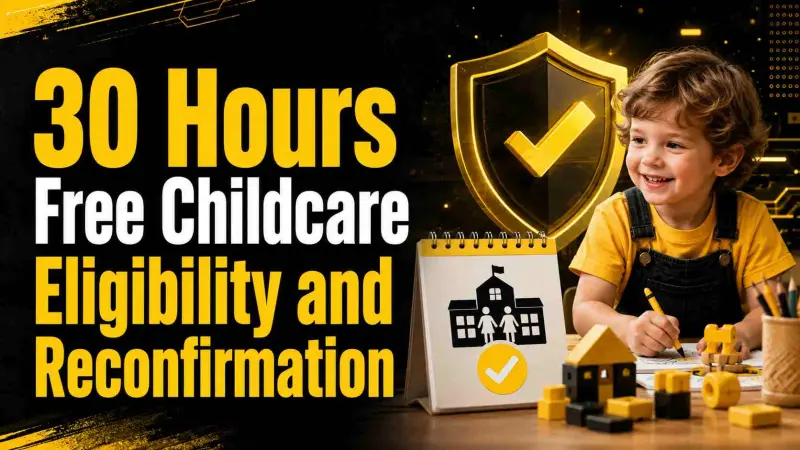
For eligible working families in England, 30 hours of free childcare can make a substantial difference to the cost of returning to work, increasing working hours or simply managing a household budget. But qualifying once is not the end of the process. Parents must also keep their eligibility up to date, and missing the three-monthly reconfirmation can create a surprisingly stressful problem.
The current Free Childcare for Working Parents scheme can provide up to 30 hours a week for 38 weeks of the year for eligible children aged from 9 months to 4 years old. The entitlement is available in England; Scotland, Wales and Northern Ireland operate different childcare arrangements.
The basic rule sounds simple: check whether you qualify, apply through the government childcare service, receive your eligibility code and give it to your nursery or childminder. The part that catches some families out is what happens afterwards. You generally have to sign into your childcare account every three months and confirm that your circumstances are still correct.
This guide explains who can qualify, how the earnings rules work, when to apply, what the 11-digit code means, what you actually receive, and how to avoid the 30 hours childcare reconfirmation trap.
How 30 hours free childcare works, who qualifies and why reconfirmation matters
What is the 30 hours free childcare scheme?
The 30 hours offer is government-funded childcare for eligible working parents in England. A qualifying child aged 9 months to 4 years can receive 30 hours of funded childcare a week for 38 weeks of the year. In some cases, providers may allow parents to stretch the funded hours over more weeks by using fewer hours each week.
That does not necessarily mean a nursery bill will become completely free.
The funded entitlement covers the eligible hours, but providers can still charge for things such as:
- Meals
- Nappies
- Additional hours
- Optional activities
- Trips or other extras
Exactly what a provider charges varies, so parents should ask for a full fee breakdown before accepting a place.
The scheme is also specifically an England entitlement. Families in Scotland, Wales and Northern Ireland need to check their own national childcare arrangements rather than assuming that the English 30-hour rules apply.
Who qualifies for 30 hours free childcare?
You can usually qualify if your child is aged 9 months to 4 years old, you live in England and you and your partner, if you have one, satisfy the working, earnings and other eligibility conditions.
You generally need to be:
- Working
- Starting a job
- Self-employed
- On eligible paid or unpaid leave connected with work
- On sick leave or annual leave
- On maternity, paternity, adoption or shared parental leave
- Receiving Statutory Neonatal Care Pay
- On certain other qualifying forms of leave or support
The rules can also cover some people who are not currently working where their partner works and they meet specified circumstances, such as receiving certain benefits or National Insurance credits.
Your child must normally live with you, and there is an important income ceiling: you or your partner must not expect adjusted net income above £100,000 for the current tax year. This is an individual threshold, meaning it can apply if either partner exceeds it.
How much do you need to earn?
This is one of the areas where parents can easily misunderstand the rules.
For the working-parent offer, you and your partner generally need to expect to earn at least a specified minimum amount over the three months following your application. The precise minimum is linked to the National Living Wage or National Minimum Wage and the number of hours you are expected to work.
Importantly, you do not necessarily need to work a conventional full-time job.
Your income can come from employment, self-employment or, in certain circumstances, a combination of jobs.
For example, someone working part-time for two employers may be able to combine their earnings when determining whether they meet the minimum income requirement. GOV.UK also states that if you are both employed and self-employed, you may be able to use your self-employment income if that makes you eligible.
Some income does not count towards the minimum earnings test. GOV.UK specifically identifies items including dividends, interest, property investment income and pension payments as income that does not count towards that minimum.
What happens if one parent earns more than £100,000?
The £100,000 limit is a major eligibility boundary.
If either you or your partner expects adjusted net income above £100,000 during the current tax year, you generally cannot receive the working-parent childcare offer. This remains the case even if the other parent earns considerably less.
This is why looking only at household income can give the wrong answer.
A couple might have a combined income of £130,000 and qualify if each person's individual adjusted net income remains below £100,000. Conversely, a couple with a combined income below £100,000 could be excluded if one person's adjusted net income exceeds the individual £100,000 limit.
Does maternity or parental leave affect eligibility?
Being away from work does not automatically mean you lose eligibility.
The government rules recognise several types of work-related leave, including maternity, paternity, adoption and shared parental leave. Sick leave and annual leave can also count.
However, timing matters.
If you are returning to work, the date you return can affect when you can apply and when the funded hours become available. GOV.UK provides separate application periods for parents returning from maternity, paternity, adoption or shared parental leave.
This can matter particularly for families planning childcare around a baby's first birthday. Applying too early or misunderstanding the term-start dates can result in parents having a valid application but not being able to use the funded hours when they expected.
When can you apply for 30 hours free childcare?
You can apply from when your child is 23 weeks old. However, the childcare itself normally begins from the relevant term after the child reaches 9 months, subject to meeting the other conditions and having a valid eligibility determination.
The three main term-start dates are:
| When your child turns 9 months | Funded childcare can start | Application deadline |
|---|---|---|
| 1 September–31 December | 1 January | 31 December |
| 1 January–31 March | 1 April | 31 March |
| 1 April–31 August | 1 September | 31 August |
These deadlines are particularly important because a parent can technically qualify but still miss the opportunity to start funded hours at the intended term if the application is not completed in time.
Why does the application deadline matter?
Imagine your child turns 9 months old in November.
You would normally be looking towards a 1 January start. The deadline for applying for that period is 31 December.
If you leave the application until January, you may have to wait for the next applicable term rather than automatically receiving the funded hours from the beginning of January.
The safest approach is to apply as soon as you are within the permitted application window and your circumstances are sufficiently clear.
How do you apply for 30 hours free childcare?
The application is made through the government's childcare service.
The process is broadly:
- Check your eligibility.
- Create or sign into your childcare account.
- Provide the requested personal, employment and income information.
- Submit the application.
- Wait for the eligibility decision.
- If approved, retrieve your 11-digit eligibility code.
- Give the code to your childcare provider.
- Keep checking your account and reconfirm your details when required.
GOV.UK says many applicants receive an eligibility decision immediately, although additional checks can mean waiting around 10 days or sometimes longer.
What is the 11-digit childcare code?
The 11-digit code is evidence that you have been approved for the working-parent childcare entitlement.
Once your application is approved, the code appears in your childcare account, and HMRC can notify you by text or email. You then give the code to your nursery, preschool, childminder or other approved provider, along with your National Insurance number and your child's date of birth.
The code is not the childcare itself. Think of it as the government's eligibility confirmation that allows the provider to claim the funded entitlement on your child's behalf.
What is the 30 hours childcare reconfirmation trap?
This is the part many parents overlook.
Getting the code is not a one-off administrative task. You normally have to reconfirm your eligibility every three months. GOV.UK says parents receiving Free Childcare for Working Parents must sign into their childcare account every three months to confirm their details remain up to date.
The trap is easy to understand.
A parent applies successfully, gives the code to the nursery and assumes the process is finished. Months later, their eligibility needs reconfirming. If they do not complete that step, the code may no longer remain valid for future funded periods.
GOV.UK specifically warns that if you apply more than three months before your childcare starts, you will have to reconfirm eligibility to keep your code valid.
This is why parents should treat the childcare account as an ongoing responsibility rather than something they only visit once.
What should you do when reconfirmation is due?
Sign into your childcare account and check the status of your eligibility.
If the service asks you to reconfirm, complete the process even if nothing has changed.
That point is easy to miss. Reconfirmation is not necessarily a declaration that your circumstances have changed. It is also a way of confirming that the information the government holds remains accurate.
It is worth checking:
- Your employment status
- Your expected earnings
- Your partner's circumstances
- Your contact information
- Your child's details
- The next reconfirmation date
A simple calendar reminder can prevent a surprisingly avoidable childcare problem.
What if your circumstances have changed?
Do not simply ignore a change because your eligibility code is already active.
Changes in employment, income, relationship circumstances or other relevant details can affect eligibility. GOV.UK advises parents to keep their childcare account information up to date and check what happens when circumstances change.
For example, consider a parent who reduces their working hours substantially after receiving their code. They should not assume that the original approval guarantees eligibility indefinitely.
The same principle applies to income. A significant expected increase could matter if it takes one parent above the £100,000 adjusted-net-income threshold.
What happens if you forget to reconfirm?
The consequences depend on the circumstances and timing, but failing to reconfirm can put your eligibility status at risk.
The government's childcare guidance makes clear that parents must reconfirm every three months. Local authority guidance also warns parents that codes need to be renewed every three months and that failing to renew on time can mean having to reapply.
The practical lesson is simple: do not wait for your nursery to remind you.
Your provider may notice an issue with funding, but the responsibility for maintaining your eligibility sits with you.
Can you still get childcare if you lose eligibility?
Possibly, depending on your circumstances and which other childcare support you qualify for.
For example, England has a separate universal entitlement for eligible 3- and 4-year-olds, while some two-year-olds can qualify for funded childcare through additional-support criteria.
This means losing eligibility for the working-parent 30-hour offer does not necessarily mean losing every form of funded early education.
Parents should check which entitlement applies to their child rather than assuming that one scheme controls all childcare support.
Can you get 30 hours and other childcare help?
Potentially, yes, but the rules differ depending on the scheme.
The government says eligible families may also be able to receive Tax-Free Childcare. HMRC checks eligibility for Tax-Free Childcare when a parent applies for Free Childcare for Working Parents.
However, childcare schemes cannot simply be stacked together without checking the rules.
For example, you cannot receive Tax-Free Childcare at the same time as Universal Credit childcare support.
The right choice therefore depends on your household circumstances, childcare costs and the type of support you receive.
What does “30 hours” actually mean?
Thirty hours a week does not mean 30 hours every week of the year.
The standard entitlement is 30 hours per week for 38 weeks a year, equivalent to 1,140 funded hours annually. Local authorities must secure the funded hours over at least 38 weeks, although providers may offer different ways of spreading the hours.
That distinction matters during school holidays.
A family might think:
30 hours × 52 weeks = 1,560 hours.
That is not the standard entitlement.
The standard calculation is:
30 hours × 38 weeks = 1,140 hours a year.
Some providers may allow the 1,140 hours to be stretched over more weeks, but parents need to discuss this directly with the provider.
Is the childcare really free?
The funded hours are free to eligible parents, but “free childcare” does not necessarily mean a completely zero-cost nursery experience.
A provider can potentially charge for meals, nappies, additional hours and certain optional activities.
This means parents should ask questions before accepting a place:
- How many hours are actually funded?
- Are meals included?
- Are nappies charged separately?
- Is there a registration or administration charge?
- Are there optional extras?
- Can the provider stretch the funded hours across more weeks?
- What happens during holidays?
- What happens if your eligibility code expires?
The headline entitlement and the actual nursery invoice are not always identical.
What if your child is fostered?
Foster children have special rules.
A foster parent may qualify for the working-parent entitlement if they are in paid work outside their fostering role and their adjusted net income is under £100,000. However, the normal online application route does not apply. Foster parents should speak to their social worker and local authority.
The government's 2026 guidance specifically recognises a separate local-authority assessment process for foster children.
What if you are self-employed?
Being self-employed does not automatically exclude you.
Self-employed earnings can count towards the minimum income requirement, and GOV.UK allows eligible parents to use their employment and self-employment circumstances when assessing whether they meet the rules.
Self-employed parents should be particularly careful with estimated income because eligibility is assessed using expected earnings rather than simply looking at one past month's income.
If your earnings fluctuate significantly, keep records and review your expected income before reconfirming.
What if one parent is not working?
The working-parent scheme is not limited to two-parent households where both adults are employed.
There are circumstances where one parent is not working but the family can still qualify. GOV.UK lists specific situations involving benefits, caring responsibilities and National Insurance credits.
This is one reason generic “both parents must work” explanations can be misleading.
The actual rules are more nuanced, so families should use the official eligibility checker rather than relying on a simplified rule.
How can parents avoid common application mistakes?
The most useful approach is to treat the application as a process rather than a single form.
First, check the child's age and term date.
Work out when the child turns 9 months and which term-start date applies.
Second, check both parents' circumstances.
Eligibility can depend on both adults where a partner is involved.
Third, check expected earnings.
Do not assume salary alone tells the whole story, particularly if you are self-employed or have multiple jobs.
Fourth, apply before the relevant deadline.
A late application can affect when the funded place begins.
Fifth, give the code to the provider.
Approval does not automatically mean your nursery has the information it needs.
Sixth, set a reminder for reconfirmation.
This is the step most easily forgotten.
A simple example of the reconfirmation problem
Suppose Sarah applies for the scheme in August and receives her eligibility code. Her child is due to start funded childcare in September.
She gives the code to the nursery and assumes everything is complete.
Three months later, her childcare account requires reconfirmation. Sarah is busy and does not log in.
The issue is not that her original application was necessarily wrong. The problem is that eligibility is designed to be checked periodically.
The safest system is to set reminders for the account's next reconfirmation date and check the account even if your circumstances have not changed.
What should parents do if an application is delayed?
Do not panic if you do not receive an immediate decision.
GOV.UK says eligibility is often confirmed immediately, but additional checks can take around 10 days or longer. If you applied more than 10 days ago and still have not heard from HMRC, you can contact the Childcare Service helpline.
If a childcare start date is approaching, tell the provider that your application is being processed rather than assuming they know what is happening.
How the 30 hours scheme may evolve
The childcare system is already broader than the older version of the 30-hour offer. Since September 2025, eligible working parents have been able to access the working-parent entitlement from the term after their child turns 9 months, subject to the eligibility rules.
The government's 2026 guidance describes the entitlement as up to 1,140 hours a year for eligible children from 9 months until school age.
Future changes are possible, particularly as policymakers continue to balance childcare affordability, parental employment and the capacity of early-years providers. However, parents should distinguish confirmed policy from speculation.
For families, the most useful preparation is not trying to predict future announcements. It is keeping current eligibility information accurate, understanding term deadlines and checking the childcare account regularly.
Key Insights
- The 30-hour offer is for England: Scotland, Wales and Northern Ireland have different childcare systems.
- Eligible children can receive up to 30 hours a week for 38 weeks a year, rather than 30 hours every week of the year.
- The child must generally be aged 9 months to 4 years and the parent or parents must satisfy the working, earnings and other conditions.
- The £100,000 adjusted-net-income limit applies individually, so one partner exceeding it can affect eligibility.
- You can apply from when your child is 23 weeks old, but the applicable term deadline determines when funded childcare can start.
- An 11-digit code confirms eligibility and needs to be given to the childcare provider.
- Reconfirmation happens every three months. Treat this as an ongoing task, not something you do only when first applying.
- “Free” does not necessarily mean no nursery bill: meals, nappies, additional hours and some activities can still incur charges.
FAQ
1. Who qualifies for 30 hours free childcare?
Eligible working parents in England can usually receive 30 hours of funded childcare for children aged 9 months to 4 years, provided they meet the work, earnings, income, residence and other eligibility requirements.
2. Is the 30 hours childcare available across the UK?
No. The specific working-parent 30-hour scheme described here applies to England. Scotland, Wales and Northern Ireland have separate childcare arrangements and eligibility rules.
3. When can I apply for 30 hours free childcare?
You can apply from when your child is 23 weeks old. The date the funded hours begin depends on when your child turns 9 months and the applicable term-start date.
4. How often do I need to reconfirm 30 hours childcare?
You generally need to sign into your childcare account every three months and confirm that your details remain accurate. This is essential for maintaining your eligibility.
5. What happens if I forget to reconfirm my childcare code?
Failing to reconfirm can affect the validity of your eligibility for future funded childcare and may mean you need to reapply. Check your childcare account regularly rather than waiting for your provider to contact you.
6. Is 30 hours free childcare really 30 hours every week?
No. The standard entitlement is 30 hours a week for 38 weeks of the year, giving 1,140 funded hours annually. Some providers may offer a stretched arrangement over more weeks.
7. Can self-employed parents get 30 hours free childcare?
Yes. Self-employed parents can qualify if they satisfy the relevant eligibility and minimum earnings rules. Self-employment income can be included when determining eligibility.
8. Can I get 30 hours childcare while on maternity leave?
You may still qualify during maternity leave because eligible maternity, paternity, adoption and shared parental leave can count under the working-parent rules. Your circumstances and return-to-work arrangements can affect when you can use the entitlement.
9. What is the 11-digit childcare code?
It is the eligibility code generated through the government childcare service when your application is approved. You give it to your childcare provider so they can verify your funded entitlement.
10. Can a nursery charge for 30 hours free childcare?
The funded hours themselves are free, but providers can charge for certain extras, including meals, nappies, additional hours and some activities. Always ask for the provider's full fee policy before accepting a place.
11. Can I get 30 hours if one partner earns over £100,000?
Generally no. The scheme uses an individual adjusted-net-income threshold of £100,000, so either partner exceeding that threshold can prevent eligibility.
12. Can I combine 30 hours childcare with Tax-Free Childcare?
You may be able to use Tax-Free Childcare alongside the funded-hours offer, depending on your circumstances and childcare costs. However, Tax-Free Childcare cannot be received at the same time as Universal Credit childcare support.
13. What if my childcare application takes longer than 10 days?
GOV.UK says you should contact the Childcare Service helpline if you applied more than 10 days ago and have not heard from HMRC. Additional checks can sometimes take longer than the usual processing period.
14. Does my child automatically get 30 hours when they turn 9 months?
No. The parent must meet the eligibility conditions and have a positive eligibility determination. The funded entitlement normally begins from the relevant term after the child reaches the required age.
15. What is the biggest mistake parents make with 30 hours childcare?
One of the easiest mistakes is treating the initial application as the end of the process. Parents must continue monitoring their childcare account and reconfirm eligibility every three months to maintain their entitlement.
Final Thoughts
The 30 hours free childcare scheme can provide valuable help with nursery and early-years costs, but the headline figure is only part of the story. Eligibility depends on your child's age, your working circumstances, expected earnings, income limits and other conditions. The entitlement is also normally delivered as 30 hours a week for 38 weeks rather than 30 hours throughout the entire year.
The biggest practical lesson is to manage your childcare code proactively. Apply within the correct window, give your eligibility code to the provider, understand what your nursery may still charge for and, above all, check your childcare account every three months.
That last step is easy to overlook. A calendar reminder for each
reconfirmation date can save a lot of unnecessary stress.
For the latest eligibility decision, application deadlines and individual circumstances, the safest source is the official GOV.UK Free Childcare for Working Parents guidance, because childcare rules and administrative requirements can change.
Disclaimer: The information provided in this article is for general informational and research purposes only. Company details, features, services, and market positions may change over time. Readers are advised to visit official company websites and conduct independent research before making any business decisions or purchasing services.
Most Searchable Keywords
Recent Blogs


Related Listings
Categories
- Accountants (295)
- Advertising Agencies (559)
- Architects (149)
- Automobiles (377)
- Beauty (300)
- Carpenters (146)
- Cleaning Services (387)
- Dentists (189)
- Driving (62)
- Education (1)
- Electricians (215)
- Energy (8)
- Event Organiser (687)
- Finance (602)
- Guide (3477)
- Health (2207)
- Information technology (206)
- Legal Services (361)
- Logistics (6)
- Maintenance (65)
Sponsored Listings in Locksmith Services


Related Blogs

Greggs App Rewards Birthday Treats and Free S...
Read this insightful article "Greggs App Rewards Birthday Treats and Free Stamps" to expand your knowledge!

B and M vs Home Bargains Which Is Cheaper
Read this insightful article "B and M vs Home Bargains Which Is Cheaper" to expand your knowledge!

Too Good To Go How to Get the Best Magic Bags
Read this insightful article "Too Good To Go How to Get the Best Magic Bags" to expand your knowledge!
Questions & Answers – Find What
You Need, Instantly!
How can I update my business listing?
Is it free to manage my business listing?
How long does it take for my updates to reflect?
Why is it important to keep my listing updated?
