
The Five Biggest Advantages of Bridging Finance
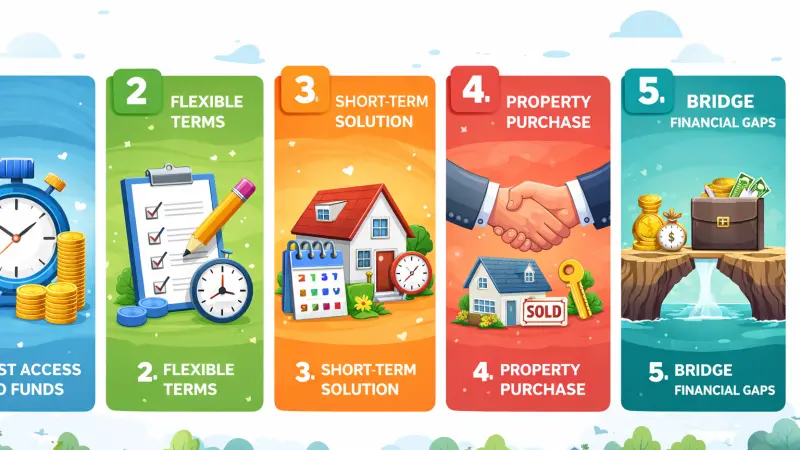
Have you ever found yourself in a position where a time-sensitive property deal was at risk of collapsing simply because a traditional high-street bank could not move fast enough? For many UK property developers, small-to-medium enterprises (SMEs), and homeowners, this scenario is a frequent and frustrating reality. In an era where traditional lending criteria have tightened, the agility of your financing often determines the success of your investment.
Bridging finance saw a steady rise in popularity throughout the latter half of the previous year. This surge was largely driven by a lack of availability on the High Street, which saw millions of borrowers seek alternative lenders for essential financial support. Far from being a niche product, bridging loans have matured into a sophisticated, highly regulated, and cost-effective alternative to traditional commercial loans or mortgages. When a purchase is time-critical, these short-term facilities provide the necessary "bridge" to cross the gap between an immediate requirement and a long-term exit strategy.
Below, we explore the five major advantages of bridging finance that have established it as a premier choice for professionals and businesses across the United Kingdom.
1. Exceptional Speed of Execution
In the world of UK real estate, speed is often more valuable than the interest rate itself. While a typical residential or commercial mortgage can take anywhere from eight to twelve weeks to reach completion, bridging finance operates on a significantly compressed timeline. Because bridging lenders are typically more agile than retail banks, they can bypass much of the bureaucratic "red tape" that slows down traditional applications.
Why Speed Matters in the UK Market
The ability to access capital quickly is not just a convenience; it is a competitive advantage. Consider the following scenarios where speed is paramount:
- Property Auctions: When purchasing at auction, a buyer is usually required to pay a 10% deposit immediately and settle the remaining 90% within 28 days. Traditional mortgages are almost never fast enough to meet this deadline.
- Preventing Chain Breaks: If a buyer in a property chain pulls out, the entire sequence of sales can collapse. A bridging loan allows a seller to "break the chain" by securing their new home before the old one has sold.
- Repossession Prevention: For businesses facing urgent creditor pressure, a fast-turnaround bridging loan can provide the liquidity needed to satisfy debts and restructure.
In many instances, funds from a specialist lender can be accessed within a few working days, provided the valuation and legal checks are prioritised.
This rapid deployment of capital ensures that lucrative opportunities are not lost to competitors who have more liquid resources.
2. Total Flexibility in Fund Allocation
One of the most restrictive aspects of traditional lending is the prescriptive nature of fund usage. High-street lenders often require granular detail on how every pound will be spent, and they may refuse a loan if the purpose does not fit into a specific "box." In contrast, the flexibility of bridging finance is a major point of appeal for UK entrepreneurs.
With a bridging loan, the funds provided by the lender can be used for virtually any legal purpose. This "blank canvas" approach allows borrowers to be creative with their capital. Common and popular uses of bridging loans include:
- Purchasing Land: Securing a plot of land before planning permission is fully granted.
- Buy-to-Let Investments: Rapidly expanding a property portfolio when a high-value asset becomes available at a discount.
- Renovation and Refurbishment: Funding the heavy structural changes required to convert a property (e.g., converting an office block into luxury flats).
- Working Capital: Providing a temporary cash injection for a business to cover seasonal stock purchases or tax liabilities.
This lack of limitation empowers SMEs to act decisively, knowing that their lender is focused on the security of the asset rather than micromanaging the operational use of the capital.
3. Flexible Lending Criteria and Accessibility
The modern credit landscape in the UK can be punishing. A minor blemish on a credit report or an irregular income stream can lead to an automatic rejection from traditional institutions. However, bridging finance is issued almost exclusively on the basis of security—specifically, the value of the assets the loan is secured against.
Asset-Backed Lending vs. Credit-Backed Lending
Unlike a personal loan that relies heavily on a credit score, a bridging lender is primarily concerned with two things: the value of the collateral and the viability of the "exit strategy" (the plan to repay the loan). This shift in focus offers several benefits:
| Factor | Traditional Mortgage | Bridging Finance |
|---|---|---|
| Credit History | Requires near-perfect credit for best rates. | Poor credit or past insolvency often accepted. |
| Income Proof | Strict stress-testing and multiple years of accounts. | Focus on the asset and the exit plan. |
| Age Limits | Often restricted for older borrowers. | Generally more flexible regarding age. |
If you have assets of sufficient value that the lender is willing to accept as security—be it residential property, commercial premises, or even land—many of the usual obstacles to accessing affordable finance are removed.
This makes bridging finance an essential tool for contractors, self-employed individuals, and those with complex financial backgrounds.
4. Ability to Purchase "Unmortgageable" Properties
For property developers, the most profitable deals often involve properties in the worst condition. However, taking out a mortgage to purchase an uninhabitable, dilapidated, or non-standard property is notoriously difficult. Most banks deem these properties "unmortgageable" if they lack a working kitchen or bathroom, or if they are structurally unsound.
Bridging finance solves this problem. Most specialist lenders are willing to issue loans against almost any type of property, regardless of its current state of repair. This allows investors to:
- Purchase rundown homes or business premises at a significantly lower market price.
- Use the bridging funds to perform essential renovations and improvements.
- Either sell the property for a profit or "exit" onto a traditional term mortgage once the property is in a habitable condition.
This capability is the engine room of the "fix-and-flip" market in the UK. By providing the capital for properties that others cannot touch, bridging finance facilitates urban regeneration and high-yield investment returns.
5. Surprising Affordability and Cost-Efficiency
There is a lingering misconception that bridging finance is prohibitively expensive. While it is true that monthly interest rates are higher than those of a 25-year residential mortgage, the short-term nature of the loan can make it extremely affordable when used correctly.
In a competitive market, a high-quality bridging loan may carry an interest rate of less than 0.5% to 0.7% per month.
Because there are typically no early repayment charges (ERCs) with many bridging products, borrowers only pay for the time they use the money.
The Power of "Retained Interest"
Many bridging loans allow for interest to be "rolled up" or "retained." This means the borrower does not have to make monthly interest payments during the term of the loan. Instead, the interest is paid at the end when the loan is redeemed. This preserves cash flow for the business or investor during the critical phases of a project. When a loan is repaid quickly—often within six to twelve months the total cost of borrowing can be kept to a minimum, often representing a small fraction of the profit generated by the project the loan enabled.
Frequently Asked Questions
What is the typical duration of a bridging loan in the UK?
Most bridging loans are designed for short-term use, typically ranging from 1 to 18 months, though some lenders may extend terms up to 24 months depending on the project.
Do I need a deposit for a bridging loan?
Yes, typically you will need a deposit or existing equity. Most lenders offer a Loan-to-Value (LTV) of up to 70% or 75%. However, if you provide additional security (such as another property), it is sometimes possible to secure 100% of the purchase price.
What is an "exit strategy" in bridging finance?
An exit strategy is your documented plan for how you intend to repay the loan. This is usually either the sale of the property or refinancing onto a long-term mortgage once certain conditions (like renovations) are met.
Is bridging finance regulated in the UK?
Bridging finance can be either regulated or unregulated. If the loan is secured against a property that is (or will be) occupied by the
borrower or their immediate family, it is regulated by the Financial Conduct Authority (FCA). Commercial or investment-led bridging is typically unregulated.
Disclaimer: The information provided in this article is for general informational and research purposes only. Company details, features, services, and market positions may change over time. Readers are advised to visit official company websites and conduct independent research before making any business decisions or purchasing services.
Most Searchable Keywords
Recent Blogs


Related Listings

Categories
- Accountants (295)
- Advertising Agencies (559)
- Architects (149)
- Automobiles (377)
- Beauty (300)
- Carpenters (146)
- Cleaning Services (387)
- Dentists (189)
- Driving (62)
- Electricians (215)
- Energy (8)
- Event Organiser (686)
- Finance (602)
- Guide (3374)
- Health (2207)
- Information technology (206)
- Legal Services (354)
- Logistics (6)
- Maintenance (65)
- Manufacturing (35)
Sponsored Listings in Travel Agencies


Related Blogs

Meet the Fair Work Agency Changing UK Work Ru...
Read this insightful article "Meet the Fair Work Agency Changing UK Work Rules in 2026" to expand your knowledge!

Collective Redundancy Errors Now Carry Higher...
Read this insightful article "Collective Redundancy Errors Now Carry Higher 2026 Penalties" to expand your knowledge!

Explore Dog Friendly Walks in the Cotswolds f...
Read this insightful article "Explore Dog Friendly Walks in the Cotswolds for 2026" to expand your knowledge!
Questions & Answers – Find What
You Need, Instantly!
How can I update my business listing?
Is it free to manage my business listing?
How long does it take for my updates to reflect?
Why is it important to keep my listing updated?
