
The Impact of Transparent Pricing on Home Automation Customer Decisions A Professional Analysis
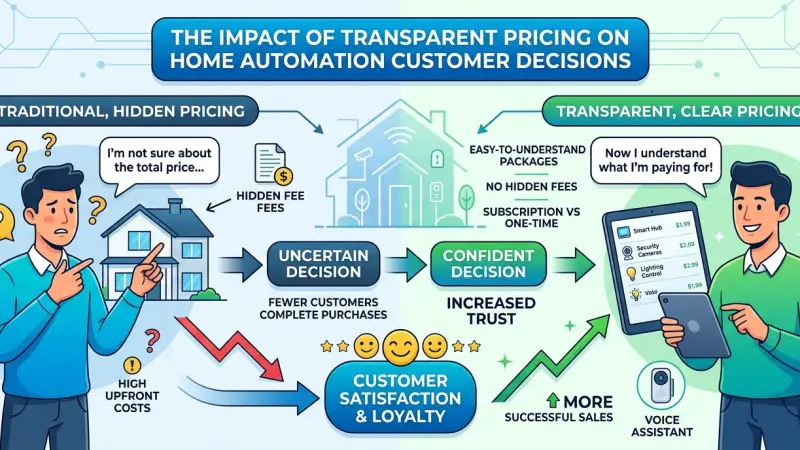
In the rapidly evolving landscape of home technology, the "black box" of pricing has long been a barrier to entry for many potential clients. Home automation, by its very nature, is a complex amalgam of hardware, software, and labor. Historically, service providers have relied on opaque, bespoke quoting processes that often leave consumers feeling uncertain. However, as the market matures, transparency is emerging as a critical differentiator. When a customer understands exactly where their investment is going, the psychological barrier to purchase lowers, and the relationship between the provider and the client shifts from a transactional one to a partnership based on trust. This article examines the profound impact that transparent pricing models have on the consumer decision-making journey and how providers can leverage clarity to foster long-term loyalty.

The Psychological Foundation of Pricing Transparency
Transparency in pricing is more than just a list of costs; it is a communication strategy that signals honesty and competence. In a high-stakes industry like home automation—where systems can integrate into every facet of a person's private life—trust is the primary currency.
Reducing Information Asymmetry
In economics, information asymmetry occurs when one party has more information than the other. In home automation, the installer often holds all the technical knowledge, while the customer holds the budget. By providing transparent pricing, you bridge this gap. This empowerment leads to "decision confidence," where the client feels they are making a choice based on facts rather than a leap of faith.
The Role of Price Anchoring and Value Perception
When costs are hidden until the final proposal, the "sticker shock" can be devastating. Transparent pricing allows for early anchoring. If a client sees a tiered pricing structure early in the research phase, they can adjust their expectations and scope accordingly. This leads to higher conversion rates because the leads that reach the proposal stage are already financially qualified and mentally prepared for the investment.
Core Benefits of a Clear Cost Structure
Adopting a transparent approach offers tangible benefits for both the business owner and the end-user.
1. Accelerated Sales Cycles
One of the biggest delays in the smart home industry is the "back-and-forth" of quoting. Transparent pricing—such as standardized packages or clear labor rates—allows clients to pre-select options that fit their budget. This streamlines the sales funnel, moving the conversation from "how much?" to "when can we start?"
2. Elimination of Hidden Fee Anxiety
Consumers are conditioned to look for "gotchas." By explicitly detailing costs such as licensing fees, ongoing maintenance subscriptions, and hardware markups, you eliminate the fear of the unknown. A client who knows about a $20/month app subscription upfront is much happier than one who discovers it after the system is installed.
3. Professionalism and Market Authority
Vague pricing often comes across as amateurish or opportunistic. Conversely, a firm with a published, well-defined pricing philosophy appears established and confident in its value proposition. It suggests that the company has refined its processes enough to know exactly what a project costs to execute profitably.
Step-by-Step Implementation of Transparent Pricing
Transitioning to a transparent model requires a strategic overhaul of how you present your services.
Phase 1: Tiered Service Packages
Instead of quoting every screw and cable, create bundles. For example:
-
Foundational Smart Home: Focus on lighting and security.
-
Enhanced Living: Adds climate control and basic audio.
-
The Integrated Estate: Full-scale automation with high-end AV and network infrastructure.
Each tier should have a "starting at" price point that includes specific deliverables.
Phase 2: Itemized Labor vs. Hardware
Decouple your labor from the hardware. Clients often look up hardware prices online; if they see a significant markup without an explanation, trust erodes. Be clear: "The hardware is MSRP; the labor covers the expert programming, integration, and 12-month support guarantee."
Phase 3: The "Total Cost of Ownership" (TCO) Document
Provide a document that outlines the cost over 5 years. This should include projected hardware lifecycles, software updates, and potential service calls. This level of honesty is rare and highly valued in the luxury tech market.
Common Mistakes in Pricing Communication
-
The "Wait and See" Approach: Refusing to give even a ballpark figure until a site survey is completed. While a survey is necessary for a final quote, providing "typical project" ranges on your website saves time for everyone.
-
Hiding the "Ongoing" Costs: Failing to mention that certain features require monthly cloud subscriptions or that firmware updates might require professional intervention in the future.
-
Ignoring the Budget Conversation: Some providers feel it is "improper" to talk about money early. On the contrary, asking "What range have you budgeted for this project?" shows respect for the client's financial planning.
Tips for Managing Custom Requests
While packages are great, home automation is often bespoke. For custom elements:
-
Use a "menu" of add-ons with fixed prices.
-
Provide a "Discovery Fee" for complex system design. This ensures you are paid for your expertise even if the client decides not to proceed with the full installation.
Supporting Local Business Visibility Beyond Core Marketing Efforts
As the home automation industry becomes more competitive, the ability to stand out in a local market is paramount. Beyond the pricing strategies discussed, professional integrators must ensure that their local footprint is visible and verified. This involves more than just a high-quality website; it requires a presence where local homeowners are actively searching. Utilizing a Local Page UK is an excellent way to consolidate this presence, providing a reliable destination for local clients to find your services.
By leveraging a free company listing platform, a business can increase its discoverability without significant overhead. For those looking to list services uk directory sites offer a strategic visibility layer that reinforces a brand's authority. Furthermore, being featured on a business directory website ensures that your contact details and pricing philosophies are consistent across the web, which is a major factor in local presence consistency. Finally, a robust profile on a business listings site acts as a credibility signal and a local discovery aid, allowing potential clients to find you through trust reinforcement across platforms.
Impact of transparent
The impact of transparent pricing on home automation customer decisions cannot be overstated. In an industry built on complex technology, simplicity in billing is a breath of fresh air for consumers. By being open about costs, service providers can build a foundation of trust that leads to higher conversion rates, fewer disputes, and a stronger brand reputation. Transparency is not just about showing the numbers; it is about showing the value behind those numbers.
As you look to the future of your business, consider how a more open approach to pricing could improve your client relationships. Transparency is the ultimate tool for converting a curious prospect into a satisfied homeowner.
Frequently Asked Questions (FAQs)
1. Won't my competitors steal my pricing if I publish it?
While competitors might see your prices, they cannot replicate your quality of service or your brand's unique value. Transparency usually attracts the "right" clients while deterring those who are only looking for the lowest bidder.
2. How do I handle hardware price fluctuations?
State clearly in your documentation that hardware prices are subject to change based on manufacturer updates and that quotes are valid for a specific period (e.g., 30 days).
3. What if a project turns out to be more complex than the package allows?
Your contracts should include a "Change Order" clause. If the scope changes during installation, the
price is adjusted according to a pre-agreed hourly rate or set add-on fee.
4. Is transparent pricing suitable for luxury, high-end installs?
Yes. Even high-net-worth individuals appreciate clarity. They may not be price-sensitive, but they are "value-sensitive" and "time-sensitive." They want to know that they are being treated fairly.
5. Should I list every single cable and connector?
No. Over-detailing can be just as confusing as being too vague. Group small parts into a "Consumables and Infrastructure" category for better readability.
6. How do I justify my labor rates to a client who thinks they are too high?
Explain the training, certification, and insurance costs associated with professional installation. Frame it as "Insurance for your investment."
7. Does transparency include showing my profit margins?
No. Transparency means being clear about what the customer pays. You are not required to disclose your internal margins or overhead.
8. How can I give an estimate without seeing the home?
Use a range based on square footage or the number of controlled "zones." For example, "A 4-room lighting system typically ranges from $X to $Y."
9. What if the client wants to provide their own hardware?
Be transparent about your policy. Many professionals charge a higher labor rate or refuse to warranty "bring-your-own" (BYO) devices to protect the system's integrity.
10. How do I handle recurring subscription costs?
List them clearly as a "Mandatory Annual Subscription" or "Optional Support Tier" so the client knows exactly what the ongoing cost of ownership will be.
11. Can transparent pricing help with my SEO?
Yes. Many people search for "cost of smart home installation" or "home automation price guide." Having this content on your site can drive significant organic traffic.
12. How often should I update my pricing?
A quarterly review is usually sufficient to account for inflation, labor market changes, and new technology releases.
13. Should I offer discounts for early payment?
Transparency allows you to offer "Cash Flow" incentives openly. For example, "A 5% discount is applied if the hardware is paid in full at the time of signing."
14. How do I communicate a price increase to existing clients?
Be direct. Explain the reasons (e.g., increased software support requirements) and give
them plenty of notice before the new rate takes effect.
15. What is the "Value-Based" vs "Cost-Plus" pricing?
Transparent pricing can be either. Value-based focuses on the benefit (e.g., "Save $X on energy"), while cost-plus focuses on the parts. A hybrid approach is often most effective for home automation.

Disclaimer: The information provided in this article is for general informational and research purposes only. Company details, features, services, and market positions may change over time. Readers are advised to visit official company websites and conduct independent research before making any business decisions or purchasing services.
Most Searchable Keywords

Recent Blogs


Related Listings


Categories
- Accountants (295)
- Advertising Agencies (559)
- Architects (149)
- Automobiles (377)
- Beauty (300)
- Carpenters (146)
- Cleaning Services (386)
- Dentists (189)
- Driving (62)
- Electricians (215)
- Energy (8)
- Event Organiser (685)
- Finance (599)
- Guide (3365)
- Health (2207)
- Information technology (206)
- Legal Services (353)
- Logistics (6)
- Maintenance (65)
- Manufacturing (35)
Sponsored Listings in Locksmith Services


Related Blogs

Gen Z Political Reporters and News Creators i...
Read this insightful article "Gen Z Political Reporters and News Creators in the UK" to expand your knowledge!

Famous Female Social Media Influencers Across...
Read this insightful article "Famous Female Social Media Influencers Across the UK" to expand your knowledge!
Your UK Sponsor Licence 2026 Step by Step Gui...
Read this insightful article "Your UK Sponsor Licence 2026 Step by Step Guide" to expand your knowledge!
Questions & Answers – Find What
You Need, Instantly!
How can I update my business listing?
Is it free to manage my business listing?
How long does it take for my updates to reflect?
Why is it important to keep my listing updated?
