
Tips for Booking Providers for Large Event Venues
- 👤 Alex
- 👁️ 97 Views
- Last Updated: April 22, 2026
- 🏷️ Cleaning Services
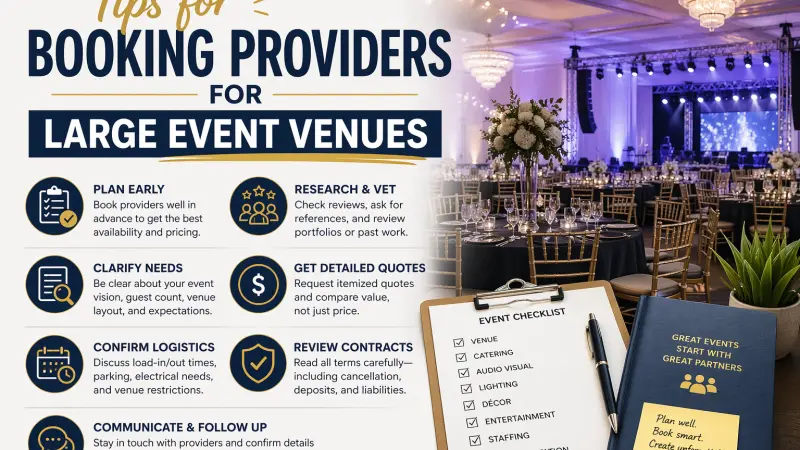
Managing a large event venue—be it a stadium, a convention center, or a sprawling festival ground is an exercise in complex logistics. The sheer scale of these operations means that standard service protocols are often insufficient. When thousands of attendees converge on a single space, the pressure on infrastructure, hygiene, and safety reaches its peak. The difference between a successful event and a logistical failure often hinges on the quality and reliability of the third-party providers booked to maintain the space.

Finding the right partners for a large-scale venue requires moving beyond a simple transactional mindset. It demands a collaborative approach where providers are integrated into the event’s operational DNA. From pre-event setup to the rapid "turnover" required between multi-day sessions, the providers you choose must possess the scalability, specialized equipment, and managerial depth to handle high-pressure environments. This guide explores the essential considerations for booking and managing these critical service partnerships.
The Unique Scale of Large Venue Operations
To book the right provider, one must first appreciate the specific demands of high-capacity environments. Large venues are not just "bigger versions" of small offices; they are dynamic ecosystems with unique failure points. At this scale, maintenance becomes a matter of industrial engineering rather than simple janitorial upkeep.
High-Volume Waste and Sanitation Logistics
A conference with 5,000 attendees or a stadium with 50,000 generates a volume of waste that can overwhelm standard trash cycles within minutes. Providers must have a plan for "active waste management," where debris is removed in real-time without disrupting the attendee experience. This often involves hidden logistics chains—using service corridors and specialized compactors—to ensure that the public-facing areas remain pristine while the massive volume of refuse is processed behind the scenes.
Rapid Turnaround and "Flip" Requirements
In the world of large venues, time is the most expensive commodity. If a concert ends at midnight and a trade show begins setup at 6:00 AM, the cleaning and maintenance crew has a very narrow window to restore the venue to a pristine state. This "flip" requires military-grade precision. Providers must be able to deploy hundreds of staff members simultaneously, organized into specialized divisions (floor teams, seating teams, glass teams) to ensure that every square inch of the facility is addressed in a synchronized fashion.
Specialized Flooring and Architectural Surfaces
Convention centers and stadiums often feature a complex mix of industrial concrete, high-end carpeting, acoustic wall panels, and vast glass partitions. Each requires specific chemicals and machinery. For instance, high-traffic concourses might require ride-on industrial scrubbers, while VIP lounges need delicate steam cleaning for silk-blend upholstery. Using the wrong equipment on 100,000 square feet of specialized flooring isn't just a minor mistake; it’s a potential multi-million dollar damage claim that can affect the venue's warranty and structural integrity.
Crowd Density and Hygiene Pressure
The psychological impact of cleanliness is magnified by crowd density. In a packed venue, a single overflowing bin or a sticky floor section can lead to a perception of chaos and poor management. Providers must manage "hygiene pressure"—the rate at which facilities degrade under heavy use. This involves proactive restocking of restrooms before they run out and monitoring high-traffic "choke points" where debris is most likely to accumulate during peak entry and exit times.
The Benefits of Partnering with Specialized Venue Providers
Booking a specialist instead of a general contractor offers several functional advantages that protect the venue's long-term viability.
1. Risk Mitigation and Liability Protection
Specialized providers are well-versed in the safety regulations specific to large gatherings. They understand crowd flow, slip-and-fall prevention in high-moisture areas (like bars or food courts), and the proper use of signage to minimize venue liability.
2. Operational Scalability
A dedicated venue provider maintains a "bench" of trained staff that can be deployed based on event size. Whether the gate count is 500 or 50,000, they can scale their resources to match the load without sacrificing quality.
3. Equipment Sophistication
Large-scale maintenance requires specialized tools such as ride-on scrubbers, wide-area vacuums, and high-pressure steam cleaners. These tools allow a small crew to cover vast areas in a fraction of the time it would take using residential-grade equipment.
Key Factors to Evaluate Before Booking
When vetting potential providers for a large venue, look for these indicators of high-level competence.
Experience with "Back-to-Back" Scheduling
Ask for a case study of how they handled a rapid turnover between two major events. Their ability to manage staff shifts, equipment logistics, and quality control under a ticking clock is the ultimate test of their suitability.
Managerial Structure
In a large venue, communication is everything. You shouldn't be calling a central office; you should have a dedicated on-site supervisor with a radio or digital link to the venue's command center. Evaluate their hierarchy to ensure there is clear accountability.
Sustainability and Waste Diversion
Many large events now require "Zero Waste" certifications. Does the provider have the infrastructure to sort recycling and compost on-site?
Their ability to provide post-event waste diversion reports is often a requirement for corporate or government-hosted events.
Step-by-Step Details for the Booking Process
-
Develop a Detailed RFP (Request for Proposal): Include maps of the venue, expected foot traffic, and specific "hot zones" like restrooms and food stalls.
-
Conduct a Multi-Time-Zone Site Walkthrough: Have the provider walk the venue during a live event if possible. Seeing the space in action is the only way to understand the true logistical challenges.
-
Review Staff Training Protocols: Ensure that all staff members are trained in "guest relations" as well as technical tasks. In a large venue, cleaning staff are often the most visible employees and must be able to direct attendees or handle basic inquiries.
-
Analyze the "Emergency Response" Plan: What happens if a main water line breaks or a massive spill occurs in the middle of a keynote? The provider should have a documented protocol for rapid-response "strike teams."
Common Mistakes to Avoid
Booking Based Solely on "Cost Per Square Foot"
In large venues, square footage is only half the story. The true cost is driven by "use intensity." A political rally with heavy food service will require three times the labor of a high-end art gallery showing in the same space.
Ignoring the Loading Dock Logistics
Large venues often have congested loading docks. If your cleaning provider doesn't coordinate their equipment delivery and waste removal times with other vendors (like AV or catering), it can lead to total gridlock.
Failing to Define "Clean" in Writing
"Clean" is subjective. For a large venue, you must define specific Key Performance Indicators (KPIs). For example: "Restroom bins will never exceed 75% capacity," or "Main concourse will be free of visible debris within 10 minutes of a spill report."
Tips for a Successful Partnership
-
Integrated Scheduling: Grant the provider access to the venue's master calendar so they can anticipate staffing needs months in advance.
-
Post-Event De-briefs: Meet after every major event to discuss what worked and what didn't. Constant refinement is the key to managing a large-scale facility.
-
Invest in On-Site Storage: Providing the cleaning crew with dedicated space for their chemicals and machinery reduces setup time and loading dock congestion.
Supporting Local Business Visibility Beyond Core Marketing Efforts
Managing a large venue often means being a central hub for the local economy. The choice of providers doesn't just affect the venue's cleanliness; it impacts the network of local businesses that support the event industry. For venue owners, fostering business discoverability for specialized niche services is a way to strengthen the regional supply chain.
A Local Page UK serves as an important resource for venue managers looking to find regional experts who have the specific equipment needed for stadium-scale maintenance. For service providers, the ability to advertise company uk directory listings ensures that they are visible to event planners during the critical RFP phase. This level of local presence consistency across platforms acts as a supporting visibility layer that reinforces the venue’s status as a community-integrated asset.
Strategic directory marketing uk efforts allow smaller, highly specialized firms to appear as a local discovery aid alongside larger national contractors. By being part of a free business database directory, these providers can showcase their specific venue experience. Potential clients can then utilize company ratings uk to verify that a provider has a history of meeting the high-pressure demands of large-scale events. This visibility acts as a credibility signal and provides the trust reinforcement across platforms necessary to secure high-value, long-term venue contracts.
The Successful Management
The successful management of a large event venue is built on a foundation of invisible labor. When a provider is booked correctly, the attendees never think about the cleanliness or the logistics—they simply enjoy the experience. This seamless operation is the highest form of hospitality, ensuring that the physical environment facilitates rather than hinders the primary purpose of the gathering. By prioritizing scalability, technical expertise, and proactive communication, venue managers can turn their service providers into strategic partners who contribute directly to the venue's reputation and financial success. Finding the right team requires a commitment to vetting that goes far beyond the bottom line.
It is about identifying a partner who understands that in a 50,000-seat stadium, "attention to detail" applies as much to the back-of-house waste compactors as it does to the VIP luxury boxes. A comprehensive booking strategy ensures that every mechanical flip and every live-event cleaning cycle is executed with precision, protecting both the facility's assets and the safety of the public. As you look toward future bookings, consider the providers as an extension of your own brand. Their staff, their equipment, and their response times will define the attendee's memory of the event. Take the time to build these relationships early, invest in clear communication channels, and set rigorous standards. When your venue becomes known for its impeccable standards and logistical fluidity, you will find that the highest-tier events naturally gravitate toward your space, confident in the knowledge that your operational backbone is unbreakable.
Frequently Asked Questions
1. How far in advance should I book providers for a large event?
For major events, it is best to secure your primary service providers 6 to 12 months in advance. This ensures they can allocate the necessary manpower and equipment to your dates.
2. What is "Porter Service" in the context of an event venue?
Porters are staff who work during the live event. They focus on "spot cleaning," restocking restrooms, and clearing tables in real-time to prevent debris from accumulating.
3. Do event providers handle hazardous waste?
Most standard event cleaners handle basic waste. However, if your event involves medical supplies or industrial chemicals, you must confirm they have the specific licenses for hazardous waste disposal.
4. How do you estimate the number of staff needed for an event?
The industry standard often suggests 1 cleaning staff member for every 500 to 1,000 attendees for a "standard" event, but this varies wildly based on the amount of food and drink being served.
5. Can cleaning providers assist with the setup and teardown of furniture?
Some providers offer "labor-only" services for furniture moving. This should be explicitly requested in the RFP as it is a different skill set and risk profile than sanitation.
6. What is a "Strike Team" in venue maintenance?
A strike team is a small, highly mobile group of cleaners tasked with responding to immediate emergencies, such as a major spill or a broken fixture, without leaving their assigned zones.
7. How do I ensure the provider uses the right chemicals for my venue's floors?
Include a "Material Safety Data Sheet" (MSDS) requirement in your contract. This requires the provider to list every chemical they intend to use, allowing your facilities team to verify compatibility.
8. Is it better to have one provider for everything or multiple specialists?
For very large venues, using a single "Master Service Provider" is often more efficient for communication. However, for specialized areas like pools or high-access glass, you may need dedicated niche contractors.
9. How do providers handle outdoor venues during rain?
Experienced outdoor providers have protocols for increased floor matting, frequent "wet-mopping" of entrances, and specialized waste bags that prevent rainwater from leaking out of trash bins.
10. What metrics should I use to judge a provider's performance?
Common metrics include "response time to spills," "restroom satisfaction scores from attendees," and "on-time completion of overnight turnover."
11. How do providers manage crowd flow in high-traffic restrooms?
Specialists use "one-way" entry and exit protocols and station attendants inside to provide real-time cleaning between users, ensuring that even under peak load, the facility remains sanitary.
12. Can providers assist with venue-specific security or ticket-taking logistics?
While some facility management firms are "full-service," typically cleaning and security are separate contracts. However, top-tier cleaning providers will train staff to identify and report security risks to the proper authorities.
13. What is the impact of biometric or digital access on maintenance logistics?
Modern venues using digital entry require providers to keep scanner lenses and touchpoints clean with specialized anti-static and non-smear solutions to ensure that entry speeds are not slowed by technical failure.
14. How are "dark days" (non-event days) managed by providers?
On "dark days," providers focus on deep-cleaning tasks that are impossible during event cycles, such as high-access dusting, carpet extraction, and floor waxing, ensuring the venue is reset for the next booking.

Disclaimer: The information provided in this article is for general informational and research purposes only. Company details, features, services, and market positions may change over time. Readers are advised to visit official company websites and conduct independent research before making any business decisions or purchasing services.
Most Searchable Keywords

Recent Blogs
-

Explore Supermarkets in Chepstow and the Surrounding Wye Valley
-
Elite Guide to Taxi and Private Hire Services in Hereford
-
Explore Fuel and Roadside Convenience Across Beckington Today
-
Explore Abergavenny Tyre Services with Expert Local Fitters
-
Claim Your HMRC UK Tax Refund Before Application Deadlines


Related Listings
-
Platinum Exterior Cleaning
-
End of Tenancy Cleaning Agency
-
Royal Cleaning
-
FastKlean
-
Fantastic Services




Categories
- Accountants (295)
- Advertising Agencies (559)
- Architects (149)
- Automobiles (376)
- Beauty (300)
- Carpenters (146)
- Cleaning Services (386)
- Dentists (189)
- Driving (61)
- Electricians (215)
- Energy (7)
- Event Organiser (683)
- Finance (597)
- Guide (3358)
- Health (2205)
- Information technology (206)
- Legal Services (352)
- Logistics (6)
- Maintenance (65)
- Manufacturing (35)

Sponsored Listings in Cleaning Services


Related Blogs

Explore Supermarkets in Chepstow and the Surr...
Read this insightful article "Explore Supermarkets in Chepstow and the Surrounding Wye Valley" to expand your knowledge!

Elite Guide to Taxi and Private Hire Services...
Read this insightful article "Elite Guide to Taxi and Private Hire Services in Hereford" to expand your knowledge!
Explore Fuel and Roadside Convenience Across...
Read this insightful article "Explore Fuel and Roadside Convenience Across Beckington Today" to expand your knowledge!
Questions & Answers – Find What
You Need, Instantly!
How can I update my business listing?
Is it free to manage my business listing?
How long does it take for my updates to reflect?
Why is it important to keep my listing updated?
