
EPC Ratings Explained Landlord Rules and Improvements
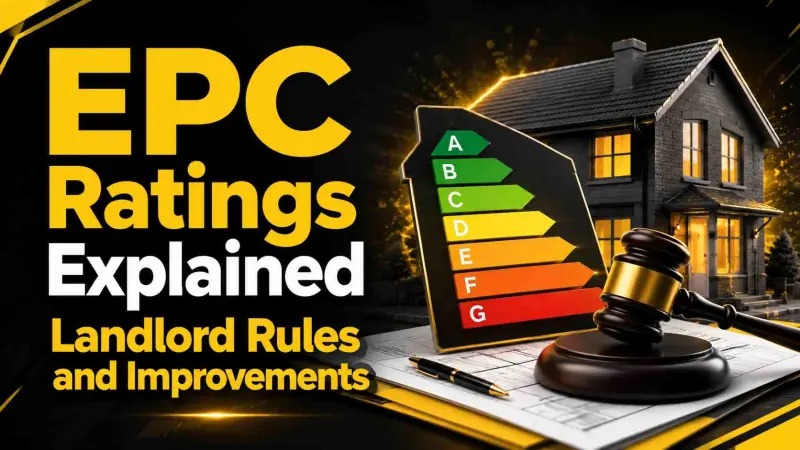
For landlords in England and Wales, an Energy Performance Certificate (EPC) is no longer just paperwork to complete before putting a property on the rental market. Its rating can affect whether a property can legally be let, what improvements a landlord may need to make, how attractive the home is to prospective tenants and, increasingly, how much future investment the property may require.
The immediate rule is straightforward: for domestic private rented properties covered by the Minimum Energy Efficiency Standards (MEES), an EPC rating of E is currently the minimum, unless a valid exemption applies. Properties rated F or G generally cannot be let or continue to be let under the MEES rules without an appropriate exemption.
But there is another deadline landlords need to plan for. The government has confirmed a higher standard for private rented homes, with all qualifying properties expected to meet an EPC C or equivalent standard by 1 October 2030, subject to the new EPC framework and exemptions. The future regime will use more than the current single EPC rating, with a fabric standard followed by either a heating-system or smart-readiness standard.
That means a landlord with an E or D-rated property should not necessarily think, "I only need to get to E." The better question is: what improvements will keep this property legally lettable and financially sensible over the next several years?
Understanding EPC Ratings and What Landlords Must Reach
What is an EPC rating?
An Energy Performance Certificate measures the energy performance of a building using a standardised assessment. For domestic properties, the current certificate gives the property an Energy Efficiency Rating (EER) on a scale from A to G, with A representing the highest rating and G the lowest.
The rating is based on the characteristics of the property and its installed systems rather than the occupants' actual energy bills. Factors can include insulation, windows, heating, hot-water systems, lighting and other building characteristics.
That distinction matters. A tenant's real-world energy consumption can be very different from the energy performance predicted by an EPC.
An EPC also contains recommendations for measures that could improve the property's energy efficiency. These recommendations can help a landlord decide where to start, but they should not automatically be treated as a complete retrofit specification. The government specifically advises property owners to obtain further expert advice before undertaking works to establish whether proposed measures are suitable for the building.
What is the minimum EPC rating for a rental property?
For qualifying domestic private rented properties in England and Wales, E is currently the minimum EPC rating under MEES.
If a property is rated F or G, a landlord generally needs to improve it to at least E or register a valid exemption before letting or continuing to let it. Since 1 April 2020, landlords have not generally been permitted to let or continue letting covered properties below EPC E unless a valid exemption applies.
This does not mean every property with an F or G rating is automatically prohibited from being rented. The regulations contain exemptions for particular circumstances, but the exemption normally needs to be properly registered and supported with evidence.
The rules also apply only to properties and tenancy arrangements within the scope of the regulations. A landlord should therefore establish whether the property is covered before assuming that an EPC rating alone determines what can be done.
Does every UK landlord have the same EPC rules?
No.
The MEES guidance discussed here applies to England and Wales. Property regulations differ across the UK, so landlords in Scotland and Northern Ireland should check the rules that apply in their jurisdiction rather than assuming the England and Wales framework applies.
There can also be differences depending on the type of property, tenancy and whether the building is legally required to have an EPC.
What happens if a rental property is rated F or G?
An F or G rating should trigger action.
The first step is not necessarily to spend thousands of pounds immediately. Start by checking the EPC itself, its recommendations, the date it was issued and whether the property has already had improvements since the assessment.
Then determine:
- Whether the property is covered by MEES.
- Whether the EPC is still valid.
- Which recommended improvements could raise the rating.
- What those measures are likely to cost.
- Whether an exemption may apply.
- Whether the property should be improved beyond the immediate legal minimum.
A valid exemption can be registered through the government's Private Rented Sector Energy Standards Exemptions service. The exemption process requires evidence appropriate to the exemption being claimed.
Why EPC D is worth treating differently from EPC F
A property rated D is currently above the minimum MEES threshold, so the immediate legal position is very different from an F-rated property.
However, D is not necessarily a comfortable long-term position.
The government has confirmed the direction of travel towards a higher standard equivalent to EPC C for private rented homes by 2030. The future rules are more complicated than simply changing a letter on the existing EPC scale, but the practical message for landlords is clear: properties below C should be assessed early rather than waiting until 2030 approaches.
A landlord with a D-rated terrace house, for example, may have time to improve insulation and heating in stages. A landlord who waits until 2029 may face higher installation costs, limited contractor availability and fewer opportunities to coordinate works with natural tenancy changes.
What does the future EPC C requirement mean?
The government's confirmed policy sets 1 October 2030 as the compliance date for the higher private rented sector standard.
Importantly, this should not be interpreted as simply saying that every property must have the old-style EPC letter C printed on its certificate by that date.
The future standard will use reformed EPC metrics. Private rented homes will need to meet a primary fabric performance standard and then a secondary standard based on either heating-system performance or smart readiness, subject to the detailed regulations and exemptions.
The government has also confirmed that properties rated C or above under the existing Energy Efficiency Rating on an EPC obtained before 1 October 2029 can be treated as compliant with the higher standard until that EPC expires or is replaced.
That creates an important planning opportunity for landlords. If a property is already close to C, improving it sooner may be more useful than repeatedly making small changes without a long-term plan.
What will change about EPCs themselves?
The EPC system is also being reformed.
Government plans are moving away from relying on one headline cost-based metric and towards multiple headline measures for domestic properties. The planned reformed EPCs will include information covering energy cost, fabric performance, heating system and smart readiness, with additional information such as modelled energy demand and carbon also retained or developed within the framework.
The government said in March 2026 that it intended to deliver new domestic EPCs from October 2026, although it acknowledged that the timetable was ambitious and further implementation work remained.
For landlords, this means an EPC should increasingly be viewed as a property-performance assessment rather than simply a letter grade.
Which improvements can raise an EPC rating?
The right upgrade depends heavily on the property.
Common measures include:
- Loft insulation
- Cavity-wall insulation where suitable
- Solid-wall insulation where technically appropriate
- Floor insulation
- Draught-proofing
- More efficient windows and doors
- Improved hot-water-cylinder insulation
- Heating-system upgrades
- Heating controls
- Low-energy lighting
- Solar photovoltaic panels
- Renewable or lower-carbon heating technologies
The government's MEES guidance gives examples of potential measures and their indicative costs and expected impact, but actual costs vary significantly by property, location, building construction and installation requirements.
Which improvements should landlords prioritise?
There is no universal "best EPC improvement."
A sensible approach is to prioritise measures that combine three things:
EPC impact + property suitability + reasonable cost.
For example, if a loft has inadequate insulation, upgrading it may be relatively straightforward compared with major external wall works.
If the property has single glazing, replacement windows may improve performance, but the financial case needs to be considered alongside other measures.
Likewise, replacing a heating system purely because it sounds more efficient may be a mistake if the building's insulation is poor and the proposed system is unsuitable.
Start with the building fabric
Fabric refers to the parts of the building that separate the inside from the outside: walls, roof, floors, windows and doors.
Improving the fabric can reduce heat loss and make heating more effective.
This is particularly important under the future MEES framework because the government has chosen a fabric-performance standard as the first part of the future requirement.
A practical sequence might therefore begin with:
- Loft or roof insulation.
- Appropriate wall insulation.
- Floor insulation where feasible.
- Draught-proofing.
- Window improvements.
- Heating and controls.
- Smart-readiness or other qualifying improvements.
The exact order should be determined from the property's EPC and professional assessment rather than applied mechanically.
How much does improving an EPC rating cost?
There is no single price for moving a property from one EPC band to another.
A small improvement might cost relatively little, while improving an older property with solid walls, poor insulation and an outdated heating system can require substantial investment.
For the current MEES regime, the regulations contain a cost-cap mechanism around relevant energy-efficiency improvements. The current government guidance describes a £3,500 including VAT cost cap for the existing minimum E standard, with specific rules about qualifying improvements and exemptions.
The future standard is different. The government has confirmed a £10,000 cost cap per property for the higher standard, including relevant third-party funding in the circumstances specified by the policy. If a property still does not meet the standard after the required investment, a landlord may be able to register a 10-year exemption, subject to the final regulatory requirements.
This is why landlords should not confuse the current £3,500 framework with the future £10,000 framework. They relate to different standards and stages of the policy.
Can landlords get an exemption from EPC requirements?
There are circumstances where a landlord may be able to register an exemption from the minimum energy efficiency requirements.
The exemption framework includes situations such as:
- High improvement costs
- Certain properties where improvements cannot reasonably be made
- Lack of required third-party consent
- Circumstances where improvements would cause specific problems
- Other qualifying circumstances established under the regulations
The government updated its exemption guidance in May 2026, including evidence requirements for different exemption categories.
An exemption is not simply a note saying that the property is expensive to improve. The landlord must meet the relevant legal test, collect the required evidence and register the exemption correctly.
The government maintains a register where exemptions and penalties can be searched.
What evidence should landlords keep?
Good record-keeping can be just as important as the physical improvement.
Keep copies of:
- Current and previous EPCs
- Quotations from contractors
- Invoices
- Installation certificates
- Survey reports
- Correspondence concerning consent
- Evidence supporting an exemption
- Photographs where useful
- Documents showing when work was completed
- Any relevant professional advice
This creates a clear audit trail.
It also helps if the property is sold, transferred to another agent or challenged by a tenant or enforcement authority.
What are the most common EPC mistakes landlords make?
Mistake 1: Only aiming for the legal minimum
Getting an F property to E may solve an immediate problem, but it does not necessarily prepare the property for future requirements.
A better strategy is to understand the likely investment needed to move towards C or the future equivalent standard.
Mistake 2: Treating the EPC recommendations as a complete building survey
An EPC recommendation is not a substitute for a detailed retrofit assessment.
Older buildings can behave differently from modern properties, and measures that appear straightforward on paper may create technical problems if installed incorrectly.
Mistake 3: Installing the cheapest measure without considering the whole property
A low-cost upgrade is not automatically the best investment.
If a property has significant heat loss through its walls and roof, for example, installing an expensive heating system before addressing the building fabric may produce disappointing results.
Mistake 4: Waiting until the deadline
Retrofit work takes time.
Landlords may need surveys, quotations, permissions, contractors and tenant cooperation. Starting early gives more room to compare options.
Mistake 5: Assuming an exemption is permanent
Exemptions generally have conditions and expiry periods. The future standard, for example, includes a 10-year exemption framework where the cost cap prevents the property from reaching the required standard.
A landlord should record the exemption's expiry date and plan what happens afterwards.
How should a landlord create an EPC improvement plan?
A useful plan can be built in five stages.
Step 1: Establish the starting point.
Check the property's EPC rating, certificate date and recommendations.
Step 2: Inspect the property.Look beyond the letter grade. Identify insulation gaps,
heating issues, windows, ventilation and other building characteristics.
Step 3: Price the options.
Obtain realistic quotations rather than relying solely on generic online estimates.
Step 4: Prioritise improvements.
Choose measures based on suitability, cost, expected performance and the property's longer-term regulatory position.
Step 5: Reassess after the work.
Where appropriate, commission a new EPC after significant improvements so the property's official record reflects its updated performance.
This approach is much more useful than trying to guess which individual improvement will produce the largest jump in the EPC band.
Should landlords improve an EPC before selling or refinancing?
Often, yes—but the financial case depends on the property and the transaction.
An improved energy rating can make a property more attractive to some buyers and tenants. Energy performance can also matter to lenders and investors assessing property portfolios.
However, landlords should not assume that every pound spent on an EPC improvement will produce an equivalent increase in property value.
The strongest reason to improve a property is usually a combination of regulatory compliance, reduced running costs, better property quality and long-term investment planning.
What should landlords do about older and listed properties?
Older properties require more care.
Solid-wall construction, historic windows, moisture behaviour, listed-building restrictions and conservation requirements can all affect which energy-efficiency measures are appropriate.
The government has acknowledged concerns from owners of heritage and older properties that some standard EPC recommendations may not be suitable. Its EPC reform work also recognises the need for more flexible approaches to assessing older buildings.
For these properties, the cheapest theoretical measure is not necessarily the safest or most appropriate one.
A landlord may need advice from someone with experience of traditional buildings and retrofit rather than relying on a generic installation package.
What should landlords do now if their property is EPC E?
If the property is E-rated, there is no automatic need to panic. It currently meets the basic MEES rating threshold where the regulations apply.
But it is sensible to treat E as a warning that the property may require further investment.
Review the EPC recommendations, identify low-cost improvements and consider whether the property can realistically move towards C.
For example, a landlord might use a tenancy changeover period to complete insulation work, improve heating controls or replace inefficient components without disrupting an occupied home.
What should landlords do now if their property is EPC D?
D is a stronger starting point.
The best approach is to determine whether relatively straightforward measures could push the property to C under the current rating methodology while also improving the underlying fabric and systems.
A D-rated property that reaches C before the relevant transition date may benefit from the government's treatment of existing EPC C properties. The exact outcome will depend on when the EPC is obtained and the property's circumstances.
What should landlords do now if their property is EPC C or above?
Do not assume the work is finished forever.
The government has confirmed that properties with an EER C rating on an EPC obtained before 1 October 2029 can be recognised as compliant with the higher standard until the EPC expires or is replaced.
That makes the date and validity of the EPC important.
Landlords should keep the certificate, understand what improvements produced the rating and monitor the transition to the reformed EPC framework.
What does the 2030 deadline mean for landlords?
The 2030 deadline changes the investment question.
Instead of asking only, "Can I legally rent this property today?", landlords should ask:
"What condition will this property need to be in by October 2030, and which improvements make financial sense before then?"
The government has chosen a single compliance date rather than the earlier proposed phased approach.
All qualifying private rented homes are expected to meet the higher standard by 1 October 2030, subject to exemptions and transitional arrangements.
The future policy also allows relevant improvement spending made from 1 October 2025 to count towards the first cost cap under the specified rules.
That gives landlords a reason to plan rather than wait.
What is the future of EPC ratings?
EPCs are moving towards a more detailed system.
The government plans to introduce reformed domestic EPCs containing several headline metrics rather than relying solely on the current single rating. The proposed framework is designed to provide more useful information about the building's fabric, heating system, energy costs and smart readiness.
For landlords, this could make retrofit decisions more targeted.
Instead of simply seeing that a property is D-rated, future information should give a clearer indication of where the building performs poorly and which type of improvement could address that weakness.
The transition is still significant, however. The government has acknowledged that the EPC reform timetable is ambitious, and detailed implementation arrangements are continuing to develop.
The safest strategy is therefore to prepare for the direction of travel without pretending that every technical detail of the future assessment methodology is already fixed.
Key Insights
- E is currently the minimum MEES rating for qualifying domestic private rented properties in England and Wales, unless a valid exemption applies.
- F and G properties require action if they fall within the regulations; landlords generally need to improve them or register an appropriate exemption.
- EPC C is the major future target, with the higher private rented sector standard due to apply by 1 October 2030, subject to exemptions and transitional rules.
- The future standard is not simply the current EPC letter C. It will use reformed metrics, including fabric performance plus either heating-system or smart-readiness performance.
- Start with the building fabric. Insulation and heat-loss improvements can form an important foundation for later heating and technology upgrades.
- Do not treat EPC recommendations as a full retrofit specification. Older or unusual buildings may need additional professional assessment.
- Keep detailed records of EPCs, quotations, invoices, permissions, improvement work and exemption evidence.
- Plan before 2030. Early improvements can reduce the risk of rushed works, higher costs and limited contractor availability.
FAQ
1. What EPC rating must a landlord have?
For qualifying domestic private rented properties in England and Wales, the current minimum standard is EPC E. A property rated F or G generally cannot be let or continue to be let unless the landlord has a valid registered exemption.
2. Is EPC E still the minimum rating for landlords?
Yes, under the current MEES rules for covered domestic private rented properties in England and Wales. However, the government has confirmed a higher standard equivalent to EPC C by 1 October 2030, so landlords should plan beyond the current minimum.
3. Will landlords need EPC C by 2030?
The government has confirmed that qualifying private rented homes must meet an EPC C or equivalent higher standard by 1 October 2030, unless a valid exemption or applicable transitional arrangement applies. The future standard will use reformed EPC metrics.
4. Can I rent out a property with an EPC F?
Generally not if the property is within the scope of MEES, unless a valid exemption applies. Landlords should check the property's circumstances and the relevant exemption rules rather than assuming an F rating can be ignored.
5. How can I improve my property's EPC rating?
Common measures include improving loft or wall insulation, reducing draughts, upgrading windows where appropriate, improving heating controls, upgrading heating systems and installing other qualifying energy-efficiency measures. The best combination depends on the property.
6. What is the cheapest way to improve an EPC rating?
There is no universal cheapest improvement. Measures such as draught-proofing, insulation and low-energy lighting can be relatively inexpensive, but their effect varies between properties. Review the EPC recommendations and obtain professional advice before choosing major works.
7. How much does it cost to improve an EPC from E to C?
Costs vary widely depending on the building. A simple property may require relatively modest work, while an older or poorly insulated home can need substantial investment. The future MEES policy introduces a £10,000 cost cap for the higher standard, subject to its detailed rules.
8. Can a landlord get an EPC exemption?
Yes. Various exemptions exist where qualifying conditions are met. The landlord must normally provide supporting evidence and register the exemption through the government's Private Rented Sector Energy Standards Exemptions Register.
9. How long does an EPC last?
An EPC is generally valid for 10 years under the current framework. The government has indicated that reformed EPCs will retain a 10-year validity period, although the interaction between EPC expiry and future private rented sector requirements is being refined.
10. Does installing double glazing improve an EPC rating?
It can, depending on the property's existing windows and the assessment. However, replacing windows is not automatically the best EPC investment. Insulation, heating, controls and other measures may provide better results depending on the starting condition.
11. Does a new boiler improve an EPC rating?
A more efficient heating system can improve the energy performance assessment, but the result depends on the property and the replacement system. Under the future EPC framework, heating-system performance will form one of the headline metrics.
12. Does insulation improve an EPC rating?
Yes, suitable insulation can improve a property's energy performance by reducing heat loss. Loft, wall and floor insulation can all be relevant, although the correct solution depends on the building's construction and condition.
13. What happens if a landlord ignores MEES rules?
Non-compliance can lead to enforcement action and financial penalties. The government has also confirmed plans for stronger enforcement of the future PRS standard, including a maximum fine of £30,000 per property per breach under the future regime.
14. Should landlords improve an EPC D property now?
For many landlords, planning improvements before the 2030 deadline makes sense. A D-rated property already exceeds the current minimum, but improving it towards C can reduce future regulatory risk and may be easier to achieve when works can be coordinated with vacancies or other property improvements.
15. Are EPC rules changing in the future?
Yes. Domestic EPCs are being reformed to provide several headline measures, including energy cost, fabric performance, heating-system performance and smart readiness. The government has been developing the new framework alongside changes to private rented sector energy standards.
Final Thoughts
For landlords, the EPC question is no longer simply whether a property has a certificate or whether its rating is above E.
The immediate requirement remains important: qualifying domestic private rented properties in England and Wales generally need to meet at least EPC E under the current MEES framework, unless a valid exemption applies. But the longer-term direction is already clear. The government has set 1 October 2030 as the compliance date for a substantially higher private rented sector standard equivalent to EPC C.
That makes the next few years an opportunity to plan rather than react.
If your property is F or G, establish compliance immediately. If it is E, identify the improvements needed to move beyond the bare minimum.
If it is D, consider whether reaching C now is practical. And if it is already C or above, keep your records and understand how the reformed EPC system could affect the property.
The best EPC strategy is not about chasing a letter grade at the lowest possible cost. It is about improving the building in a sensible order, choosing measures that suit its construction, keeping proper evidence and making investment decisions with the 2030 standard in mind.
Disclaimer: The information provided in this article is for general informational and research purposes only. Company details, features, services, and market positions may change over time. Readers are advised to visit official company websites and conduct independent research before making any business decisions or purchasing services.
Most Searchable Keywords
Recent Blogs

Related Listings


Categories
- Accountants (295)
- Advertising Agencies (559)
- Architects (149)
- Automobiles (377)
- Beauty (300)
- Carpenters (146)
- Cleaning Services (387)
- Dentists (189)
- Driving (62)
- Education (1)
- Electricians (215)
- Energy (8)
- Event Organiser (687)
- Finance (602)
- Guide (3458)
- Health (2207)
- Information technology (206)
- Legal Services (361)
- Logistics (6)
- Maintenance (65)
Sponsored Listings in Legal Services
Related Blogs
EPC Ratings Explained Landlord Rules and Impr...
Read this insightful article "EPC Ratings Explained Landlord Rules and Improvements" to expand your knowledge!

Rent Deposit Rules Five Week Cap and Full Ref...
Read this insightful article "Rent Deposit Rules Five Week Cap and Full Refund" to expand your knowledge!

Section 21 Evictions End New Landlord Rules
Read this insightful article "Section 21 Evictions End New Landlord Rules" to expand your knowledge!
Questions & Answers – Find What
You Need, Instantly!
How can I update my business listing?
Is it free to manage my business listing?
How long does it take for my updates to reflect?
Why is it important to keep my listing updated?
