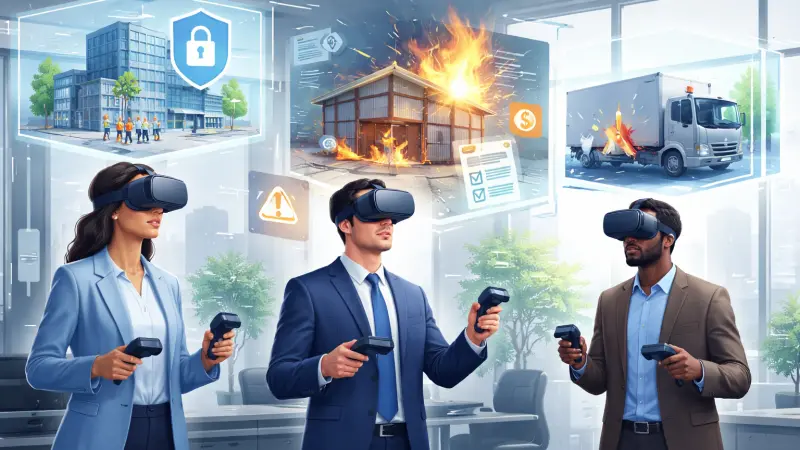

Imagine a scenario where a commercial insurance broker can transport a client into a high-fidelity digital twin of their own warehouse to identify potential fire hazards before a single policy document is signed. Virtual reality product demos for commercial insurance are transforming this futuristic vision into a practical reality for firms across the United Kingdom. As the UK insurance market becomes increasingly digitised, the traditional reliance on static brochures and complex spreadsheets is giving way to immersive experiences that allow clients to "see" their risks in three dimensions. This technological leap not only enhances the clarity of policy coverage but also fosters a deeper level of trust between the insurer and the policyholder, as abstract liabilities are rendered into tangible, navigable environments that highlight the necessity of robust protection and risk mitigation strategies.
The adoption of VR technology within the commercial sector is driven by the need for more sophisticated risk communication. In complex industries such as manufacturing, construction, or logistics, the nuances of a commercial combined policy can often be lost in technical jargon. By utilizing virtual reality product demos, brokers can walk a business owner through a simulated environment where various "what-if" scenarios are played out. For instance, a broker might demonstrate the catastrophic impact of a burst pipe in a server room or the structural implications of a minor seismic event on a high-rise development. These simulations provide a visceral understanding of risk that no written report can match, effectively bridging the gap between perceived safety and actual vulnerability in an increasingly unpredictable economic and environmental climate within the British Isles.
Furthermore, the use of virtual reality is streamlining the underwriting process by providing more accurate data points for risk evaluation. Instead of relying solely on a physical site visit, which can be time-consuming and limited by geographical constraints, underwriters can use VR-captured data to conduct "virtual surveys." This allows for a more granular analysis of a property's features, such as the proximity of hazardous materials or the efficacy of existing fire suppression systems. For UK-based insurance firms, this leads to more precise pricing and tailored policy wording, reducing the likelihood of disputes during the claims process. As the industry moves toward "Insurtech" integration, the ability to offer immersive product demonstrations becomes a significant competitive advantage, positioning forward-thinking brokers as true partners in business resilience and long-term strategic planning.
The Impact of Immersion on Client Engagement
In the highly competitive UK commercial insurance market, standing out to prospective clients requires more than just a competitive premium; it requires a superior service proposition. Virtual reality product demos offer a unique way to engage decision-makers who are often inundated with standard sales pitches. When a client puts on a VR headset, they are fully immersed in the presentation, free from the distractions of their office or mobile devices. This focused environment allows for a much more productive conversation about coverage limits and exclusion clauses. It changes the dynamic from a transactional negotiation to an educational experience, where the client is an active participant in understanding their own risk profile, leading to higher retention rates and a more collaborative relationship between the insurer and the insured.
Visualisation is particularly powerful when explaining non-physical risks, such as cyber liability or business interruption. While it is difficult to "see" a data breach, a VR demo can simulate the cascading effects of a ransomware attack across a company's global network, showing how operations grind to a halt and how the insurance policy steps in to provide recovery services.
For UK businesses, especially those in the professional services or technology sectors, this clarity is invaluable. It helps justify the investment in comprehensive cover by demonstrating the real-world utility of the product. The psychological impact of experiencing a loss in a virtual setting often serves as a powerful catalyst for businesses to upgrade their insurance portfolios from basic requirements to fully comprehensive protection plans.
Moreover, VR demos can be used as a tool for staff training and health and safety compliance, adding further value to the insurance proposition. Many UK insurers are now offering VR safety modules as part of their risk management services. By training employees in a virtual environment—teaching them how to handle hazardous spills or operate heavy machinery safely—businesses can significantly reduce the frequency of claims. This proactive approach to insurance, where the product includes both financial protection and active risk reduction tools, is becoming the new standard. It demonstrates a commitment to the client's long-term success, moving the role of the insurer from a necessary expense to a vital component of the business's operational safety net and overall strategic governance framework.
Enhancing Risk Assessment and Underwriting Accuracy
Accuracy in risk assessment is the cornerstone of a sustainable insurance industry. Virtual reality, combined with 3D scanning technology, allows for the creation of precise digital twins of commercial properties. For underwriters in the City of London and beyond, these digital twins offer a level of detail that was previously impossible to obtain without multiple, costly on-site inspections. An underwriter can zoom in on specific architectural details, check the age of roofing materials, or assess the layout of a retail space for potential trip hazards. This data-driven approach minimises the "information asymmetry" that often exists between the policyholder and the insurer, leading to fairer premiums that accurately reflect the level of risk being transferred to the balance sheet of the insurance company.
In the event of a claim, VR technology can also play a pivotal role in loss adjustment and forensic investigation. Adjusters can use 360-degree photography and VR captures of a site immediately following a loss to preserve a detailed record of the damage. This virtual record can be reviewed by experts located anywhere in the UK, facilitating a faster and more transparent claims settlement process. For commercial clients, where downtime can cost thousands of pounds per hour, the speed and accuracy provided by these digital tools are crucial for business continuity. The ability to revisit the "frozen" scene of a loss in virtual reality helps in identifying the root cause of an incident, which is essential for both settling the current claim and preventing similar occurrences in the future.
The integration of VR into underwriting also supports the growing trend of "Parametric Insurance" in the UK. Parametric policies pay out based on predefined triggers—such as a specific flood level or wind speed—rather than actual loss. VR simulations can help businesses understand these triggers by showing the physical effects of different weather events on their specific premises. This helps the business owner choose the right parameters for their policy, ensuring they have liquidity precisely when they need it most. As climate change increases the frequency of extreme weather events across the UK, the combination of immersive visualisation and parametric triggers will provide a much-needed layer of financial security for commercial properties in vulnerable locations, such as coastal towns or flood plains.
Strategic Integration into the Broker Workflow
For UK insurance brokers, implementing virtual reality product demos requires a thoughtful integration into their existing sales and service workflows. It is not merely about having the technology; it is about knowing when and how to use it to maximum effect. The most successful brokers use VR at critical touchpoints: during the initial discovery phase to highlight overlooked risks, and during the renewal process to demonstrate how changes in the client's business have altered their risk profile. By making VR a standard part of the annual review, brokers can provide a tangible "report card" of the client's risk management progress, reinforcing the value of the advice provided and strengthening the long-term professional bond between the two parties.
- Initial Site Survey: Use 3D scanning to create a baseline digital twin of the client's premises for more accurate quotes.
- Risk Workshops: Hold immersive sessions where client teams can identify hazards in a virtual version of their workplace.
- Policy Walkthroughs: Use VR to show exactly where certain policy exclusions might apply in a physical space.
- Claims Education: Demonstrate the step-by-step process of a claim through a simulated incident and subsequent response.
- Renewal Reviews: Update the virtual model annually to reflect new equipment, extensions, or changes in operational layout.
However, brokers must also consider the hardware and software logistics. While high-end VR headsets provide the best experience, "mobile VR" solutions allow brokers to send affordable viewers to clients for remote presentations. This scalability is essential for reaching SMEs (Small and Medium Enterprises) across the UK, who may not have the budget for high-end technology but still require sophisticated risk advice.
The key is to ensure that the virtual content is high-quality, relevant, and easy to navigate. As the cost of VR production continues to fall, it is becoming increasingly accessible for smaller provincial brokerages to offer these immersive demos, democratising access to high-level risk management tools that were once the exclusive domain of the world's largest insurance corporations.
The Future of Immersive Insurance Technology
The trajectory of virtual reality in the UK insurance sector is pointing toward even greater integration with other emerging technologies, such as Artificial Intelligence (AI) and the Internet of Things (IoT). Imagine a VR demo that is powered by real-time data from sensors located throughout a client's factory. As a machine begins to overheat or a security door is left ajar, the virtual model updates instantly, allowing the broker to show the client the immediate risk in a simulated environment. This "Real-Time Risk Visualisation" would allow for dynamic pricing, where premiums could fluctuate based on the actual safety behaviours observed in the virtual twin, providing a powerful financial incentive for businesses to maintain high safety standards at all times.
We are also likely to see the rise of "Social VR" in the commercial insurance space. This would allow multiple stakeholders—the broker, the underwriter, the client, and a health and safety consultant—to meet inside a virtual model of a property from their respective locations across the UK. They could walk through the site together, discussing specific risks and negotiating policy terms in a collaborative, 3D space. This would significantly reduce the need for travel, supporting the industry's sustainability goals while making the negotiation process more efficient and transparent. The "metaverse" for commercial insurance will not be about gaming; it will be a professional tool for collaborative risk management, technical training, and complex problem-solving in a borderless digital environment.
In the end, the success of virtual reality product demos will depend on the industry's ability to remain human-centric. Technology should enhance the broker's expertise, not replace it. The goal is to use immersion to make the invisible visible, the complex simple, and the abstract concrete. By providing clients with a clearer view of their risks and the solutions available to them, UK insurance professionals can elevate the conversation about commercial protection. As we move further into the 21st century, the firms that embrace these immersive tools will be best equipped to protect the UK's vibrant commercial landscape, ensuring that businesses are not just insured, but truly resilient in the face of an ever-changing world of risk and opportunity.
Frequently Asked Questions
How do virtual reality product demos work in commercial insurance?
Virtual reality demos use 3D modeling or 360-degree photography to create an immersive digital environment that simulates a client's business premises.
Brokers use these environments to visually demonstrate potential risks such as fire, flood, or workplace accidents and show how specific insurance policies provide protection against these scenarios.
Are VR demos expensive for a small UK business to access?
While high-end VR systems require an investment, many brokers offer these demos as part of their value-added service at no extra cost to the client. Additionally, mobile-based VR solutions make it possible for businesses to view immersive content using their own smartphones and affordable cardboard viewers.
Can VR help in reducing commercial insurance premiums?
Indirectly, yes. By using VR to identify and mitigate risks more effectively, a business can reduce the frequency and severity of claims. A better claims history, combined with the detailed risk data provided by a VR survey, can give underwriters more confidence to offer more competitive rates and better terms.
Is the data captured for VR demos secure and GDPR compliant?
Yes, UK insurance firms must adhere to strict GDPR regulations when handling any data, including 3D scans or images of a commercial property. Data is typically encrypted and stored on secure servers, with access restricted to authorised personnel involved in the underwriting or risk management process.
What industries benefit most from VR insurance demos?
Industries with complex physical environments or high-risk operations benefit the most. This includes manufacturing, construction, warehousing, hospitality, and agriculture. However, even office-based businesses can benefit from VR demos focused on cyber security risks and emergency evacuation procedures.
Do I need special equipment to view a VR demo from my broker?
Your broker will typically provide the necessary headset for an in-person meeting. For remote demos, they may send you a link to view a 3D
model in your web browser or provide a mobile-compatible viewer that works with your existing smartphone, making the experience highly accessible.
In summary, the integration of immersive technology is setting a new benchmark for excellence in the UK insurance sector, providing brokers and clients alike with the tools needed to visualise and manage risk with unprecedented precision. For businesses looking to expand their reach or find reputable partners in this evolving landscape, staying connected through professional networks is essential. Many companies choose to join a verified business directory to showcase their innovation and reliability. By listing your services in a free company search directory or a free business search directory, you can significantly enhance your online presence. For more information on improving your visibility, consider visiting Local Page UK. Using a comprehensive company directory online ensures that your business remains accessible to those seeking modern insurance solutions, helping you build a stronger, more visible brand within the UK's competitive commercial marketplace.