
‘De Gaulle: Résistance’ — Antonin Baudry on Pathé’s Epic WWII Saga and Why It Speaks to Today’s Youth
 Previous

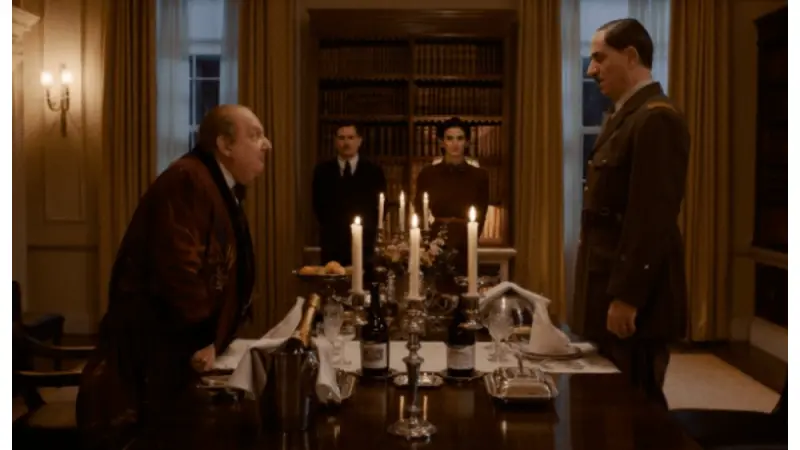
In an era where French cinema is storming global audiences with outsized historical epics, Pathé has delivered its next major gambit: “De Gaulle: Résistance,” the first installment of a two-part saga chronicling Charles de Gaulle’s wartime defiance. Directed by former diplomat Antonin Baudry, the film debuted out of competition at Cannes to strong reviews—Variety called it “a proudly French and massively scaled production with the energy of a vintage Hollywood blockbuster.” Now in French theaters, the €70 million production is poised to become one of the summer’s biggest local hits, with the second chapter, “The Sovereign Edge,” set for a July 3 rollout.
Baudry, who previously helmed the acclaimed submarine thriller “The Wolf’s Call,” brings a unique geopolitical lens to this project. Having worked at France’s Foreign Ministry and lived in the United States for five years, he returned home with a nagging frustration: European narratives, especially around World War II, have been largely written by American and British perspectives. “De Gaulle: Résistance” aims to correct that, offering a French-centric view of the conflict that challenges long-held assumptions about the war’s heroes and power dynamics.
A Leader Forged in Loneliness
At the heart of the film is de Gaulle’s transformation from a little-known brigadier general into the symbol of French resistance. Baudry was drawn to the paradox of a solitary figure who rallied a nation through sheer conviction. “He's someone who turns a dream into reality,” Baudry explains. “Reality was capitulation. The dream was: France can't accept this. People accepted the dream.” The director wanted to peel away the mythologized version of de Gaulle taught in schools—the stoic president of the Fifth Republic—and reveal the vulnerable, tenacious leader who faced death sentences and global indifference.
The film leans heavily on Julian Jackson’s biography, which Baudry praises for its fresh, foreign perspective. “Jackson paints a very fresh portrait, maybe because he's British and isn't overwhelmed by the political figure the way the French are,” Baudry notes. This outsider’s clarity allowed the director to question the romanticized narratives de Gaulle himself later cultivated, including the notion that all of France was behind him. “After the war, his obsession was to reunify France, so he embellished the story,” Baudry says. “It was foreigners—Jackson, Spanish and German authors—who told the real story.”
Challenging the American WWII Narrative
One of the film’s most provocative arguments is that the U.S. strategy during the war was driven more by efficiency than morality. Baudry points to Roosevelt’s choice of Vichy figure François Darlan as a potential leader of liberated France. “The Americans didn't care that the guy was a former Vichy figure—for them, what mattered was sparing American lives,” Baudry says. The film contrasts this pragmatic approach with de Gaulle’s insistence that war is a moral struggle—a vision shared by Winston Churchill, who is portrayed by Simon Russell Beale in a performance that Baudry calls “his revenge” after two previous unsatisfying portrayals.
The dynamic between de Gaulle and Churchill—allies who often clashed—forms the emotional core of the second film. Baudry teases that Churchill is “caught between the two, needing Roosevelt to win the war while sensing he doesn't agree with what he's doing in Europe.” This layered depiction of history is what makes the project resonate beyond France. American test screenings scored well, with audiences telling Baudry, “It's the first time we see World War II from a perspective other than the one we know.”
The Untold Story of Youth and African Contributions
Perhaps the most surprising section of the film focuses on the role of young people and African soldiers. Baudry highlights the November 11, 1940 demonstration at the Arc de Triomphe, where thousands of high school students spontaneously defied the Nazis. “Adults across France thought: if the kids are doing this, maybe we should do something,” Baudry recounts. This event, barely covered in history books, becomes a symbol of hope for the director. “I didn't want to make a film about this period without showing that, because it seems to me really major.”
Equally important is the contribution of African soldiers under General Leclerc. Baudry notes that without Félix Éboué—the first French prefect of color—and the African contingents, “France would have remained the France of Vichy.” The film also reveals that the U.S. military had a policy against Black soldiers in armored divisions, forcing Leclerc to shed a third of his men to keep American equipment. These details, often omitted from mainstream histories, are central to Baudry’s mission of reclaiming a more inclusive narrative.
Casting Against Type: Simon Abkarian as de Gaulle
One of the boldest choices was casting Simon Abkarian, an actor of Armenian descent, as the iconic French leader. Baudry calls it an obvious decision: “I needed the best possible actor.” Abkarian’s childhood nickname in Lebanon was “de Gaulle,” and Baudry believes his “touch of madness” was essential to capture the character’s internal fire. The director explains that the voice and gaze were the keys: “When an actor has the gaze and the voice, he has the character.” Opposite him, Simon Russell Beale brings gravitas to Churchill, having been dissatisfied with his previous takes on the role.
Production spanned 190 sets and involved 150 actors, with tanks and massive constructed environments. Baudry fought to ensure every euro appeared on screen, a challenge given the film’s budget. When Simon Russell Beale’s agent saw the teaser, he texted: “It looks like a €200 million film. How did you do that?” The answer, Baudry says, lies in prioritizing script and ambition over empty spectacle. “The problem on big French films is usually the script, the foundation. Here we had both the scope and the script.”
Why This Film Matters Now
Baudry sees direct parallels between the uncertainty of 1940 and today’s anxieties. “We're in a world where we feel constantly overwhelmed by forces much larger than us: artificial intelligence, climate destabilization, big economic forces,” he says. The story of young people who stood up against the Nazis—despite the odds—offers a model for agency. “To see kids who had soldiers on their street, and who a few months later managed to overturn the course of French history—I find that a source of hope.”
The film’s release comes at a time when European identity is being reexamined, and the narratives that shaped the post-war order are crumbling. Baudry hopes “De Gaulle: Résistance” will spark conversations about whose stories are told and how. As he puts it, “France should reclaim the idea that you can make films with real cinema resources. There's nothing American about this film—just quality, resources and ambition.”
With the second installment on the horizon and the first already captivating audiences, Pathé’s bet on historical epics seems validated. “De Gaulle: Résistance” doesn’t just retell a chapter of French history—it reframes it, inviting a new generation to find their own echoes of resistance in the cracks of the past.
Disclaimer - All celebrity-related content, information, and images on this website are based on publicly available online sources and AI-generated insights/data. Information such as biography, age, career, personal details, and images may change without notice over time. While we strive for accuracy, we do not guarantee the accuracy, completeness, reliability, or timeliness of any information or imagery displayed on this website. This content is provided for general informational purposes only.
Top Trending News of TV Series
 👁️ 219 views
🔥 Netflix Loses ‘Seinfeld’ This Year: Here’s the Last Day to Watch the Iconic Sitcom
Netflix’s five-year deal for ‘Seinfeld’ expires October 1, 2026. We break down what happens next, potential bidding wars, and why the classic sitcom still matters in the streaming era.
 👁️ 175 views
🔥 ‘Stranger Things’ Dominates 2025-26 TV Season as Nielsen’s Multiplatform Rankings Reshape the Ratings Landscape
Stranger Things tops Nielsen's 2025-2026 multiplatform rankings with 32.9M viewers, as Netflix dominates and Taylor Sheridan's Marshals leads broadcast. Full analysis of the most-watched TV series of the season.





Details
Send Us an Enquiry
We'll get back to you as soon as possible.
Thank You!
Your enquiry has been submitted. We'll be in touch shortly.