
The Far Away Tree Is Back — And This Time, It's Streaming Into a Whole New World
 Previous

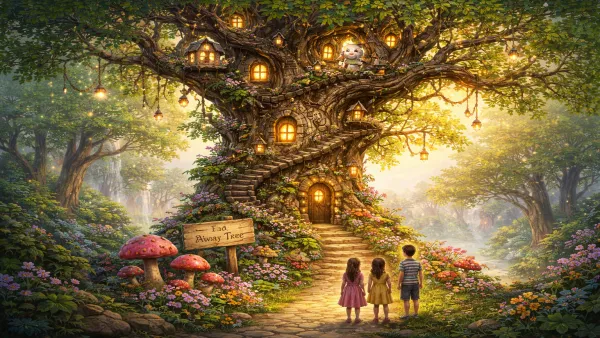
There is a tree at the edge of an Enchanted Forest. It stretches so high that its topmost branches brush against lands that shift and change with every visit — the Land of Dreams, the Land of Goodies, the Land of Do-As-You-Please. For generations of children growing up with dog-eared paperbacks and library copies worn thin at the spine, this tree was a portal. Not just into fantasy, but into something rarer: the feeling that the world could be infinitely larger and stranger and more wonderful than anything the grown-ups were letting on.
Now, that tree is back. And it has arrived — somewhat fittingly — in a land that changes its offerings every Friday: the streaming world.
The new adaptation of Enid Blyton's beloved The Magic Faraway Tree series has landed on screens with the kind of soft but persistent buzz that builds slowly before it suddenly seems like everyone is talking about it. It is the sort of entertainment news story that begins in parenting forums, spills into social media threads, and ends up on the radar of people who haven't thought about Moon-Face or Silky the fairy since they were nine years old. Which, depending on your age, might have been last decade — or might have been half a century ago.
This is the particular magic of the Far Away Tree: its audience is multigenerational in a way few properties can genuinely claim.
Why the Timing Feels Exactly Right
To understand why this adaptation is landing with such resonance right now, you have to understand what the streaming landscape looks like in 2024 and into 2025. After years of prestige drama arms races and superhero fatigue, platforms are increasingly leaning into something audiences are hungry for but rarely say out loud: comfort. Stories that feel warm. Worlds where the stakes are high enough to be exciting but not so bleak that you need a recovery period afterward.
The Far Away Tree fits this mood like a hand into a perfectly sized glove. It is inherently episodic — each visit to the top of the tree reveals a new Land with new rules, new characters, new problems to solve. For a streaming format, this is structural gold. Every episode promises novelty while the core emotional anchors — the children, the tree folk, the forest — remain reassuringly constant. It is, essentially, the formula that made anthology-adjacent television the darling of the streaming era, but wrapped in the kind of whimsical British countryside aesthetics that have proven enduringly popular with global audiences.
Think of it like a cousin to the way Paddington conquered cinema audiences who assumed they had no particular interest in a bear from Peru. Or the way His Dark Materials reminded an entire generation that adapting a beloved British fantasy novel, done with care and conviction, could generate genuine cultural electricity. The Far Away Tree is reaching for that same current — and the early signs suggest it is finding it.
The Book, the Legacy, and the Complicated Conversation
Of course, no Enid Blyton adaptation in the modern era arrives without a conversation about the author herself, and this one is no exception.
Blyton's work sold over 600 million copies worldwide and translated into nearly 90 languages. She was, by any commercial measure, one of the most successful children's authors in history. She was also a product of her time in ways that modern audiences — and modern streaming executives — cannot simply paper over. Her books have faced ongoing scrutiny for racial stereotyping, class-based attitudes, and characterizations that sit uncomfortably against contemporary values.
The producers of the new adaptation have been open about navigating this terrain. The approach taken — updating character names, diversifying the cast, reimagining some of the more dated social dynamics — reflects a familiar playbook that adaptations like this increasingly rely on. It is a playbook that satisfies almost no one completely. Purists who grew up with the original texts find the changes jarring. Critics who note the original's problems find the updates insufficient. And then, somewhere in the middle, are the viewers who simply want to watch three children climb an impossible tree and find out what Land waits at the top today.
This tension is, in its own way, a sign of the adaptation's cultural relevance. You do not have heated arguments about properties nobody cares about.
Inside the Enchanted Forest: What the Adaptation Gets Right
What the production genuinely excels at is atmosphere. The Enchanted Forest — rendered through a combination of practical sets, location shooting in real woodland, and carefully deployed visual effects — feels genuinely magical in a way that resists the over-polished CGI sheen that has made so many fantasy productions feel slightly plastic. There is texture here. Moss. Bark. The sense that something extraordinary might be living just behind the next root system.
The casting of the tree folk is where the show earns its most enthusiastic early praise. Moon-Face — a character whose appeal on the page always seemed to rely entirely on the reader's childhood willingness to simply accept a person with a perfectly round head as utterly normal — has been reimagined with a physical performance that is warm, genuinely funny, and oddly moving. Silky, the gentle elf who provides the emotional center of much of the original source material, is given more agency and interiority than Blyton typically afforded her. And Saucepan Man, who mishears everything due to the rattling of his pots and pans, is — as he has always been — inexplicably the character children love most.
The children at the center of the story anchor everything with a naturalness that avoids the stiffness that sometimes plagues child-led productions. Their dynamic — curious, occasionally fractious, fundamentally loyal — feels authentic rather than performed. When they stand at the base of the tree and look up into its impossible height, something in the framing captures exactly what it feels like to be a child confronting something so much larger than yourself: equal parts terrifying and irresistible.
The Streaming Buzz — Numbers and Noise
The show debuted quietly, without the marketing blitzkrieg that platforms typically deploy for their highest-profile launches. This was either strategic humility or a genuine uncertainty about how a classic British children's fantasy would perform in an era when streaming audiences have the attention span of a hummingbird and the algorithm loyalty of none.
What happened instead was organic. Parents watched it with their children. The children asked to watch it again. The parents, unexpectedly, found themselves invested. Social media clips of specific scenes — particularly a sequence in the Land of Dreams that has been described by multiple viewers as surprisingly affecting — started circulating with the kind of genuine enthusiasm that no marketing department can manufacture.
By the second week after release, search trends for "Far Away Tree," "Moon-Face," and "Enchanted Forest series" had spiked in ways that caught industry observers off guard. Entertainment news outlets that had filed the adaptation as a minor footnote in the streaming calendar were scrambling to give it proper coverage. The word "viral" gets overused to the point of meaninglessness, but the show's grassroots momentum has the shape of something real rather than engineered.
This is partly the power of nostalgia, which operates on streaming platforms in a way that traditional broadcast television never quite managed to capture. When a parent puts on a show they loved as a child and finds themselves genuinely moved — not just by memory but by the thing itself, renewed and standing on its own legs — the recommendation becomes personal in a way that changes how it travels. This is not "you might also enjoy" algorithm noise. This is a phone call to a sibling saying: watch this. Tonight.
What It Means for the Future of Classic Book Adaptations
The Far Away Tree's early streaming success — modest in scope but meaningful in quality — arrives at a moment when the entertainment industry is reconsidering its relationship with classic children's literature as source material.
For years, the dominant wisdom was that name recognition was enough. A beloved book title would guarantee an audience. What has become clear, project by project, is that recognition is only the invitation. What happens after the audience arrives — whether the adaptation honors the spirit of the source while genuinely reimagining it for a new context — determines whether the show becomes a cultural moment or a disappointing footnote.
The adaptations that have worked recently — across film, television, and streaming — share a common quality: they treat the source material with respect without treating it as sacred. They understand what made the original resonate emotionally and they pursue that emotional truth, even when it means departing from the letter of the text. They do not mistake familiarity for quality.
The Far Away Tree adaptation, at its best moments, demonstrates this understanding. When the children first climb through the branches and emerge into an entirely new Land — disoriented, astonished, immediately curious — the scene works not because of any particular special effect or plot cleverness, but because it recreates a specific emotional experience: the one you had when you were young and the world surprised you into wonder.
That feeling, it turns out, is remarkably well-suited to streaming. It does not require a large screen or a particular time slot. It works on a tablet at bedtime. It works on a Sunday afternoon with the curtains half-drawn. It is the kind of entertainment that earns its keep not through spectacle but through genuine emotional generosity.
The Cultural Conversation It's Quietly Sparking
Beyond the immediate entertainment news cycle, the Far Away Tree adaptation is part of a broader and more interesting conversation about what children's fantasy means in a world that has never felt more in need of imagination.
There is something pointed about the fact that the most viral aspect of the show — the detail that keeps surfacing in reviews, in social media threads, in conversations between parents — is the Lands. The fact that the Land at the top of the tree is always changing. That you never know what you will find when you get there. That some Lands are wonderful and some are dangerous and some are simply strange. And that the children go anyway.
This is, when you look at it squarely, a fairly radical piece of storytelling. It does not promise a stable world. It does not promise that the adventure will always be safe. It promises only that the world is larger than you know, that there are places worth visiting even if they are unfamiliar, and that curiosity — the willingness to climb, to look, to ask what is up there — is its own reward.
For children growing up in a climate of genuine uncertainty, that message lands differently than it did in the 1940s when Blyton first wrote it. It does not feel like escapism. It feels, oddly, like preparation.
What Could Come Next
The show has been received warmly enough that the question of a second series is being asked with genuine curiosity rather than desperation. Blyton's original trilogy — The Faraway Tree, The Folk of the Faraway Tree, and The Enchanted Forest — provides ample material. There are Lands yet to visit, characters yet to introduce, corners of the Enchanted Forest that the adaptation has only gestured toward.
More broadly, the show's success — quiet but real — will almost certainly influence which classic children's books find themselves being optioned and developed in the next eighteen months. Properties that might have seemed too modest, too British, too rooted in a particular cultural moment are suddenly looking like more viable bets. The lesson the industry is taking, correctly or not, is that there is an audience for this. That nostalgia, handled with craft and genuine affection, is not a niche play but a mainstream one.
Whether the Far Away Tree remains a one-season phenomenon or grows into something more enduring will depend, in the end, on the same thing that determined the original books' longevity: whether the story continues to make people feel something. Whether it continues to offer that specific, irreplaceable sensation of standing at the base of an impossible tree, looking up, and deciding to climb.
The tree is tall. The Lands keep changing. And somewhere near the top, Moon-Face is probably making pop biscuits and waiting for you to arrive.
That, as it turns out, is more than enough.
Frequently Asked Questions (FAQ)
1. What is The Far Away Tree based on? The new streaming adaptation is based on Enid Blyton's classic children's book series, originally comprising The Enchanted Forest (1939), The Magic Faraway Tree (1943), and The Folk of the Faraway Tree (1944). The books follow a group of children who discover a magical tree in an enchanted forest, home to fantastical characters and ever-changing lands at its top.
2. Where can I watch the new Far Away Tree series? The new Far Away Tree adaptation is available on a major streaming platform. Given the nature of streaming deals, availability may vary by region — check your local streaming services for the most up-to-date information on where to watch.
3. Is the Far Away Tree adaptation suitable for all ages? Yes. The show is primarily aimed at family audiences and children aged approximately five and up, but its nostalgic appeal and layered storytelling make it genuinely enjoyable for adults, particularly those who grew up with the books.
4. How faithful is the adaptation to Enid Blyton's original books? The adaptation stays true to the core spirit and structure of the books — the Enchanted Forest, the tree folk like Moon-Face, Silky, and Saucepan Man, and the rotating Lands at the top of the tree — while updating elements of the story for a contemporary audience, including a more diverse cast and some modernized character dynamics.
5. Who are the main characters in the new Far Away Tree series? The central characters include the group of children who discover the tree, and the beloved tree folk: Moon-Face, Silky the fairy, and the mishearing Saucepan Man. The specific casting varies by production, so check the show's official page for the full cast list.
6. Why is Enid Blyton controversial? Blyton's works have faced criticism over racial stereotyping, class attitudes, and characterizations that reflect the prejudices of early 20th-century Britain. Her literary legacy is significant, but modern adaptations typically address these issues by updating content and diversifying representation.
7. How many episodes does the Far Away Tree series have? The exact episode count depends on the specific production. Most streaming adaptations of this nature run between six and ten episodes per season, with each episode typically exploring a different Land at the top of the tree.
8. Will there be a second season of The Far Away Tree? As of the time of writing, the show's strong early reception has generated genuine conversation about a second series. Blyton's trilogy provides ample source material. Official confirmation would depend on streaming platform decisions following viewership data.
9. What makes the Far Away Tree different from other fantasy series for children? Its unique episodic structure — a new Land with new rules in each episode — gives it a fresh, anthology-like quality within a consistent, character-driven world. It blends genuine whimsy with emotional warmth in a way that distinguishes it from both high-stakes fantasy adventures and lower-stakes children's animation.
10. Is the Far Away Tree a good show for adults watching without children? Absolutely. The show's nostalgic resonance, quality production design, and genuinely affecting character moments make it rewarding for adult viewers, particularly those who grew up with the books. Multiple reviews have noted its surprising emotional depth for a children's property.
11. What is the streaming buzz around the Far Away Tree really about? Beyond nostalgia, the buzz reflects a broader audience hunger for warm, imaginative, beautifully crafted storytelling that isn't relentlessly dark or cynical. The show arrived at the right cultural moment, offering comfort and wonder in a streaming landscape often dominated by prestige drama and gritty content.
12. How has the Far Away Tree been updated for modern audiences? The adaptation features a more diverse and contemporary cast, gives female characters like Silky greater agency and depth, and adjusts some of the more dated social dynamics of the original books. Character names have also been updated in some versions of the text over the years.
13. Is the Far Away Tree connected to other Enid Blyton adaptations? It is a standalone adaptation of the Faraway Tree series specifically, not part of a broader Blyton adaptation universe. However, its success is part of a renewed interest in bringing Blyton's work to screen in ways that balance heritage with contemporary sensibility.
14. What age group is the Far Away Tree streaming series aimed at? The primary target audience is children aged five to twelve, but the show's nostalgic pull and quality production values give it genuine cross-generational appeal — much like the books themselves, which have been read and loved by multiple generations of the same families.
15. How does the Far Away Tree compare to other trending streaming series for families? It occupies a distinctive niche: more imaginative and whimsical than live-action adventure series, more emotionally grounded than animated fantasy, and more episodically varied than most serialized children's dramas. Think of it as sitting comfortably alongside properties like The Chronicles of Narnia adaptations or Paddington in terms of tone and cultural warmth.
16. What are the Lands in the Far Away Tree series? The Lands are magical realms that appear at the very top of the Far Away Tree, changing with each visit. Blyton's original books featured places like the Land of Dreams, the Land of Goodies, the Land of Topsy-Turvy, and many others — each with its own rules, dangers, and wonders. The adaptation draws on these while also creating new Lands suited to the visual storytelling format.
17. Why is the Far Away Tree considered a landmark of British children's literature? Enid Blyton's Faraway Tree series has been continuously in print since the 1940s, selling tens of millions of copies and remaining a staple of British childhood reading for over eighty years. Its combination of accessible prose, vivid imagination, and emotionally warm characters gave it an endurance that outlasted both its era and many of the controversies surrounding its author — a testament to the power of the story at its core.
Disclaimer - All celebrity-related content, information, and images on this website are based on publicly available online sources and AI-generated insights/data. Information such as biography, age, career, personal details, and images may change without notice over time. While we strive for accuracy, we do not guarantee the accuracy, completeness, reliability, or timeliness of any information or imagery displayed on this website. This content is provided for general informational purposes only.
Iconic Photos of Andrew Garfield

Top Trending News of Andrew Garfield
 👁️ 136 views
🔥 Andrew Garfield & Monica Barbaro Relationship Timeline
From their 2025 Wimbledon "hard launch" to their 2026 Vegas date night, here is the complete relationship timeline for Andrew Garfield and Monica Barbaro.
👁️ 131 views
🔥 The Far Away Tree Is Back — And This Time, It's Streaming Into a Whole New World
The Far Away Tree is climbing back into pop culture with a buzzy new streaming adaptation. Discover why Enid Blyton's beloved fantasy world is sparking a fresh wave of nostalgia, controversy, and cultural conversation — and what it means for the future of children's entertainment on streaming platforms.
Details
Send Us an Enquiry
We'll get back to you as soon as possible.
Thank You!
Your enquiry has been submitted. We'll be in touch shortly.