
Trump’s Iran Strategy: Better Than Obama’s or Riskier?
 Previous

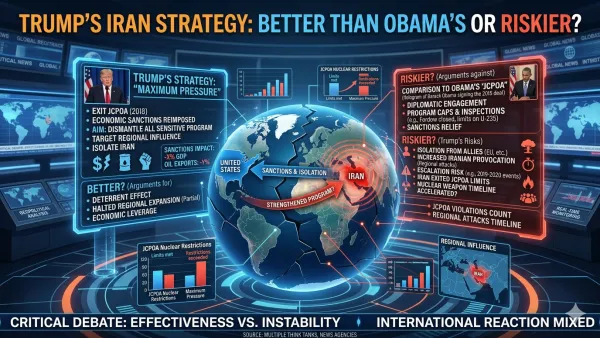
As of late 2023, the debate surrounding United States foreign policy toward the Islamic Republic of Iran remains one of the most contentious subjects in international relations. The divergence in approach between the Obama and Trump administrations created two distinct eras of geopolitical strategy, each with vastly different mechanisms for addressing Iran’s nuclear program and regional influence. The Joint Comprehensive Plan of Action (JCPOA), commonly known as the Iran Nuclear Deal, served as the cornerstone of the Obama era, focusing on diplomatic containment and economic integration. In stark contrast, the Trump administration adopted a strategy characterized by unilateral withdrawal, the reimposition of stringent sanctions, and a "Maximum Pressure" campaign aimed at curtailing Iran’s broader geopolitical activities.
Understanding the trajectory of Trump’s Iran Strategy requires a granular analysis of the factual outcomes observed between 2015 and 2021. Proponents of the diplomatic approach argue that the JCPOA successfully froze Iran’s nuclear advancements, while critics contend it ignored Tehran’s ballistic missile programs and proxy warfare. Conversely, supporters of the Maximum Pressure strategy argue it highlighted the regime's economic vulnerabilities and deterred regional aggression, whereas opponents point to the resumption of high-level uranium enrichment and increased militarization. This article provides a neutral, data-driven examination of both strategies, assessing their efficacy based on nuclear verification reports, economic indicators, and regional stability metrics.
The Obama Administration’s Diplomatic Foundation
The foundation of modern US-Iran relations was fundamentally altered by the administration of President Barack Obama. Prior to 2013, relations were characterized by deep mistrust and incremental sanctions. However, the election of President Hassan Rouhani in Iran and the engagement of US Secretary of State John Kerry led to secret talks that culminated in a formal interim agreement in late 2013.
- November 2013: The interim Joint Plan of Action was signed in Geneva.
- Key Goal: Freeze critical aspects of Iran's nuclear program in exchange for limited sanctions relief.
- Framework: Established the groundwork for what would eventually become the JCPOA.
The Obama strategy relied heavily on multilateralism. It did not act alone; it brought together the P5+1 (the five permanent members of the UN Security Council plus Germany). The central premise was that economic integration and verified limits on nuclear enrichment were preferable to isolation and potential military conflict. The administration viewed Iran’s pursuit of a nuclear weapon as the single most urgent threat to national security, prioritizing this issue above other grievances regarding Iran’s regional behavior or human rights record.
- Core Philosophy: Nuclear non-proliferation through diplomatic engagement.
- Mechanism: Incentivization via sanctions relief in exchange for transparency.
- Outcome: The formal signing of the JCPOA on July 14, 2015.
Technical Parameters of the Joint Comprehensive Plan of Action (JCPOA)
To accurately assess whether Trump’s Iran Strategy was more effective or riskier, one must first understand the specific constraints established by the JCPOA. The agreement was not merely symbolic; it contained strict technical limitations monitored by the International Atomic Energy Agency (IAEA).
Key Technical Limits Under the JCPOA
- Uranium Enrichment Cap: Iran was limited to enriching uranium to 3.67%, well below weapons-grade (90%).
- Stockpile Limits: Iran’s stockpile of low-enriched uranium was capped at 300 kg.
- Centrifuges: The number of installed centrifuges was reduced from roughly 20,000 to 6,104, with only 5,060 allowed to spin.
- Fordow Facility: Converted from a nuclear enrichment site to a research/technology center.
- Arak Heavy Water Reactor: Redesigned to produce significantly less weapons-grade plutonium.
- Monitoring and Verification: Implementation of the IAEA's Additional Protocol, granting inspectors access to declared and undeclared sites.
For the duration of the agreement's adherence (verified until roughly 2019), the IAEA issued multiple quarterly reports confirming that Iran was complying with these strict limitations. This period represents the most significant constraint on Iran's nuclear infrastructure in decades.
The Trump Administration’s Strategic Pivot
The election of President Donald Trump in 2016 signaled a paradigm shift. Throughout the campaign, Trump criticized the JCPOA as "the worst deal ever negotiated," arguing that it was temporary, failed to address ballistic missile development, and provided sanctions relief that funded Iranian proxies. On May 8, 2018, President Trump announced the US withdrawal from the JCPOA, effectively ending the United States' participation in the agreement.
- Executive Order: Signing of the National Security Presidential Memorandum to reinstate sanctions.
- Justification: The administration cited the "Sunset Clauses" (expiration of limits on enrichment) and Iran’s failure to disclose past military dimensions of its program.
- Strategic Goal: Force Iran to renegotiate a "better deal" that covered missiles and regional behavior, or force a collapse of the regime's economic capacity to export terror.
This withdrawal initiated a gradual but severe tightening of the economic screws. The strategy was not solely about nuclear containment but about a comprehensive attempt to isolate the Islamic Republic diplomatically and financially. The administration demanded that oil exports from Iran drop to zero, a target they aggressively pursued.
Implementation of the "Maximum Pressure" Campaign
Following the withdrawal, the Trump administration launched the Maximum Pressure Campaign. This strategy relied on secondary sanctions—penalizing third-party countries and companies that traded with Iran. The US revoked waivers that had allowed some countries to continue purchasing Iranian oil, creating a sharp downturn in Iran's revenue.
Major Sanctions Milestones (2018–2020)
- August 2018: Reimposition of sanctions on trade in gold, precious metals, aluminum, steel, and graphite.
- November 2018: Sanctions targeting Iran’s energy, shipping, and banking sectors (including the Central Bank of Iran).
- April 2019: Designation of the Islamic Revolutionary Guard Corps (IRGC) as a Foreign Terrorist Organization (FTO).
- May 2019: End of sanctions waivers for importers of Iranian oil.
- June 2020: Sanctions targeting Iran’s defense sector and individuals involved in nuclear proliferation.
The economic impact was immediate and severe. According to the U.S. Energy Information Administration (EIA), Iran’s crude oil production fell from a peak of roughly 3.8 million barrels per day in early 2018 to below 2 million barrels per day by the end of 2019. The Iranian Rial collapsed, inflation soared, and the country faced significant hardships in importing essential goods and medical supplies. However, the strategy failed to force Iran to the negotiating table to accept a broader treaty, and instead, Tehran began to incrementally breach the nuclear limits set by the JCPOA.
Comparative Analysis: Nuclear Non-Proliferation Outcomes
The core metric for evaluating "better" or "riskier" strategies often revolves around the "breakout time"—the time required for Iran to amass enough fissile material for a nuclear weapon.
Under the Obama Administration (JCPOA Era):
- Status: Nuclear program frozen.
- Breakout Time: Estimated by intelligence officials to be roughly one year.
- Verification: Robust IAEA access; all enriched uranium stockpiles below 300 kg.
Under the Trump Administration (Post-Withdrawal):
- Status: Nuclear program expanded.
- Breakout Time: Estimated to have shrunk to a few weeks by 2021.
- Verification: IAEA access restricted; monitoring cameras disconnected.
Following the US withdrawal and the subsequent European inability to salvage the deal via the INSTEX mechanism (Instrument in Support of Trade Exchanges), Iran began rolling back its commitments. Starting in 2019, Iran exceeded the 300kg uranium cap, began enriching uranium to levels higher than 3.67%, and resumed advanced centrifuge R&D.
Nuclear Escalation Timeline (Post-2018)
- July 2019: Iran exceeds 300kg low-enriched uranium limit.
- November 2019: Iran begins uranium enrichment at Fordow.
- January 2020: Iran announces no longer adhering to limits on R&D.
- November 2020: Iran begins enriching uranium to 4.5% purity.
- April 2021: Iran begins enriching uranium to 60% purity, a technical step closer to weapons-grade levels.
From a pure non-proliferation perspective, the data suggests that Trump’s Iran Strategy resulted in a significantly more advanced nuclear program with fewer monitoring mechanisms compared to the status quo under Obama’s deal. The risk of an unmonitored nuclear dash increased substantially during the Maximum Pressure era.
Regional Security and Proxy Conflict Dynamics
While the nuclear program is the primary focus of Western discourse, regional stability is a critical factor. The Obama administration faced criticism for remaining largely silent regarding Iran’s support for the Assad regime in Syria, the Houthi movement in Yemen, and Hezbollah in Lebanon, arguing that addressing these issues would jeopardize the nuclear deal.
The Trump administration sought to directly confront Iran’s regional posture. This led to a series of dangerous escalations that brought the US and Iran to the brink of open war.
Key Regional Escalations (2019–2020)
- May 2019: Explosions attack four commercial vessels, including two Saudi oil tankers, in the Gulf of Oman.
- June 2019: Iran shoots down a US Navy RQ-4A Global Hawk drone over the Strait of Hormuz.
- September 2019: Drone and cruise missile attacks on Abqaiq and Khurais oil facilities in Saudi Arabia (claimed by Houthi rebels, attributed to US intelligence to Iran).
- December 2019: Rocket attack on the K-1 Air Base in Iraq, killing a US civilian contractor.
- January 2020: US airstrike kills Qasem Soleimani, commander of the IRGC’s Quds Force, at Baghdad International Airport.
- January 2020: Iran launches ballistic missile attacks on Al Asad Airbase in Iraq hosting US troops.
The killing of Soleimani was a defining moment of the Trump strategy, representing a maximum use of force against Iranian leadership. While it deterred immediate massive retaliation from Iran, it also solidified hardline sentiment within Iran and disrupted any remaining diplomatic pathways. The strategy succeeded in decapitating key leadership but increased the volatility of the operational environment, leading to frequent skirmishes in the Persian Gulf.
Economic Consequences and Diplomatic Isolation
The economic divergence between the two strategies is pronounced. Under the Obama administration, the relief of sanctions led to a brief period of economic opening for Iran. Oil revenues surged, allowing the Rouhani government to promise domestic stability. However, much of this liquidity flowed into the IRGC and regional proxies, a point frequently raised by critics of the deal.
Under the Maximum Pressure Campaign, the Iranian economy contracted sharply.
Economic Indicators Comparison
- GDP Growth: Iran saw growth of roughly 12.5% in 2016 (post-JCPOA) but contracted by -6.5% in 2018 and -6.8% in 2019 post-withdrawal.
- Currency Value: The Iranian Rial depreciated from roughly 32,000 to $1 in 2017 to over 240,000 to $1 by 2020.
- Oil Exports: Dropped from over 2 million barrels per day to under 500,000 barrels per day at the height of sanctions.
- Inflation: Peaked at over 40% annually during the Maximum Pressure years.
Diplomatically, the US found itself isolated under the Trump administration. While the US imposed sanctions, the remaining signatories to the JCPOA (UK, France, Germany, Russia, China) actively opposed the US withdrawal and attempted to keep the agreement alive. This schism complicated US-EU relations and allowed China and Russia to deepen their foothold in Iran, filling the vacuum left by Western companies.
Featured Snippet Optimization
The difference between the two strategies lies in their mechanisms and outcomes. Obama’s strategy utilized diplomatic engagement to strictly limit Iran’s nuclear enrichment capabilities via the JCPOA. Trump’s strategy, known as Maximum Pressure, abandoned diplomacy in favor of severe economic sanctions to force broader concessions on regional behavior and missiles. The result under Obama was a frozen nuclear program, while the Trump era saw the economy collapse but nuclear advancement accelerate.
Trump’s Iran Strategy
In assessing whether Trump’s Iran Strategy was "better" or "riskier," the evidence points to a trade-off between economic leverage and nuclear containment. The Maximum Pressure Campaign successfully inflicted significant economic damage on the Iranian state and demonstrated a willingness to use kinetic force against leadership figures like Qasem Soleimani. However, it failed to secure a renegotiated deal and resulted in Iran abandoning all nuclear restrictions, thereby decreasing the breakout time for a weapon and increasing regional instability.
Conversely, the Obama strategy succeeded in its narrow focus of stopping the nuclear advancement without conflict, but it did so at the cost of legitimizing the Iranian regime economically and temporarily ignoring its regional malign activities. As of today, the geopolitical landscape reflects the aftermath of the Maximum Pressure approach: a nuclear-empowered Iran, a crippled economy, and a deeply entrenched distrust that complicates any future diplomatic overtures. The answer to which strategy was better depends on whether one prioritizes strict non-proliferation metrics or the maximal application of pressure on the regime’s broader behavior.
FAQs
1. What was the primary difference between Obama and Trump’s Iran strategy?
Obama focused on diplomatic engagement to limit nuclear enrichment via the JCPOA, while Trump utilized economic sanctions ("Maximum Pressure") and military strikes to target Iran's regional behavior and force a new deal.
2. What does JCPOA stand for?
JCPOA stands for the Joint Comprehensive Plan of Action, formally known as the Iran Nuclear Deal signed in 2015.
3. When did the US withdraw from the Iran Nuclear Deal?
President Donald Trump announced the US withdrawal from the JCPOA on May 8, 2018.
4. Did Iran comply with the nuclear deal during the Obama administration?
According to quarterly reports by the International Atomic Energy Agency (IAEA),
Iran was in compliance with the JCPOA limits until the US withdrawal in 2018.
5. What is the "Maximum Pressure" campaign?
It was a policy implemented by the Trump administration involving severe economic sanctions, particularly on oil exports and banking, designed to cut off Iran's revenue sources.
6. Did the Maximum Pressure campaign stop Iran’s nuclear program?
No. Following the US withdrawal and the reimposition of sanctions, Iran gradually breached all limits set by the JCPOA and began enriching uranium to higher levels.
7. Who was Qasem Soleimani?
Qasem Soleimani was the commander of the IRGC's Quds Force, responsible for Iran's overseas military operations. He was killed in a US airstrike ordered by President Trump in January 2020.
8. How did Iran respond to the death of Soleimani?
Iran launched ballistic missile attacks on the Al Asad and Erbil airbases in Iraq, which housed US troops. Over 100 US service members were diagnosed with traumatic brain injuries.
9. What happened to Iran's economy after Trump's sanctions?
The Iranian Rial collapsed, losing significant value against the dollar, and the country experienced hyperinflation and a sharp contraction in GDP due to the halt in oil exports.
10. Did European countries support the US withdrawal?
No, the E3 (UK, France, and Germany) expressed regret and opposition to the US withdrawal, attempting to keep the deal alive through diplomatic means.
11. What is "breakout time" regarding Iran's nuclear program?
Breakout time is the theoretical time Iran needs to produce enough fissile material for one nuclear weapon. It was roughly one year under the JCPOA but shrank to weeks after the deal collapsed.
12. What are Iran's proxy groups?
Iran supports various non-state actors across the Middle East, including Hezbollah in Lebanon, militias in Iraq, the Houthis in Yemen, and Hamas and Palestinian Islamic Jihad in Gaza.
13. Did the Iran Nuclear Deal address ballistic missiles?
No, the JCPOA exclusively focused on nuclear enrichment capabilities. Restrictions on ballistic missile development were handled under separate UN resolutions that eventually expired.
14. Is the JCPOA still active?
The US is no longer a participant. While the UN sanctions were controversially snapped back by the US (a move disputed by other members), Iran technically remains a party but has violated most core limits.
15. What is the current status of Iran's uranium enrichment?
As of the latest reports from late 2023, Iran is enriching uranium up to 60% purity and possesses a stockpile of enriched uranium far exceeding the 300kg limit set by the JCPOA.
Disclaimer - All celebrity-related content, information, and images on this website are based on publicly available online sources and AI-generated insights/data. Information such as biography, age, career, personal details, and images may change without notice over time. While we strive for accuracy, we do not guarantee the accuracy, completeness, reliability, or timeliness of any information or imagery displayed on this website. This content is provided for general informational purposes only.








Details
Send Us an Enquiry
We'll get back to you as soon as possible.
Thank You!
Your enquiry has been submitted. We'll be in touch shortly.