
Why The Brutalist Was Shot on VistaVision

 Previous

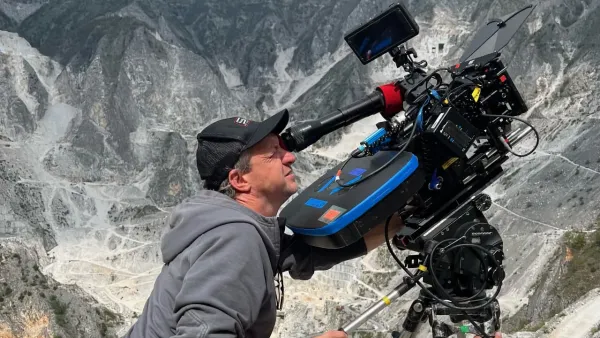
As the 2026 awards season hits its peak, Brady Corbet’s The Brutalist stands as a monumental achievement in modern cinema—not just for its 215-minute runtime, but for its breathtaking visual language. While most modern epics lean on 65mm or digital IMAX, Corbet and cinematographer Lol Crawley took a different path, reviving VistaVision, a 35mm format that has been largely dormant for feature filmmaking since the early 1960s.
Their decision was both an aesthetic choice and a technical necessity, designed to capture the "presence of the past" and the immense scale of the film's architectural themes.
What is VistaVision?
Invented by Paramount in 1954 (famously used by Alfred Hitchcock for Vertigo and North by Northwest), VistaVision differs from standard 35mm in one crucial way: orientation.
-
Horizontal Flow: In standard 35mm, the film runs vertically through the camera. In VistaVision, the film runs horizontally.
-
Larger Negative: By running horizontally, each frame uses 8 perforations (sprockets) instead of the standard 4. This results in a negative area roughly twice the size of standard 35mm, offering significantly higher resolution and a finer grain structure.
1. Capturing the Power of Architecture
The film follows László Tóth (Adrien Brody), a Hungarian architect. Corbet noted that VistaVision was the only format capable of capturing the "minerality" and geometric precision of brutalist structures without the distortion common in other widescreen formats.
"You could be right up against the side of a building with a 50mm lens... and you can see from the cement to the sky because the field of view is so immense," Corbet explained.
Unlike Anamorphic lenses, which can "warp" straight lines at the edges of the frame, VistaVision uses spherical lenses. This allowed the filmmakers to preserve the clean, vertical lines of László’s buildings, ensuring the architecture felt as solid and imposing on screen as it would in real life.
2. The Historical "Archival" Quality
Since the narrative spans from the late 1940s through the 1980s, the choice of a mid-century format served as an "archival" anchor.
-
Period Authenticity: VistaVision was at its peak during the 1950s, the era in which László arrives in America. Using a camera system from that exact time period helped create an "artifact" feel.
-
The 1.66:1 Aspect Ratio: While VistaVision is a widescreen format, Corbet opted to frame the film in 1.66:1—a taller, more European ratio that provides enough height to capture towering monuments while maintaining the grand "vista" of the American landscape.
3. High Resolution on an Indie Budget
Despite its "Oscar-winning" look (Lol Crawley took home the Academy Award for Best Cinematography in 2025), The Brutalist was made for under $10 million.
-
65mm vs. VistaVision: Shooting on 65mm (like Oppenheimer) is prohibitively expensive for indie productions due to the cost of the stock and specialized processing.
-
Workflow Efficiency: Because VistaVision uses standard 35mm stock, it can be processed in traditional labs (like the NFI FilmLab in Budapest). This allowed the production to achieve a "Large Format" look with a significantly lower price tag.
The Technical "Drawbacks"
Reviving a dead format wasn't without its challenges. The production primarily used a single Beaumont VistaVision camera, which brought unique hurdles:
-
Weight: The cameras are notoriously bulky and heavy, making the film's many "handheld" shots a feat of physical endurance for Crawley.
-
Short Loads: A standard reel of VistaVision only allows for about 5 minutes of footage at a time (because it eats through film twice as fast). This required meticulous planning for the film's famous "oners" and long takes.
-
The "Flicker": The vintage cameras sometimes produced a rhythmic flicker, which the digital intermediate team occasionally had to embrace or correct to maintain the film's "discovered artifact" texture.
A Legacy Revived
The success of The Brutalist has sparked a "VistaVision Renaissance" in 2025 and 2026. Paul Thomas Anderson reportedly utilized the same cameras for his 2025 project The Battle of Baktan Cross, and other directors are now looking to the 8-perf format as the perfect middle ground between the intimacy of 35mm and the grandeur of 70mm.
Source - https://www.redsharknews.com/why-epic-period-drama-movie-the-brutalist-was-shot-on-vistavision
Disclaimer - All celebrity-related content, information, and images on this website are based on publicly available online sources and AI-generated insights/data. Information such as biography, age, career, personal details, and images may change without notice over time. While we strive for accuracy, we do not guarantee the accuracy, completeness, reliability, or timeliness of any information or imagery displayed on this website. This content is provided for general informational purposes only.
Iconic Photos of Felicity Jones


Top Trending News of Felicity Jones
 👁️ 199 views
🔥 Nick Cave "Train Dreams" Music Video Unseen Footage
Nick Cave and Bryce Dessner release the official music video for their Oscar-nominated song "Train Dreams," featuring exclusive deleted footage.
👁️ 90 views
🔥 Why The Brutalist Was Shot on VistaVision
Discover why director Brady Corbet chose the vintage VistaVision format for his Oscar-winning film The Brutalist to capture architecture and 1950s authenticity.









Details
Send Us an Enquiry
We'll get back to you as soon as possible.
Thank You!
Your enquiry has been submitted. We'll be in touch shortly.