
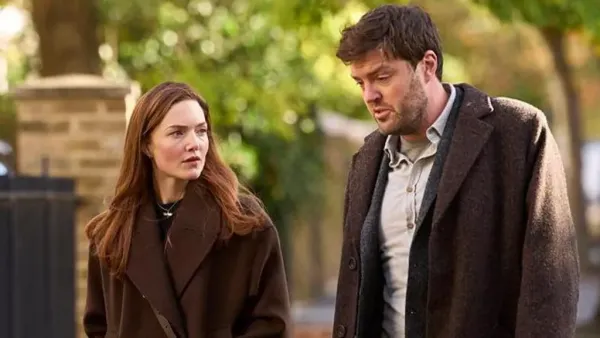
The Capture Season 3 Episode 4 "Kill Switch"
 Previous

here is a particular kind of dread that BBC thrillers do better than almost anyone else in television — not the jump-scare variety, not the gore-drenched spectacle, but the slow, creeping realisation that the world you thought you understood has been silently replaced with a forgery. The Capture has been engineering that precise sensation since its debut in 2019, and with Season 3 now blazing a Sunday-night trail across BBC One and BBC iPlayer, the show has arrived at the cultural moment it was always building towards. Episode 4 — titled "Kill Switch" — dropped on Sunday, 29 March 2026, and if the online chatter is any indication, it may just be the episode that tips this already-addictive viral series into full-blown national obsession.
To understand why "Kill Switch" lands with the force it does, you have to understand what the series has quietly been doing for the past three weeks: accumulating pressure, stacking betrayals like plates on a spinning rod, and daring its audience to trust what they see on screen. By the midpoint of Season 3, that rod is wobbling spectacularly. Rachel Carey — Holliday Grainger's moral compass wrapped in a detective's lanyard — is facing her most precarious position yet, caught between institutional machinery that wants her silenced, a new commanding officer who almost certainly just murdered her closest ally, and a broader geopolitical conspiracy so deep it has roots she hasn't found yet. With two episodes left to follow, "Kill Switch" represents the season's fulcrum. And it does not disappoint.
When and Where to Watch The Capture S03E04
For UK viewers, "Kill Switch" became available on BBC iPlayer at the early-bird hour of 6:00 AM GMT on Sunday, 29 March 2026 — the now-familiar arrangement that the BBC has deployed throughout this season, rewarding those who can't wait with an early morning streaming window before the episode's primetime broadcast. The traditional television airing followed at 9:00 PM GMT on BBC One, with BBC iPlayer streaming remaining free of charge for any viewer in the United Kingdom, no subscription required. If you missed it live, it sits on iPlayer now, ready and waiting.
International viewers face a more fragmented picture, which has become something of an ironic subplot in its own right for a show about the weaponisation of information. In the United States, The Capture Season 3 will stream on Peacock, continuing the partnership established in previous seasons, though a specific premiere date for American audiences had not been officially confirmed at the time of publication — the show's Stateside rollout tends to follow the BBC run by several weeks. Canadian viewers can expect the season to land on Prime Video, while Australian audiences will find it on ABC iview. If you're watching from elsewhere in the world, a VPN paired with a BBC iPlayer account remains the path of least resistance for the impatient.
One further note for those just discovering the series via the current streaming buzz: Seasons 1 and 2 are available on Netflix in many territories, making it entirely possible to binge your way current in a weekend. The BBC also made both prior seasons available on iPlayer ahead of Season 3's March 8 premiere — a savvy move that acknowledges just how much new-release energy the show has attracted from viewers who slept on it first time around.
The Story So Far: Three Episodes of Escalating Chaos
Rewinding briefly for context — because The Capture rewards those who pay close attention to its interlocking storylines — Season 3 picks up approximately twelve months after the incendiary finale of Season 2, in which Rachel Carey (Grainger) pulled off perhaps the boldest act of institutional whistleblowing in the show's history: broadcasting a live deepfake of a government minister to the nation to expose the UK intelligence service's clandestine video manipulation programme, known internally as Correction. In the year since, Carey has been elevated — somewhat uneasily — to Acting Commander of Counter-Terrorism Command, SO15. She is the face of a supposed new transparency, the architect of Operation Veritas, a revolutionary new camera system designed to detect deepfakes in real time. The press, with characteristic tabloid affection, have already given it a nickname: the Careycam.
The season's catastrophic opening gambit dismantles all of that carefully constructed optimism in about twenty minutes. During the high-profile Operation Veritas launch event, communications drop. Feeds cut. And then Home Secretary Isaac Turner — played with quiet, tragic dignity by Paapa Essiedu — is shot dead in plain sight. Carey witnesses the shooting. She saw the shooter's face clearly: Noah Pearson (Killian Scott), her new commanding officer at SO15. But when the camera footage is reviewed? The face it shows belongs to someone else entirely — James Whitlock (Joe Dempsie). The season's central nightmare is crystallised in that gap between what Carey saw and what the cameras recorded. The series' Rotten Tomatoes synopsis puts it elegantly: this is a story about "an investigation of damning video evidence" that "calls into question whether seeing is deceiving."
Episodes 2 and 3 ratcheted the tension further. CIA Section Chief Frank Napier, the thunderously compelling Ron Perlman operating in that grey space between American geopolitical interest and personal loyalty, attempted to get Pearson alone and extract the truth — with Carey's quiet blessing. It did not go well. Pearson, cold and clinical in Killian Scott's unnervingly understated performance, found a weapon among Napier's own men and turned it on them. By the end of Episode 3, Frank Napier was dead, and Noah Pearson had strolled back to his desk at SO15 as if nothing had happened. Carey — the sole person who knows what she witnessed and what it cost — was left completely alone, surrounded by people who either don't believe her or actively want her neutralised.
"Kill Switch": Episode 4 in Full — What Happens and Why It Matters
The official synopsis from Rotten Tomatoes frames Episode 4 with characteristically elliptical BBC precision: "Carey is under pressure to charge Whitlock, but with Napier off-radar, she has bigger problems. Pierson's colleagues have a crisis in confidence, which takes a dangerous turn." That thumbnail sketch, accurate as it is, barely scratches the surface of what "Kill Switch" delivers emotionally and narratively.
The episode opens in the aftermath of Napier's death — or, more precisely, in the fog of it. From what has emerged in early post-air commentary and episode recaps, the instalment begins with Lieutenant James Chivers (Mark Field) reporting that "black fish" — evidently a codename within the Correction network — has lost command of CTC. The crisis of confidence referenced in the official synopsis ripples through Pearson's associates as they realise their operation may be more exposed than they thought. Meanwhile, the institutional machinery grinds on: Carey is being pushed hard to formally charge James Whitlock, the man the cameras implicate in Turner's murder — the man she knows is innocent. It is a profoundly uncomfortable position, the kind of institutional coercion that the series has always been particularly sharp at depicting: the system doesn't need to be malicious to be monstrous; it just needs to be efficient.
What makes "Kill Switch" land so heavily — and what has clearly sent it trending across social channels in the hours since broadcast — is the way it refuses to offer Carey any easy escape. She is the woman who knows the truth. She has the receipts. And it means precisely nothing, because the evidence trail points in the opposite direction. Think of it as the world's most sophisticated game of Whose Line Is It Anyway? — except the rules are written by intelligence agencies and the prize for losing is a ruined life or a bullet. The episode reportedly reaches a genuine crisis point when Pearson's associates take a "dangerous turn" — a moment described in early episode coverage as involving the reactivation of a cattle prod (yes, you read that correctly) and the haunting, almost supernatural resilience of Pearson himself. The episode's title, "Kill Switch," operates on at least three levels simultaneously: the literal, the metaphorical — who can switch off whom? — and the deeply unsettling philosophical: in a world of Correction, where every image can be altered and every truth can be reframed, is there any kill switch for the machinery of disinformation once it's running?
One detail worth noting for those watching for thematic throughlines: the episode leans hard into the season's central interrogation of the gap between witness testimony and recorded evidence. Carey saw Pearson commit murder. The cameras say otherwise. Now she is being pressed to prosecute someone she knows is innocent. This is not just good thriller plotting — it is a meditation on the nature of epistemic authority in 2026, a year when deepfake technology is, as one reviewer noted, no longer a "niche technological curiosity" but something achievable on a smartphone. The Capture has always asked its audience to feel that vertigo personally. "Kill Switch" might be the episode where that vertigo becomes impossible to ignore.
Holliday Grainger and the Art of Playing the Last Honest Person in the Room
Any conversation about why The Capture works as well as it does has to begin and end with Holliday Grainger. There is a particular kind of performance that television thrillers require from their leads — a quality of watchful intelligence, a sense that the character is always three moves ahead even when the script is actively trying to knock them off balance — and Grainger has it in such abundance that watching Season 3 sometimes feels like watching a masterclass in restraint. Rachel Carey could easily tip into the tiresome trope of the Brilliant Detective Who Plays By Her Own Rules; instead, Grainger plays her as someone whose rules are very specifically the right ones, and whose tragedy is that the institutions around her keep rewriting them.
The actress herself has spoken about the show's unusual relationship with topicality. "CCTV to deepfakes to AI," she told the BBC ahead of Season 3's premiere. "Ben takes real truths and asks 'what if?', encouraging audiences to question the world we're living in. What once felt futuristic now feels real. People are still discovering the show, and its themes keep catching up with the world." That last line is worth sitting with. There is something genuinely remarkable about a series that premiered in 2019 with a premise critics called "preposterous" — surveillance footage altered in real time to frame innocent people — and has watched the real world spend seven years diligently catching up with it. When The Capture debuted, deepfakes were a laboratory curiosity. In 2026, they are an election weapon, a harassment tool, and a daily conversation. The show didn't predict the future so much as follow its logical thread to its uncomfortable conclusion.
The Season 3 ensemble is formidable. Ron Perlman brought a kind of gravel-voiced, morally corroded magnificence to Frank Napier that made his demise at Episode 3's conclusion genuinely shocking — the show has rarely killed a character who felt quite so load-bearing. Killian Scott as Noah Pearson has become one of British television's most quietly terrifying antagonists: the performance is built almost entirely on controlled stillness, a quality that makes the rare moments of violence all the more destabilising. Indira Varma's Khadija Khan — the BBC journalist who functions as the series' moral Greek chorus — continues to be essential, not least because she voices the question that the audience is constantly asking: how do we sort fact from fiction? And Lia Williams as DSU Gemma Garland brings a glacial pragmatism to the intelligence world that is more frightening, in its way, than any explicit villainy. These are people who have simply decided that the ends justify the means. The show never lets you forget that they probably believe they're the good guys.
Why This Is the Most Urgent Series on Television Right Now
It is rare, and worth marking, when a piece of entertainment feels genuinely necessary. The Capture in its third season has achieved something that most political thrillers only gesture towards: it has made the abstract machinery of surveillance capitalism and state disinformation feel intimate, immediate, and personal. The show achieves this not through polemics but through plot — through the simple, devastating device of making us care about a woman who is telling the truth and being systematically unbelieved by everyone around her. Rachel Carey is, in the most literal sense, a single reliable narrator in a story where narrators have been rendered unreliable. That is not just good drama. In 2026, it is a profound political metaphor.
The Times gave Season 1 four stars and described it as "the thinking man's Bodyguard" — a comparison that the show has long since outgrown. Bodyguard was a thriller about institutional failure and personal courage. The Capture is something more disturbing: a thriller about institutional design, about systems that work exactly as intended, and about what happens to the individuals who stand in their way. Season 3 ups the geopolitical stakes considerably, pulling in American intelligence through Perlman's Napier, Chinese technology firms, and a British political establishment that appears to have rotted from somewhere well above the waterline. In this context, "Kill Switch" — with its pressure on Carey to charge an innocent man, its glimpse of the chaos erupting inside Pearson's network, and its quiet insistence that the truth is still out there even if no one will print it — feels less like television entertainment and more like a very well-produced anxiety dream.
The streaming buzz around Season 3 has been striking. Viewers flooding social media after the Season 3 premiere called it "the best show on TV" and described the opening episode as "sensational." The Times awarded the new season four stars. The return has been described as arriving at exactly the right cultural moment — and that instinct is well-founded. We are living in a time when manipulated video is used in courtrooms, elections, and international diplomacy. The Capture didn't arrive at this conversation late. It has been patiently waiting for the conversation to arrive at it.
What's Next: Episodes 5 and 6
With "Kill Switch" setting the season's final act in motion, the road to the finale is mercifully short. Episode 5 arrives on Sunday, 5 April 2026 (6 AM on iPlayer, 9 PM on BBC One), and Episode 6 — the season finale — follows on Sunday, 12 April 2026 at the same times. Six episodes. That is the whole architecture of Season 3: lean, considered, and structured like a very good piece of clock-work. Ben Chanan, who writes, directs, and executive produces the series, has always understood that the thriller format works best when it doesn't overstay its welcome, when each episode functions as both a satisfying unit and an irresistible hook for the next. Season 3 has delivered that in spades.
The questions the finale will need to answer are several and significant. Can Carey produce evidence that implicates Pearson without Correction being turned against her? Will Whitlock be charged — and if so, can she stop it? What exactly did happen to Frank Napier's body, and who else inside the intelligence apparatus knows? And, perhaps most pressingly, who is "pulling the strings" of a conspiracy that has now reached deep enough into the British state to include the murder of a Home Secretary? The season has been slowly, deliciously revealing that Correction is, as one character puts it, "only the tip of the iceberg." Two episodes remain to show us what lies beneath.
Whatever those answers are, The Capture has already earned its place as the defining British thriller of this particular cultural moment — a series about the weaponisation of truth, told at a time when truth itself feels more contested than ever. Like a hall of mirrors that keeps revealing new corridors, Season 3 has rewarded patience and punished complacency in equal measure. "Kill Switch" is not just a great episode of television. It is a reminder of what the medium can do when it decides to take the audience seriously.
Everything You Need to Know About The Capture S03E04
1. When does The Capture Season 3 Episode 4 air?
Episode 4, titled "Kill Switch," aired on Sunday, 29 March 2026. It was available on BBC iPlayer from 6:00 AM GMT and broadcast on BBC One at 9:00 PM GMT.
2. What is the title of The Capture S03E04?
"Kill Switch" — a title that operates on multiple thematic levels, referencing both the literal threat to Pearson's operation and the broader question of whether the Correction machinery can ever truly be switched off.
3. What is the storyline of The Capture Season 3 Episode 4?
Carey faces institutional pressure to charge the innocent James Whitlock for the murder of Home Secretary Isaac Turner, while the absence of Frank Napier leaves her dangerously isolated. Meanwhile, Noah Pearson's associates experience a crisis of confidence that escalates into genuine danger.
4. Where can I watch The Capture Season 3 outside the UK?
In the US, Season 3 will stream on Peacock. Canadian viewers can find it on Prime Video. Australian audiences can watch on ABC iview. A specific US premiere date had not been confirmed at the time of writing.
5. Who stars in The Capture Season 3?
The main cast includes Holliday Grainger as Rachel Carey, Killian Scott as Noah Pearson, Ron Perlman as Frank Napier, Indira Varma as Khadija Khan, Lia Williams as Gemma Garland, Joe Dempsie as James Whitlock, Ben Miles as Danny Hart, and Nigel Lindsay as Tom Kendricks, among others.
6. Is The Capture Season 3 available on Netflix?
Seasons 1 and 2 of The Capture are available on Netflix in many territories. Season 3 is a new release on BBC One and iPlayer in the UK; international platform availability differs by region.
7. Who is Noah Pearson in The Capture?
Noah Pearson is played by Killian Scott. He is Carey's new commanding officer at SO15 — a shadowy, highly dangerous figure whom Carey witnessed shooting Isaac Turner in Season 3's opening episode, though camera footage implicates a different suspect.
8. What happened to Frank Napier in Episode 3?
Frank Napier (Ron Perlman), attempting to extract information from Pearson about the Turner murder, was killed along with his associates when Pearson turned one of their own weapons against them. His death leaves Carey without her most powerful off-book ally.
9. What is Operation Veritas in The Capture?
Operation Veritas is Carey's revolutionary new camera system, launched at the start of Season 3, designed to detect deepfake manipulation in real time. The press nicknamed it "Careycam." Its failure during the Turner assassination sets the season's central crisis in motion.
10. How many episodes does The Capture Season 3 have?
Season 3 consists of six episodes in total. Episodes air weekly on Sundays on BBC One and iPlayer. The finale airs on 12 April 2026.
11. What is the Correction programme in The Capture?
Correction is the series' fictional (though chillingly plausible) programme used by UK intelligence agencies to manipulate live video feeds in real time, creating false evidence and controlling public narratives. Carey exposed it at the end of Season 2.
12. What are critics saying about The Capture Season 3?
Reception has been strongly positive. The Times awarded it four stars, and viewers have hailed it online as "the best show on TV." The season holds a positive critical consensus on Rotten Tomatoes. Some critics note the storylines are becoming more elaborate, but the general view is that the show remains compelling and culturally timely.
13. Who created and writes The Capture?
The series is created, written, directed, and executive produced by BAFTA-winning filmmaker Ben Chanan, known for high-profile work including The Missing and The Last Kingdom. The production company is Heyday Television, part of Universal International Studios.
14. When does Episode 5 of The Capture Season 3 air?
Episode 5 airs on Sunday, 5 April 2026, with the same schedule: 6 AM on BBC iPlayer and 9 PM on BBC One.
15. When is The Capture Season 3 finale?
The Season 3 finale, Episode 6, airs on Sunday, 12 April 2026 — again available on iPlayer from 6 AM and on BBC One at 9 PM.
16. Why is The Capture so relevant right now?
The series, which premiered in 2019 when deepfakes were still considered speculative technology, has found its cultural moment fully. In 2026, AI-generated video manipulation, surveillance capitalism, and institutionalised disinformation are daily realities rather than sci-fi premises. The show feels, as one critic wrote, less like fiction and more like "a mirror held up to our present reality."
17. Is The Capture Season 3 free to watch on BBC iPlayer?
Yes. BBC iPlayer is free to use for viewers in the United Kingdom with a valid TV licence. All episodes of Season 3 are available on the platform, with new episodes dropped early (6 AM) on Sundays ahead of their primetime BBC One broadcast.
Disclaimer - All celebrity-related content, information, and images on this website are based on publicly available online sources and AI-generated insights/data. Information such as biography, age, career, personal details, and images may change without notice over time. While we strive for accuracy, we do not guarantee the accuracy, completeness, reliability, or timeliness of any information or imagery displayed on this website. This content is provided for general informational purposes only.
Iconic Photos of Holliday Grainger


Top Trending News of Holliday Grainger
👁️ 57 views
🔥 The Capture Season 3 Episode 4 "Kill Switch"
The Capture Season 3 Episode 4 "Kill Switch" airs March 29, 2026 at 9 PM GMT on BBC One and 6 AM on iPlayer. Get the full release time, episode storyline breakdown, cast updates, streaming info, and why this viral BBC thriller is the most culturally urgent new release of spring 2026.
 👁️ 37 views
🔥 The Capture Season 3 Trailer: Holliday Grainger Returns
BBC’s 96% Rotten Tomatoes thriller ‘The Capture’ is back. Watch the new Season 3 trailer and discover DCI Rachel Carey’s next geopolitical conspiracy.


Details
Send Us an Enquiry
We'll get back to you as soon as possible.
Thank You!
Your enquiry has been submitted. We'll be in touch shortly.