
The Sky's the Limit: The Daring and Tragic Life of John Light, America's Forgotten Ballooning Superstar

 Previous

The Spectacle of 1859
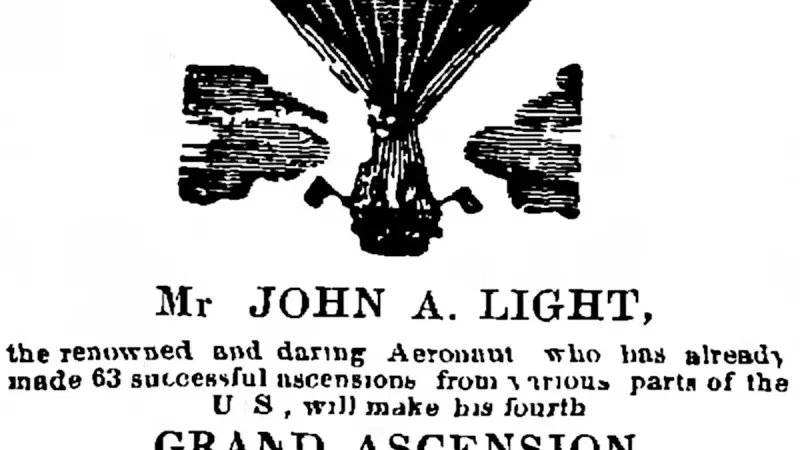
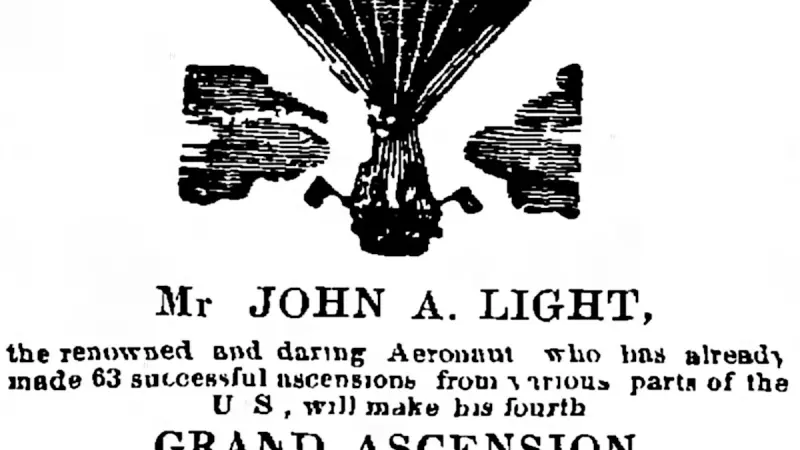
On August 6, 1859, a young man named John A. Light became the talk of Hagerstown, Maryland. According to the documented text in Screenshot (550).png, several thousand spectators packed the streets, leaning out of hotel windows and balancing on rooftops as Light prepared to ascend in a massive silk hot air balloon called the Eclipse. The ropes were cut, and Light soared hundreds—then thousands—of feet above the crowd, a pioneer in an era gripped by what historians call "balloonomania."
This was no mere carnival stunt. Light was described as a "scientific and daring Aeronaut," and his ascensions were serious business. Over 18 years, he made more than 120 flights across Pennsylvania, Maryland, Delaware, and Virginia. But behind the cheers lay a life of drama, danger, and eventual tragedy that reads like a Hollywood script.
A Career Takes Flight
Born in 1838 in Lebanon County, Pennsylvania—a hotbed of balloon innovation—Light married Lucetta Lutz in 1858 and fathered two children. By the 1860 census, his occupation was listed simply as "Aeronaut." That was a bold choice for a man barely in his twenties, but Light had the skills to back it up.
His 1860 return to Hagerstown featured a stunt that would make modern animal rights activists cringe: he dropped a parachute-clad cat overboard from 1,000 feet. The cat landed safely (if terrified) outside town. He also released a pair of bewildered pigeons that flew straight home. The Eclipse finally touched down in Waynesboro, Pennsylvania, where Light caught a carriage back to Hagerstown.
By fall 1860, Light had completed 24 ascensions, including a memorable flight from Chambersburg. But danger was never far away. He allegedly "had an incident over Clear Spring," though details remain murky. In December 1860, newspapers mistakenly reported that Light had died after being thrown from his balloon with a broken neck. It was the first of many false death notices—a recurring theme in his turbulent life.
War in the Skies
The Civil War interrupted Light's career, but he didn't stay grounded. In 1862, he enlisted in Company H, 3rd Regiment, Pennsylvania Heavy Artillery, rising from private to senior second lieutenant. His unit saw action at Gettysburg in 1863. Meanwhile, the Union Army had formed a Balloon Corps under Thaddeus Lowe, using gas-filled balloons for reconnaissance—a precursor to the U.S. Air Force. Though the corps was disbanded due to logistical challenges, it hinted at the military potential of flight.
Light's own war experience was gritty, not glamorous. But after the war, he returned to his true passion: entertaining crowds with death-defying ascents.
Post-War Glory and Danger
The post-war years were Light's golden era. According to Screenshot (550).png, he earned $100 for a single ascension in Middletown, Pennsylvania—roughly $1,976 today. That was serious money in the 1860s.
On August 11, 1866, Light unveiled a new balloon, the Flying Cloud, lifting off from Hagerstown's Public Square. Soon after, he ascended from Chambersburg (still recovering from being burned down by Confederate forces in 1864) and dropped a small dog with a parachute. The dog landed in a plant nursery, unharmed. In 1867, he drifted all the way from Chambersburg to Funkstown, where farmers looked up from their harvest to witness the silk marvel crossing the sky.
But disaster struck that same year. Light's balloon Montgolfier split mid-air, sending him plummeting into the Juniata River. Miraculously, he survived without injury—and promptly adopted the title "Professor," presenting himself as a man of science. Over the next four years, he built three more balloons: Albion, Aerial, and Celeste.
Scandal and False Deaths
By 1872, Light was expanding his reach, performing in New York, Indiana, and Illinois. He even took passengers aloft, including his wife Lucetta, who became an aeronaut herself. But fame came with a dark side.
In July 1876, newspapers reported that Light had been shot dead by an unnamed woman—his "paramour"—after a dispute in Paris, Illinois. Once again, the reports were false. Light wrote letters to the press assuring the public he was alive and would continue flying.
Yet the scandal hinted at deeper troubles. The Pittsburgh Post-Gazette later noted his increasing alcohol consumption. On April 5, 1877, Light died of "throat consumption" (likely tuberculosis) at age 38, with alcohol abuse accelerating his decline. This time, the obituaries were real. The Shepherdstown Register remembered him as a "well-known and intrepid balloonist." The Post-Gazette quipped: "He is dead this time for sure."
Final Descent
John Light never reached the prominence of Thaddeus Lowe or the Wright Brothers. But his legacy is undeniable. For nearly two decades, he brought wonder to small-town America, inspiring onlookers with the simple magic of flight. His story, preserved in Screenshot (550).png, is a reminder that the sky was never a limit—only a beginning.
From the heights of the Eclipse to the depths of the Juniata River, Light's life was a thrilling, dangerous, and ultimately tragic ride. And that, perhaps, is the essence of true celebrity.
Disclaimer - All celebrity-related content, information, and images on this website are based on publicly available online sources and AI-generated insights/data. Information such as biography, age, career, personal details, and images may change without notice over time. While we strive for accuracy, we do not guarantee the accuracy, completeness, reliability, or timeliness of any information or imagery displayed on this website. This content is provided for general informational purposes only.
Iconic Photos of John Light




Top Trending News of John Light
 👁️ 25 views
🔥 The Tragic Rise and Fall of 19th Century Balloonist John Light: A Sky-High Celebrity Before It Was Cool
Discover the thrilling, scandal-filled life of John Light, the 'Professor' who enchanted crowds with dangerous balloon ascents and died in disgrace. A true celebrity of the 1800s.
👁️ 23 views
🔥 The Sky's the Limit: The Daring and Tragic Life of John Light, America's Forgotten Ballooning Superstar
Discover the thrilling story of 19th-century aeronaut John Light, who captivated crowds with hot air balloon ascents, survived Civil War combat, and a scandalous death hoax. Read more from Screenshot (550).png.










Details
Send Us an Enquiry
We'll get back to you as soon as possible.
Thank You!
Your enquiry has been submitted. We'll be in touch shortly.