
Supreme Court's Fiery Verdict: Wife's 'Adultery' Plea Must Be Heard Before Maintenance Finale — And Private Detectives Are in the Crosshairs

 Previous

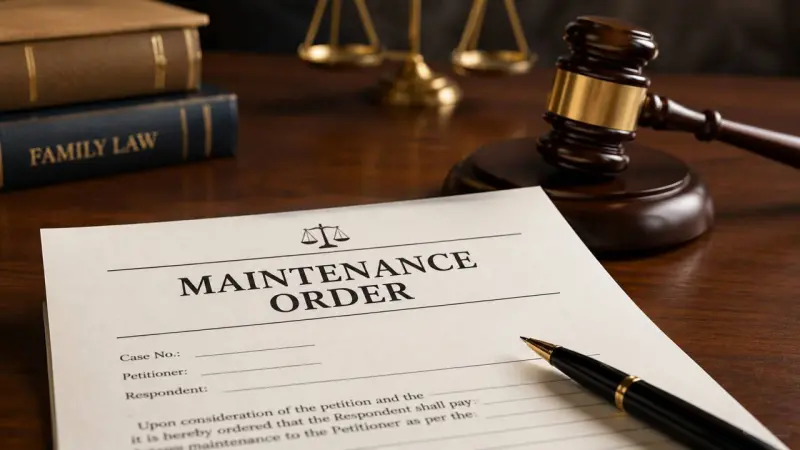
The Legal Bombshell That Has Everyone Talking
The Supreme Court just dropped a legal grenade in the ongoing war over spousal maintenance, and the shockwaves are being felt across India's family courts. In a dramatic ruling, the country's top court has declared that a husband's plea alleging his wife is living in adultery cannot be swept under the rug until the final maintenance order. The decision, meticulously documented in Screenshot (550).png, is being hailed as a game-changer for thousands of bitter matrimonial battles.
The case, Himanshu Chordia versus State of Rajasthan & Anr., was decided on 31.07.2026 by a Bench of Justice Sanjay Karol and Justice Vipul M. Pancholi. At its core, the ruling wrestles with a fiery question: Can a husband stop paying interim maintenance the moment he cries 'adultery'? The answer, as the Bench made crystal clear, is a resounding 'not so fast' — but the accusation itself cannot be ignored either.
The Backstory: A Marriage Gone Supernova
This legal firestorm began with a marriage that took place on 07.07.2014. But by 2020, the fairy tale had curdled into a nightmare. According to the husband, the wife packed her bags, grabbed their minor son and her valuables, and walked out of the matrimonial home on 13.05.2020. She then filed a maintenance application under Section 125 of the Code of Criminal Procedure, seeking both interim and final financial support from the Special Additional Chief Judicial Magistrate in Udaipur.
The husband, clearly playing offense, fired back with an application under Section 125(4) CrPC, alleging that his wife was living in adultery. To back up his claims, he produced photographs, electronic material, and additional affidavits. He even moved an application under Section 91 CrPC, demanding bank details, call records, income tax returns, and information about the alleged paramour.
But here's where the drama truly exploded: the trial court dismissed both applications. It ruled that the authenticity of the electronic evidence could only be test-cried during the full trial, and so the adultery plea would have to wait until the final act. Interim maintenance, meanwhile, was granted at ₹25,000 per month for the wife and an equal amount for the minor son.
The High Court Stumbles, the Supreme Court Pounces
The Rajasthan High Court upheld that decision, treating the adultery allegation as a disputed question of fact that needed a full evidence-led battle before any final word. But the Supreme Court was having none of it. The Bench tore into this approach, noting that it would effectively render Section 125(4) 'otiose' — a legal slap that echoed through the courtroom.
In a powerful passage, the Supreme Court clarified that while interim maintenance should normally continue during the pendency of proceedings, a husband who wants to halt it must present clear and cogent evidence that ex facie establishes adultery. If the evidence is admitted or conclusive, the maintenance claim can be snuffed out at the threshold. But if there's genuine dispute, the court must examine the material before deciding — and until then, the money keeps flowing.
The Three-Stage Tango of Maintenance Proceedings
The Court laid out a step-by-step roadmap that will now guide every family judge in the land. These are the three critical junctures:
- Stage One: The court weighs whether interim maintenance should be granted, providing immediate lifeline support to the claimant.
- Stage Two: The court must independently decide any application filed under Section 125(4) — including adultery allegations — on its own merits, not postpone it indefinitely.
- Stage Three: Only after that does the final adjudication of the main maintenance petition take place.
The takeaway is unmistakable: a plea of adultery is not a magical incantation that automatically freezes a wife's bank account. But it's also not a ticket to be ignored while the legal machinery grinds through years of hearings.
Why This Matters for Every Warring Couple
The ruling is a delicate balancing act between two competing legal philosophies. On one hand, Section 125 CrPC is a benevolent social justice provision, designed to prevent destitution and vagrancy. The Supreme Court reminded everyone that these proceedings are summary in nature, substantially civil in character, and deserve liberal interpretation. On the other hand, Section 125(4) carves out a hard exception: if a wife is living in adultery, refuses to cohabit without sufficient cause, or the spouses are separated by mutual consent, the maintenance claim can be stripped away.
The Bench also acknowledged the 2001 amendment that introduced explicit interim maintenance provisions, meant to provide expeditious financial aid while the main case churns. But the Court made it painfully clear that this does not mean an adultery plea can be shelved until the final verdict. The statutory exception must be given teeth, and if the evidence is strong enough, the wife loses her right to both interim and final maintenance.
Private Investigators Put on Notice
But wait, there's more. The Supreme Court used this case as a platform to launch a blistering critique of the shadowy world of private detectives in matrimonial disputes. The husband in this case reportedly produced a trove of photographs and videos showing his wife in a relationship outside marriage — materials that appeared to have been procured through private investigators.
The Bench didn't just raise an eyebrow; it sounded the alarm. Questions about the legality of surveillance, the authenticity of electronic evidence, privacy implications, and the risk of morphed or manipulated images were all flagged. The Court noted that the proposed Private Detective Agencies (Regulation) Bill, 2007, never became law, leaving this unregulated industry free to operate in the shadows.
A Legal Framework Demanded
The Supreme Court took the extraordinary step of ordering that a copy of its judgment be sent to the Secretary, Ministry of Law and Justice and the Chairman of the Law Commission of India. The message is unambiguous: it's time to regulate private investigators before they become the unaccountable arbiters of marital infidelity.
The suggested framework covers everything from licensing and permissible investigation methods to data retention, privacy rights, and grievance redressal. In a world where a single leaked photograph can destroy reputations, the Court wants rules that protect individuals from surveillance abuse.
The Final Word: Remanded for a Fresh Fight
In this specific case, the Supreme Court allowed the husband's appeal and set aside the Rajasthan High Court's judgment. The matter now goes back to the Trial Court to decide the husband's Section 125(4) application on its own merits, based on the evidence produced. The interim maintenance, meanwhile, continues — but the husband now has a fighting chance to prove his wife's alleged adultery with clear, cogent evidence.
The decision is a potent reminder that in India's high-stakes divorce and maintenance wars, the law is no longer willing to let allegations gather dust. Whether you're a spouse seeking maintenance or one desperate to stop paying, the Supreme Court has laid down the new rules of engagement: bring your strongest evidence, or watch the money flow.
Disclaimer - All celebrity-related content, information, and images on this website are based on publicly available online sources and AI-generated insights/data. Information such as biography, age, career, personal details, and images may change without notice over time. While we strive for accuracy, we do not guarantee the accuracy, completeness, reliability, or timeliness of any information or imagery displayed on this website. This content is provided for general informational purposes only.
Iconic Photos of Karol g




Top Trending News of Karol g
 👁️ 77 views
🔥 Karol G and Feid Split After 3 Years of Dating
Get the details on Karol G and Feid’s "amicable" breakup. After three years together.
 👁️ 72 views
🔥 Karol G’s Sheer Dress Steals the Super Bowl 2026 Spotlight
Karol G turned heads at Super Bowl LX in a daring, almost fully sheer Ann Demeulemeester dress.










Details
Send Us an Enquiry
We'll get back to you as soon as possible.
Thank You!
Your enquiry has been submitted. We'll be in touch shortly.