
Kanye Bully Review: The Album That Whispers When It Should Roar
 Previous

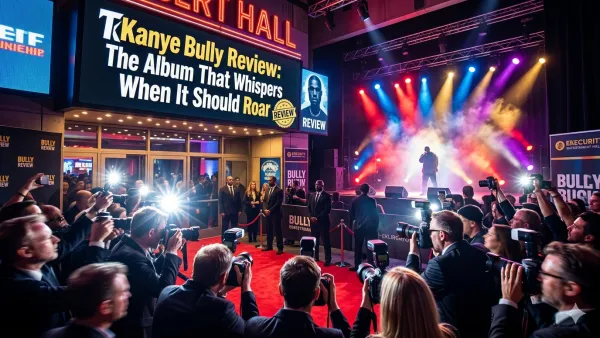
When Kanye West released his 12th studio album "Bully" on March 27-28, 2026, the moment carried the weight of accumulated expectations, fresh apologies, and lingering skepticism. This wasn't just another album drop from a contentious figure. It was a statement—or perhaps, a confession wrapped in basslines and soul samples. The question everyone asked before hitting play was the same: Can Kanye West make music that stands apart from the chaos of his own life? What we discovered, after spending time with the record, is more complicated than a simple yes or no.
The journey to Bully wasn't straightforward. Kanye West had been teasing Bully since September 2024, previewing songs such as "Preacher Man" and "Beauty and the Beast" during performances and online posts. What should have been a clean release became a sprawling narrative of delays, reversions, and revisions. West originally said the album would arrive on March 20, 2026, but that date passed before the project was ultimately premiered at a Los Angeles event and then released to streaming shortly after. In that gap between promises and delivery exists the real story of Bully—not as a finished product, but as a document of a restless, uncertain process.
The backdrop to all of this, of course, matters. Just weeks before the album's release, Kanye West took out a full-page newspaper ad in The Wall Street Journal to explain, in public, that a brain injury has been driving years of antisemitic tirades and swastika merch and manic implosions, naming his diagnosis (bipolar type 1, stemming from a car wreck twenty-four years ago) and crediting his wife and inpatient treatment in Switzerland with pulling him back. It was a rare moment of accountability, a confession that felt weighty and genuine. Then the album came out, and almost none of that vulnerability made its way into the music itself.
The Sound of Retreat
Sonically, Bully resembles West's work on 808s & Heartbreak (2008) and My Beautiful Dark Twisted Fantasy (2010), extensively relying on sampling and interpolations, with West mostly singing instead of rapping. If you're familiar with Kanye's discography, you recognize the vocabulary here. There are moments of genuine beauty—the rumbling bass of "This is a Must," the sped-up soul samples of "Punch Drunk," even "All the Love" feels like the next-of-kin to "Stronger," thanks to the electronic aesthetic. These are moments that feel like the Kanye West who built a reputation on impeccable sample selection and meticulous production.
But there's a staleness to much of what follows. The vintage sampling on "Punch Drunk" seems like it should yield an immediate standout, but it has one verse about Sonny Liston and fathers in the penitentiary that gets abandoned the second the chorus kicks back in. It's emblematic of the album's larger problem: beautiful foundations that never quite become buildings. These songs exist in fragments—pretty to look at, but incomplete as statements.
The AI controversy that haunted the rollout looms large here. On March 25, 2026, West posted a tracklist and wrote "BULLY ON THE WAY NO AI," directly rejecting the idea that the album used AI-generated material, contradicting remarks he made in a 2025 interview where he described AI as a tool in his writing and recording process. Whether West ultimately used AI in the final version or re-recorded vocals himself, the fact that this became a central point of discourse speaks to how diminished trust has become in his project-to-project evolution.
The Collaboration Question
The roster of collaborators on Bully reads like a highlight reel from West's various eras: Travis Scott, CeeLo Green, Ty Dolla $ign. These are artists who've worked with Kanye when his star was highest, when collaboration meant something. Travis Scott shows up on "Father" over a Johnnie Frierson gospel sample and a James Brown vocal snippet, and his verse does exactly as much as you'd expect from 2026 Travis Scott, which is not much. Even the best collaborators can't salvage moments that feel fundamentally incomplete.
The guest appearance that caught the most attention was arguably more controversial than musical. West included collaborator Nine Vicious, who has been criticized for a number of homophobic and xenophobic remarks, which may be read obliquely as a small act of defiant red-piling. It's the kind of choice that, regardless of the music's quality, complicates how audiences receive the work.
Mixed Reception and Critical Consensus
The critical response to Bully has been precisely what the album deserves: mixed-to-positive, frustrated, and searching for a way to separate the music from the messiness surrounding it. The album received mixed-to-positive reviews from music critics, who credited it as a significant improvement to its past revisions. Some critics saw a return to form, or at least a return to some form of discipline. Others saw retreat, safety, and a kind of artistic complacency.
What's striking is how consistently reviewers grapple with the same central tension: the album contains flashes of the brilliance that made Kanye West essential, but those flashes are surrounded by vast stretches of the mundane. The album sounds like a restless artist trying to recover form through mood, texture, and control rather than chaos. That does not make Bully a flawless release, but it does make it one of the more closely watched rap albums of the year.
Thematic Emptiness Despite Bombast
Lyrically, Bully retreads familiar territory without adding new dimensions. Like much of Ye's oeuvre, the big question on Bully is: Who is Kanye pumping up in his music, his audience or himself? Or both? Musically, the album harkens back to the industrial harshness of 2013's Yeezus, while thematically Bully plays with religious notions and familial nostalgia that populated 2021's Donda. These themes—divine purpose, familial connection, personal vindication—have become the recurring motifs of West's later work. They're no less important for being repeated, but they're handled with less poetry, less nuance, less care than they receive on earlier albums.
As usual, the album's lyrical content seems focused on Kanye's egotism. "I had to learn to read between the lines/ Overboard when they mention me in Times," he raps on "Punch Drunk." "Know the Lord's intervention was divine/ Political and social tensions on decline/ Not to mention, they forget to mention/ How I'm swingin' through like Sonny Liston in his prime." It's Kanye at his most self-focused, reframing his own struggles as cosmic significance, his own recovery as divine intervention. There's a desperate quality to it—the need to convince us (and perhaps himself) that everything matters, that it all adds up to something.
The Digital vs. Physical Divide
One of the strangest aspects of Bully is that it exists in multiple versions, and those versions matter. The streaming version rewrites the title cut entirely, while the physical's "Bully" was a neurochemical list. These aren't minor differences. They're evidence of fundamental uncertainty about what the album is supposed to be. The physical release came with poor quality mastering that drew immediate criticism, forcing West to delay the streaming version while he ostensibly perfected it.
This fragmentation is telling. In an era when albums are meant to be unified statements, Bully exists as a collection of different attempts at the same project. It's as if West couldn't decide on a version and released several, asking listeners to figure out which was closest to his actual intention. That's not artistic evolution. That's artistic crisis.
What Should Have Been
The most intriguing thing about Bully is what it could have been if West had actually integrated the vulnerability of his Wall Street Journal apology into the music itself. Imagine an album that directly addressed the consequences of his words, the damage of his actions, the reality of his diagnosis. That would be remarkable—uncomfortable, potentially redemptive, certainly artistically significant. Instead, Bully offers vague proclamations of love and serotonin and God, with none of the songs engaging with what he described in that letter; the mania, the antisemitism, the institutional wreckage all vanish the second the music starts.
It's a significant failure of imagination. Not the failure of someone who can't create art anymore—the production and samples prove that's not the case—but the failure of someone unwilling to make himself truly vulnerable within the work. The apology was the brave part. The album is the retreat.
Track-by-Track Observations
On "I CAN'T WAIT," West taps back into that confident, bulldozing delivery that made him stand out in the first place. The production leans cold and dusty, built around a haunting flip of "You Can't Hurry Love" by The Supremes, giving the track a worn, almost ghostly feel. Ye cuts through it with authority, landing punchlines that feel natural rather than forced.
The best tracks on the album share this quality—they're built on strong sonic foundations that West doesn't undermine. The album's best track, by leaps and bounds, is "Preacher Man" a crisp sample of The Moments "To You With Love" that layers religious symbolism over Ye's usual braggadocios bars. These songs work because they know what they are: moments of flash and ego wrapped in gorgeous production.
Other moments falter. "Sisters and Brothers" rides a Jonah Thompson gospel sample and a Loleatta Holloway interlude while Ye rattles off flex bars about mach three and armored cars, and the spiritual and the materialistic crash into each other with no awareness from anyone involved. It's the album in miniature: beautiful ingredients, confused intention, incomplete execution.
The Tour and What's Next
West is set to embark on a world tour to support Bully from April to August 2026. This will be the test of whether the album connects in live contexts. Music that feels incomplete in the studio sometimes acquires urgency on stage, where Kanye's legendary energy can compensate for production shortcomings. But it's also possible that a tour simply extends the feeling that something is fundamentally unresolved.
The larger question is what comes after. If they want a neat redemption narrative, Bully does not provide one. If they want a record that proves West can still shape compelling soundscapes, the answer is more favorable. The album doesn't settle anything. It leaves everything in suspension.
FREQUENTLY ASKED QUESTIONS
1. Is Kanye's Bully album worth listening to? If you appreciate sample-based production and Kanye's sonic vocabulary, there are moments worth your time. The best tracks ("Preacher Man," "I CAN'T WAIT") showcase classic strengths. However, the album overall feels incomplete and emotionally distant. Set expectations accordingly.
2. What is the main controversy surrounding the Bully album? The primary controversy concerns AI vocal generation. West initially claimed the album contained no AI, contradicting earlier statements. While the final streaming version appears to use West's re-recorded vocals, the rollout confusion damaged credibility.
3. How many tracks are on Kanye's Bully album? The album contains 18 tracks. However, different versions (physical vs. streaming) feature different arrangements, with the streaming version arriving later with revisions.
4. What does Kanye mean by the title "Bully"? West hasn't provided explicit explanation. Contextually, it appears to reference themes of dominance, protection, and masculine assertion—consistent with his later-era lyrical interests.
5. Which artists collaborate on the Bully album? Notable collaborators include Travis Scott, Ty Dolla $ign, CeeLo Green, Don Toliver, and others. Each adds texture but none substantially changes the album's overall trajectory.
6. How does Bully compare to Donda or My Beautiful Dark Twisted Fantasy? MBDTF is more cohesive and artistically ambitious. Donda is more religious but also more scattered. Bully sits between them—not as accomplished as MBDTF, not as chaotic as Donda, but also not as distinctive as either.
7. What's the best track on Bully? "Preacher Man" and "I CAN'T WAIT" consistently receive praise. Both feature strong sample selections and relatively focused compositions.
8. Why did Kanye delay the album release multiple times? West announced the album in September 2024, with various release dates passing throughout 2025 and early 2026. He cited production refinements, though the multiple different versions suggest genuine uncertainty about the album's final form.
9. Does the Bully album address Kanye's recent controversies? No. Despite his Wall Street Journal apology addressing antisemitism and bipolar disorder diagnosis, the album contains no direct engagement with these topics. This disconnect disappointed many listeners.
10. Is the Bully streaming version different from the physical release? Yes. The physical version arrived in March with quality issues. The streaming version, released days later, features a rewritten title track and additional polish, though not substantial musical changes.
11. What happened with the AI controversy? West tweeted "BULLY ON THE WAY NO AI" on March 25, 2026, claiming no artificial intelligence in the album. However, early versions reportedly contained AI-generated vocal deepfakes. The final streaming version appears to use West's own vocals, though timeline details remain unclear.
12. How have critics responded to the Bully album? Mixed-to-positive overall. Critics acknowledge improved production and cohesion compared to recent projects, but note the album lacks emotional depth and artistic risk. The consensus: competent but disappointing.
13. What is Kanye West planning after the Bully release? West announced a world tour from April to August 2026 supporting the album. He also has two concerts scheduled for Los Angeles in early April 2026.
14. How long is the Bully album? The album runs approximately 65-70 minutes depending on version, with 18 tracks of varying lengths.
15. What production techniques dominate the Bully sound? Soul sampling, electronic elements reminiscent of 808s & Heartbreak, and layered production. The album leans toward stripped-down arrangements rather than maximalist soundscapes.
16. Who are the primary producers on Bully? Mike Dean and co-writers including Quentin Miller, Ty Dolla Sign, Toliver, Malik Yusef, and Billy Walsh contributed significantly. West handled substantial production himself.
17. Where can I stream or purchase Kanye's Bully album? The album is available on all major streaming platforms (Spotify, Apple Music, Amazon Music, etc.) as well as physical formats (vinyl, CD, cassette) through Kanye's website and major retailers.
Kanye West spent decade
Bully isn't a disaster or a provocation. It's a screen saver—and maybe that's the real tragedy. Kanye West spent decades proving he could create art that provoked, disrupted, and transformed. Bully suggests someone protecting himself behind beautiful samples and vague proclamations, unwilling to risk genuine vulnerability in the actual music.
The album will likely find an audience among dedicated West listeners willing to excavate meaning from ambiguous material. It will likely be a fixture on "best hip-hop of 2026" lists, though rarely at the top. And it will definitely be discussed, analyzed, and debated as yet another chapter in the ongoing conversation about whether Kanye West's art can ever be truly separated from the contradictions of his life.
But for those hoping the Wall Street Journal apology would translate into art of consequence, Bully offers only beautiful surface and hollow depths. That's not nothing. But it's far from what Kanye West used to be capable of creating.
Disclaimer - All celebrity-related content, information, and images on this website are based on publicly available online sources and AI-generated insights/data. Information such as biography, age, career, personal details, and images may change without notice over time. While we strive for accuracy, we do not guarantee the accuracy, completeness, reliability, or timeliness of any information or imagery displayed on this website. This content is provided for general informational purposes only.
Iconic Photos of Keira Knightley


Top Trending News of Keira Knightley
👁️ 191 views
🔥 Kanye Bully Review: The Album That Whispers When It Should Roar
In-depth Kanye "Bully" album review examining the 2026 release's mixed reception, AI controversy, and what it reveals about Ye's evolution. Mixed-to-positive critical response, streaming availability, and tour details.
 👁️ 106 views
🔥 Spellbinding Keira Knightley Period Drama Streaming Free
A critically praised period drama starring Keira Knightley is now streaming free in the UK, giving audiences a chance to rediscover the acclaimed film.
Details
Send Us an Enquiry
We'll get back to you as soon as possible.
Thank You!
Your enquiry has been submitted. We'll be in touch shortly.