
Kim Kardashian and Trump Helped Free Him: Chris Young’s Triumphant Memoir Details Prison-to-Freedom Journey
 Previous

Chris Young was 26 years old when a federal judge sentenced him to life in prison without the possibility of parole. His crime? A marginal role in a drug conspiracy case, swept up under a harsh three-strikes law that left no room for mercy. A decade later, Young walked free — thanks to a relentless legal fight, a judge who changed sides, and two of the most famous names in America: Kim Kardashian and President Donald Trump.
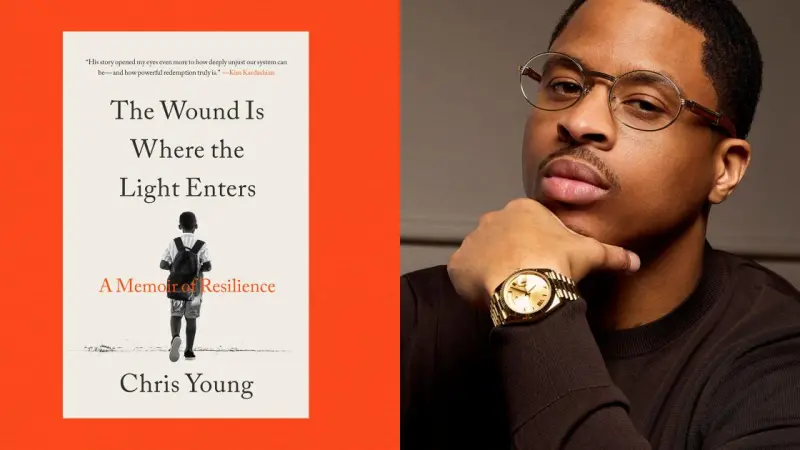
Now, Young is telling his own story in a searing new memoir, The Wound Is Where the Light Enters. The book, documented in Screenshot (550).png, traces an unbelievable arc: from a childhood of chaos and poverty to the hell of federal prisons, and finally to redemption through self-education, hope, and an extraordinary legal battle.
A Childhood Marked by Chaos and Loss
Young grew up in Clarksville, Tennessee, under circumstances most of us can hardly imagine. He never knew his father. His mother was addicted to crack and had a history of stabbing romantic partners. While she was locked up, Young and his older brother, Robert, were left to fend for themselves — often in a house without electricity or running water.
The pain was constant. Young suffered from sickle-cell disease, a painful blood disorder, and watched far too many of the people closest to him die from homicide or suicide.
There were flickers of kindness. A neighbor let the boys shower until the water bill got too high. Another family brought hot meals. A woman they called Big Mama offered shelter and tough love. But it was never enough. Desperate for money, the smart, ambitious teenager — who dreamed of a rap career — turned to selling drugs. He carried a gun.
The Case, the Trial, and a Judge’s Change of Heart
By the time Young got caught up in a federal drug investigation, he already had two felony drug convictions. His role in the conspiracy, as he tells it, was marginal. He was no kingpin. He had never even met most of the people charged alongside him.
Still, the system came down on him hard. He faced a zealous prosecutor and only court-appointed attorneys. And he was up against a brutal three-strikes law that stripped judges of discretion and forced mandatory minimum sentences.
Young’s own pride played a part. He could have pleaded guilty, maybe even cooperated, and gotten a finite sentence — still heavy, but finite. Instead, he insisted on a trial where conviction was all but guaranteed. Then, against every lawyer’s advice, he delivered a carefully crafted speech at his sentencing hearing.
That speech changed everything — eventually.
By then, Young had spent four years behind bars. A former straight-A student who had dropped out of high school, he had launched a fierce program of self-education. He read deeply in African American history, Greek philosophy, finance, and more. As he put it in the memoir: “Every day, I left the library with new language to put to my thoughts.”
Judge Kevin H. Sharp was in the courtroom that day. In the book’s foreword, he writes: “He spoke of the things he could do if he did not have to die in prison. He told me of the possibilities that would never be. It was impossible to listen to someone so full of compassion, intelligence, and, above all, promise, and not question the system that had not just allowed this to happen but required it.”
But the law was the law. Sharp sentenced Young to life without parole. Two years later, the judge stepped down from the bench — and joined Young’s defense team.
Surviving America’s Brutal Prisons
The memoir is no gentle read. Young writes unflinchingly about what it’s like to survive inside a federal penitentiary. “The constant state of heightened agitation and awareness that it takes to survive a single day in a federal penitentiary is enough to drive a man insane,” he writes. “At every turn, the system is designed to crush your humanity. You’re an animal in there and are expected to act like one.”
He spent time at McCreary, the high-security federal prison in Kentucky known to inmates as Misery Mountain. There, he meditated, worked out, read prodigiously, taught GED classes to fellow prisoners, and stayed connected to his few surviving loved ones. He refused to let the system win. “The system’s control over my body was absolute,” Young writes. “Its control over my mind was not.”
In 2015, his body broke down. Sickle-cell disease had destroyed his hips. He was transferred to Federal Medical Center Lexington, a lower-security facility with a better library and friendlier inmates. There, Young taught himself to code and dreamed up an app focused on mental health and suicide prevention. He still had to fight to get the hip replacement surgery he desperately needed.
Then came another nightmare: Bloody Beaumont. The terrifying prison, hit hard by COVID-19, pushed Young into even deeper darkness. A judge reduced his sentence, but for reasons never fully explained, he was thrown into solitary confinement — the brutal isolation cells known as “the hole.”
It was from that hell that Young finally emerged to freedom, more than a decade after his arrest.
The Fight for Freedom and a Second Act
Young’s path to freedom was not a solo mission. He had a dedicated legal team, a growing wave of sympathetic press attention, and some very famous allies. In 2021, he was granted executive clemency — with his lawyers and reality-TV star Kim Kardashian to thank, as well as President Trump.
Kardashian has become one of the most prominent celebrity advocates for criminal justice reform, using her platform to spotlight cases like Young’s. For Young, the clemency was a lifeline after years of legal limbo.
Since walking free, Young has packed more into life than most people do in decades:
- He earned a degree in economics and public policy from Southern Methodist University.
- He launched a consulting career.
- He wrote The Wound Is Where the Light Enters, a memoir that is already being compared to the most powerful prison literature of our time.
The book’s title comes from a line by 13th century Persian poet Rumi. And while Young’s story is not an innocence tale, it is a devastating indictment of the U.S. justice system — its laws, its courts, and its brutal prisons.
But it is also a celebration of hope. Young’s memoir is proof that even in the darkest places, intellect, community, and the stubborn belief in a better future can light the way.
The Wound Is Where the Light Enters: A Memoir of Resilience, by Chris Young, is published by Little, Brown and Company. It runs 336 pages and is available for $35.
Disclaimer - All celebrity-related content, information, and images on this website are based on publicly available online sources and AI-generated insights/data. Information such as biography, age, career, personal details, and images may change without notice over time. While we strive for accuracy, we do not guarantee the accuracy, completeness, reliability, or timeliness of any information or imagery displayed on this website. This content is provided for general informational purposes only.
Iconic Photos of Kim Kardashian

Top Trending News of Kim Kardashian
 👁️ 57 views
🔥 Kim Kardashian & Lewis Hamilton: Viral Super Bowl Debut
Kim Kardashian and Lewis Hamilton "hard launch" their romance at Super Bowl 2026. See the viral photos and details of their star-studded debut in Santa Clara.
 👁️ 50 views
🔥 Inside Kim Kardashian’s $150M "Kim Air" Flying Palace
Explore the luxury of Kim Kardashian’s $150 million private jet used for her Lewis Hamilton visits.



Details
Send Us an Enquiry
We'll get back to you as soon as possible.
Thank You!
Your enquiry has been submitted. We'll be in touch shortly.