
Rene Magritte
 Previous

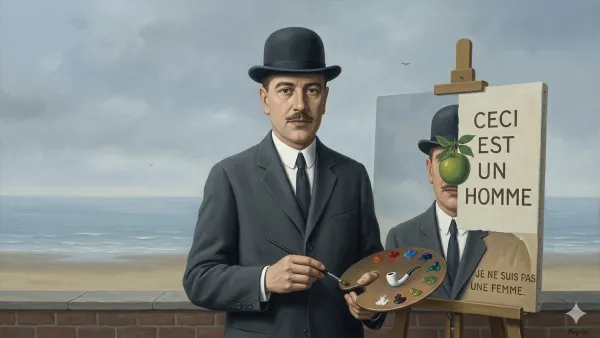
Born in 1898, Magritte’s early life was marked by a profound tragedy: the suicide of his mother, who drowned herself in the River Sambre when he was only 14. Legend suggests he was present when her body was recovered, her dress wrapped around her face—an image that many critics believe inspired his later "shrouded" figures, such as those in The Lovers. While Magritte himself often downplayed this connection, preferring to focus on the mystery of the image rather than psychological trauma, the theme of hidden identity remained a cornerstone of his work.
Magritte’s professional journey didn't begin in a gallery but in a wallpaper factory. This background in commercial design and advertising influenced his clean, flat style. He understood the power of the "sign"—how an image of an object could stand in for the object itself, or disrupt it entirely. His debut into Surrealism came in 1926 with The Lost Jockey, but it was his move to Paris in 1927 that truly ignited his career. There, he joined the circle of André Breton and the French Surrealists, though he always remained a bit of an outsider, eventually returning to Brussels to escape the "intellectual drama" of the Paris scene.
The core of Magritte's philosophy is captured in his most famous work, The Treachery of Images (1929), which features a realistically painted pipe and the caption: Ceci n'est pas une pipe ("This is not a pipe"). It was a simple, revolutionary reminder: the painting is just oil and canvas, not the object itself. He delighted in "poetic displacement," taking ordinary items—apples, bowler hats, umbrellas, and stones—and placing them in situations that defied gravity, logic, and common sense.
Throughout the 1940s and 50s, Magritte’s fame grew internationally. He experimented briefly with Impressionism (his "Renoir Period") and a crude, provocative style (the "Vache Period"), but he ultimately returned to the crisp, haunting surrealism that defined his legacy. Works like The Son of Man and Golconda (featuring men in bowler hats raining from the sky) became iconic, cementing his place as a cultural titan whose influence extends into modern pop art and advertising today.
Magritte died in 1967 at the age of 68, but his "enigmatic objects" continue to challenge our perception of reality. He didn't want his paintings to be "interpreted" or "solved" like puzzles; he wanted them to remain mysteries, reflecting the inherent mystery of existence itself.
Disclaimer: All celebrity-related content, information, and images on this website are based on publicly available online sources and AI-generated insights/data. Information such as biography, age, career, personal details, and images may change without notice over time. While we strive for accuracy, we do not guarantee the accuracy, completeness, reliability, or timeliness of any information or imagery displayed on this website. This content is provided for general informational purposes only.
 👁️ 49 views










Details
Send Us an Enquiry
We'll get back to you as soon as possible.
Thank You!
Your enquiry has been submitted. We'll be in touch shortly.