
Power, Scandal, and War: The Wyoming Trio Who Foretold America’s Iran Crisis

 Previous

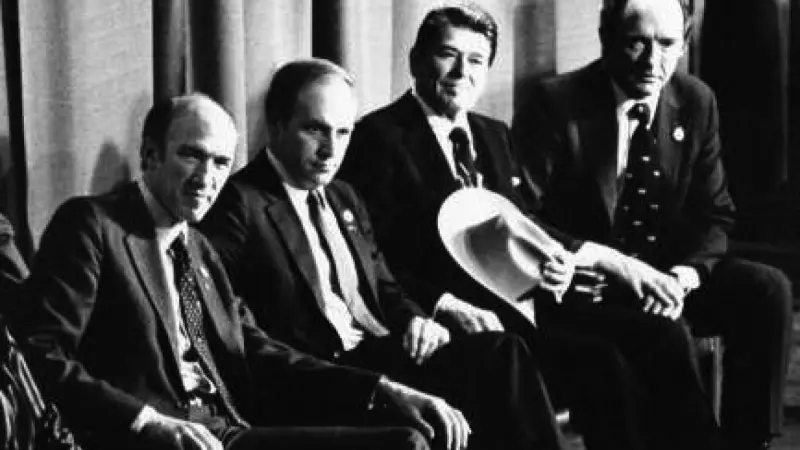
In 1979, three men from Wyoming—a state with fewer people than most American cities—stormed into Washington just as the world was about to explode. Over the next decade, they witnessed a revolution, a bombing, a hostage crisis, and a constitutional scandal that set the stage for open war with Iran. Their story reads like a political thriller, full of raw power, secret deals, and a legacy that still haunts the Middle East.
The 'Most Powerful Delegation' in Washington
Alan K. Simpson, Malcolm Wallop, and Dick Cheney were not your typical freshmen. Simpson, a 6-foot-7 Cody lawyer with a gift for profanity and bipartisan deal-making, became Senate Republican whip by 1985. Wallop, a Yale-educated rancher with English aristocratic roots, was the Senate's fiercest hawk—the first to push for missile defense, a plan Reagan adopted in 1983. Cheney, the quietest of the three, had already worked in the Nixon and Ford White Houses before winning Wyoming's House seat. He rose swiftly, sketching out a blueprint for executive power that would define his future as Defense Secretary and Vice President.
“It was said that was the most powerful delegation pound for pound in Washington,” Simpson told the Associated Press in 2011. “And I’m sure we didn’t let it go to our heads.”
Revolution and Hostage Crisis: Front-Row Seats to Chaos
They arrived in January 1979, smack in the middle of a revolution. On January 16—just 13 days after the three were sworn in—the Shah of Iran fled the country. By February, Ayatollah Khomeini had seized power. By November, 66 Americans were taken hostage in Tehran. The crisis that doomed Jimmy Carter's presidency was unfolding, and Wyoming's delegation was watching from the front row.
But the worst was yet to come. In 1983, the crisis came home to Americans in Beirut.
The Beirut Barracks Bombing: A Day That Changed Everything
On October 23, 1983, a truck bomb demolished the U.S. Marine barracks in Beirut, killing 220 Marines, 18 sailors, and 3 soldiers. It was the deadliest single-day toll for the Marine Corps since Iwo Jima. The attack was carried out by operatives linked to Hezbollah—acting at Iran's direction, as later investigations confirmed.
Two days after the bombing, Dick Cheney was in the Cabinet Room with other top lawmakers, listening to General John Vessey brief them on the next moves. The meeting sparked a months-long reckoning. Congressional support for keeping Marines in Lebanon eroded, and Reagan ordered a withdrawal in February 1984. Hezbollah had won—but they weren't finished.
For Cheney, this moment left a scar. Two decades later, as Vice President, he repeatedly cited the Lebanon withdrawal as proof that appearing to retreat from terrorism only invites more attacks. That conviction helped drive the second Bush administration's approach to the War on Terror.
Iran-Contra: The Scandal That Exposed a Secret War
Washington responded by designating Iran a state sponsor of terrorism in 1984—a label still in place today. But that didn't stop Hezbollah from kidnapping Americans off Beirut streets throughout the mid-80s. The hostages became leverage for secret arms sales to Iran, in defiance of the U.S. policy of never negotiating with terrorists. When the deals came to light in 1986, the Iran-Contra affair exploded.
The congressional investigation put all three Wyoming men in the crossfire. Simpson, as Senate Republican whip, was caught between loyalty to Reagan and the constitutional questions the scandal raised. He gave fiery floor speeches and wrote candid letters to constituents—records now preserved at the American Heritage Center.
Wallop, serving on the Select Intelligence Committee, had access to classified dimensions the public hearings never revealed. He fiercely defended presidential power, arguing that the commander-in-chief needed maximum freedom to confront threats.
Cheney, as the ranking Republican on the House Select Committee, became the scandal's most determined defender. He praised Oliver North as “the most effective and impressive witness” and refused to sign the bipartisan majority report, which found that senior officials broke the law and misled Congress. Instead, he and seven others issued a minority report arguing there was no constitutional crisis—just mistakes in judgment.
That report turned out to be a time bomb. It argued that Congress overreached by restricting the president's foreign policy actions, and that the president could legally work around such laws in national security matters. Years later, when the Bush administration's controversial wiretapping program came under fire, Cheney told reporters to look up his minority report for a better understanding of his views on executive power. The quiet congressman from Casper had staked out a position in 1987 that he would act on as Defense Secretary and then Vice President for the next two decades.
How the Wyoming Trio Shaped Today's Iran Crisis
The chain of events that began with the 1953 coup—deposing Iran's democratically elected prime minister and installing the Shah—never broke. It led to the 1979 revolution, the 1983 Beirut bombing, the hostage crisis, and Iran-Contra. The Islamic Revolutionary Guard Corps that helped build Hezbollah is the same IRGC American forces are targeting today. Iran has been on the state sponsor of terrorism list continuously since January 19, 1984—a direct consequence of the 1983 bombing.
On February 28, 2026, the United States and Israel launched airstrikes on Iran, killing Supreme Leader Ali Khamenei. Iran responded with missiles and drones against Israel, U.S. bases, and allies, and closed the Strait of Hormuz, disrupting global trade. For many Americans, the conflict feels sudden. It isn't. The road runs back through the 1980s, and through Wyoming's own front-row seat to a crisis that never really ended.
Three very different Wyoming men. One very turbulent decade. And a legacy that still echoes in every headline about Iran.
Disclaimer - All celebrity-related content, information, and images on this website are based on publicly available online sources and AI-generated insights/data. Information such as biography, age, career, personal details, and images may change without notice over time. While we strive for accuracy, we do not guarantee the accuracy, completeness, reliability, or timeliness of any information or imagery displayed on this website. This content is provided for general informational purposes only.
Iconic Photos of Rose Leslie



Top Trending News of Rose Leslie
 👁️ 206 views
🔥 Kit Harington and Rose Leslie Home Targeted by Burglars
Game of Thrones stars Kit Harington and Rose Leslie's Suffolk estate was hit by burglars in a series of rural break-ins.
 👁️ 173 views
🔥 Suranne Jones Confirms Vigil Series 3 Wrap with Rose Leslie
Suranne Jones shares an Instagram update confirming filming for Vigil Series 3 has finished. See the first look at the Arctic-set mystery starring Rose Leslie.





Details
Send Us an Enquiry
We'll get back to you as soon as possible.
Thank You!
Your enquiry has been submitted. We'll be in touch shortly.