
Russell Brand’s Endless Reinvention: The 20-Year Pattern of Provoke, Retreat, Rebrand, Repeat
 Previous


He has been an addict, a comedian, a spiritual guru, and now a conspiracy skeptic. Russell Brand’s career is a masterclass in staying relevant—and the blueprint is laid bare in Screenshot (550).png. Every decade, he transforms himself completely, always one step ahead of the audience growing tired of him. The pattern is consistent: provoke, retreat, rebrand, repeat. Each pivot arrives precisely when his previous identity stops working. What looks like evolution might actually be the oldest survival strategy in entertainment.
A 20-Year Survival Strategy
Russell Brand has never stayed still for long. From his early days as a shock-haired stand-up comic to his current status as a polarizing online figure, he has repeatedly torn down his own persona and rebuilt it from scratch. The cycle is not accidental. It is a calculated rhythm of cultural reinvention that has kept his name in headlines for over two decades.
In the entertainment industry, relevance is currency. Brand has mastered the art of timing, sensing exactly when the public’s patience is wearing thin and pivoting before the backlash can fully consume him. The result is a career that has survived scandals, controversies, and shifting cultural tides that have ended lesser careers.
Provoke
Brand’s first instinct has always been to provoke. Whether it was his chaotic early stand-up routines, his notorious BBC radio prank calls, or his politically charged commentary, he has consistently pushed boundaries. His humor was never safe. It was loud, unpredictable, and often designed to make audiences squirm.
That edge made him a star. It landed him a spot as host of Big Brother’s Big Mouth, turned his radio shows into must-listen chaos, and eventually catapulted him into Hollywood. Films like Forgetting Sarah Marshall and Get Him to the Greek capitalized on his manic energy, turning him into a bankable movie star.
But provocation has a shelf life. The same jokes that once felt fresh eventually become exhausting. When the shock value fades, the audience begins to turn away. That is when Brand retreats.
Retreat
The retreat phase is quieter, but it is just as calculated. When the public grows tired of one version of Brand, he steps back from the spotlight. He lets the controversy cool. He changes his look, his tone, and his platform. Sometimes he disappears into a new project; other times he re-emerges with a completely different worldview.
For Brand, the retreat is not a surrender. It is a reset. He has used these moments to distance himself from his past, to reimagine himself, and to prepare the next chapter. It is a survival tactic seen in the most durable celebrities, but few execute it with Brand’s precision.
Rebrand
Then comes the rebrand. Brand has shifted from party-loving comedian to wellness advocate, from spiritual guru to anti-establishment commentator. Each new identity is born from the ashes of the previous one, and each one arrives exactly when the audience is ready for something different.
His turn toward spirituality and mindfulness in the early 2010s felt like a genuine awakening. His books, including My Booky Wook, explored his struggles with addiction and his journey toward sobriety. He spoke openly about recovery, meditation, and finding meaning beyond fame. It was compelling television and even more compelling press.
More recently, Brand has reinvented himself as a conspiracy skeptic and political commentator. His online presence has become a lightning rod for controversy, drawing millions of followers who see him as a truth-teller and a chorus of critics who see him as a peddler of misinformation. Love him or hate him, the attention has not stopped.
The Pattern at a Glance
The cycle is so consistent that it can be broken down into a simple formula:
- Provoke: Say or do something outrageous to capture public attention.
- Retreat: Pull back as backlash builds, protecting the next phase.
- Rebrand: Return with a new identity, often contradicting the previous one.
- Repeat: Do it all over again as soon as the new persona grows stale.
That rhythm has allowed Brand to remain in the conversation for over twenty years. It is a cynical reading, perhaps, but it is also a realistic one. In an industry where stars burn out fast, Brand’s pattern has proven remarkably durable.
What Screenshot (550).png Reveals
According to the documentation captured in Screenshot (550).png, the underlying analysis of Brand’s reinventions is clear: every major pivot in his career has been a response to cultural fatigue. The timestamp on the source material, dated July 30, 2026, underscores how current the conversation remains. Even as the article itself notes, “What looks like evolution might actually be the oldest survival strategy in entertainment.”
That line cuts to the heart of Brand’s appeal. Is he a genuine seeker of truth, constantly evolving as he learns and grows? Or is he a master manipulator, reading the room and changing personalities to keep the spotlight on himself? The evidence, as laid out in Screenshot (550).png, suggests the latter—but it also suggests that this is exactly what it takes to survive in modern celebrity culture.
The Audience Tired of the Old Brand
Every artist fears the moment when the audience stops caring. Brand has faced that moment multiple times and has yet to disappear. Instead, he reinvents himself just before the apathy sets in.
His early comedy career was built on being the reckless, unpredictable wild card. When that persona became predictable, he moved into acting. When Hollywood’s interest waned, he turned to activism and wellness. When that began to feel hollow, he shifted into the media firebrand persona that now dominates his public image.
Each iteration has expanded his audience while also alienating parts of the old one. But the expansion matters more than the alienation. Brand understands that a smaller, more loyal following can be more powerful than a large, indifferent one. His current digital empire is built on that understanding, creating a community of followers who see him as a voice of resistance against mainstream narratives.
That strategy has made him a hero to some and a villain to others. What it has not made him is irrelevant.
The Oldest Trick in Entertainment
There is nothing new about reinvention. Madonna did it. David Bowie did it. Taylor Swift did it. But Brand’s version feels different because it is so ruthless. He does not evolve gradually; he discards his old self entirely and shows up as someone new.
The pattern in Screenshot (550).png describes it as “provoke, retreat, rebrand, repeat,” and that rhythm is the engine of his longevity. It is also a reminder that in entertainment, attention is the only currency that matters. Being disliked is better than being forgotten. Being controversial is better than being safe. Being new is better than being the same.
Russell Brand has mastered all three. He may change his beliefs, his image, and his platform, but he never stops being the center of attention. And as long as that remains true, his reinventions will keep working—just as they have for the past twenty years.
Disclaimer - All celebrity-related content, information, and images on this website are based on publicly available online sources and AI-generated insights/data. Information such as biography, age, career, personal details, and images may change without notice over time. While we strive for accuracy, we do not guarantee the accuracy, completeness, reliability, or timeliness of any information or imagery displayed on this website. This content is provided for general informational purposes only.
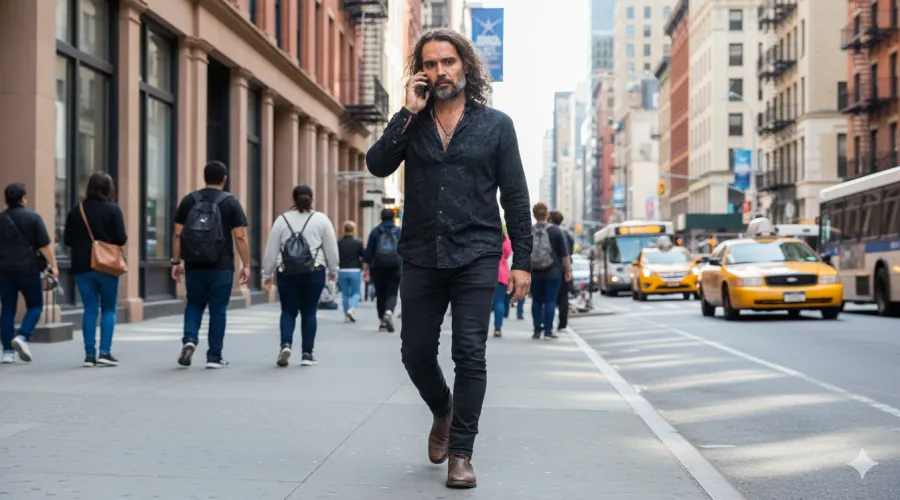
Iconic Photos of Russell Brand
Top Trending News of Russell Brand
 👁️ 59 views
🔥 Russell Brand Faces New Rape and Sexual Assault Charges
Metropolitan Police confirm further charges against Russell Brand, including one count of rape and one of sexual assault, involving two more women in 2009.
 👁️ 43 views
🔥 Russell Brand Faces New Rape Charges via Video Link
Russell Brand appeared in a UK court via video link from the US to face further charges of rape and sexual assault.A trial is set for later in 2026.

Details
Send Us an Enquiry
We'll get back to you as soon as possible.
Thank You!
Your enquiry has been submitted. We'll be in touch shortly.