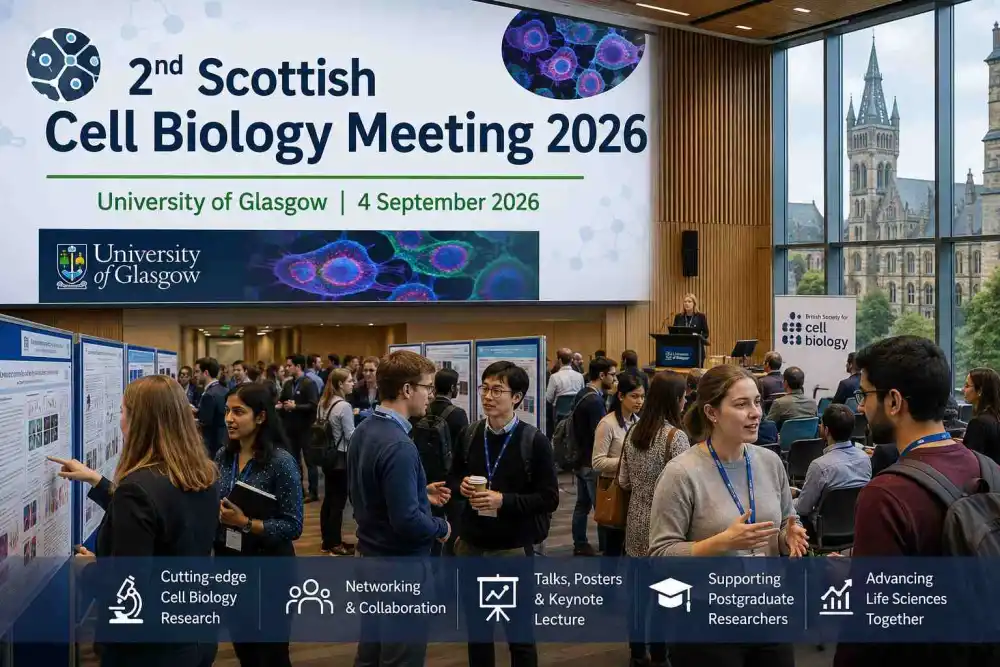
The 2nd Scottish Cell Biology Meeting 2026 is an upcoming one-day scientific conference taking place on 4 September 2026 at the University of Glasgow in Glasgow, Scotland. The event is designed to bring together researchers working in cell biology and related areas of the life sciences, creating an opportunity to share research, exchange ideas and build professional connections.
According to the University of Glasgow's official event information, the meeting will run from 09:00 to 17:00 and will be held at the Sir Charles Wilson Building, 1 University Avenue, Glasgow G12 8QQ. The conference is free to attend and is sponsored by the British Society for Cell Biology.
The meeting is particularly relevant to postgraduate and early-career researchers who want to gain experience presenting their work in a supportive scientific environment. Delegates from institutions across Scotland and beyond are welcome, making the event an effective platform for sharing research and strengthening connections within the cell biology community.
A Platform for Cell Biology Research
Cell biology is fundamental to understanding how living organisms function at the microscopic level. Research into cells supports progress across many areas, including biomedical science, genetics, molecular biology, cancer research, developmental biology, immunology and biotechnology.
The Scottish Cell Biology Meeting provides researchers with an opportunity to present their findings and discuss emerging questions within the discipline. Rather than focusing solely on established research leaders, the conference places particular value on contributions from postgraduate and early-career scientists.
This makes the meeting useful for researchers who are developing their academic careers and looking for opportunities to communicate their work to colleagues outside their immediate research groups.
Opportunities for Early-Career Researchers
One of the strongest features of the conference is its emphasis on postgraduate and early-career participation. Researchers at this stage often need opportunities to present their findings, receive constructive feedback and develop confidence in communicating scientific ideas.
The event programme includes short talks and flash talks, allowing attendees to present their work in concise formats. These sessions can help researchers explain complex scientific concepts clearly while giving fellow delegates an opportunity to learn about a broad range of research projects.
The conference also welcomes abstracts from attendees across career stages, with the official event information highlighting the value of the meeting for early-career researchers presenting even preliminary research.
For postgraduate students preparing for future academic conferences, this type of environment can be particularly valuable. Presenting research to a specialist audience can help researchers identify new perspectives, refine their arguments and develop presentation skills that can be useful throughout their careers.
Poster Presentations and Scientific Discussion
Poster sessions are another important component of the Scottish Cell Biology Meeting. Posters allow researchers to communicate experimental approaches, research findings and emerging projects in a visual and accessible format.
For attendees, poster sessions provide an opportunity to engage directly with researchers and ask questions about their work. Compared with formal presentations, poster discussions can often encourage more detailed conversations about experimental methods, research challenges and potential collaborations.
The combination of formal talks and poster presentations gives the conference a varied structure. Delegates can move between sessions, listen to research presentations and participate in informal scientific discussions throughout the day.
Keynote Lecture
The conference programme also features a keynote lecture from Professor Helen Walden, adding an established scientific perspective to the programme. Keynote presentations can provide broader context around developments in cell biology and highlight important directions for future research.
For students and early-career scientists, hearing from experienced researchers can also provide insight into how research questions develop over time and how discoveries contribute to wider scientific understanding.
Networking Across Scotland's Research Community
Networking is another major reason to attend the Scottish Cell Biology Meeting. The conference welcomes delegates from different institutions, creating opportunities to meet researchers who may be working on related questions or complementary scientific problems.
For postgraduate researchers, networking can support future collaborations, academic connections and knowledge exchange. It can also help researchers become more familiar with the wider Scottish cell biology research community.
The University of Glasgow venue provides a central academic setting for these interactions. Glasgow is well connected by rail and public transport, while the conference venue is located on the University's Gilmorehill Campus. The official event information notes that Hillhead Subway Station is approximately a 5–7 minute walk from the Sir Charles Wilson Building.
Research Areas and Scientific Exchange
Although the meeting is centred on cell biology, the subject naturally connects with numerous areas of modern life sciences research. Delegates may benefit from exposure to work involving molecular mechanisms, cellular processes, biomedical applications and other related research fields.
This cross-disciplinary character can be particularly valuable because modern biological research increasingly involves collaboration between different scientific specialisms. Techniques and discoveries developed in one research area may provide useful approaches for researchers working in another.
By bringing researchers together in one conference environment, the event encourages discussion around these shared scientific challenges and opportunities.
A Supportive Conference Environment
The organisers have also established a code of conduct intended to provide an inclusive and harassment-free conference experience. The official conference information states that the code applies to talks, panels, workshops, social events and other conference-related activities.
A supportive environment is especially important for early-career researchers who may be attending a specialist conference for the first time. Clear expectations around professional behaviour can help create an atmosphere where participants feel comfortable asking questions, presenting research and meeting new colleagues.
Glasgow as the Host City
Glasgow is one of Scotland's major academic and research centres and provides a strong setting for a scientific conference. The University of Glasgow's Gilmorehill Campus offers a historic academic environment while remaining accessible from the city centre.
The Sir Charles Wilson Building is located on University Avenue and is served by local transport connections. According to the University's travel guidance for the meeting, Glasgow Central and Glasgow Queen Street stations are approximately 10–15 minutes from the campus by subway or taxi, while Hillhead Subway Station is within walking distance.
For visitors travelling from other Scottish cities, Glasgow's rail and bus connections make the location practical for a one-day meeting.
Why Attend the Scottish Cell Biology Meeting?
The event offers several benefits for researchers and students. First, it provides an opportunity to learn about current cell biology research being conducted across Scotland. Second, it creates a platform for postgraduate and early-career researchers to present their own work.
The conference can also help attendees expand their professional networks. Meeting researchers outside one's own institution can lead to useful academic conversations and potentially support future collaboration.
Another benefit is the combination of different presentation formats. Short talks, flash talks, posters and the keynote lecture offer delegates multiple ways to engage with scientific research throughout the day.
Because the event is free, it can also be an accessible opportunity for researchers and students who may have limited conference budgets. The official University of Glasgow listing specifically describes the meeting as a free one-day conference.
Registration and Important Note
The official event page lists a 31 July 2026 registration deadline and provides [email protected] for general enquiries and conference communication.
Because the current date is 7 August 2026, this registration deadline has already passed. Therefore, anyone intending to publish or use this listing should verify directly with the organisers whether late registration or attendance is still possible before promoting registration availability.
Event Summary
The 2nd Scottish Cell Biology Meeting 2026 is a focused research conference for the Scottish and wider cell biology community. Taking place on 4 September 2026 at the University of Glasgow, it combines scientific presentations, poster sessions, networking and a keynote lecture.
Its emphasis on postgraduate and early-career researchers makes it particularly suitable for scientists developing their research careers. With a free entry policy, a central Glasgow location and participation opportunities across different presentation formats, the event provides a useful forum for scientific communication and collaboration.
For researchers interested in cell biology, biomedical science and related life sciences disciplines, the meeting represents an opportunity to discover new research, present findings and connect with colleagues from across the academic community.
Key Event Highlights
- Latest Cell Biology Research: Discover recent developments and research findings from cell biology researchers across Scotland.
- Short and Flash Talks: Postgraduate and early-career researchers can present their work through short talks and flash presentations.
- Research Poster Sessions: Attendees can explore a wide range of research posters and discuss projects directly with researchers.
- Keynote Lecture: The programme includes a keynote lecture from Professor Helen Walden.
- Networking Opportunities: Connect with researchers, postgraduate students and colleagues from universities and research institutions across Scotland.
Venue & Location Info
Timings
Entry Fees
Event Type
Estimated Turnout & Audience
Community Reviews
How was your experience?
Share your thoughts with the community. Your reviews help others discover the best local events.