
Office of the Leader of the House of Commons
- 👤 Admin
- 👁️ 37 Views
- 📅 January 28, 2026
- 🏷️ Goverment Schemes
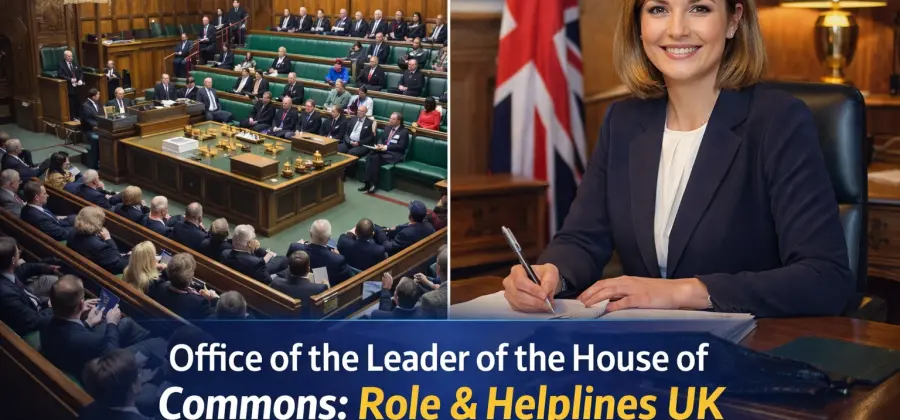
The Office of the Leader of the House of Commons stands as a cornerstone of British democracy, serving as the vital link between the Government’s executive powers and the sovereign will of the House of Commons. As one of the most significant parliamentary leadership roles, the Leader of the House is tasked with the meticulous orchestration of the Government’s legislative programme, ensuring that the wheels of governance turn efficiently within the Palace of Westminster.
In the United Kingdom, the effective management of parliamentary business is essential for national stability. From scheduling crucial debates to providing the weekly business statement, the Office of the Leader of the House of Commons ensures that MPs have the opportunity to scrutinize legislation and represent their constituents. This guide provides an in-depth analysis of the office’s responsibilities, the historical evolution of the role, and a directory of parliamentary support helplines and charities for those engaged in the democratic process.
Understanding the Office of the Leader of the House of Commons
The primary objective of the Office of the Leader of the House of Commons is to ensure the smooth passage of the Government’s legislative agenda. Unlike other ministerial departments that manage specific policy areas like health or education, this office focuses on the "mechanics" of Parliament. The Leader of the House works in close coordination with the Government Chief Whip to determine which Bills are debated and when votes occur.
Also Read: Corporate Officers of the House of Commons Support and Guidance
The role is multifaceted, requiring the Leader to act as both a representative of the Government to the House and a representative of the House to the Government. This dual responsibility is critical for maintaining parliamentary privilege and upholding the rights of backbench members.
Key Responsibilities of the Leader
-
Legislative Planning: The Office of the Leader of the House of Commons is responsible for the delivery of the King's Speech and the subsequent legislative sessions.
-
Weekly Business Statement: Every Thursday, the Leader provides an update to the House, detailing the schedule for the following week. This is a high-profile session where the Shadow Leader of the House and other MPs can question the Government's priorities.
Also Read: Office of the Leader of the House of Lords
-
Cabinet Committee Chair: The Leader typically chairs the Parliamentary Business and Legislation (PBL) Cabinet Committee, which reviews and clears all Government Bills before they are introduced.
-
Parliamentary Reform: The office leads on modernising House of Commons procedures and enhancing digital engagement, such as the e-petitions system.
Also Read: Prime Minister's Office UK
Historical Evolution of the Parliamentary Leadership
The title of "Leader of the House" was not formally established until the mid-19th century, although the function has existed since the dawn of modern UK Parliament governance. Historically, the Prime Minister often held this role personally if they sat in the Commons. However, as the complexity of the Government’s legislative programme grew, it became a dedicated ministerial position, often held alongside the office of Lord President of the Council.
Today, the Office of the Leader of the House of Commons is a symbol of the "usual channels"—the informal and formal negotiations between parties that allow the House to function despite political friction.
Common Parliamentary Challenges and Support
Working within or engaging with the House of Commons can be a high-pressure environment. The Office of the Leader of the House of Commons acknowledges the importance of maintaining a safe, professional, and supportive atmosphere for all.
Issues Facing the Parliamentary Community
-
Procedural Complexity: Understanding standing orders and parliamentary privilege.
-
Constituent Pressure: Managing the high volume of correspondence and public expectations.
-
Workplace Wellbeing: Addressing the unique stresses of the political cycle and late-night sittings.
-
Integrity and Standards: Ensuring adherence to the Code of Conduct for MPs.
National Parliamentary helplines and Charities
For those working within the parliamentary estate, constituents, or those seeking to understand their rights and the standards of the House, the following organisations provide confidential support and expert guidance:
-
Independent Complaints and Grievance Scheme (ICGS)
-
Phone: 0808 168 9281 (Freephone)
-
Email: Support@ICGShelpline.org.uk
-
Website: https://www.parliament.uk/about/independent-complaints-and-grievance-scheme/
-
Provides support for those experiencing bullying, harassment, or sexual misconduct within the parliamentary community.
-
-
Parliamentary and Health Service Ombudsman (PHSO)
-
Phone: 0345 015 4033
-
Website: https://www.ombudsman.org.uk/
-
The final stage for complaints about UK government departments and the NHS in England.
-
-
Hansard Society
-
Phone: 020 3848 4540
-
Email: contact@hansardsociety.org.uk
-
Website: https://www.hansardsociety.org.uk/
-
An independent charity focused on research and education to strengthen parliamentary democracy.
-
-
The Charity Commission
-
Phone: 0300 066 9197
-
Website: https://www.gov.uk/government/organisations/charity-commission
-
The regulator for charities in England and Wales, ensuring transparency and public trust.
-
-
Charity for Civil Servants (Civil Service Support)
-
Phone: 0800 056 2424 (helpline)
-
Website: https://www.cfcs.org.uk/
-
Support for current and former civil servants facing tough times, from mental health to financial assistance.
-
-
UK Parliament Public Enquiry Service
-
Phone: 020 7219 4272
-
Email: hcenquiries@parliament.uk
-
Website: https://www.parliament.uk/site-information/contact-us/house-of-commons-enquiry-service/
-
Direct line for the public to ask questions about the work, history, and membership of the House of Commons.
-
The Role of the Shadow Leader of the House
To ensure accountability, the Shadow Leader of the House scrutinises every action of the Office of the Leader of the House of Commons. They play a pivotal role during the business questions on Thursdays, challenging the government on why certain topics are being debated and ensuring that the rights of the Opposition are protected.
Managing the Legislative Programme: Step-by-Step
The Office of the Leader of the House of Commons follows a rigorous process to manage the Government’s legislative agenda:
-
Strategic Planning: Aligning Bills with the priorities outlined in the King's Speech.
-
PBL Clearance: Ensuring every Bill is legally sound and ready for parliamentary scrutiny.
-
Scheduling: Allocating "Days in the House" for Second Readings, Committee Stages, and Report Stages.
-
Liaising with Whips: Coordinating with the Government Chief Whip to ensure majority support during divisions.
-
Business Statement Delivery: Formally announcing the upcoming schedule to the House.
Public Engagement and E-Petitions
One of the modern triumphs of the Office of the Leader of the House of Commons is the e-petitions system. This allows the public to directly influence the parliamentary agenda. If a petition reaches 100,000 signatures, the Leader’s office facilitates a debate in Westminster Hall, bridging the gap between the electorate and their representatives.
Final Essential Contacts for Parliamentary Matters
-
Emergency Services: 999
-
ICGS helpline: 0808 168 9281
-
Parliamentary Enquiries: 020 7219 4272
-
Ombudsman: 0345 015 4033
-
Hansard Society: 020 3848 4540
-
NHS 111: (For urgent wellbeing concerns for staff)
The Office of the Leader of the House of Commons remains an indispensable part of the UK Government structure. By balancing the need for efficient law-making with the essential rights of MPs to debate and dissent, the office ensures that the British Parliament remains a robust and transparent institution. Whether you are a student of politics, a parliamentary staffer, or a concerned citizen, understanding this office is key to understanding how power is exercised and held to account in the United Kingdom.
Support-Related Questions & Answers
1. Who is the current Leader of the House of Commons? The current holder is a senior Cabinet Minister appointed by the Prime Minister. As of late 2025, the role is held by the Rt Hon Sir Alan Campbell MP.
2. Is the Leader of the House the same as the Speaker? No. The Speaker of the House of Commons is an impartial officer who chairs debates. The Leader of the House is a partisan Government Minister responsible for the legislative programme.
3. What happens during Business Questions on Thursdays? The Leader of the House announces the business for the following two weeks. MPs from all parties then ask questions about the schedule or request debates on specific urgent topics.
4. How does the Office of the Leader of the House of Commons support backbenchers? The Leader has a duty to protect the "rights and interests of the House as a whole," ensuring backbenchers have time for Private Members' Bills and adjournment debates.
5. Can the public contact the Leader of the House directly? While the Leader acts as a Minister, they also serve as an MP. Public enquiries regarding general parliamentary business should go through the Public Enquiry Service, while constituent matters go to their specific MP.
6. What is the Parliamentary Business and Legislation (PBL) Committee? It is a Cabinet committee chaired by the Leader that prepares the government’s legislative agenda and ensures Bills are fit for introduction to Parliament.
7. Does the Leader of the House manage the House of Lords too? No. There is a separate Leader of the House of Lords who performs a similar role in the upper chamber.
8. What is the "usual channels"? This is a term used to describe the private discussions between the Government and Opposition Whips and the Office of the Leader of the House of Commons to agree on how business will be handled.
9. How do e-petitions become debates? The Petitions Committee, supported by the Leader’s office, reviews petitions. Those with over 100,000 signatures are usually considered for debate in Westminster Hall.
10. What is a "Business Motion"? It is a procedural motion moved by the Leader to change the scheduled time or order of parliamentary business.
11. Is the Leader of the House always in the Cabinet? Almost always. The role is vital for government coordination, so the Leader is typically a full member of the Cabinet or a senior Minister attending Cabinet.
12. How does the office handle "Prerogative" powers? The Leader facilitates the House's involvement in matters like the prorogation of Parliament or the setting of recess dates.
13. What support is available for parliamentary staff? Staff can access the ICGS helpline (0808 168 9281) for workplace issues and various employee assistance programmes.
14. Can the Leader of the House change the law alone? No. The Leader only manages the schedule. All laws must be passed by a majority vote in both the Commons and the Lords.
15. Where can I find the weekly business statement online? The statement is published on the UK Parliament website and the official GOV.UK page for the Office of the Leader of the House of Commons.
DISCLAIMER: Please verify all phone numbers, email addresses, and service details on the official government or organisation websites before use. Numbers and contact information are subject to change without notice.
Most Searchable Keywords
Recent Helplines


Related Listings
Sponsored Listings in Cleaning Services


Related Helplines

Strike Off Your Limited Company Helpline & Su...
Closing your limited company? Find free, confidential support and official UK helpline numbers to guide you through the Companies House stri...

The King’s Awards for Enterprise UK Helpline...
Apply for The King's Awards for Enterprise. Find the right UK helpline number, free support services, and official guidance for your busines...

Free Business Finance Advice UK – Helpline Su...
Need funding or advice? Find the right helpline for finance and support for your business. Access free support UK, grants, and business debt...
Questions & Answers – Find What
You Need, Instantly!
How can I update my business listing?
Is it free to manage my business listing?
How long does it take for my updates to reflect?
Why is it important to keep my listing updated?
