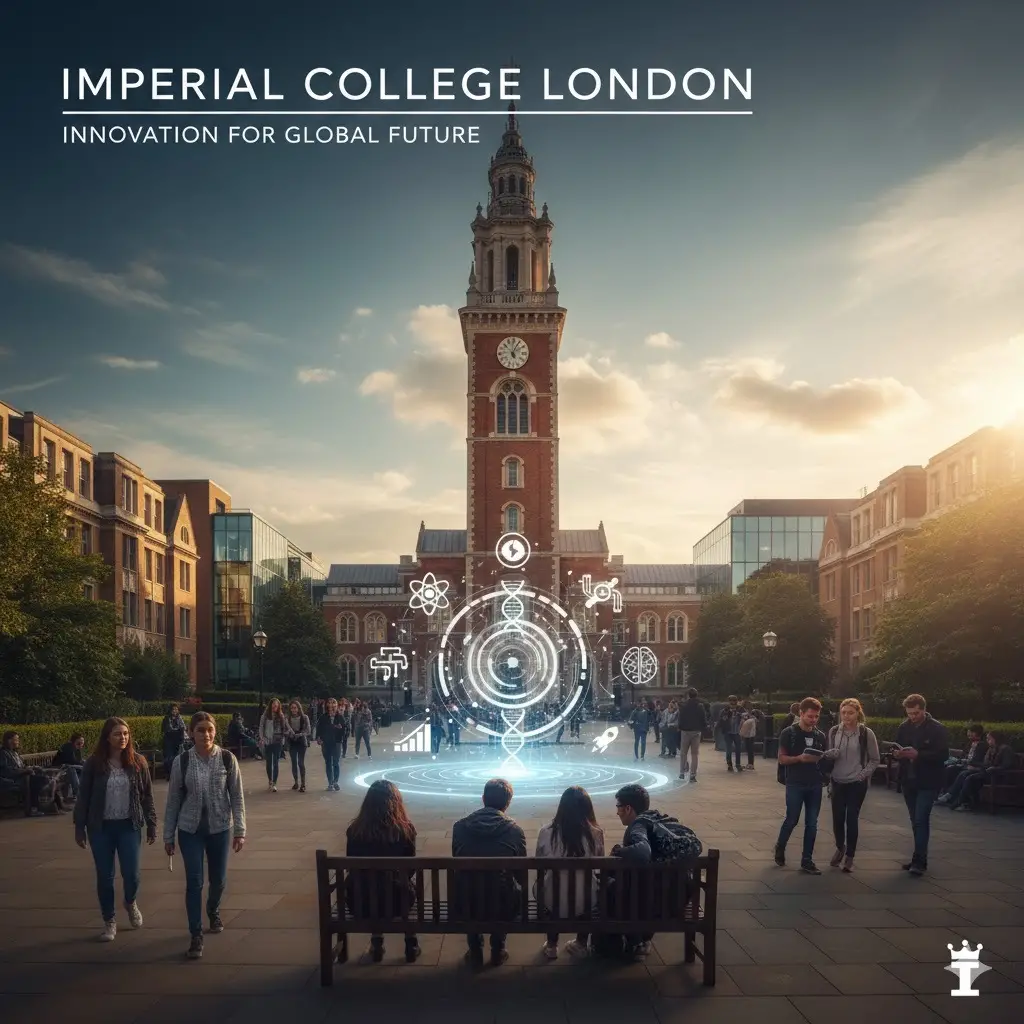
In the heart of London’s "Albertopolis"—a district dedicated to the advancement of the arts and sciences—stands Imperial College London. Officially known as the Imperial College of Science, Technology and Medicine, this institution is more than a university; it is a global engine for innovation. Founded in 1907 with a mission "To be useful," Imperial has spent over a century bridging the gap between theoretical excellence and real-world application.
Consistently ranked within the top 10 universities globally, Imperial remains the only UK university to focus exclusively on Science, Technology, Engineering, Medicine, and Business (STEMB). This specialized focus allows for a concentration of talent and resources that is unmatched, making it a primary destination for the world’s future leaders, researchers, and entrepreneurs.
The Heritage of Excellence: From Prince Albert to a Royal Charter
The story of Imperial College London is inextricably linked to the Great Exhibition of 1851. Initiated by Prince Albert, the exhibition’s success generated a surplus that was used to purchase the 86-acre estate in South Kensington. This area, now famously known as Albertopolis, became the home of the Science Museum, the Natural History Museum, the Royal Albert Hall, and eventually, the constituent colleges that formed Imperial.
Established by Royal Charter on 8 July 1907, Imperial brought together the Royal College of Science, the Royal School of Mines, and the City and Guilds College. Today, the university operates under the Royal Charter RC000231, maintaining its status as a public research university that honors its heritage while relentlessly pursuing the future.
A World-Class Academic Portfolio
Imperial College London is structured into four main faculties, each a leader in its respective field:
Faculty of Engineering
Imperial’s engineering departments are world-renowned for their rigorous curricula and pioneering research. From aeronautics and bioengineering to civil and mechanical engineering, students are immersed in an environment that prioritizes hands-on problem-solving and technical mastery.
Faculty of Natural Sciences
This faculty is the bedrock of Imperial’s scientific discovery. It encompasses departments like Physics, Chemistry, and Mathematics, producing research that ranges from the subatomic to the galactic. It is home to the Grantham Institute for Climate Change, a global leader in environmental science.
Faculty of Medicine
Ranking among the best globally, the Faculty of Medicine at Imperial is a critical player in the UK’s healthcare landscape. Through its Academic Health Science Centre (AHSC), it translates laboratory findings directly into clinical practice, driving breakthroughs in oncology, infectious diseases, and neurotechnology.
Imperial College Business School
A cornerstone of the university's "STEMB" identity, the Business School is Triple-Accredited (AACSB, AMBA, and EQUIS). It is uniquely positioned to integrate management studies with technology and entrepreneurship. Key programs include:
-
Full-Time and Global Online MBAs
-
MSc Business Analytics & AI
-
MSc Climate Change, Management & Finance
The White City Innovation District: A Hub for Deep-Tech
While South Kensington remains the historic heart, the White City Innovation District represents the university’s future. This multi-billion-pound campus is a platform for innovation and entrepreneurship.
Molecular Sciences Research Hub (MSRH)
A world-leading facility that breaks down departmental silos to allow chemists, biologists, and engineers to collaborate on molecular-scale solutions.
The Sir Michael Uren Hub
Focused on biomedical engineering, this hub brings together clinicians and engineers to develop life-changing medical technologies.
Imperial Enterprise
Through the White City campus, Imperial Enterprise supports the commercialization of research. With over 100 pioneering companies co-located at Scale Space and the I-HUB, Imperial provides the "talent pipeline" and the infrastructure needed to turn deep-tech ideas into scalable businesses.
Solving Global Challenges: Research and Impact
Imperial is dedicated to solving the most pressing issues of the 21st century.
Artificial Intelligence (AI) and Data Science
With the I-X initiative, Imperial is at the forefront of AI development. Research focuses on ethical AI, machine learning for healthcare, and using data to secure global supply chains.
Climate Science and Sustainable Energy
The university is a primary advocate for the green transition. From developing carbon-capture technologies to pioneering sustainable aviation fuels, Imperial’s researchers are drafting the blueprint for a net-zero future.
Global Healthcare
During the COVID-19 pandemic, Imperial’s epidemiological modeling guided global policy. Today, the focus has shifted to pandemic preparedness, antimicrobial resistance, and the application of AI in personalized medicine.
Student Life and Campus Amenities
With over 20,000 students from 140+ countries, life at Imperial is vibrant and diverse.
-
Libraries: The Central Library offers 24/7 access, providing a sanctuary for the university’s famously hardworking student body.
-
Ethos Sports Centre: Located in South Kensington, it offers world-class gym facilities, a swimming pool, and sports halls.
-
Imperial College Union: With over 300 clubs and societies, the Union is the heart of social life, ensuring students have a balanced experience.
-
Dining and Multi-faith Centres: The campus features extensive café facilities and dedicated spaces for reflection and worship, reflecting its global community.
Strategic Partnerships and Global Standing
Imperial is a member of the prestigious Russell Group, the League of European Research Universities (LERU), and the Association of Commonwealth Universities (ACU).
Its value proposition as a "critical partner to global industry" is bolstered by long-term collaborations with giants like Rolls-Royce, GSK, and Google. These partnerships ensure that research is not just academic but has a clear pathway to societal and economic impact.
Alumni: A Legacy of Innovation
The Imperial alumni network includes 14 Nobel Laureates and thousands of industry pioneers. Notable names associated with the institution include:
-
Sir Alexander Fleming: The discoverer of penicillin.
-
H.G. Wells: The legendary science fiction author.
-
Sir Brian May: Astrophysicist and lead guitarist of Queen.
-
Rajiv Gandhi: Former Prime Minister of India.
Business Operations and Accessibility
For businesses and prospective students wishing to engage with the university, Imperial maintains a streamlined operational structure:
-
Business Headquarter: London, United Kingdom.
-
Working Hours: Core hours are Monday–Friday, 9:00 AM – 5:00 PM, though the campus is a hive of 24/7 activity.
-
Payment and Funding: Accepted methods include Bank Transfer, Credit/Debit Cards, Flywire, and Student Loan Company (SLC) support.
-
Contact General Enquiries: [email protected] or +44 (0)20 7589 5111.
Frequently Asked Questions
1. What is Imperial College London best known for?
Imperial is a world leader in Science, Technology, Engineering, Medicine, and Business (STEMB). It is particularly renowned for its high-impact research, engineering excellence, and its triple-accredited Business School.
2. Where is Imperial College London located?
The main campus is in South Kensington, London (Exhibition Road, SW7 2AZ), near the Science Museum and Royal Albert Hall. It also has a major innovation campus in White City.
3. Is Imperial College London part of the Ivy League?
No, the Ivy League is a group of universities in the United States. However, Imperial is a member of the Russell Group, which is the UK equivalent of the Ivy League, and it consistently outranks many Ivy League schools in global tables.
4. How do I contact the Imperial student hub?
The ASK Student Hub can be reached at +44 (0)20 7594 9444 or via email at [email protected].
5. Does Imperial offer Executive Education?
Yes, Imperial College Business School offers a wide range of Executive Education and Professional Development (CPD) programs focused on leadership, digital transformation, and finance.
6. What are the core working hours for the university administration?
Core business hours are Monday to Friday, 9:00 AM to 5:00 PM. However, research facilities and libraries are often accessible 24/7 for authorized staff and students.
7. Who founded Imperial College London?
The university was established by Royal Charter in 1907, following the vision of Prince Albert and the 1851 Commissioners to create a center for scientific and industrial education.
8. What are the accepted payment methods for tuition?
Accepted methods include Bank Transfer, Credit/Debit Cards (Visa, Mastercard), Flywire, Convera, and the Student Loan Company (SLC).
9. What is the White City Innovation District?
White City is Imperial’s newest campus, designed as a "deep-tech" hub where academics, startups, and major corporations work together to commercialize research in AI, biotech, and sustainability.
10. How many students and staff are at Imperial?
Imperial is home to over 20,000 students and approximately 8,000 staff members, making it one of the most densely populated centers of expertise in the world.
Imperial College London remains at the pinnacle of global higher education. By staying true to its mission "To be useful," it continues to attract the brightest minds to solve the world’s most complex problems. Whether you are a prospective student, a researcher, or a business partner, Imperial offers an ecosystem where innovation isn't just a goal—it’s the daily reality.
Top Categories
Top Viewed Articles



Spread the Word
Know someone who would love this? Share it with them!