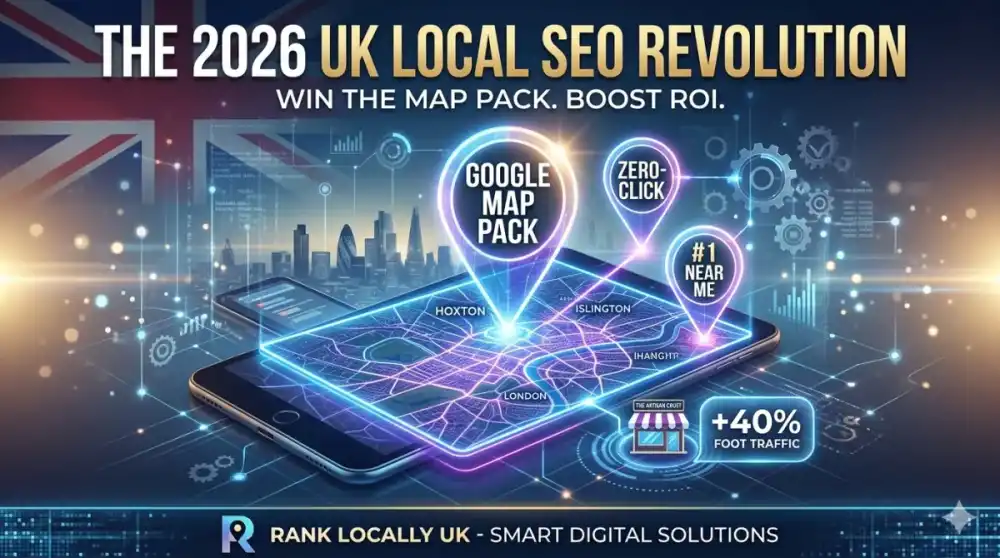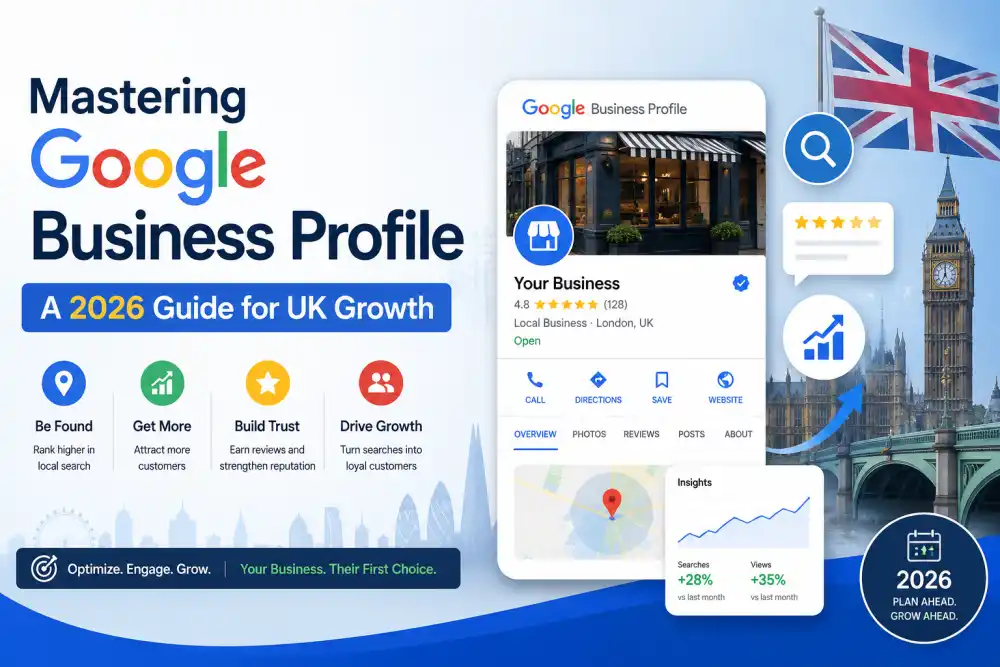
If the Google Map Pack is the most valuable real estate in the digital world, your Google Business Profile (GBP) is the deed to that land. In 2026, for the average UK small business, your website is no longer the first point of contact—your GBP is.
At Rank Locally UK, we see businesses every day that have excellent websites but remain invisible in the Map Pack. Why? Because they treat their GBP as an afterthought. This guide will show you how to treat your profile as your primary storefront, optimized for the AI-driven, Zero-Click economy.
The Evolution of the "Business Profile" in 2026
We are living in the age of "Discovery Search." Consumers aren't just searching for brand names; they are searching for solutions ("Emergency Plumber," "Vegan Cafe," "Dentist Open Now"). Google’s AI acts as a concierge, matching these needs with the most relevant, proximate, and trustworthy business.
To compete in 2026, you must stop thinking of your GBP as a "listing" and start thinking of it as a live, interactive ecosystem.
Core Pillars of GBP Optimization
To rank consistently, you must address the three core pillars that AI algorithms prioritize:
-
Relevance: How well does your profile match the user's intent?
-
Distance: Are you physically close to the user?
-
Prominence: Do you have the trust signals (reviews, website, mentions) to back up your claim?
Perfecting Your Business NAP and Categories
"NAP" stands for Name, Address, and Phone Number. In 2026, even a minor discrepancy between your GBP and your Technical SEO implementation can trigger a trust deficit with Google’s AI.
-
Category Precision: Your primary category is the single biggest factor for relevance. If you are a "Dentist," do not just choose "Healthcare." Use the most specific category available. Utilize secondary categories to capture related searches (e.g., "Cosmetic Dentist," "Emergency Dental Service").
-
Service Area Management: If you are a mobile business (like a locksmith or gardener), define your service areas by specific London boroughs or postcode districts, not just "London." This helps you appear for hyper-local queries.
Review Velocity and "Keyword-Rich" Responses
Reviews are no longer just for social proof; they are a major ranking factor for "Prominence." However, the strategy has changed. In 2026, the content of the review matters as much as the rating.
The Art of the Solicitation
Don't just ask for a 5-star review. Ask for a descriptive one. "Would you mind mentioning the specific service we helped you with today?"
When a customer writes, "The artisan sourdough from The Bakery in Hoxton was fantastic," you have just gained a powerful keyword signal for your local area.
Response Strategy
-
Reply Promptly: AI models track the latency between a review and your response.
-
Include Keywords Naturally: If a customer praises your "boiler leak repair," your response should be: "Thank you! We pride ourselves on being the go-to team for boiler leak repairs in Islington." This reinforces the connection between your brand and the specific service keyword.
The Power of "GBP Updates" and "Products"
Many businesses fail to use the "Updates" and "Products" features, which are free real estate to signal your activity to Google.
-
Product Posts as Content: If you sell physical items, use the "Products" tab to showcase your inventory. Each product card is a mini-landing page for the AI to crawl.
-
The "Update" Cycle: Treat your GBP like a social media feed. Post 2-3 times a week. Share photos of your team, a completed project in a specific borough, or a link to a new service page on your website. This signals "Recency," a key metric in the 2026 search algorithm.
Advanced GBP Features: Q&A and Messaging
Pre-populating the Q&A
The "Questions & Answers" section is often neglected. Use it to your advantage. Log in as the business owner and ask yourself the questions customers typically have: "Do you offer emergency call-outs in N1?" then provide the answer. This is gold for the AI when it’s trying to generate a "Featured Answer" for a user's voice search.
Enabling Booking and Messaging
If you aren't using Google's direct booking integration or the chat feature, you are losing conversions. In the Zero-Click era, if a user has to leave the search result page to call or book, they might just click the competitor who made it easier. Contact us to discuss seamless booking integration.
Case Study: The 30% Growth of "London Heights Property Maintenance"
"London Heights," a property maintenance firm, was stuck on Page 2 for "General Contractor." They had a professional website, but their Map Pack presence was stagnant.
The Rank Locally Strategy:
-
Category Audit: We found they had misidentified their primary category. We shifted them to "Property Maintenance Service" and added specific sub-categories.
-
Review Campaign: We launched a SMS-based review strategy, specifically prompting satisfied clients to mention their borough (e.g., "Great service in Hackney").
-
GBP Updates: We started posting weekly before/after photos of their renovations, explicitly tagging the project location.
The Result: Within four months, they moved into the top 3 of the Map Pack for three key boroughs. Their "Discovery" search volume grew by 30%, and they stopped needing to pay for expensive "General Contractor London" ads.
FAQ
1. Is it better to have one big website or multiple location pages for my GBP?
You need one main website, but you should create distinct location-specific landing pages that link to your GBP for each of your key service areas.
2. Can I delete a negative review?
No, you cannot delete them, but you can flag them if they violate Google’s policies. If the review is legitimate, the best strategy is a professional, polite, and constructive response.
3. Does adding more photos actually help my ranking?
Yes. Google’s AI performs image recognition. High-quality photos of your shop, your team, or your finished work help the algorithm confirm your location, your services, and your industry.
4. How long does it take for GBP changes to reflect in rankings?
Small changes can reflect within 24-48 hours. Major changes, such as category shifts or significant review surges, may take 2-4 weeks to stabilize in the Map Pack.
5. What is the most common mistake UK businesses make on GBP?
Inconsistency. Having a different address or phone number on your website, your GBP, and your social media accounts destroys trust with Google.
6. Does my social media activity affect my GBP ranking?
Directly? No. Indirectly? Yes. Active social media drives traffic and brand awareness, which creates the "Prominence" signals that improve your Map Pack authority.
7. Should I use emojis in my GBP posts?
Use them sparingly. They can draw the eye, but ensure your text remains professional and keyword-focused.
8. Is it worth paying for Google Ads if I have a strong GBP?
They serve different purposes. A strong GBP captures organic local demand. Google Ads can help you "leapfrog" into visibility while you are still building your organic authority.
9. Can I manage multiple business locations from one account?
Yes, use the "Business Groups" feature in your Google Business Profile dashboard to manage multiple locations efficiently.
10. How can Rank Locally UK help me specifically with my GBP?
We offer full GBP audits, ongoing optimization, review management strategies, and technical integration to ensure your profile is the strongest in your local market.
Future-Proofing Your Profile
The goal is to provide the AI with so much data—reviews, photos, Q&A, and service descriptions—that it can answer any question about your business without the user ever leaving the interface. When you become the immediate answer, you become the only choice.
Rank Locally UK is here to ensure that when your neighbors search, they find you.
Top Categories
Top Viewed Articles


Spread the Word
Know someone who would love this? Share it with them!