
ATOL Protection What Does It Cover
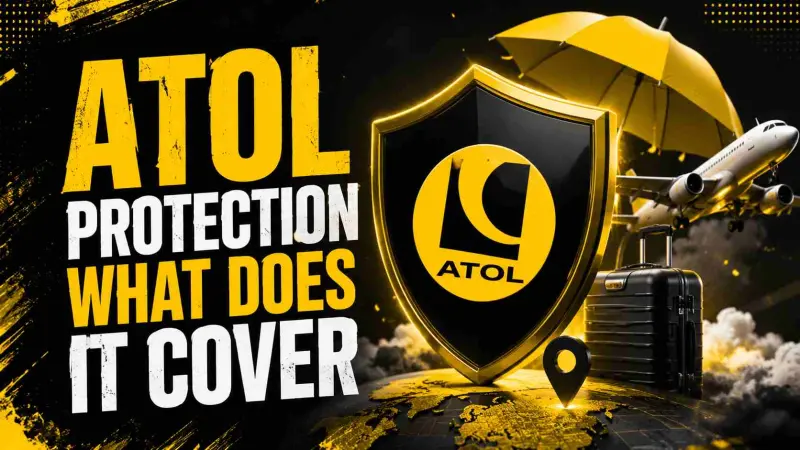
Booking a holiday is exciting until the company you paid suddenly stops trading. If that happens, ATOL protection can make the difference between losing thousands of pounds and having a route to a refund or getting home safely.
ATOL, or Air Travel Organiser's Licence, is a UK financial protection scheme administered by the Civil Aviation Authority (CAA). It generally protects consumers who book ATOL-protected flight-inclusive package holidays, and certain flight-only arrangements, when the ATOL holder fails. Depending on the circumstances, travellers who have not yet departed can claim a refund, while people already abroad may receive help completing their holiday or arranging replacement travel home.
But ATOL is often misunderstood. It is not ordinary travel insurance, it does not protect every holiday booking, and it does not automatically mean every travel-related expense will be reimbursed.
The details on your ATOL Certificate matter.
This guide explains exactly what ATOL protects, what happens when a holiday company collapses, how refunds and repatriation work, what is excluded, and what you should do if you discover that your travel provider has failed.
What does ATOL protection cover?
ATOL protects your money if an ATOL holder fails
The central purpose of ATOL is financial protection.
If an ATOL-protected travel company ceases trading and you have a qualifying booking that has not yet started, the scheme can provide a route to recover money paid for the protected arrangements. The CAA administers the protection and handles claims following an ATOL holder failure.
That means the protection is aimed at one of the biggest financial risks associated with package holidays: paying a substantial amount in advance for flights, accommodation and other travel arrangements, only for the organiser to become insolvent before delivering them.
For example, imagine you pay £3,200 for a family holiday covering flights, hotel accommodation and transfers. Two weeks before departure, the company organising the package goes into insolvency and cannot provide the trip.
If your booking is ATOL protected, you may be able to claim the protected amount rather than simply becoming another unsecured creditor of the failed business.
It can help travellers already abroad
ATOL is not only about refunds for future holidays.
If an ATOL holder fails while customers are already abroad, the CAA can work with suppliers and other parties to establish what services remain available. In many cases, travellers can continue their holiday and return on their original arrangements. If their return flight is no longer available, the CAA may arrange replacement flights.
This is one of the most valuable aspects of ATOL protection.
Being stranded overseas can create immediate problems:
- Your hotel may not have received payment.
- Your return flight may be cancelled.
- A transfer provider may refuse to provide transport.
- You may be asked to pay again for accommodation or travel.
- You may not know whether your original booking is still valid.
The CAA's approach is generally to establish the status of the affected services and minimise disruption. Where suppliers insist that customers pay again for services forming part of the protected trip, those additional expenses may potentially be included in an ATOL claim, depending on the circumstances and evidence available.
ATOL protection can cover the package shown on your ATOL Certificate
One of the simplest ways to understand your protection is to look at your ATOL Certificate.
The CAA advises travellers to confirm that the company has an ATOL licence before booking and says that, for an ATOL-protected trip, the arrangements covered by the certificate receive the relevant financial protection if the ATOL holder ceases trading.
Your certificate is therefore more than a piece of booking paperwork.
Keep it alongside:
- Booking confirmations
- Receipts
- Payment records
- Invoices
- Flight details
- Hotel confirmations
- Correspondence with the travel company
- Evidence of any additional expenses following a failure
These documents can become important if you need to make a claim.
What happens to your holiday if the company collapses?
There are two broad situations.
| Situation | What ATOL may provide |
|---|---|
| You have not travelled | A claim for a refund of protected money |
| You are already abroad | Assistance with completing the trip and returning home |
| Original return flight unavailable | Possible replacement flight arrangements |
| Hotel or other supplier demands payment | Potential claim for eligible replacement costs |
| Flight-only booking with valid tickets | The booking may continue and you may be able to travel |
| Booking is not ATOL protected | ATOL generally cannot provide protection |
The exact outcome depends on the failed company's circumstances and the nature of your booking. The CAA publishes specific guidance when an ATOL holder fails.
What is ATOL protection not?
ATOL is not travel insurance
This distinction is essential.
ATOL primarily protects against the financial consequences of an ATOL holder's failure. Travel insurance protects against a much wider range of travel risks, depending on the policy.
Travel insurance can potentially cover things such as:
- Medical treatment overseas
- Lost or stolen belongings
- Cancellation for specified insured reasons
- Missed departures
- Certain travel delays
- Personal liability
- Emergency assistance
The exact cover depends on the policy wording.
ATOL does not replace travel insurance.
Conversely, having travel insurance does not mean you should ignore ATOL protection when booking a package. The two forms of protection solve different problems. The CAA itself recommends taking out travel insurance as soon as you book while also considering ATOL protection for package holidays.
ATOL does not protect every type of holiday booking
This is where many travellers get caught out.
A hotel booked directly with an overseas hotel is not automatically ATOL protected simply because you are travelling by air.
Likewise, booking a flight directly with an airline does not normally give you ATOL protection.
The CAA specifically explains that ATOL protection applies to package trips that include flights and certain flight-only arrangements, rather than every travel purchase.
This means you should not assume:
"I booked through a travel website, so my holiday must be ATOL protected."
The important question is who sold the protected travel arrangement and whether that booking is covered by an ATOL licence.
ATOL does not protect you against every reason for cancelling
Suppose your holiday company remains financially healthy but you decide you no longer want to travel.
ATOL is not a general cancellation policy.
Likewise, if you miss your flight because you arrive late at the airport,
ATOL does not function as a general compensation scheme for that event.
Its key trigger is the failure of an ATOL holder, subject to the rules applying to your particular booking.
This is why ATOL should be viewed as financial failure protection rather than a substitute for comprehensive travel insurance.
How do you know whether your holiday is ATOL protected?
Check the ATOL Certificate
An ATOL Certificate should tell you whether the booking is protected and identify the relevant ATOL holder.
Do not rely solely on a company's logo or a statement such as "financially protected".
Before travelling, check the actual documentation.
You can also use the CAA's ATOL checking facilities to verify whether a business holds an ATOL or is operating under an appropriate ATOL arrangement.
Check the company, not just the website
A familiar-looking travel website is not enough evidence.
Travel businesses can sell different types of arrangements, and the legal protection attached to one transaction may not necessarily apply to another.
Before paying, establish:
- Who is taking your money?
- Who is the organiser?
- Is the booking a package?
- Does the booking include a flight?
- Is the seller an ATOL holder or authorised agent?
- Will you receive an ATOL Certificate?
- What exactly is listed on the certificate?
If the answers are unclear, ask the travel company before making a substantial payment.
Why the ATOL Certificate matters after a collapse
Following a failure, the CAA may need documentation from customers to establish the booking and payment position.
The CAA states that claimants are asked for documentation issued by the failed ATOL holder and evidence of payment.
That is why deleting old emails or throwing away booking documents can create unnecessary problems.
Save everything until your holiday has ended and, if there is a failure, until your claim has been resolved.
What happens if your ATOL-protected holiday company goes bust?
Step 1: Confirm that the company has actually failed
A company being in financial difficulty is not necessarily the same thing as an official ATOL failure.
The CAA publishes information about failed ATOL holders and determines a formal failure under the applicable regulatory process.
If you hear rumours that your travel company is struggling, avoid immediately cancelling or making alternative bookings without checking official information.
Step 2: Check the CAA's failure information
When an ATOL holder fails, the CAA provides information specific to that failure.
This should be your first authoritative source rather than social-media rumours or unverified advice from other travellers.
Look for instructions covering:
- Whether you should continue with your holiday
- Whether existing flights remain valid
- Whether accommodation is available
- Whether replacement travel is being arranged
- How to submit a claim
- What supporting evidence is required
Step 3: If you are abroad, follow the official instructions
If you're already overseas, do not automatically assume that you need to buy a completely new holiday.
The CAA may establish whether accommodation and other services remain available. In many cases, return travel can continue as originally planned. If replacement flights are required, the CAA may arrange them.
If a supplier insists on payment for something that was part of the original protected arrangement, keep receipts and evidence of what you were asked to pay.
Step 4: If you have not travelled, prepare your claim
If the holiday cannot proceed, gather your evidence.
A useful claim file should contain:
- ATOL Certificate
- Booking reference
- Invoice
- Payment confirmation
- Bank or card statement
- Correspondence with the travel company
- Details of the original package
- Receipts for eligible additional costs
The CAA says the ATOL claim process requires the ATOL claim form and supporting documentation, including evidence of payment.
Step 5: Check whether your payment method provides another route
In some cases, the CAA may refer consumers to their card provider, particularly where a payment was made by credit card.
The CAA also notes that credit-card payments can potentially provide protection under Section 75 of the Consumer Credit Act in appropriate circumstances.
This does not mean you should automatically make multiple overlapping claims for the same money. Follow the instructions provided for your particular failure and payment method.
What happens to your money after an ATOL failure?
The Air Travel Trust provides the financial backing
ATOL protection is supported by the Air Travel Trust (ATT).
The CAA states that the Air Travel Trust is the primary source of funding when an ATOL holder fails, with funds used for refund and repatriation costs. ATOL holders also make an ATOL Protection Contribution to the scheme.
As of current CAA guidance, the ATOL Protection Contribution is £2.50 per qualifying passenger, paid by ATOL holders into the Air Travel Trust rather than being charged separately to consumers as an additional passenger fee.
For consumers, the practical point is simple: ATOL is backed by a formal financial protection structure rather than being merely a promise made by the travel company itself.
Does ATOL cover flights booked on their own?
Sometimes, but do not assume every flight-only booking is protected
Flight-only ATOL protection has specific rules.
The CAA explains that certain flight-only bookings can be protected. It also gives an important example involving a failed ATOL holder: where an ATOL-protected flight-only booking has already been issued with valid tickets or e-tickets, the booking may remain unaffected and the passenger may still travel. In such circumstances, there may be no ATOL claim simply because the travel company has failed.
That is very different from assuming every flight bought from every travel website has ATOL protection.
Check your documentation and the status of the ticket.
Does ATOL cover accommodation?
Accommodation can be protected when it forms part of the protected package
ATOL is not simply hotel insurance.
However, accommodation can form part of an ATOL-protected package. If the ATOL holder fails, the protection can therefore extend to the protected package arrangements covered by the certificate.
The distinction matters.
Booking a hotel separately does not become ATOL protected simply because you later book an unrelated flight.
The protection relates to qualifying arrangements covered by the ATOL scheme and your booking documentation.
This is one reason package holidays can provide valuable financial security compared with assembling multiple unrelated bookings yourself.
ATOL vs travel insurance vs Section 75
These protections can overlap, but they are not interchangeable.
| Protection | Main purpose | Typical trigger |
| ATOL | Protects qualifying flight-inclusive travel financially | ATOL holder fails |
| Travel insurance | Covers insured travel risks | Event covered by policy |
| Section 75 | Can provide consumer credit protection | Qualifying credit transaction goes wrong |
| Chargeback | Card-scheme dispute mechanism | Specific card-payment circumstances |
The safest approach is not to choose one and assume everything else is unnecessary.
For a package holiday, ATOL can protect against organiser failure. Travel insurance can address medical, cancellation and personal-risk issues. A suitable payment method may provide another layer of financial protection.
The CAA recommends considering both ATOL-protected holidays and travel insurance, while also noting potential credit-card protection.
What should you do if your hotel asks for payment again?
Do not panic, but do not ignore the request
This can happen when a travel company fails and the supplier says it has not been paid.
The CAA says that it contacts suppliers of the failed ATOL holder and works to establish the status of the services. If a supplier insists that consumers pay for services, the consumer may be able to include those expenses in an ATOL claim.
If you're asked to pay:
- Ask the hotel or supplier for written confirmation.
- Keep the original booking details.
- Record the amount requested.
- Obtain a receipt if you have to pay.
- Check the CAA's instructions for the specific failure.
- Include relevant evidence in your claim.
Avoid paying cash without documentation where another payment method is available.
What are the common mistakes travellers make?
Assuming every travel company offers ATOL
The biggest mistake is treating ATOL as universal.
It is not.
Always check the status of the specific company and booking.
Confusing ATOL with ABTA
ATOL and ABTA are different forms of protection.
ATOL is the statutory financial protection scheme associated with qualifying air travel arrangements and is administered by the CAA.
ABTA is a trade association whose members may offer financial protection under their own arrangements. Membership and the precise protection available depend on the booking and circumstances.
Do not assume that seeing an ABTA logo means an air-inclusive booking is automatically covered by ATOL.
Assuming travel insurance will automatically refund everything
Travel insurance policies contain exclusions, limits and conditions.
An insurer may cover a travel company failure in some circumstances, but that depends on the policy.
Read the wording rather than assuming "travel insurance" means complete financial protection.
Booking everything separately without checking protection
Independent booking can offer flexibility, but it can also mean you have several separate contracts.
If an airline fails, your hotel may still be operating. If your hotel fails, the airline may still fly. One provider's collapse does not necessarily create a single mechanism for recovering every part of a self-built trip.
A package can simplify this risk because qualifying package arrangements receive specific legal and financial protections.
What should you check before booking your next holiday?
A few minutes of checking can prevent a major headache later.
Use this pre-payment checklist
Before paying a travel company, check:
- Is the company ATOL protected?
- Who is the ATOL holder?
- Will I receive an ATOL Certificate?
- Is the booking actually a package?
- What services are included?
- Is the payment going directly to the ATOL holder or another business?
- Does the booking documentation match what I think I am buying?
- Do I have suitable travel insurance?
- What protection does my payment method provide?
- Have I saved the confirmation and payment evidence?
The CAA specifically recommends checking that a company has an ATOL licence before booking.
What is changing about ATOL protection?
Digital claims and consumer information are becoming more important
ATOL itself is an established financial protection system, but the way consumers interact with it is changing.
In July 2026, the CAA announced a new ATOL claims portal designed to improve consumer service, with enhanced security and a master booking database intended to support automated verification of claims submitted following an ATOL holder failure.
This is particularly relevant because major travel failures can involve thousands of individual bookings. Faster access to reliable booking data could reduce administrative friction for both travellers and the regulator.
The CAA has also continued to stress the importance of clear cash-refund rights in relevant package-travel situations. In July 2026, it reminded travel businesses that consumers entitled to cash refunds are not required to accept vouchers instead, and that voucher amounts held in such circumstances are not ATOL protected.
What travellers should expect in future
The broad principle is unlikely to change: financial protection matters because consumers pay for holidays well before receiving the service.
What may change is the administration.
Digital booking records, automated claim verification and clearer online information could make it easier to establish:
- What was booked
- Who received the money
- Which services were included
- Whether the booking was protected
- What refund is due
- Whether replacement travel is required
For travellers, that makes keeping accurate digital records increasingly useful.
Do not rely on the travel company's website remaining online after a collapse. Save your certificate, invoice and payment evidence when you book.
Key Insights
- ATOL protects qualifying travel arrangements when an ATOL holder fails. It is primarily financial failure protection, not general travel insurance.
- You may receive a refund if you have not travelled, provided your booking is covered by ATOL and meets the applicable requirements.
- Travellers already abroad may receive assistance returning home. The CAA can arrange replacement flights in circumstances where the original return arrangements are unavailable.
- Your ATOL Certificate is important evidence. Keep it together with booking confirmations, invoices and payment records.
- ATOL does not automatically cover every flight, hotel or holiday booking. Check the exact booking and protection status before paying.
- ATOL is not a substitute for travel insurance. Medical expenses, baggage problems and many cancellation risks fall into a different category of protection.
- If a supplier asks you to pay again after an ATOL failure, keep evidence. Eligible replacement costs may potentially form part of an ATOL claim, depending on the circumstances.
- Check official CAA information after a travel-company failure. The regulator publishes failure-specific instructions and claim information rather than applying one identical process to every collapse.
FAQ
1. What does ATOL protection cover?
ATOL protects qualifying flight-inclusive package holidays and certain other covered flight arrangements when the ATOL holder fails. Depending on the circumstances, it can provide a refund for future bookings or assistance with completing a holiday and returning home if you are already abroad.
2. What happens if my holiday company goes bust?
If the company is an ATOL holder and your booking is protected, the CAA will publish information about the failure. Travellers who have not departed may be able to claim a refund, while customers already abroad may receive assistance with remaining services or repatriation.
3. Will ATOL give me all my holiday money back?
If your qualifying ATOL-protected booking cannot proceed because the ATOL holder has failed, you may be entitled to a refund of protected money. The exact amount and claim process depend on the booking, payments made and circumstances of the failure.
4. Does ATOL cover me if I am already abroad?
Yes, ATOL protection can assist eligible travellers who are already abroad when an ATOL holder fails. The CAA may arrange replacement flights if the original return flight cannot operate, while other services may continue if suppliers confirm they remain available.
5. Does ATOL cover hotel bookings?
Accommodation can be protected when it forms part of a qualifying ATOL-protected package. However, booking a hotel separately does not automatically make that accommodation ATOL protected.
6. Does ATOL cover flights booked directly with an airline?
Generally, ATOL is not the protection scheme for a flight booked directly with an airline. Certain flight-only bookings sold through ATOL arrangements can be protected, so you should check the specific booking documentation rather than assuming all flight purchases are covered.
7. Is ATOL the same as travel insurance?
No. ATOL primarily protects qualifying travel financially if an ATOL holder fails. Travel insurance covers specified risks such as medical treatment, cancellation and baggage problems, subject to policy terms. You may need both.
8. How do I check whether my holiday is ATOL protected?
Check your ATOL Certificate and verify the travel company's ATOL status through the CAA's official ATOL checking service. Pay particular attention to the company named as the ATOL holder rather than relying only on branding or statements on a booking website.
9. What is an ATOL Certificate?
An ATOL Certificate is booking documentation that identifies the protected travel arrangements and the relevant ATOL holder. Keep it after booking because it can be important evidence if the travel company subsequently fails.
10. What should I do if my hotel wants me to pay again?
Ask for written confirmation of the amount and why payment is required. Keep the receipt and original booking evidence. Follow the CAA's instructions for the specific ATOL failure because additional costs for replacement services may potentially be claimable.
11. Can I claim on ATOL and my credit card?
You may have more than one potential route to financial recovery depending on how the booking was paid for. The CAA notes that some consumers may be referred to their card issuer and that Section 75 protection can apply to qualifying credit-card transactions. Follow the instructions for your individual case.
12. Does ATOL cover cancellation because I change my mind?
No. ATOL is not a general cancellation policy. Its primary purpose is protecting qualifying travel arrangements against the financial consequences of an ATOL holder failure.
13. Is my holiday protected just because the company says it is financially protected?
Not necessarily. Look for specific evidence of ATOL protection, including the relevant ATOL Certificate and holder details. If the company makes a general claim about financial protection, ask what scheme applies to your particular booking.
14. How much does ATOL protection cost passengers?
ATOL holders currently pay an ATOL Protection Contribution of £2.50 per qualifying passenger into the Air Travel Trust. The CAA states that this is paid by ATOL holders rather than being added to consumers' bills as a separate passenger charge.
15. Is ATOL protection still important when booking holidays in 2026?
Yes. ATOL remains a significant form of financial protection for qualifying flight-inclusive holidays. The CAA has also continued improving its claims infrastructure, including the launch of a new ATOL claims portal in July 2026.
Final Thoughts
ATOL protection is best understood as a financial safety net for qualifying air-inclusive holidays when the travel company responsible for your protected booking fails.
It can protect money paid for a future holiday, and it can help people already overseas deal with the practical consequences of a travel company's collapse. In some circumstances, that may mean a refund; in others, it may mean arrangements that allow you to finish your holiday and get home.
But ATOL is not a catch-all travel protection policy.
It does not automatically cover every hotel, flight or self-arranged holiday. It does not replace travel insurance, and simply booking through a travel website does not guarantee that every transaction on that website is ATOL protected.
The smartest approach is straightforward: check the ATOL status before paying, read your ATOL Certificate, understand
exactly what your booking includes, take suitable travel insurance, and keep your payment records.
If your holiday company ever does collapse, those few minutes of preparation can make the difference between uncertainty and having a clear route to assistance or a refund.
Disclaimer: The information provided in this article is for general informational and research purposes only. Company details, features, services, and market positions may change over time. Readers are advised to visit official company websites and conduct independent research before making any business decisions or purchasing services.
Most Searchable Keywords
Recent Blogs


Related Listings


Categories
- Accountants (295)
- Advertising Agencies (559)
- Architects (149)
- Automobiles (377)
- Beauty (300)
- Carpenters (146)
- Cleaning Services (387)
- Dentists (189)
- Driving (62)
- Education (1)
- Electricians (215)
- Energy (8)
- Event Organiser (687)
- Finance (602)
- Guide (3468)
- Health (2207)
- Information technology (206)
- Legal Services (361)
- Logistics (6)
- Maintenance (65)
Sponsored Listings in Legal Services
Related Blogs
30 Hours Free Childcare Eligibility and Recon...
Read this insightful article "30 Hours Free Childcare Eligibility and Reconfirmation" to expand your knowledge!
Term Time Holiday Fines Costs and Payment Rul...
Read this insightful article "Term Time Holiday Fines Costs and Payment Rules" to expand your knowledge!

16 to 25 Railcard Discount and Digital Versio...
Read this insightful article "16 to 25 Railcard Discount and Digital Version Explained" to expand your knowledge!
Questions & Answers – Find What
You Need, Instantly!
How can I update my business listing?
Is it free to manage my business listing?
How long does it take for my updates to reflect?
Why is it important to keep my listing updated?
