
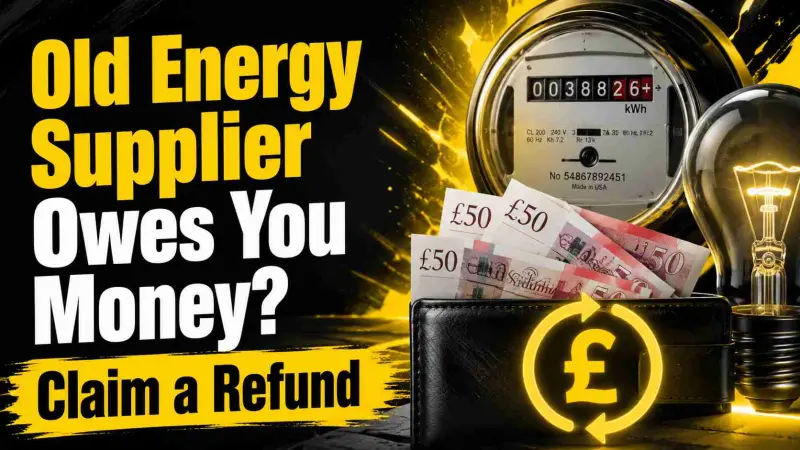
Old Energy Supplier Owes You Money Claim a Refund
If you switched energy supplier months or even years ago, your old supplier could still owe you money. The amount may be sitting on a closed account as a credit balance, particularly if you paid by monthly Direct Debit and your payments were higher than your actual energy use.
The good news is that an old energy account does not simply become worthless because you have moved to another supplier. Ofgem says consumers can claim back credit they believe an energy supplier owes them, including credit on a closed account. Suppliers are also expected to send a final bill after a switch and refund money left on the account.
So if you have ever wondered, “Does my old energy supplier owe me money?”, it is worth checking.
This guide explains how to find an old energy account, establish whether you are owed a refund, what evidence you need, how long the supplier should take to pay you, what compensation may apply if it fails to meet the required standards, and what to do if the company no longer exists.
How to check whether an old energy supplier owes you money
A credit balance means you have paid more money than was ultimately required for the energy you used. This can happen for several ordinary reasons, rather than because anything has necessarily gone wrong.
For example, you might have been paying £150 a month by Direct Debit while your actual annual energy costs turned out to be lower. If you switched supplier during the year, your old account could have ended with a substantial credit balance.
Ofgem specifically recognises several reasons why energy accounts can build up credit, including estimated bills, fixed monthly Direct Debit payments and differences between the timing of payments and actual consumption.
What counts as money owed by an energy supplier?
The most obvious example is a positive balance on your final bill.
Suppose your final account looks like this:
| Item | Amount |
|---|---|
| Direct Debit payments made | £1,800 |
| Actual energy charges | £1,540 |
| Final credit | £260 |
In this example, the supplier owes you £260.
The same principle applies if you moved house rather than switched supplier. Your account should be closed and a final bill should establish whether you owe the supplier money or whether the supplier owes you.
Credit can also arise from billing corrections, meter-reading adjustments or payments that were made after the final period of consumption had already been calculated.
Why old energy accounts can be easy to forget
Energy refunds are particularly easy to miss because switching normally changes the company you deal with.
Once your new supplier starts billing you, the old account may disappear from your everyday routine. If you changed address at roughly the same time, you may also stop receiving correspondence sent to the previous property.
Some people assume that a supplier would automatically find them and send every penny owed. In many cases, refunds are processed automatically, but a missing final bill, incorrect bank details, account error or incomplete meter information can leave an old credit unresolved.
That is why checking historical energy accounts can be worthwhile.
How far back can you claim an energy refund?
There is no simple “it has expired after X years” rule for an ordinary credit balance on a closed energy account.
Citizens Advice states that if a previous supplier confirms it owes you money, you can ask for the refund no matter how long ago the account was closed.
That makes old paperwork surprisingly valuable.
If you moved home several years ago or switched suppliers repeatedly, look through old bills, emails and bank statements. You may discover that a credit balance was never returned.
What should happen when you switch energy supplier?
The normal switching process should leave you with a final account from your previous supplier.
Your old supplier should calculate the charges up to the point at which responsibility for your energy supply transferred. Your new supplier should then take over from the relevant switching date.
Ofgem's guaranteed standards require suppliers to send a final bill within six weeks of a switch. They must also automatically refund a credit balance within 10 working days of sending the final bill.
This creates two important deadlines:
| Stage | Required timeframe |
| Final bill after switching | Within 6 weeks |
| Refund of closed-account credit | Within 10 working days of final bill |
| Compensation for a missed standard | Generally £40 under current rules |
These deadlines are particularly useful if you are trying to work out whether your supplier has simply delayed your refund or has failed to follow the required standards.
What if the final bill never arrived?
Do not assume that no final bill means no refund is due.
Contact your previous supplier and ask for a copy of the final bill. You can still ask the supplier to investigate the closed account even if you no longer have the paperwork.
Citizens Advice says that if you have not received your final bill within six weeks, you should contact the former supplier and ask for it.
If the supplier took longer than six weeks, compensation may be due.
How to claim money from your old energy supplier
The process is usually straightforward, although finding an old account can be the hardest part.
Step 1: Find your previous supplier
Start with your old paperwork.
Check:
- Previous energy bills
- Emails from your former supplier
- Bank statements
- Direct Debit records
- Online accounts
- Documents from a house move
- Records from your previous landlord, if applicable
If you cannot remember the supplier, Citizens Advice suggests checking old bank statements or asking your current supplier to check the relevant supplier database. Former landlords or flatmates may also help if you were renting.
Step 2: Find your old account number
Your account number is useful because it allows the supplier to identify the correct account quickly.
However, do not give up if you no longer have it.
Citizens Advice says the supplier may be able to locate an old account using the address associated with it.
Have as much information as possible available, such as:
- Your name at the time
- Previous address
- Approximate dates you lived there
- Approximate date you switched supplier
- Old meter readings
- Account number, if available
- Previous payment details
- Copies of old bills
Step 3: Ask for the final account balance
Tell the supplier that you previously held an account and want to know whether it ended in credit.
If the supplier says it owes you money, ask them to confirm:
- The credit balance.
- The date the account was closed.
- The date the final bill was issued.
- Whether a refund was previously attempted.
- Which payment method they intend to use.
- Whether any compensation is also due.
Getting the information in writing is useful if the issue later becomes a formal complaint.
Step 4: Request the refund
If the supplier confirms a credit balance, explicitly request repayment.
Depending on the company, you may be able to request the refund online, by phone or in writing.
Make sure the supplier has the correct bank details if it requires them.
Be cautious about unsolicited messages claiming to offer an energy refund. If somebody contacts you unexpectedly asking for banking information, verify the request through the supplier's official contact details before providing anything.
Step 5: Keep evidence
Save:
- Your final bill
- Emails
- Screenshots
- Letters
- Payment confirmations
- Dates and times of calls
- Names or reference numbers from customer-service conversations
This becomes important if the supplier disputes the amount or fails to pay.
How long should an energy refund take?
For a closed account following a switch, the current Ofgem standard says a supplier should automatically refund credit within 10 working days of sending the final bill.
That is different from saying you will necessarily receive the money 10 working days after you first contact the company.
The relevant sequence is generally:
Switch → final bill within six weeks → credit identified → refund within 10 working days.
If the supplier has not issued a final bill, the refund deadline cannot simply be calculated from the day you switched.
That is why requesting the missing final bill is often the first practical step.
What compensation can you claim for a delayed energy refund?
Ofgem's current guaranteed standards provide compensation when suppliers miss certain deadlines.
For domestic customers, the current standards include:
- £40 if the supplier fails to send the final bill within six weeks of the switch.
- £40 if it fails to refund money owed from a credit balance within 10 working days of the final bill.
If the supplier does not make the required compensation payment within 10 working days after identifying the breach, a further £40 can be payable.
The rules changed from 2 January 2025. Ofgem notes that breaches occurring before that date could attract £30 rather than the current £40 amount.
Does every energy customer qualify for this compensation?
Not necessarily.
Ofgem's guidance says the switching-related compensation described above does not apply in the same way to business energy customers or where the supplier has gone bust.
If you are a small business, the position can be different from that of a household customer, particularly when a supplier becomes insolvent.
That distinction matters before assuming that a household consumer rule automatically applies to a business account.
What if your old supplier says your account was not in credit?
Do not immediately accept a disputed balance.
Ask the supplier to explain how it calculated the final account.
Compare its figures with your own records.
Check the meter readings
An incorrect final meter reading can change the balance significantly.
For example, imagine the supplier believes your final electricity reading was 18,500 kWh, but your photograph from the day of the switch shows 18,100 kWh.
That difference may affect the final bill.
If you have photographs of your meter from around the switching date, keep them.
Check estimated readings
Estimated readings can also create discrepancies.
If the supplier calculated your final bill using an estimate but you have an actual reading, ask it to recalculate the account.
Ofgem encourages regular meter readings because accurate readings help prevent credit balances and billing problems caused by inaccurate estimates.
Check your Direct Debit payments
Look at your bank statements rather than relying solely on your memory.
Add up payments made to the supplier during the relevant period and compare them with the charges appearing on the final account.
This is especially useful when your monthly payment changed during the contract.
Check for refunds already made
Sometimes the supplier did issue a refund, but it went to an old bank account or was processed under a different reference.
Ask for evidence of any previous refund, including:
- Date
- Amount
- Payment method
- Bank details used, where appropriate
- Transaction reference
Do not assume that a statement saying “refund issued” proves the money reached you.
What if you cannot remember which supplier you had?
This is common after several house moves.
Start with your bank statements. Search for the names of energy companies or regular Direct Debit payments.
Old emails can also reveal the supplier.
If you rented, your former landlord or housemates may have records that help identify the company.
Citizens Advice also says your current supplier may be able to help identify the supplier associated with your previous property.
The more precise your old address and dates are, the easier the search should be.
What if the energy supplier has gone bust?
This situation requires more care.
If a household energy supplier fails, Ofgem normally appoints another supplier to protect continuity of supply. Where a domestic account is in credit, Citizens Advice says that credit is protected, with the new supplier normally explaining how it will be repaid.
Small business customers can face a different process.
If the new supplier cannot repay the credit, you may need to deal with the administrator of the failed company and register as a creditor.
Repayment can take considerably longer and may not cover the entire amount.
So there is a major difference between:
“My old supplier is still operating but has not refunded me”
and
“My old supplier has entered insolvency.”
The first is normally a customer-service and regulatory complaint issue. The second can involve an insolvency process.
What if an old Direct Debit was taken after you switched?
Occasionally, a payment can be collected by the previous supplier after a switch has taken place.
If money was wrongly taken from your account, raise the issue with the relevant supplier and your bank.
Citizens Advice states that where a Direct Debit payment accidentally goes to an old supplier, the new supplier is responsible for refunding money owed in that situation.
Keep the bank statement showing the payment because it provides a clear record of what happened.
Can you claim interest on an old energy credit?
You can ask.
Citizens Advice advises consumers to ask for any interest the supplier has earned on money held since the account was closed. However, it also states that suppliers are not legally required to repay that interest.
That means interest is different from the underlying credit balance.
If the supplier owes you £300, the £300 itself is the principal amount owed. Any interest is a separate question and should not be assumed to form part of the automatic refund.
What should you do if the supplier refuses to refund you?
Start with the supplier's complaints process.
Ask for a formal explanation of why the refund has been refused or delayed.
A useful written complaint should state:
- The account number
- The previous property address
- The date you left or switched
- The amount you believe is owed
- The evidence supporting your calculation
- What resolution you want
- The date by which you expect a response
Avoid making the complaint unnecessarily complicated. A clear timeline and supporting evidence are usually more useful than a long argument.
When should you contact the Energy Ombudsman?
If you have complained to the supplier and the matter remains unresolved, the Energy Ombudsman may be able to help.
Citizens Advice says that if the Energy Ombudsman takes up a case, its decision normally comes within six to eight weeks; where the Ombudsman decides that a refund is due, the supplier must refund it within 28 days.
The Ombudsman route is free for eligible consumers.
Before escalating, keep copies of your complaint and the supplier's response.
A simple example of recovering an old energy credit
Imagine Sarah moved home in March 2023.
She switched electricity suppliers and assumed her previous company had settled everything. In 2026, she checks old bank statements and discovers that her former supplier had been collecting £140 a month by Direct Debit.
She finds her final bill and sees a £215 credit balance.
Sarah contacts the former supplier with her old account number and previous address. The supplier confirms that the account still shows £215 in credit.
She asks for the money to be refunded and requests written confirmation.
The important lesson is not the £215 figure. It is the habit of checking old accounts.
A refund does not become irrelevant simply because the account is no longer active.
Common mistakes that can delay an energy refund
Assuming the supplier will always find you
Your former supplier may have outdated contact or bank details.
Throwing away old bills
Old bills can prove account numbers, meter readings, payment history and credit balances.
Ignoring estimated meter readings
An incorrect estimate can produce an incorrect final balance.
Accepting unexplained figures
If the final bill does not make sense, ask the supplier to explain the calculation.
Treating a supplier's insolvency like a normal refund
A failed supplier can involve administrators and different protections, particularly for business customers.
Giving banking details to an unsolicited caller
Verify the company and the reason for the payment request first.
How to make an old energy refund claim stronger
The best approach is evidence-led.
Create a simple timeline:
| Information | Example |
| Old supplier | Former electricity company |
| Property | Previous address |
| Account closed | March 2023 |
| Final reading | 18,100 kWh |
| Final bill | April 2023 |
| Credit claimed | £215 |
| Refund requested | August 2026 |
| Complaint reference | Supplier's reference number |
This makes it much easier for customer service or a complaints team to understand what you are asking for.
You do not need specialist knowledge of energy regulation to begin the process.
You simply need enough information to establish that the account existed, determine its final balance and demonstrate that the money has not already been returned.
Why accurate meter readings matter when switching
Meter readings are one of the simplest forms of evidence available to an energy customer.
Take a reading when you move or switch, and ideally photograph the meter so that the date and reading can be established.
With a smart meter operating correctly in smart mode, readings may be transmitted automatically. Even then, keeping a record around a switch can be useful if the account later becomes disputed.
For traditional meters, actual readings are particularly important because an estimate can differ from the amount of energy actually consumed.
What is likely to change in the future?
Energy billing is gradually becoming more data-driven.
Smart meters, automated readings and digital accounts can make it easier for suppliers to calculate consumption without relying on customers to submit readings manually. Ofgem says smart meters can help consumers monitor and control energy spending.
That does not mean billing disputes will disappear.
Accounts can still contain incorrect readings, duplicated payments, payment allocation problems or administrative errors. The more energy customers switch suppliers, move properties and change tariffs, the more important accurate account closure remains.
The likely direction of travel is toward more automated final billing and refunds, but consumers should still keep their own records.
An automated system is useful. It is not a substitute for checking a final bill.
Key Insights
- Check old energy accounts after switching or moving. A closed account can still contain money owed to you.
- Look for the final bill first. It should show whether your account ended in credit or debt.
- You can still claim an old credit balance. Citizens Advice says a confirmed refund can be requested regardless of how long ago the account was closed.
- Keep meter-reading evidence. Actual readings and photographs can help resolve disputes over final bills.
- Know the deadlines. Ofgem's current standards require a final bill within six weeks of a switch and a credit refund within 10 working days of the final bill.
- Check compensation separately. Missing the relevant standards can trigger £40 compensation, subject to the applicable rules and circumstances.
- Do not treat failed suppliers like ordinary companies. Insolvency can create a different refund process, particularly for small business customers.
- Escalate unresolved disputes. Make a formal complaint first and consider the Energy Ombudsman if the issue remains unresolved.
FAQ
1. How do I find out if my old energy supplier owes me money?
Contact your previous supplier and ask it to check your closed account for a credit balance. Your old account number and previous address will help. You can also check old bills, emails and bank statements for evidence of payments and the final balance.
2. Can I claim an energy refund from a supplier I left years ago?
Yes. If your former supplier confirms that a credit balance remains on a closed account, Citizens Advice says you can ask for the money back regardless of how long ago the account was closed.
3. How long does an energy supplier have to refund me after switching?
For a domestic switch, Ofgem's current guaranteed standard requires a supplier to refund a credit balance within 10 working days of sending the final bill. The final bill itself should normally be sent within six weeks of the switch.
4. What happens if my energy supplier never sent a final bill?
Contact the former supplier and request the final bill. If it took more than six weeks after a switch to provide the bill, you may be entitled to compensation under Ofgem's guaranteed standards.
5. How much compensation can I get for a late energy refund?
The current guaranteed standard provides £40 compensation for certain failures involving the final bill and £40 for certain failures to refund credit within the required timeframe. An additional £40 may apply if compensation itself is not paid within 10 working days after the breach is identified.
6. What if I no longer have my old energy account number?
Contact the former supplier with your name and previous address. Citizens Advice says a supplier may be able to locate an old account using the address even if you no longer have the account number.
7. Can my old energy supplier keep my credit balance?
A supplier should not simply retain money that it owes you. Ofgem says suppliers must take steps to return money held as credit on closed accounts, and consumers can contact the former supplier to claim it.
8. Can I claim interest on money my old supplier held?
You can ask the supplier to pay interest earned on the balance. However, Citizens Advice says the supplier is not legally required to repay that interest.
9. What if my old supplier says I owe money instead?
Ask for a detailed final bill and check the meter readings, dates, payments and tariff charges. If you believe the calculation is wrong, make a formal complaint and provide your supporting evidence.
10. Can estimated meter readings affect my refund?
Yes. An estimated final reading can produce a different balance from your actual consumption. If you have an actual reading from the switching or moving date, give it to the supplier and ask whether the final bill should be recalculated.
11. What if my old energy supplier has gone bust?
The process depends on the type of customer and the circumstances of the supplier's failure. Domestic customers with credit are generally protected through the supplier-of-last-resort arrangements, while small business customers may need to deal with an administrator if credit cannot be recovered through the replacement supplier.
12. What if an old supplier took a Direct Debit after I switched?
Raise the payment with the relevant supplier and your bank. Citizens Advice says the new supplier is responsible for refunding money owed where a Direct Debit payment accidentally goes to an old supplier in the circumstances it describes.
13. Should I keep old energy bills after switching?
Yes. Keeping old bills can help prove your account number, payment history, meter readings, tariff and final balance. Digital copies are usually sufficient and can save considerable time if a dispute arises later.
14. What if my energy supplier refuses to refund my credit?
Ask for a written explanation and make a formal complaint. If the dispute remains unresolved after going through the supplier's complaints process, you may be able to take it to the Energy Ombudsman. Citizens Advice says the Ombudsman can make decisions on eligible energy disputes.
15. Is it worth checking old energy accounts if I only expect a small refund?
Usually, yes. Checking an old account can take only a few minutes if you have the bill or bank statement available. Even a modest credit balance is still your money, and you may also discover that compensation is due if the supplier missed applicable billing or refund standards.
Final Thoughts
An old energy account is easy to forget, especially after moving home or switching supplier. But closing an account does not necessarily mean the financial relationship is finished.
If your final bill shows a credit balance, that money belongs back with you. The first step is simply to identify the former supplier and ask it to check the closed account. If you cannot find the account number, your previous address and payment records may be enough to get started.
For domestic customers, the current Ofgem standards give you useful benchmarks: a final bill should normally arrive within six weeks of a switch, while a credit balance should be refunded within 10 working days of the final bill.
If those deadlines were missed, check whether compensation applies rather than focusing only on the original refund.
The practical lesson is simple: do not write off an old energy account just because you have moved on to another supplier. Check the final balance, keep your evidence and ask for every amount you are legitimately owed.
Disclaimer: The information provided in this article is for general informational and research purposes only. Company details, features, services, and market positions may change over time. Readers are advised to visit official company websites and conduct independent research before making any business decisions or purchasing services.
Most Searchable Keywords
Recent Blogs
Related Listings

Categories
- Accountants (295)
- Advertising Agencies (559)
- Architects (149)
- Automobiles (377)
- Beauty (300)
- Carpenters (146)
- Cleaning Services (387)
- Dentists (189)
- Driving (62)
- Education (1)
- Electricians (215)
- Energy (8)
- Event Organiser (687)
- Finance (602)
- Guide (3422)
- Health (2207)
- Information technology (206)
- Legal Services (361)
- Logistics (6)
- Maintenance (65)
Sponsored Listings in Plumbers


Related Blogs
Water Meter or Fixed Bill: Which Is Cheaper
Read this insightful article "Water Meter or Fixed Bill: Which Is Cheaper" to expand your knowledge!

ECO4 Free Insulation: What’s Still Available...
Read this insightful article "ECO4 Free Insulation: What’s Still Available in This Year" to expand your knowledge!

What It Costs to Run an Electric Fan Air Frye...
Read this insightful article "What It Costs to Run an Electric Fan Air Fryer or Tumble Dryer" to expand your knowledge!
Questions & Answers – Find What
You Need, Instantly!
How can I update my business listing?
Is it free to manage my business listing?
How long does it take for my updates to reflect?
Why is it important to keep my listing updated?
