
Black Box Insurance Telematics and Lower Premiums
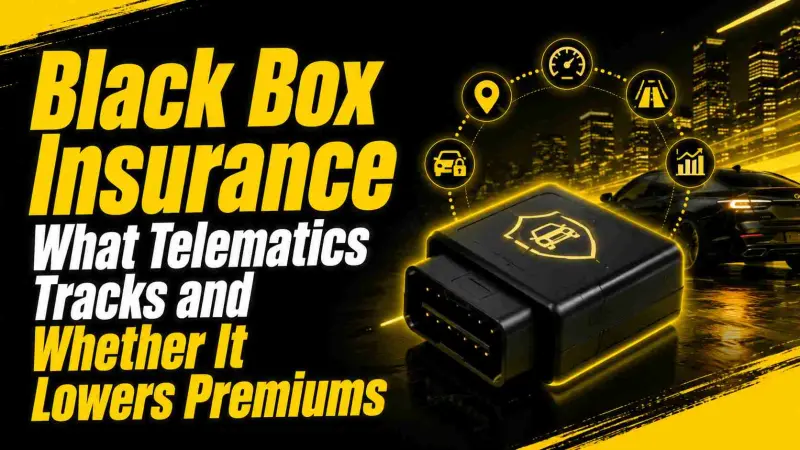
A black box can turn your everyday driving into insurance data. Instead of relying only on factors such as your age, location, vehicle and claims history, a telematics policy can use information about how, where and when you drive to assess your risk.
The good news is that careful drivers can potentially benefit from this approach. The catch is that a black box does not automatically make car insurance cheaper. Depending on the insurer and policy, factors such as speed, braking, mileage, time of day and road type can affect how your driving is assessed. Some policies may reward safer driving, while others can impose restrictions, charges or other consequences for behaviour considered high risk.
This guide explains exactly what black box insurance is, what telematics can track, how insurers use the information, when it can reduce premiums, what happens if your driving score is poor, and what you should check before choosing a telematics policy.
What Does Black Box Insurance Track and How Can Telematics Affect Your Premium?
What is black box insurance?
Black box insurance is a type of telematics motor insurance that uses technology to collect information about how a vehicle is driven. The term “black box” usually refers to a small device installed in the vehicle, although modern telematics insurance can also work through a smartphone app or technology built directly into a vehicle.
The Association of British Insurers (ABI) describes telematics insurance as “pay how you drive” insurance because the policy can take driving behaviour into account when assessing risk and setting or reviewing premiums.
Traditional car insurance already considers multiple risk factors. These can include your age, address, occupation, vehicle, claims history and driving experience.
Telematics adds another layer: actual information about how the insured vehicle is being used.
That can be particularly attractive to young or newly qualified drivers who may otherwise face expensive premiums because insurers have limited evidence about their individual driving behaviour.
However, a black box is not simply a device that guarantees a discount. Your insurer decides which measurements matter, how they are scored and how the results affect your policy.
What does a black box actually track?
The exact information varies between insurers and products, so there is no universal list of measurements that every black box records.
Common telematics measurements include:
- Speed
- Braking patterns
- Acceleration
- Cornering
- Mileage
- Time of day
- Types of roads used
- Location or journey information
- How the vehicle is driven overall
The ABI specifically identifies mileage, road types, driving time, speed and braking patterns among the factors commonly considered by telematics insurers.
Some systems can also provide additional services. Depending on the policy and technology, telematics may help locate a stolen vehicle, provide accident notifications or supply useful information following a collision.
Does a black box track your location?
Potentially, yes.
Because telematics systems commonly use GPS, an insurer may be able to establish where and when journeys take place. Location information can help the insurer understand the circumstances in which the vehicle is being driven.
That does not necessarily mean an insurer is watching your every movement in the way people sometimes imagine.
The actual data collected, how frequently it is transmitted, how long it is retained and how it is used depend on the particular policy. Your insurer's privacy information and policy terms should explain these details.
Location data can also be useful for services such as stolen-vehicle recovery and accident investigation.
Does it record everything inside the car?
Not necessarily.
A standard telematics device designed for driving-risk assessment is different from a camera or audio surveillance system. The data collected depends on the technology installed and the insurer's product design.
Some connected-car systems can collect much more information than a basic black box, particularly as vehicles become increasingly connected.
The Information Commissioner's Office (ICO) notes that connected vehicle technology can involve information such as real-time location data and driving patterns, and that information linked to an identifiable driver can fall under UK data protection legislation.
If cameras, microphones or more intrusive monitoring are involved, you should check the policy documentation carefully rather than assuming that all telematics products work in the same way.
How does telematics affect your insurance premium?
The basic principle is straightforward: the insurer uses telematics data to build a picture of driving risk.
A driver who consistently demonstrates safer behaviour may be viewed more favourably than someone whose data indicates frequent high-risk driving.
For example, imagine two newly qualified drivers with similar cars and broadly similar personal circumstances.
Driver A:
- Usually drives during daylight hours
- Keeps speeds within appropriate limits
- Brakes smoothly
- Avoids aggressive acceleration
- Drives relatively moderate mileage
Driver B:
- Frequently drives late at night
- Regularly brakes harshly
- Accelerates aggressively
- Travels at higher speeds
- Drives significantly more miles
A telematics insurer may assess these two drivers differently because the data provides additional evidence about their driving behaviour.
That does not mean Driver A is guaranteed a cheaper renewal. Other underwriting factors still matter.
Can black box insurance actually lower your premium?
Yes, it can, but there is no universal discount.
The ABI states that safer drivers will usually benefit from lower premiums than less safe drivers under telematics insurance, although the exact effect varies by insurer and policy.
There are several ways a telematics policy may provide a financial benefit.
| Telematics outcome | Possible effect |
|---|---|
| Consistently safe driving | Lower premium or renewal price |
| Good driving score | Possible reward or benefit |
| High-risk driving | No discount, additional charge or other consequence |
| Limited mileage | Potentially suitable pricing for lower-mileage drivers |
| Driving outside permitted hours | Possible charge or policy issue |
| Improved driving over time | Potentially better future pricing |
The important point is that black box insurance is not automatically cheaper than conventional insurance.
The ABI explicitly warns that telematics policies will not always be cheaper. For example, frequent late-night driving, unsafe road use or consistently unsafe driving could result in a policyholder being treated as higher risk.
When might a black box be particularly useful?
Telematics can be worth considering if you have characteristics that traditionally make car insurance expensive.
Young and newly qualified drivers
Young drivers often face higher insurance costs. Telematics can give an insurer more information about individual driving behaviour rather than relying solely on broader risk characteristics.
The ABI says telematics policies can potentially reduce insurance costs for young or novice drivers who demonstrate safer driving.
For someone who drives carefully, this can make the concept attractive.
Drivers with relatively low mileage
If you only use your car occasionally, a policy that takes mileage into account may be worth investigating.
However, you should compare the actual policy structure. A low-mileage policy may still contain conditions or pricing rules that make another conventional policy better value.
Drivers comfortable with monitoring
Some people like receiving feedback about their driving. A telematics app may show information about journeys and
driving performance, allowing the driver to identify habits such as harsh braking or unnecessary acceleration.
For these drivers, the black box can serve as both an insurance tool and a driving-feedback system.
Can bad driving make black box insurance more expensive?
Yes.
One of the biggest misconceptions about telematics insurance is that the technology can only help you.
In reality, the data can work both ways.
The ABI explains that insurers respond differently to high-risk behaviour. Depending on the policy, consequences can include losing access to premium reductions, a specific charge, a premium increase or, in serious circumstances, cancellation.
This makes the policy terms especially important.
A driver should not choose a black box policy simply because the initial quotation is cheaper. You need to understand what happens if the insurer considers your driving performance poor.
What driving behaviour can affect your score?
Speed
Speed is one of the most obvious telematics measurements.
Repeated speeding can indicate increased risk, although insurers differ in exactly how speed data is evaluated.
A driver should always follow legal speed limits and drive according to road and traffic conditions.
A black box is not a system that tells you how fast you can safely drive. Its purpose is to help the insurer assess risk.
Braking
Harsh or sudden braking can affect telematics scoring.
Of course, emergency braking is sometimes unavoidable. A sensible telematics policy should be understood in the context of how the insurer actually interprets events rather than assuming that every firm treats every hard brake identically.
Acceleration
Rapid acceleration can be treated as an indicator of more aggressive driving.
Smooth acceleration is generally more compatible with the cautious driving profile telematics policies are designed to encourage.
Cornering
Some systems consider how sharply or aggressively the vehicle takes corners.
Again, the exact scoring model depends on the provider.
Time of day
When you drive can matter.
The ABI notes that some policies consider the time of day the vehicle is driven. Certain products may also place restrictions on when the car can be used.
For example, a policy might be less suitable for someone whose work requires frequent driving during late-night hours.
Mileage
Mileage can also be relevant.
Some policies use mileage as part of their risk assessment, while others may have annual mileage limits. If you exceed an agreed mileage allowance, there could be an additional charge depending on the policy.
Always check whether the quoted price assumes a specific annual mileage.
What happens if someone else drives your car?
This is an easy detail to overlook.
Many telematics policies assess how the vehicle is driven overall rather than looking exclusively at the main policyholder's driving.
That means the behaviour of named drivers or other permitted users may affect the information recorded and potentially the premium or benefits.
For example, a parent might have a telematics policy covering a vehicle that is also regularly driven by a child.
If the child's driving affects the telematics data, the policyholder needs to understand that before allowing others to use the vehicle.
The safest approach is to read the insurer's definition of permitted drivers and understand whose driving is included in the assessment.
What are the advantages of black box insurance?
Telematics insurance has several potential advantages.
Potentially lower premiums: Safe driving may result in a lower price, particularly where the policy is designed to reward good driving.
Driving feedback: Some insurers provide scores, reports or suggestions through an app or online portal.
Potential theft assistance: Certain systems can help locate a stolen vehicle.
Accident evidence: Telematics information can provide objective evidence about what happened around a collision and may assist claims handling.
More personalised pricing: Instead of relying entirely on broad statistical categories, telematics allows insurers to incorporate observed vehicle use into their assessment.
For a careful driver, that can be appealing.
What are the disadvantages?
The main downside is that you give the insurer more information about how the vehicle is used.
There can also be practical restrictions.
Depending on the product, you could face:
- Driving-time restrictions
- Mileage limits
- Charges for certain usage
- Installation or removal fees
- Potential consequences for poor driving scores
- Privacy concerns
- Rules affecting named drivers
The ABI notes that some policies may charge for installing or removing a black box, or recovering device costs if a policy is cancelled early.
That means the headline premium is only one part of the calculation.
Is black box insurance a privacy risk?
Privacy is a legitimate consideration.
Telematics data can constitute personal information because it can relate to an identifiable driver. The ICO specifically identifies vehicle telematics data used for insurance as personal data subject to UK data protection requirements.
Before purchasing a policy, check:
- What data is collected?
- How frequently is it collected?
- Why is it collected?
- Who receives it?
- How long is it retained?
- Is it shared with third parties?
- Can named drivers access or see information?
- What happens to the data after cancellation?
The ABI says customers may have rights to access personal data held by an insurer, including information that may go beyond what appears in an online portal or app.
Privacy should therefore be treated as part of the insurance comparison rather than an afterthought.
What happens to telematics data when you cancel?
The answer depends on the type of telematics technology.
For a physical black box, the insurer may arrange removal or stop the device from transmitting information. There may be a removal charge.
For an app-based policy, data collection can stop once the relevant app is deleted, subject to the insurer's processes and policy terms.
For technology built into the vehicle, physically removing the technology may not be possible. In such cases, the insurer can stop receiving the relevant data after cancellation.
The ABI says insurers may still access information received during the policy period for purposes such as claims or accident handling, even after cancellation.
How should you compare black box insurance with standard insurance?
Don't compare policies using the initial price alone.
Instead, consider the total arrangement.
| Factor | Black box insurance | Traditional insurance |
| Driving behaviour | Can directly influence assessment | Usually not monitored through telematics |
| Location/journey data | May be collected | Generally less driving-specific data |
| Potential reward for safe driving | Yes, depending on policy | Not usually based on live driving behaviour |
| Driving restrictions | May apply | Usually fewer telematics-specific restrictions |
| Privacy considerations | Greater data collection | Typically less telematics data |
| Suitable for | Drivers comfortable with monitoring and potentially rewarded for safe driving | Drivers wanting simpler conditions |
| Price | May be lower or higher depending on risk | Depends on standard underwriting factors |
The right question is not “Is black box insurance cheaper?”
It is:
“Is this particular telematics policy cheaper and more suitable for the way I actually drive?”
What should you check before buying a black box policy?
Read the policy terms before accepting the quote.
Pay particular attention to:
- How your driving is scored
- Which behaviours affect the score
- Whether there are mileage restrictions
- Whether there are time-of-day restrictions
- What happens after poor driving
- Whether premiums can increase
- Whether charges apply
- Whether named drivers are monitored
- What data is collected
- How data is shared
- What happens if the device fails
- What happens when the policy is cancelled
This is especially important because telematics products differ substantially between insurers.
A low initial quote can become less attractive if it comes with restrictions that do not fit your lifestyle.
A practical example: when a black box could work well
Suppose a newly qualified driver uses a small car mainly for commuting and occasional weekend journeys.
They drive mostly during the day, stay within speed limits, avoid aggressive acceleration and braking, and have relatively modest annual mileage.
A telematics policy could provide the insurer with evidence supporting a lower-risk assessment.
Now consider another driver with the same type of car who regularly works night shifts and drives home at 2 a.m.
Even if that person drives carefully, a policy with strict night-time restrictions may be inconvenient or unsuitable.
This illustrates why the cheapest-looking quote is not necessarily the best policy.
How can you improve your telematics driving score?
If you already have black box insurance, focus on consistent, sensible driving rather than trying to manipulate individual journeys.
Useful habits include:
- Keep within speed limits.
- Accelerate smoothly.
- Brake progressively whenever traffic conditions allow.
- Leave enough following distance to avoid unnecessary hard braking.
- Take corners at an appropriate speed.
- Understand your policy's mileage allowance.
- Check whether your policy has permitted driving hours.
- Make sure named drivers understand the policy conditions.
Do not drive differently merely to produce a better score if doing so compromises safety.
Road conditions, traffic, pedestrians and unexpected hazards should always take priority.
Can telematics data help after an accident?
It can.
Telematics information may provide an independent record of aspects of a journey around an incident. According to the ABI, this can help insurers assess liability more quickly and may reduce the risk of honest motorists becoming victims of fraud.
That does not mean telematics automatically proves who was legally responsible for every collision.
Claims are assessed using the relevant evidence and circumstances.
But where reliable data exists, it can potentially add useful information to the claims process.
Are black boxes only for young drivers?
No.
Young drivers are a prominent audience for telematics because they can face particularly high insurance costs, but telematics insurance is not exclusively for them.
The broader concept is simple: if an insurer can use actual driving behaviour to assess risk, any driver who fits the product's target market may potentially benefit.
The deciding factor should be the policy's price, terms and suitability for your driving habits.
What does the future of telematics insurance look like?
Telematics is likely to become increasingly connected with broader vehicle technology.
Modern vehicles can generate substantial amounts of information, while smartphone apps and connected-car systems can provide insurers with new ways to understand vehicle use.
The ICO's technology research highlights the expanding volume of information that connected vehicles may process, including location and driving-pattern information.
That creates opportunities as well as challenges.
For insurers, more detailed data could support increasingly personalised risk assessment.
For drivers, it could mean more tailored insurance and better driving feedback.
But greater data collection also increases the importance of transparency, privacy and responsible data use.
The future is therefore unlikely to be simply “more tracking equals cheaper insurance.” A more realistic direction is more personalised insurance combined with greater scrutiny of how driver data is collected, analysed and used.
Regulation and data-protection expectations will also remain important as technology develops.
For drivers, the practical lesson is straightforward: don't just ask how much a telematics policy costs today. Ask what information it collects, how your behaviour affects pricing, what restrictions apply and what happens if your circumstances change.
Key Insights
- Black box insurance uses telematics data to assess how a vehicle is driven rather than relying only on traditional insurance risk factors.
- Common measurements include speed, braking, mileage, road type, driving time and other driving characteristics.
- A black box can lower insurance costs, but it is not guaranteed. The outcome depends on the insurer, policy and individual driving behaviour.
- Poor driving can have negative consequences, including losing discounts, facing additional charges or, in serious cases, policy cancellation depending on the terms.
- Named drivers can matter. Some policies assess the way the insured vehicle is driven overall, not just the main driver's behaviour.
- Privacy should be checked before purchase because telematics information about identifiable drivers can be personal data under UK data protection law.
- Compare the complete policy, not just the initial quote. Installation fees, mileage limits, driving-hour restrictions and cancellation charges can affect the overall value.
- The best telematics policy is one that matches your real driving habits. A cheap quote is of little benefit if the policy's restrictions make it impractical.
FAQ
Is black box insurance cheaper than normal car insurance?
It can be, particularly for drivers whose telematics data demonstrates lower-risk driving. However, black box insurance is not automatically cheaper. The insurer may consider other risk factors and may respond differently to driving behaviour.
What does a black box record?
A telematics device may record information such as speed, braking, mileage, road type and time of driving. The exact information varies between insurers and policies, so the policy documentation should be checked before purchase.
Does a black box track your location?
Many telematics systems use GPS and can therefore collect location-related journey information. The precise information collected and how it is used depends on the insurer and product.
Can a black box increase my insurance premium?
Potentially. Some insurers may increase a premium, apply a charge or withhold rewards when driving behaviour is considered high risk. The consequences vary by policy.
Does speeding affect black box insurance?
Speed is commonly considered by telematics insurers. Repeated speeding can therefore affect how driving risk is assessed, although each insurer uses its own scoring and underwriting approach.
Does harsh braking affect a telematics score?
It can. Braking behaviour is one of the measurements commonly considered by telematics insurers. However, insurers differ in how they interpret braking events.
Does a black box track when I drive?
Some telematics policies consider the time of day the vehicle is used. Certain products may also have restrictions on driving during particular hours.
Can someone else drive my car with a black box?
This depends on the policy and who is insured to drive the vehicle. Some telematics policies assess vehicle use overall, meaning named drivers' behaviour may affect the policyholder's assessment.
Is black box insurance good for young drivers?
It can be. Young and novice drivers may potentially benefit if their safer driving is reflected in the telematics assessment. However, they should compare the restrictions and total cost against conventional insurance.
Can I remove a black box after buying insurance?
You should not remove or interfere with an insurer-installed device yourself. If the policy is cancelled or the device needs to be removed, follow the insurer's process. Charges may apply.
Is telematics data personal data?
It can be. The ICO states that telematics data recording driver activities for insurance purposes is personal data and is subject to data protection law where it relates to an identifiable individual.
Can I see the information my insurer holds about me?
Potentially. The ABI notes that individuals may have rights to access personal data held by their insurer, including information beyond what is displayed through a telematics portal or app.
What happens to my black box data when I cancel?
The insurer should stop receiving new telematics data once the cancellation takes effect, subject to the technology used. However, information collected during the policy may still be retained or accessed for legitimate purposes such as claims handling.
Does a black box monitor the inside of my car?
A standard telematics device does not necessarily record audio or video. However, connected-car and surveillance technologies can collect additional information, so you should check exactly what technology and sensors a particular policy uses.
Should I choose black box insurance?
Consider it if you are comfortable with telematics monitoring and the quotation is competitive for your circumstances. Before buying, compare the price, driving restrictions, mileage conditions, potential charges, data practices and consequences of poor driving.
Final Thoughts
Black box insurance can make car insurance more personalised by giving insurers information about how a vehicle is actually driven. For careful drivers, that can create an opportunity to obtain a more competitive premium or other policy benefits.
But the technology is not a guaranteed money-saving shortcut.
A telematics policy can monitor factors such as speed, braking, mileage, road type and driving time, and some policies can use the resulting data to reward safer driving. At the same time, high-risk behaviour can have negative consequences depending on the insurer's rules.
The smartest approach is to compare the whole policy, not simply the headline premium. Look at restrictions, mileage allowances, fees, named-driver rules, data collection and what happens if your driving score falls.
If you are a careful driver and comfortable with the level of monitoring involved, black box insurance may be worth considering.
If you value unrestricted driving or prefer not to share detailed journey data, a conventional policy may be a better fit.
Ultimately, the right insurance is not necessarily the policy with the cheapest first-year quote. It is the one that gives you appropriate cover at a competitive overall cost while fitting the way you genuinely use your car.
Disclaimer: The information provided in this article is for general informational and research purposes only. Company details, features, services, and market positions may change over time. Readers are advised to visit official company websites and conduct independent research before making any business decisions or purchasing services.
Most Searchable Keywords
Recent Blogs

Related Listings


Categories
- Accountants (295)
- Advertising Agencies (559)
- Architects (149)
- Automobiles (377)
- Beauty (300)
- Carpenters (146)
- Cleaning Services (387)
- Dentists (189)
- Driving (62)
- Education (1)
- Electricians (215)
- Energy (8)
- Event Organiser (687)
- Finance (602)
- Guide (3458)
- Health (2207)
- Information technology (206)
- Legal Services (361)
- Logistics (6)
- Maintenance (65)
Sponsored Listings in Legal Services
Related Blogs
EPC Ratings Explained Landlord Rules and Impr...
Read this insightful article "EPC Ratings Explained Landlord Rules and Improvements" to expand your knowledge!

Rent Deposit Rules Five Week Cap and Full Ref...
Read this insightful article "Rent Deposit Rules Five Week Cap and Full Refund" to expand your knowledge!

Section 21 Evictions End New Landlord Rules
Read this insightful article "Section 21 Evictions End New Landlord Rules" to expand your knowledge!
Questions & Answers – Find What
You Need, Instantly!
How can I update my business listing?
Is it free to manage my business listing?
How long does it take for my updates to reflect?
Why is it important to keep my listing updated?
