Have you ever considered what actually happens behind the scenes when you flick a light switch or plug in a kettle? For most homeowners in the United Kingdom, the electrical panel—more commonly referred to locally as the "consumer unit"—is a mysterious metal or plastic box tucked away under the stairs, in a garage, or inside a hallway cupboard. Yet, this single component is arguably the most critical safety feature in any modern building. Understanding how these systems operate is not just a matter of curiosity; it is a fundamental aspect of home maintenance and electrical safety that every occupant should grasp.

The Evolution of Electrical Protection: From Fuses to Breakers
Before we delve into the intricacies of modern 18th Edition wiring regulations and smart consumer units, it is essential to look back at the origins of electrical protection. The primary goal of any electrical safety device has always been the same: to interrupt the flow of electricity when it becomes dangerous. Historically, this was achieved through the humble fuse.
The Era of the Rewirable Fuse
In older British properties, you might still encounter "wylex" style fuse boxes. These systems utilised a simple bridge of sacrificial wire. When the current travelling through the circuit exceeded the wire's designated capacity (measured in Amps), the resulting heat would cause the wire to melt or "blow." This physical disintegration created a gap in the circuit, effectively stopping the flow of electricity and preventing a potential fire.
While effective, fuses had significant drawbacks. They were single-use components, requiring manual replacement or "rewiring" every time a fault occurred. Furthermore, there was a significant risk of human error; if a homeowner replaced a 5A fuse with a 30A wire to stop it from blowing, they would inadvertently remove the safety protection, allowing the cables within the walls to overheat and potentially ignite.
The Rise of the Miniature Circuit Breaker (MCB)
Modern electrical panels have largely moved away from sacrificial wires in favour of Miniature Circuit Breakers (MCBs). These are mechanical switches designed to "trip" when they detect an overcurrent or a short circuit. Unlike a fuse, an MCB can be reset simply by flipping the switch back to the 'on' position once the fault has been cleared. This shift represents a leap in both convenience and safety, as MCBs are calibrated to precise tolerances that cannot be easily tampered with by an unskilled user.
How a Modern UK Consumer Unit Works
A consumer unit is effectively the "brain" of your home's electrical system. It takes the high-voltage feed coming from the National Grid (via your provider's meter) and distributes it safely into various "sub-circuits" throughout the property. Each circuit is designed to handle a specific load, such as lighting, socket outlets, or heavy-duty appliances like electric showers and hobs.
The Anatomy of the Panel
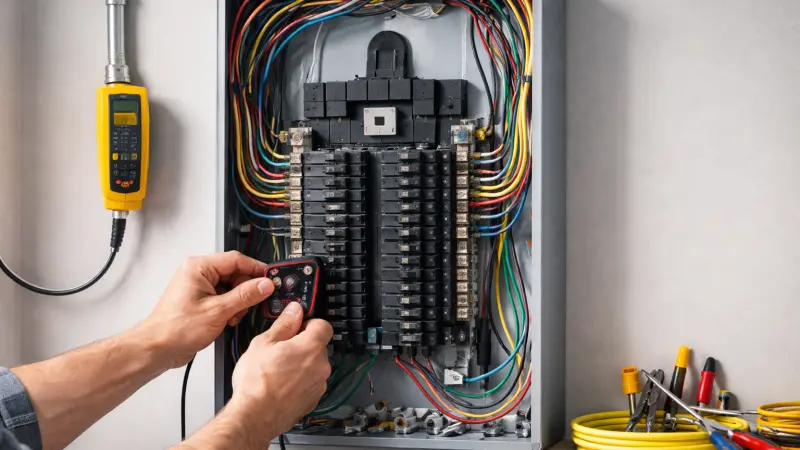
When you open the access door of a standard UK consumer unit, you
will typically see several distinct components arranged in a specific hierarchy:
- The Main Switch: This is the primary isolator. Turning this off cuts power to the entire property. It is your first port of call in an emergency or during major electrical works.
- Residual Current Devices (RCDs): These are life-saving devices designed to prevent electric shock. They monitor the balance of electricity between the live and neutral wires. If they detect a tiny leakage (usually 30mA), they trip in milliseconds.
- Miniature Circuit Breakers (MCBs): These protect the individual cables from being overloaded. For example, a lighting circuit usually has a 6A MCB, while a ring main for sockets typically uses a 32A breaker.
- Bus Bars: These are the copper strips hidden behind the breakers that carry the live current from the main switch to each individual circuit breaker.
Types of Circuit Breakers and Their Specific Roles
Not all breakers are created equal. Depending on the age of your installation and the specific needs of your home, you may find various types of protection installed. Understanding these is vital for any DIY enthusiast or property manager.
1. Single-Pole Miniature Circuit Breakers (MCBs)
In residential UK settings, these are the standard. They monitor the 'live' wire and trip if they detect an overload or a short circuit. They are categorized by "Types" (A, B, or C) based on their sensitivity to "inrush" current—the initial surge some appliances need to start up.
2. Residual Current Breaker with Overload (RCBO)
The RCBO is a sophisticated hybrid. It combines the functions of an MCB (overload protection) and an RCD (shock protection) into a single, narrow module. In modern premium installations, electricians prefer to use RCBOs for every individual circuit. This means that if a fault occurs in the toaster, only the kitchen socket circuit trips, leaving the rest of the house in the light.
3. Arc Fault Detection Devices (AFDDs)
Introduced more prominently in the 18th Edition, AFDDs are designed to detect "arcing"—small electrical sparks caused by loose connections or damaged insulation. Standard MCBs often fail to detect these, yet they are a leading cause of electrical fires in the home. AFDDs are now highly recommended for bedrooms and high-occupancy buildings (HMOs).
4. Surge Protection Devices (SPDs)
With the increasing amount of sensitive electronics in UK homes (smart TVs, laptops, EV chargers), SPDs have become essential. They protect your home from voltage spikes, whether caused by lightning strikes or switching transients on the grid.
The Importance of Grounding and Earth Bonding
Electricity always seeks the path of least resistance to return to its source or the earth. In a fault condition, a metal appliance casing could become "live." Without proper grounding (earthing), anyone touching that appliance would become the path to earth, resulting in a fatal shock.
Your electrical panel serves as the hub for the property's earthing system. All the green-and-yellow wires you see inside the unit are connected to an Earth Bar, which in turn is connected to the
physical ground via an earth rod or the provider's cable. This ensures that if a fault occurs, the current is safely diverted, triggering the breaker to trip instantly.
Common Electrical Panel Problems and Troubleshooting
Recognising the signs of a failing or overloaded electrical panel can save lives and prevent expensive repairs. Here are the most common issues encountered in UK households:
Frequent Tripping
If a breaker trips repeatedly, it is usually doing its job. It indicates either an overloaded circuit (too many appliances on one plug) or a "hard fault" (a short circuit). However, if an RCD trips, it could indicate "nuisance tripping" caused by moisture in outdoor lights or a faulty heating element in a dishwasher.
Buzzing or Humming Noises
A quiet hum is sometimes normal due to the vibration of the magnetic coils within the breakers. However, a loud buzzing or "crackling" sound is a red flag. It often indicates a loose connection on the bus bar or an internal mechanical failure, both of which generate heat and can lead to a fire.
Discolouration or Plastic Odours
If you notice a smell similar to "fish" or burning plastic near your consumer unit, or see brown scorching on the casing, you must isolate the power immediately. This is a clear sign of overheating, often caused by a loose terminal screw (thermal cycling) causing high resistance.
Upgrading Your Consumer Unit: What You Need to Know
Many UK homes still operate on "split-load" boards that do not meet current 18th Edition standards. While you are not legally required to upgrade your board just because the regulations
change, an upgrade is mandatory if you are carrying out significant renovation work or adding new circuits (such as an EV charger or an extension).
Why Upgrade?
- Enhanced Safety: New boards include RCD protection on all circuits, significantly reducing the risk of fatal shocks.
- Legal Compliance: A modern board with an Electrical Installation Certificate (EIC) is often a requirement for selling a property or for landlords' insurance.
- Capacity: Modern living requires more power. An upgrade allows for the safe integration of heat pumps, solar panels, and high-power appliances.
Types of Electrical Supply in the UK
The type of panel you need also depends on the incoming supply. In the UK, there are three primary earthing arrangements:
| System Type | Description | Common Usage |
|---|---|---|
| TNC-S (PME) | The earth and neutral are combined in the provider's cable. | Most modern urban residential properties. |
| TN-S | The provider provides a separate earth connection (usually the lead sheath of the cable). | Older urban properties. |
| TT | No earth is provided by the grid; the property relies entirely on a physical stake in the ground. | Rural properties and outbuildings. |
FAQ: Frequently Asked Questions
A: For homeowners, the IET recommends an Electrical Installation Condition Report (EICR) every 10 years. For rented properties, this is a legal requirement every 5 years or at the change of a tenancy.
A: While technically possible, it is highly discouraged. Working inside a live consumer unit is extremely dangerous. Furthermore, DIY replacement may invalidate your home insurance and violate Part P regulations.
A: A fuse protects the *cables* from catching fire by stopping overcurrent. An RCD protects *people* from electric shock by detecting tiny leakages of current to earth.
A: Lightning causes atmospheric surges that can trick highly sensitive RCDs into tripping. Installing a Surge Protection Device (SPD) can help mitigate this.
Conclusion The Backbone of Home Safety
The electrical panel is much more than a collection of switches; it is a sophisticated safety system designed to protect your property and your family from the inherent dangers of electricity.
By understanding how your consumer unit functions—from the historical roots of the fuse to the modern precision of RCBOs and AFDDs—you are better equipped to identify potential hazards before they escalate into emergencies.
Whether you are planning a DIY project, managing a commercial property, or simply curious about your home's infrastructure, always remember that electricity demands respect. Regular testing, professional inspections, and staying informed about current UK regulations are the best tools at your disposal for maintaining a safe, efficient, and reliable electrical system.