
Finding the Right Exam Calculator Top Picks for Academic Success
In the high-stakes environment of a 2026 examination hall, the difference between an 'A' and a 'B' often boils down to more than just mental math—it is about the efficiency of your tools. As curriculum standards for AP, SAT, and IB exams evolve to incorporate more complex data sets and multi-variable calculus, the humble calculator has transformed into a sophisticated computing engine. However, with this power comes a labyrinth of "Approved List" regulations that can disqualify a student before they even open their test booklet. Finding the right exam calculator is no longer just a trip to the stationery aisle; it is a strategic academic decision.
This article satisfies the "search intent" for students, educators, and parents who require a definitive, technical breakdown of current hardware. We move beyond basic reviews to explain how the 2026 generation of calculators integrates with digital testing platforms, which models offer the fastest processing for competitive exams, and how to stay compliant with international testing boards.
The Core Pillars: Precision, Compliance, and Performance
To secure academic success, one must understand the hardware tiers, the shift toward Python-integrated logic, and the rigorous standards of global testing bodies.
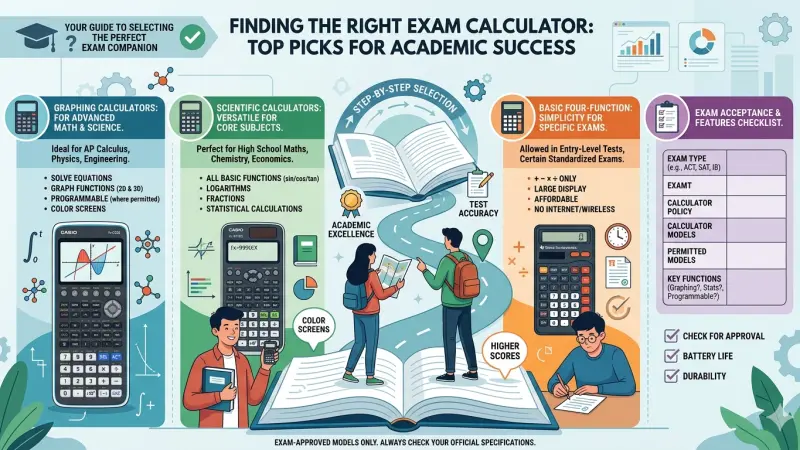
Pillar I: Understanding Hardware Tiers – Scientific vs. Graphing
The first step in academic strategy is selecting the correct "weight" of technology for your specific field of study.
-
Technical Breakdown: Scientific calculators are the workhorses of general education. They handle basic trigonometry, logarithms, and probability with multi-line displays that allow users to view previous calculations. Graphing calculators (like the TI-84 Plus CE or Casio fx-CG50) are effectively handheld computers. They offer high-resolution color screens, 3D plotting, and, in some cases, Computer Algebra Systems (CAS) that can manipulate symbolic variables ($x + x = 2x$) rather than just numerical values.
-
Current Trends (2026): We are seeing a "Processing Power Peak." The latest 2026 models now feature ARM-based processors that reduce the lag time for complex recursive functions by 40% compared to 2024 models. Furthermore, haptic feedback on keypresses is becoming a standard feature to reduce "input anxiety" during timed tests.
-
Strategic Advice: If you are a middle schooler or taking the ACT, stick to a high-end Scientific model (like the TI-30X Pro). The ACT has a stricter policy than the SAT regarding "advanced" features. For STEM-track university students, a Graphing model with Python capability is now the non-negotiable standard, as coding is increasingly integrated into math finals.
Pillar II: The "Approved List" Ecosystem – Navigating Regulation
A powerful calculator is a paperweight if a proctor confiscates it at the door.
-
Historical Context: For decades, the SAT and AP boards have maintained strict "No QWERTY" and "No Wi-Fi" rules to prevent cheating. In 2026, these rules have expanded to include "Deep Memory Clearance" (DMC) protocols. This ensures that students cannot store unauthorized "cheat sheets" in the notes application of their graphing calculators.
-
Data & Trends: Recent data suggests that 15% of testing delays are caused by students bringing CAS (Computer Algebra System) models to non-CAS permitted exams. The 2026 trend among manufacturers is the inclusion of "Exam Mode" LEDs—bright, external lights that blink to prove to proctors that all restricted programs and personal notes are locked out.
-
Actionable How-To: Always check the College Board or IBO website 48 hours before your exam. Look for the "Version Number" on your calculator’s backplate; some boards permit the TI-Nspire CX II but not the CAS version of the same model. Label your calculator with your name using a permanent engraver, as "calculator swapping" is a common issue in crowded testing centers.
Pillar III: Digital Integration – Calculators in the Hybrid Age
In 2026, the barrier between physical calculators and digital testing software is blurring.
-
Technical Breakdown: Many modern calculators now feature USB-C connectivity that allows for "Dual-Booting" into school-approved digital interfaces. This means a student can use their physical device to input data that appears instantly on their digital exam tablet.
-
Current Context: As exams move to tablets (Digital SAT), the "on-screen" Desmos calculator is becoming standard, but physical hardware remains preferred for tactile speed. Most 2026 exams allow you to sync your physical calculator's "History" to the digital exam portal to prevent transcription errors.
-
How-To for Readers: Practice "Keyboard Shortcuts." Many students waste 5–10 minutes per exam just navigating menus. Familiarizing yourself with the "Alpha-Shift" commands on a physical device is significantly faster than using a mouse or stylus on a screen-based calculator.
Advanced Insights: The "Hidden" Features for Competitive Edge
Generic AI often misses the nuance of how a student interacts with the device under pressure. Here is what the experts and top-performing students suggest.
The "Step-by-Step" Solver Myth
Many students buy CAS calculators thinking it will show them the "work" for a problem. In reality, most exam boards require human-generated steps. If you copy a calculator's symbolic output without understanding the intermediate logic, you risk zero credit on "Free Response" questions. Use the calculator to verify your answer, not to generate it.
The Power of Solver Functions
Most modern scientific calculators have a "Numeric Solver" hidden in the menus. This allows you to input an equation like $5x + 3 = 18$ and have the calculator find $x$ instantly. In a timed environment, using the solver for simple algebra can save 30 seconds per question—time that is better spent on complex word problems.
Custom Constants
If you are taking a Physics or Chemistry exam, check if your model allows for "User Constants." Storing the value of Planck's Constant or the Speed of
Light as a single-key shortcut ($K1$, $K2$) prevents the most common exam error: typing a digit wrong in a long scientific notation string.
The Psychology of Calculator Choice: Reducing Cognitive Load
When you are in the middle of a three-hour exam, your brain is under immense cognitive load. The "UX" (User Experience) of your calculator matters more than its raw processing power.
-
Tactile Reliability: Buttons should be plastic, not rubber. Rubber keys tend to "stick" or register double-taps as the device ages. Top picks like the TI-84 Plus CE use hard plastic keys with a distinct "click" that provides neurological confirmation of an entry.
-
Screen Contrast: In 2026, backlit screens are essential. Older models without backlights rely on ambient room lighting, which can vary wildly in gymnasiums or lecture halls, causing eye strain and slower reading times.
-
Menu Depth: A calculator that requires six button presses to find the "Square Root" function is a liability. Before buying, test the "Menu Depth" of common functions like Sine, Cosine, and Log. The more "top-level" buttons a calculator has, the better it is for speed-run testing.
Comparative Analysis: Top Models of 2026
| Feature | TI-84 Plus CE (2026 Ed.) | Casio fx-CG50 | HP Prime G2 | TI-30X Pro (Scientific) |
| Primary Audience | AP / SAT Students | STEM / IB Students | Engineering Majors | ACT / Middle School |
| Display Type | Backlit LCD (High Res) | Natural Textbook | Multi-Touch Screen | 4-Line Mono LCD |
| CAS Support | No (Safe for all) | No (Safe for all) | Yes (Check Rules) | No |
| Coding | Python | Python | HP PPL | None |
| Boot Time | 2 Seconds | Instant | 1 Second | Instant |
| Price Tier | Premium ($120+) | Mid-Range ($80-90) | High-End ($150+) | Budget ($30-40) |
Maintenance and Troubleshooting in the Final Hour
Nothing is more terrifying than a "Low Battery" warning or a "Syntax Error" during the last ten minutes of a final.
-
The Hard Reset: Know the physical "pinhole" reset location. If the software freezes (rare but possible with Python scripts), a paperclip reset is the only way to recover mid-exam.
-
Screen Brightness Management: Lowering your brightness to 50% can extend battery life by nearly 300%. If you forgot to charge, this is your best defense.
-
ROM Updates: Manufacturers release firmware patches. A "buggy" OS can lead to slow graphing or incorrect rounding. Check for updates at the start of every semester.
Detailed FAQs
-
What is the best calculator for the SAT in 2026? The TI-84 Plus CE remains the gold standard for reliability and board approval.
-
Can I use a CAS calculator on the ACT? No. The ACT strictly prohibits calculators with Computer Algebra Systems.
-
What does "Natural Textbook Display" mean? It means the calculator shows fractions and square roots exactly as they appear in your textbook ($1/2$ looks like a vertical fraction, not $1 / 2$).
-
Do I need Python on my calculator? For 2026 STEM curricula, yes. It is frequently used for data science and basic algorithm testing in class.
-
Is the TI-Nspire allowed on the IB exams? The non-CAS version is allowed, but it must be in "Press-to-Test" mode with the light blinking.
-
How do I clear my calculator for an exam? Usually, it is
2nd->Mem->Reset. -
Which calculator has the longest battery life? Scientific calculators (non-graphing) can last years. Graphing models usually last 1-2 weeks per charge.
-
Can I use my phone's calculator app? No. Phones are prohibited due to communication capabilities.
-
What is the best budget graphing calculator? The Casio fx-9750GIII is the best "bang for your buck" model in 2026.
-
Is the HP Prime G2 worth it? Only for university-level engineering where the touch screen is helpful for 3D modeling.
-
Are 3D graphing features allowed? Yes, in most advanced math exams.
-
Why are TI calculators so expensive? High demand, testing board certifications, and long-term software support.
-
How do I update my calculator's OS? Use the manufacturer's desktop software and a USB-C cable.
-
What is "Reverse Polish Notation" (RPN)? A logic system (found in HP) that removes parentheses. It's faster but very hard to learn.
-
Can a calculator be used for SAT Reading? No, only during the designated Math sections.
Calculating Your Path to Success
As we navigate the academic landscape of 2026, the calculator remains the most vital bridge between theoretical knowledge and practical results. Choosing the right device is not about finding the most expensive model, but the one that aligns with your specific exam board's rules and your personal workflow.
A student who masters their TI-84 is far more dangerous in an exam hall than a student who is confused by a top-of-the-line HP Prime.
Academic success in the modern era is a combination of mental agility and technical proficiency. By selecting a tool that minimizes your stress and maximizes your speed, you turn a potential obstacle into a powerful ally.
Disclaimer: The information provided in this article is for general informational and research purposes only. Company details, features, services, and market positions may change over time. Readers are advised to visit official company websites and conduct independent research before making any business decisions or purchasing services.
Most Searchable Keywords
Recent Blogs


Categories
- Accountants (295)
- Advertising Agencies (559)
- Architects (149)
- Automobiles (377)
- Beauty (300)
- Carpenters (146)
- Cleaning Services (387)
- Dentists (189)
- Driving (62)
- Education (1)
- Electricians (215)
- Energy (8)
- Event Organiser (689)
- Finance (602)
- Guide (3492)
- Health (2207)
- Information technology (207)
- Legal Services (361)
- Logistics (6)
- Maintenance (65)
Sponsored Listings in Educational Services

Related Blogs

Creamfields Daresbury: Impact on Local Reside...
Read this insightful article "Creamfields Daresbury: Impact on Local Residents" to expand your knowledge!

UK High Street Businesses in 2026-27: Which S...
Read this insightful article "UK High Street Businesses in 2026-27: Which Sectors Are Growing?" to expand your knowledge!

Why Complete Business Listings Matter More Th...
Read this insightful article "Why Complete Business Listings Matter More Than You Think" to expand your knowledge!
Questions & Answers – Find What You Need, Instantly!
Connect with local business experts, share verified insights, and find trusted answers across the Local Page UK network.
Ask Community
Ask questions to the Local Page UK community
Share Knowledge
Share your knowledge to help out others
Find Solutions
Find answers or offer instant solutions
Some of the most popular fantasy TV shows include "Game of Thrones," known for its epic battles and political intrigue, "The Witcher," which features monster hunting and magic, and "Stranger Things," blending supernatural elements with 1980s nostalgia. Other notable mentions are "His Dark Materials," "Shadow and Bone," and "The Mandalorian," each offering unique worlds and captivating storytelling that have garnered large fan bases.
When seeking bathroom renovation providers that handle both plumbing and tiling, it's advisable to look for licensed contractors who specialize in comprehensive bathroom remodels. Companies such as Home Depot, Lowe's, and Bath Fitter offer these services, often providing a seamless experience by managing all aspects of the renovation process. Additionally, local contractors with positive reviews in platforms like Angie's List or Houzz may also offer tailored solutions for your bathroom needs.
Absolutely, there are several distributors that supply crash mats and soft play equipment to gymnastics clubs in and around Birmingham. National companies like Gymnova, S & G (Spieth Gymnastics), and Jaques of London offer a wide range of crash mats, foam pits, and soft play pieces, and they typically deliver to the Birmingham area. For more local options, you might try The Gym Equipment Company, which has a showroom in the West Midlands, or check out smaller specialist suppliers like Playtime UK. Many of these distributors cater specifically to clubs, offering high-density foam mats that meet safety standards. I'd recommend reaching out to a few to compare pricing, delivery times, and whether they offer custom sizes or installation services. It's also worth checking if any of them have a physical showroom near Birmingham so you can test the equipment before buying. Happy tumbling!
For professionals seeking a reliable sanitaryware supplier in Manchester with trade account facilities, several established merchants combine extensive product ranges, competitive pricing, and dedicated trade support. The most reputable option is Graham Plumbers Merchant, which operates multiple branches across Manchester, including Salford Quays and Oldham. They offer a dedicated trade account service with preferential pricing, priority delivery scheduling, and access to a vast inventory of leading sanitaryware brands such as Villeroy & Boch, Duravit, Ideal Standard, and Roca. Their trade accounts typically include net 30-day payment terms, online account management, and a tailored project quotation system. Similarly, City Plumbing Supplies has several Manchester-based depots (such as Ashton-under-Lyne and Stockport) that cater specifically to trade customers, providing a rapid order-and-collect service, trade-only promotions, and a loyalty programme offering rebates on repeat purchases. Their product range covers everything from basins and WCs to complete bathroom suites and brassware, with in-house technical advisors available for specification support. Another key player is Plumb Center, part of the Wolseley Group, which offers trade accounts with bespoke pricing structures, direct-to-site deliveries within the Greater Manchester area, and access to over 10,000 lines of sanitaryware, including premium brands like Grohe and Hansgrohe. Their trade portal allows for real-time stock checking and order history tracking, facilitating efficient project management. For those seeking a more specialist or high-end option, Bathroom Spares in Manchester provides trade accounts with a focus on hard-to-find sanitaryware and discontinued ranges, which can be invaluable for refurbishment projects. Additionally, independent merchants such as M&B Plumbase in Trafford Park offer flexible trade terms, personalised service, and competitive pricing on both mainstream and luxury sanitaryware. When evaluating suppliers, trade customers should consider factors beyond price: reliability of stock availability, delivery timescales within Manchester’s often congested zones, clarity of returns policies, and the quality of after-sales support for warranty claims. It is advisable to request a trade account application from at least two to three suppliers to compare discounts, minimum order values, and payment terms. Many suppliers also offer showroom access for trade clients, allowing you to inspect finishes and dimensions before committing to large orders. For ongoing projects, establishing a relationship with a single supplier who offers consolidated invoicing and dedicated account management can streamline procurement. Ultimately, the most reliable supplier for your trade account in Manchester will be one that aligns with your volume requirements, preferred brands, and service expectations, so a site visit to their local branch and a discussion about your specific trade needs is highly recommended before committing to an account.
People in Leeds are loving their local florists—customers often mention gorgeous, fresh arrangements and super friendly service. Many rave about reliable same-day delivery and creative wedding bouquets. A few note pricing can vary, but overall, the buzz is all about quality and that personal touch making every order feel special.
Common problems for commercial gardening in Bristol include weed overgrowth, soil degradation, pest infestations, and irrigation malfunctions. Additionally, managing seasonal transitions, adhering to sustainability regulations, and maintaining consistent aesthetics pose significant challenges. Expert services mitigate these via structured maintenance, integrated pest management, and soil analysis to ensure long-term landscape health.