
High Income Child Benefit Charge: The Salary Trap That Catches Parents
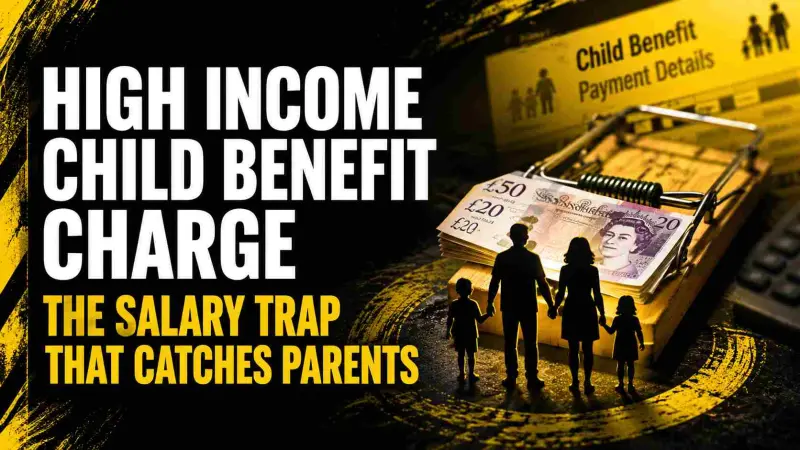
A pay rise can leave you better off — but for some parents, crossing the £60,000 income threshold can also trigger an unexpected tax bill.
The High Income Child Benefit Charge (HICBC) applies when an individual’s adjusted net income is above £60,000 and they or their partner receive Child Benefit. The charge gradually increases as income rises and can effectively claw back some or all of the Child Benefit received.
That does not mean families earning more than £60,000 automatically lose their Child Benefit. Instead, the higher earner may have to repay some or all of its value through the tax system.
For the 2026/27 tax year, Child Benefit is £27.05 a week for an eldest or only child and £17.90 a week for each additional child. That works out at £1,406.60 a year for one eldest or only child, plus £930.80 for each additional child.
The important point is that the charge is based on adjusted net income, not simply the salary printed on your payslip.
That distinction is where many parents get caught.
How the High Income Child Benefit Charge Works and Why a Pay Rise Can Create a Tax Bill
What is the High Income Child Benefit Charge?
The High Income Child Benefit Charge is an additional tax charge applied to certain people with higher incomes who are connected to a Child Benefit claim.
For the 2026/27 tax year, the charge starts when an individual's adjusted net income is above £60,000. It applies up to £80,000, at which point the charge can recover the full amount of Child Benefit received. HMRC's Child Benefit tax calculator confirms the £60,000 threshold applies for the 2024/25, 2025/26 and 2026/27 tax years.
The charge is not based on the combined household salary.
Instead, HMRC looks at each individual's adjusted net income and identifies the higher earner where both partners are involved.
This creates an important rule:
A household can have a combined income well above £80,000 without the charge necessarily applying, while a household with one person earning just over £60,000 can face it.
The identity of the person receiving Child Benefit does not necessarily determine who pays the charge.
How much is Child Benefit worth in 2026/27?
From 6 April 2026, Child Benefit rates are:
| Child | Weekly rate | Approximate annual amount |
|---|---|---|
| Eldest or only child | £27.05 | £1,406.60 |
| Each additional child | £17.90 | £930.80 |
These are the confirmed 2026/27 rates published by HMRC.
For example, a family with two children could receive:
£27.05 + £17.90 = £44.95 per week
Across a full year, that is approximately £2,337.40.
That amount is significant enough that parents should not assume the benefit is irrelevant simply because one person earns more than £60,000.
Why does the £60,000 threshold matter?
The £60,000 figure is the starting point for the High Income Child Benefit Charge for 2026/27.
Once adjusted net income rises above that level, the charge increases progressively.
The charge is designed to recover 1% of Child Benefit for every £200 of adjusted net income above £60,000.
That means the charge does not suddenly equal the entire Child Benefit as soon as you earn £60,001.
Instead, it builds gradually.
For example, if your adjusted net income is £62,000, you are £2,000 above the threshold.
£2,000 ÷ £200 = 10%.
So the charge would generally equal 10% of the Child Benefit received.
If your adjusted net income reaches £80,000, you are £20,000 above the threshold.
£20,000 ÷ £200 = 100%.
At that point, the full Child Benefit amount can be recovered through the charge.
Is it your salary or your adjusted net income that matters?
This is one of the most important distinctions to understand.
The High Income Child Benefit Charge uses adjusted net income, rather than simply your gross employment salary.
HMRC says adjusted net income can include taxable benefits received through employment, such as a company car or medical insurance.
It can also be affected by certain forms of income and deductions.
This means someone with a £61,000 salary does not necessarily have exactly £61,000 of adjusted net income.
Equally, someone whose salary is below £60,000 could potentially exceed the threshold once other taxable income is taken into account.
What can reduce adjusted net income?
Certain deductions can reduce adjusted net income.
One particularly important example is pension contributions that qualify for the relevant tax treatment.
Gift Aid donations can also affect the calculation.
This can make a difference for someone who is close to the £60,000 threshold.
Imagine a parent has adjusted net income of £63,000 before an eligible pension contribution. If the contribution reduces adjusted net income sufficiently, the parent may reduce the amount subject to the High Income Child Benefit Charge.
However, the calculation can be more complicated than simply taking the pension contribution away from salary. The tax treatment depends on how contributions are made and the individual's circumstances.
For a borderline case, it is sensible to use HMRC's calculator or obtain professional tax advice rather than relying on a rough calculation.
Does the higher earner always pay the charge?
Generally, the charge applies to the person with the higher adjusted net income where both partners have relevant income above the threshold.
HMRC explains that where a partner also has adjusted net income above £60,000, the partner with the higher adjusted net income is responsible for the charge.
Consider this example:
- Parent A earns £64,000.
- Parent B earns £48,000.
- Parent B receives Child Benefit.
Parent A may still be responsible for the High Income Child Benefit Charge because Parent A is the higher earner.
Now consider:
- Parent A earns £58,000.
- Parent B earns £65,000.
- Parent B does not receive the Child Benefit payment directly.
Parent B can still be the person liable for the charge.
The key issue is the income of the individuals and the Child Benefit entitlement, rather than simply whose bank account receives the payment.
What happens if one parent earns £60,000 and the other earns £30,000?
If the relevant individual's adjusted net income is £60,000 or below, the High Income Child Benefit Charge does not apply.
The threshold is exceeded only when adjusted net income goes above £60,000.
That makes the £60,000 figure particularly important for parents approaching the threshold.
But do not rely on gross salary alone.
A bonus, taxable benefit, investment income or other taxable income could change the calculation.
What happens when your salary rises during the tax year?
This is where the "salary trap" becomes particularly relevant.
The charge is assessed by reference to the tax year, which runs from 6 April to 5 April.
Suppose someone starts the tax year earning £58,000 but receives a promotion and bonus that pushes their adjusted net income above £60,000.
They may suddenly become liable for the High Income Child Benefit Charge for that tax year.
The charge is not simply based on the salary level on the day they receive the promotion.
The overall income for the tax year matters.
This is why parents should revisit their position after:
- A promotion
- A significant pay rise
- A large annual bonus
- Starting a second job
- Receiving taxable employment benefits
- Taking on rental or investment income
- Changes to pension contributions
- Changes to a partner's income
Can two parents earning £50,000 each trigger the charge?
Not simply because their combined income is £100,000.
The charge is based on individual adjusted net income, not household income.
If both parents have adjusted net income of £50,000, neither is above the £60,000 threshold.
This is one of the most common misunderstandings surrounding the scheme.
A household's combined income can be substantially higher than £60,000 without the charge applying.
Can a single parent earning £65,000 be affected?
Yes.
If the parent is responsible for a Child Benefit claim and has adjusted net income of £65,000, the High Income Child Benefit Charge may apply.
The fact that there is no partner does not remove the income threshold.
The calculation depends on the individual's adjusted net income and the amount of Child Benefit received.
How much could you have to repay?
The amount depends on two factors:
- How far your adjusted net income is above £60,000.
- How much Child Benefit your family receives.
The basic calculation for 2026/27 can be expressed as:
Adjusted net income above £60,000 ÷ £200 = percentage of Child Benefit subject to the charge
For example:
| Adjusted net income | Amount above £60,000 | Approx. percentage charged |
| £60,000 | £0 | 0% |
| £62,000 | £2,000 | 10% |
| £64,000 | £4,000 | 20% |
| £66,000 | £6,000 | 30% |
| £70,000 | £10,000 | 50% |
| £75,000 | £15,000 | 75% |
| £80,000 | £20,000 | 100% |
The percentage is applied to the Child Benefit received.
So two families with exactly the same income can face different charges if they receive different amounts of Child Benefit.
Example: one child
Suppose a parent receives Child Benefit for one eldest or only child during the full 2026/27 tax year.
The annual amount is £1,406.60.
If adjusted net income is £70,000, the parent is £10,000 over the £60,000 threshold.
£10,000 ÷ £200 = 50%.
The potential charge would therefore be around £703.30, assuming the full annual Child Benefit amount applies.
The parent would retain the remaining economic value of the Child Benefit after the charge.
Example: two children
Now consider a family receiving £2,337.40 in annual Child Benefit for two children.
If the higher earner's adjusted net income is £70,000, the charge would be approximately 50% of the Child Benefit.
That is around £1,168.70.
The calculation becomes more noticeable as the number of children increases because the underlying Child Benefit payment is larger.
Why do some parents opt out of Child Benefit payments?
Parents who know they will face the full charge sometimes choose to opt out of receiving Child Benefit payments.
But opting out of payments is not necessarily the same as giving up the Child Benefit claim entirely.
This distinction matters because a Child Benefit claim can provide access to National Insurance credits, which can help protect entitlement to the State Pension for someone who is not paying enough National Insurance through work.
For families with a non-working parent or a parent with low earnings, that can be an important consideration.
Before opting out, parents should therefore consider more than just the immediate cash payment.
Can you keep Child Benefit and pay the tax charge instead?
Yes.
You do not necessarily have to stop receiving Child Benefit simply because the charge applies.
One option is to continue receiving the benefit and pay the corresponding tax charge.
Another option is to opt out of receiving payments.
The right choice depends on the household's circumstances, including income, National Insurance records and whether income is likely to change.
HMRC also allows people who previously opted out to restart their Child Benefit payments.
How do you pay the High Income Child Benefit Charge?
Historically, many people dealt with the charge through Self Assessment.
There is now also a PAYE route for eligible people.
HMRC says that from the 2025/26 tax year onwards, someone who does not need to submit a tax return for another reason may be able to pay the charge through PAYE. The PAYE option is available where the relevant deadline conditions are met.
This can be useful for employees who would otherwise have to complete Self Assessment solely because of the Child Benefit charge.
HMRC has also introduced a digital service designed to make payment through salary easier.
If you are already required to complete a tax return for another reason, such as self-employment, the charge generally needs to be dealt with through Self Assessment.
What is the Self Assessment deadline?
For the 2025/26 tax year, the deadline for filing the online Self Assessment return and paying any remaining tax due is 31 January 2027.
Do not leave the calculation until the final few days.
If your income changed significantly during the year, gathering information early can help you identify whether you owe a charge and how much you may need to pay.
Can HMRC calculate the charge automatically?
HMRC has been making changes to simplify the process.
From July 2026, HMRC began pre-populating Child Benefit information for some Self Assessment customers, including information about Child Benefit payments connected with the return.
However, taxpayers remain responsible for checking their tax return.
Pre-populated information should be reviewed rather than blindly accepted.
If your family circumstances changed, the Child Benefit dates or payment information may need attention.
What if your income changes during the year?
Do not assume that the charge will stay the same.
If your adjusted net income falls below £60,000 for the relevant tax year, the charge does not apply.
HMRC confirms that you can opt out of or restart Child Benefit payments when circumstances change.
For example, a parent might receive a large bonus one year and fall below the threshold the following year.
The correct approach should therefore be based on each tax year's actual circumstances.
What common mistakes should parents avoid?
The biggest mistakes are often simple ones.
Mistake 1: Looking only at basic salary
Your adjusted net income can differ from your salary.
Check the full income calculation rather than assuming the number on your employment contract is the figure HMRC will use.
Mistake 2: Thinking household income is used
The charge is based on individual adjusted net income.
A couple earning £55,000 each is not treated in the same way as one person earning £110,000.
Mistake 3: Cancelling Child Benefit immediately
Before opting out, consider National Insurance credits and the wider consequences of ending or stopping payments.
Mistake 4: Forgetting bonuses
A one-off bonus can push adjusted net income above £60,000.
This is particularly easy to miss when someone normally earns below the threshold.
Mistake 5: Ignoring pension contributions
For people close to the threshold, eligible pension contributions can affect adjusted net income.
The exact tax treatment should be checked carefully.
Mistake 6: Assuming the charge starts at 100%
It does not.
The charge increases progressively between £60,000 and £80,000.
What should you do if you are close to £60,000?
If your income is hovering around the threshold, take a proactive approach.
Start by estimating your full-year adjusted net income.
Then check:
- Expected salary
- Bonuses
- Taxable benefits
- Savings and investment income
- Other taxable income
- Eligible pension contributions
- Gift Aid donations
- Child Benefit received
HMRC provides a Child Benefit tax calculator that can estimate both the amount of Child Benefit and the potential High Income Child Benefit Charge.
A calculation made early in the tax year gives you more opportunity to plan.
Could pension contributions help avoid or reduce the charge?
Potentially, yes.
If pension contributions reduce adjusted net income, they can reduce the income figure used for the High Income Child Benefit Charge.
For example, someone whose adjusted net income would otherwise be £65,000 may be able to reduce that figure through eligible pension contributions.
But pension planning should not be done solely to avoid the Child Benefit charge.
A pension contribution involves putting money aside for retirement, and the appropriate amount depends on the person's broader financial position.
For larger contributions or complicated income situations, professional advice can be worthwhile.
What happens if your partner's income is higher?
The higher-income partner can become liable for the charge even when the other partner receives the Child Benefit.
This is especially relevant when couples have different salaries.
A change in either partner's income can therefore alter who is responsible for the charge.
If you separate, move in together or otherwise change your family circumstances, HMRC should be updated where necessary.
What happens if you separate from your partner?
Family changes can affect Child Benefit entitlement and responsibility for the tax charge.
HMRC's guidance covers circumstances where families split up or join together, including which person receives Child Benefit.
Do not assume the previous arrangement automatically remains correct after a separation.
Check the Child Benefit claim and the income position for the relevant tax year.
What about teenagers aged 16 or over?
Child Benefit can continue for certain young people aged 16 to 19 if they remain in qualifying full-time non-advanced education or approved unpaid training.
HMRC highlighted in 2026 that parents should make sure HMRC knows when a teenager begins a new qualifying course or training arrangement.
This matters because continued Child Benefit can also mean continued exposure to the High Income Child Benefit Charge if the relevant parent is above the income threshold.
What is likely to change in the future?
The Child Benefit system is already being administered through increasingly digital processes.
HMRC has introduced a digital route for eligible taxpayers to deal with the High Income Child Benefit Charge through PAYE, while Child Benefit information is also being incorporated into parts of the Self Assessment process.
For parents, the practical lesson is straightforward: keep income and Child Benefit records accurate throughout the year rather than treating the charge as something to resolve only when a tax return arrives.
Future tax policy could change thresholds, rates or administration, so parents should check current HMRC guidance for the relevant tax year before making decisions.
What is the smartest approach for parents?
There is no single best option for every household.
A sensible process is:
- Check whether you receive Child Benefit.
- Calculate your expected adjusted net income.
- Check whether it exceeds £60,000.
- Estimate the percentage of Child Benefit subject to the charge.
- Consider legitimate ways of managing adjusted net income, such as eligible pension contributions where appropriate.
- Decide whether to continue receiving Child Benefit or opt out of payments.
- Consider National Insurance credit implications before opting out.
- Use HMRC's calculator to check the figures.
- Choose PAYE or Self Assessment where you are eligible.
- Recheck the calculation if your income changes.
The biggest benefit of this approach is predictability.
Instead of discovering an unexpected tax liability after the end of the year, you can understand the likely position much earlier.
Why the "salary trap" catches parents
The problem is not really the £60,000 number by itself.
It is the fact that income can change without parents immediately connecting that change to Child Benefit.
A promotion may look like a straightforward financial win.
A bonus may feel like extra money for a successful year.
A company car or other taxable benefit may not feel like cash income at all.
Yet these changes can affect adjusted net income.
At the same time, Child Benefit continues to arrive in the household bank account, which can make it easy to forget that a tax charge may be accumulating in the background.
That is why parents approaching the threshold should think about total adjusted net income, not just monthly take-home pay.
The tax system does not necessarily penalise the entire pay rise. Instead, it gradually increases the amount of Child Benefit recovered as income moves above £60,000.
Understanding that mechanism removes much of the surprise.
Key Insights
- The High Income Child Benefit Charge starts above £60,000 of adjusted net income for the 2026/27 tax year.
- The charge rises gradually, rather than taking away all Child Benefit immediately.
- At £80,000 adjusted net income, the charge can recover 100% of Child Benefit received.
- Household income is not the deciding figure; individual adjusted net income is what matters.
- Bonuses, taxable benefits and other income can push someone over the threshold, even when their basic salary appears below it.
- Pension contributions may reduce adjusted net income in appropriate circumstances.
- Opting out of Child Benefit payments should not be an automatic reaction, because National Insurance credits may matter.
- Eligible taxpayers may now be able to pay the charge through PAYE rather than completing Self Assessment solely for this reason.
Frequently Asked Questions
What is the High Income Child Benefit Charge?
It is an additional tax charge for people with adjusted net income above the relevant threshold who are connected with a Child Benefit claim. For 2026/27, the charge begins above £60,000 and can reach the full Child Benefit amount at £80,000.
How much can I earn before Child Benefit is taxed?
For 2026/27, the High Income Child Benefit Charge starts when an individual's adjusted net income is above £60,000. The calculation is based on adjusted net income rather than simply gross salary.
Do I lose Child Benefit if I earn over £60,000?
No. You can continue receiving Child Benefit, but you may have to pay some or all of it back through the High Income Child Benefit Charge. The amount increases as adjusted net income rises.
Do both parents' salaries count toward the £60,000 limit?
No. The charge is based on individual adjusted net income. Where both partners have income above £60,000, the higher earner is generally responsible for the charge.
What happens if I earn exactly £60,000?
If your adjusted net income is £60,000 or below, the High Income Child Benefit Charge does not apply. The charge begins once adjusted net income goes above £60,000.
What happens when I earn £70,000?
At £70,000 adjusted net income, you are £10,000 above the £60,000 threshold. Under the 1%-per-£200 calculation, approximately 50% of your Child Benefit can be subject to the charge.
What happens when I earn £80,000?
At £80,000 adjusted net income, you are £20,000 above the £60,000 threshold. This corresponds to 100% of the Child Benefit received being subject to the charge.
Can pension contributions reduce the Child Benefit tax charge?
They can potentially reduce adjusted net income when they qualify for the relevant tax treatment. This can reduce or eliminate the charge for some people, but individual circumstances and the method of making contributions matter.
Should I stop claiming Child Benefit if I earn over £60,000?
Not necessarily. You can consider opting out of payments, but Child Benefit can also provide National Insurance credits. Check the consequences before deciding to stop payments.
Can I keep Child Benefit and pay the tax instead?
Yes. Many parents continue receiving Child Benefit and deal with the resulting tax charge. Depending on circumstances, payment may be made through Self Assessment or, for eligible people, through PAYE.
Can I pay the High Income Child Benefit Charge through PAYE?
Yes, if you meet HMRC's conditions. For eligible people who do not need Self Assessment for another reason, HMRC allows the charge to be collected through PAYE for relevant tax years.
What is adjusted net income?
Adjusted net income is the income figure HMRC uses for several tax purposes. It is not necessarily the same as gross salary because taxable benefits and certain deductions can affect the calculation.
Can a bonus trigger the High Income Child Benefit Charge?
Yes. A bonus can increase your adjusted net income enough to take you above £60,000. This is why parents should estimate their full-year income rather than relying only on their regular monthly salary.
What if my income falls below £60,000 again?
If your adjusted net income for the tax year is below the threshold, the High Income Child Benefit Charge does not apply for that year. HMRC advises checking your circumstances and updating arrangements when income changes.
Where can I calculate my Child Benefit tax charge?
HMRC provides an official Child Benefit tax calculator that can estimate the Child Benefit received and the potential High Income Child Benefit Charge.
Final Thoughts
The High Income Child Benefit Charge is easy to misunderstand because the headline figure — £60,000 — does not tell the whole story.
The real calculation depends on adjusted net income, the amount of Child Benefit your family receives and how far your income is above the threshold.
For 2026/27, Child Benefit itself has increased to £27.05 a week for an eldest or only child and £17.90 for each additional child. That makes understanding the tax charge more relevant for families whose earnings are approaching or exceeding £60,000.
If you have recently received a pay rise, expect a bonus or receive taxable employment benefits, check your projected adjusted net income rather than waiting for a tax bill.
And if you are considering opting out of Child Benefit, look beyond the immediate payment.
National Insurance credits and your longer-term entitlement can also matter.
The safest approach is to calculate the position for each tax year, keep your Child Benefit records up to date and use HMRC's current calculator and guidance before making a decision.
Disclaimer: The information provided in this article is for general informational and research purposes only. Company details, features, services, and market positions may change over time. Readers are advised to visit official company websites and conduct independent research before making any business decisions or purchasing services.
Most Searchable Keywords
Recent Blogs


Related Listings

Categories
- Accountants (295)
- Advertising Agencies (559)
- Architects (149)
- Automobiles (377)
- Beauty (300)
- Carpenters (146)
- Cleaning Services (387)
- Dentists (189)
- Driving (62)
- Education (1)
- Electricians (215)
- Energy (8)
- Event Organiser (687)
- Finance (602)
- Guide (3394)
- Health (2207)
- Information technology (206)
- Legal Services (361)
- Logistics (6)
- Maintenance (65)
Sponsored Listings in Shopping

Related Blogs
High Income Child Benefit Charge: The Salary...
Read this insightful article "High Income Child Benefit Charge: The Salary Trap That Catches Parents" to expand your knowledge!
Carer’s Allowance £204 Earnings Limit Explain...
Read this insightful article "Carer’s Allowance £204 Earnings Limit Explained" to expand your knowledge!

Attendance Allowance: How to Claim Up to £114...
Read this insightful article "Attendance Allowance: How to Claim Up to £114.60 a Week" to expand your knowledge!
Questions & Answers – Find What
You Need, Instantly!
How can I update my business listing?
Is it free to manage my business listing?
How long does it take for my updates to reflect?
Why is it important to keep my listing updated?
