
Cold Weather Payment £25: Postcodes & Payment Dates
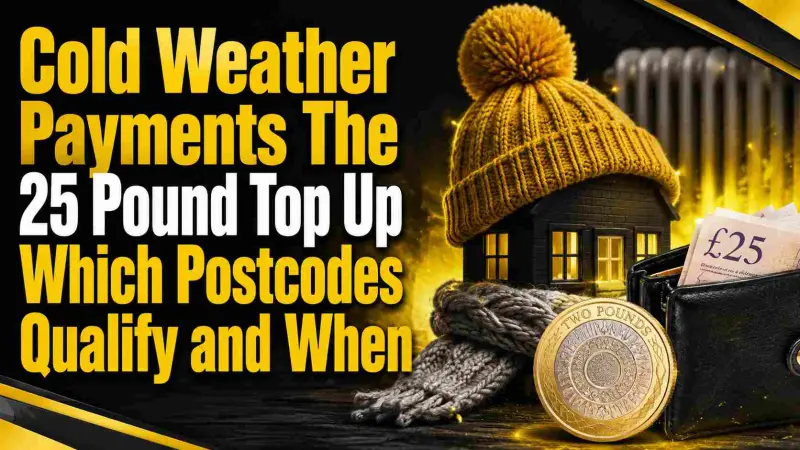
A £25 Cold Weather Payment can make a useful difference when heating costs rise during a prolonged cold spell. The scheme is designed to provide extra support to people receiving certain benefits when the temperature in their local area falls to a qualifying level.
For winter 2026–27, the government has confirmed that Cold Weather Payments will return from 1 November 2026 to 31 March 2027. Eligible people can receive £25 for each qualifying seven-day period when the average temperature in the area is recorded as, or forecast to be, 0°C or below. Payments are normally made automatically, so there is no standard application form to complete.
But there is an important detail behind the phrase “which postcodes qualify?” There is not a simple list of postcodes that permanently qualify for £25. Instead, residential postcodes are linked to weather stations. If the weather station covering your postcode records or forecasts a qualifying cold spell, eligible benefit recipients in that coverage area can receive the payment.
This guide explains who can qualify, how the postcode system works, when the £25 is paid, what happens in Scotland and Northern Ireland, why you might not receive a payment, and how Cold Weather Payments differ from other winter support such as Winter Fuel Payment and the Warm Home Discount.
Cold Weather Payments: How the £25 Top Up Works, Which Postcodes Qualify and When You’ll Be Paid
What is a Cold Weather Payment?
A Cold Weather Payment is a £25 payment for eligible benefit recipients during a qualifying period of very cold weather.
For the 2026–27 winter season, the government says the scheme will operate from 1 November 2026 through 31 March 2027. A £25 payment can be triggered when the average temperature in the relevant area is recorded as, or forecast to be, 0°C or below for seven consecutive days.
The payment is intended to help with additional heating costs during particularly cold weather. It is separate from your normal benefit payment and does not reduce your other benefits.
There is also no general rule saying that everybody living in a cold postcode receives £25. You must satisfy both sides of the test:
- You must be receiving a qualifying benefit or Support for Mortgage Interest under the applicable rules.
- The weather station covering your residential postcode must trigger a Cold Weather Payment.
That distinction is important because someone living in exactly the same town as you could receive the payment while you do not, depending on their benefit circumstances.
Who can get the £25 Cold Weather Payment?
The main qualifying groups include people receiving Pension Credit, income-related Employment and Support Allowance, Universal Credit or Support for Mortgage Interest, subject to the detailed eligibility conditions for each benefit.
The DWP's latest published technical methodology also identifies certain people receiving legacy benefits such as Income Support and income-based Jobseeker's Allowance as potentially eligible, depending on their circumstances.
Pension Credit
People receiving Pension Credit will usually qualify for Cold Weather Payments.
This is one of the clearest routes into the scheme. If you receive Pension Credit and the weather station covering your home triggers a qualifying period, the £25 payment should normally be issued automatically.
Universal Credit
Universal Credit eligibility is more conditional.
You will usually qualify where the relevant Universal Credit conditions are satisfied. The government currently states that you and your partner, if you have one, must generally not be employed or gainfully self-employed, and one of the required circumstances must apply.
These can include:
- You or your partner having a health condition or disability resulting in limited capability for work.
- Having a child under five living with you.
- Having a disabled child amount included in your Universal Credit claim.
There are specific rules around employment and self-employment, so simply receiving Universal Credit does not automatically mean that you will receive a Cold Weather Payment.
Income-related ESA
People receiving income-related ESA may qualify.
For example, the government says you will usually qualify if you are in the work-related activity group or support group. Other circumstances can also create eligibility, including certain disability or pensioner premiums, having a disabled child or having a child under five living with you.
Support for Mortgage Interest
Support for Mortgage Interest recipients may also qualify when the additional eligibility conditions are met.
The rules can involve circumstances such as a severe or enhanced disability premium, a pensioner premium, having a disabled child or having a child under five living with you.
Do you have to apply for the £25 payment?
No. Cold Weather Payments are normally automatic.
If you are eligible and the weather station covering your postcode triggers, the payment should be processed without you submitting a separate Cold Weather Payment application.
There is, however, an important exception involving changes in family circumstances.
If you receive Universal Credit or income-related ESA and have a baby or a child under five comes to live with you, you should report the change to the relevant benefit service. If the government does not have the correct information about your household, you may not automatically be identified as eligible.
How do postcodes determine who gets a Cold Weather Payment?
This is where many people misunderstand the scheme.
Your postcode does not qualify for a payment simply because it is listed as a “cold postcode”.
Instead, the DWP uses a postcode-to-weather-station system. The latest published methodology for England and Wales says residential postcodes are linked to one of 71 weather stations used for the scheme. The Met Office provides temperature information, and the DWP uses those results to determine whether a weather station has triggered.
The process broadly works like this:
- Your residential postcode is linked to a designated weather station.
- The weather station records daily average temperatures.
- The system examines seven-day temperature periods and forecasts.
- If the relevant seven-day average is recorded as or forecast to be 0°C or below, a trigger can occur.
- DWP identifies eligible benefit recipients in that weather station's coverage area.
- A £25 payment is automatically issued to eligible recipients.
The postcode-to-weather-station relationship is designed to reflect local climate conditions. The DWP says factors such as topography, built-up areas and distance from weather stations are considered when determining the representative station for a postcode.
Is there a list of qualifying Cold Weather Payment postcodes?
There can be postcode and weather-station data associated with the scheme, but there is no simple permanent list of postcodes that guarantees a £25 payment.
The reason is that postcode eligibility and weather triggering are two different things.
A postcode can be linked to a particular weather station throughout the winter, but that station only triggers a payment when the seven-day temperature condition is met.
For readers checking their own area, the safest approach is to use the official GOV.UK Cold Weather Payment postcode checker when it is available for the relevant season rather than relying on social-media lists or old postcode tables. The government specifically provides a postcode checking service for England and Wales.
This matters because weather-station mappings and scheme data can change between seasons.
Why might one postcode get a payment while a nearby postcode does not?
It can seem strange when two neighbouring communities experience almost identical weather
but only one appears to have received a Cold Weather Payment.
The reason is that the scheme does not simply measure the temperature outside every individual home.
Instead, postcode districts are assigned to representative weather stations. The DWP then uses recorded and forecast temperatures associated with those stations to determine whether a qualifying trigger has occurred.
A small geographical difference can therefore put two households under different weather-station coverage.
For example, imagine two households living 10 miles apart. Both receive Pension Credit, but one postcode is connected to Weather Station A and the other to Weather Station B. If Station A records a qualifying seven-day period while Station B does not, only the first household may receive a Cold Weather Payment.
The system is therefore postcode-linked but weather-triggered.
When will the Cold Weather Payment be available in 2026–27?
The confirmed 2026–27 Cold Weather Payment season runs from:
| Winter season | Start | End | Payment per qualifying period |
|---|---|---|---|
| 2026–27 | 1 November 2026 | 31 March 2027 | £25 |
The government's current cost-of-living support information confirms that Cold Weather Payments will return between 1 November 2026 and 31 March 2027.
The scheme does not normally operate outside this period. That means a cold spell in October or April would not normally create a Cold Weather Payment under the standard scheme.
When will the £25 actually arrive?
After a qualifying cold-weather trigger, eligible recipients should generally receive their payment within 14 working days.
The money is normally paid into the same bank or building society account used for the person's benefit payments.
This means the payment does not necessarily arrive on the day the cold spell is announced.
For example:
Monday: Weather station triggers.
Following days: DWP processes the trigger against benefit records.
Within 14 working days: Eligible recipient should normally receive the £25.
The actual arrival date can therefore vary.
Can you receive more than one £25 payment?
Yes. There is no single £25 payment covering the whole winter.
If separate qualifying cold-weather periods occur during the season, an eligible person can receive £25 for each qualifying period.
For example, if three separate qualifying periods occur during winter and you remain eligible throughout, the total could be:
£25 + £25 + £25 = £75.
The DWP methodology also makes clear that overlapping periods are not treated as separate triggers for additional payments.
So the number of payments depends on the weather and your eligibility, rather than there being a fixed annual amount.
What should you do if you expected £25 but did not receive it?
If your area experienced a confirmed Cold Weather Payment trigger and you believe you were eligible, check the situation before assuming the payment has been refused.
Start with these steps:
- Check your benefit entitlement.
Make sure you were receiving a qualifying benefit during the relevant period. - Check your household circumstances.
Universal Credit eligibility can depend on factors including children, disability and employment status. - Check the postcode trigger.
Use the official government postcode checker for England and Wales. - Allow for the payment processing period.
Payments can take up to 14 working days after a trigger. - Contact the correct benefit service if it remains unpaid.
If you receive Universal Credit, the government says you can sign in to your account and add a note to your journal if you think a Cold Weather Payment should have been made. If you do not have an online account, you can contact the Universal Credit helpline using the details associated with your claim.
People receiving other qualifying benefits may need to contact the Pension Service or Jobcentre Plus, depending on which benefit they receive.
What happens if your circumstances change during winter?
Your eligibility can change even though your postcode remains exactly the same.
This is particularly relevant to Universal Credit households.
Suppose a household has a child who turns five during the winter. The household's circumstances may change in a way that affects eligibility. Likewise, a change in employment, self-employment, health circumstances or benefit entitlement can affect whether the household qualifies.
The postcode itself does not guarantee payment.
Think of eligibility as two separate checks:
Weather check: Did the relevant area experience a qualifying cold period?
Benefit check: Did you meet the benefit rules at the relevant time?
You need both for a Cold Weather Payment.
What happens in Scotland?
Scotland does not use the Cold Weather Payment scheme.
The Scottish Government replaced Cold Weather Payments with Winter Heating Payment, which provides annual support
to eligible people without depending on whether a particular cold spell occurs.
The DWP's published methodology confirms that Winter Heating Payment replaced Cold Weather Payment for eligible people living in Scotland from November 2022.
This is an important distinction for anyone searching for “Cold Weather Payment postcode checker Scotland”. A Scottish postcode will not qualify for the England and Wales Cold Weather Payment simply because temperatures fall below freezing.
What about Northern Ireland?
Northern Ireland operates a separate Cold Weather Payment scheme that mirrors the England and Wales approach.
The Northern Ireland government's guidance confirms that the scheme will run from 1 November 2026 to 31 March 2027, with £25 available for each seven-day qualifying period.
Northern Ireland also provides its own postcode checker.
Therefore, someone in Belfast, Derry/Londonderry, Newry or another Northern Ireland location should use the Northern Ireland service rather than an England and Wales postcode checker.
Cold Weather Payment vs Winter Fuel Payment vs Warm Home Discount
These schemes are often confused because they all help with winter energy costs, but they work very differently.
| Scheme | How it works | Typical amount | Main trigger |
| Cold Weather Payment | Payment during qualifying cold periods | £25 per trigger | 0°C or below for 7 consecutive days |
| Winter Fuel Payment | Annual winter heating payment | £100–£300 for 2026–27, depending on circumstances | Age and qualifying conditions |
| Warm Home Discount | Discount on electricity bill | £150 | Eligibility under the Warm Home Discount rules |
The Winter Fuel Payment is separate from Cold Weather Payment. For winter 2026–27, the government says eligible people can receive between £100 and £300 depending on circumstances, while people with income over £35,000 can have the payment recovered by HMRC.
The Warm Home Discount is also different: it is a discount on an electricity bill rather than a £25 cash payment.
Some households may qualify for more than one form of support.
Can Cold Weather Payments affect your other benefits?
No. Cold Weather Payments do not reduce your other benefit entitlement.
The government specifically states that Cold Weather Payments do not affect other benefits.
They are intended as additional help with heating costs during periods of unusually cold weather.
For people receiving Pension Credit, official technical guidance also confirms that Cold Weather Payments are disregarded when income is assessed for Pension Credit purposes.
Why the £25 payment matters despite being relatively small
£25 may not cover a full energy bill, but the purpose of the scheme is targeted help during periods when heating needs can rise.
For a household already managing a tight weekly budget, £25 can help pay for:
- Electricity or gas usage.
- A meter top-up.
- Additional heating.
- Essential household costs.
- Other winter expenses that become harder to manage during a cold spell.
The value can also build up if several separate qualifying periods occur.
The scale of the scheme is significant. During the 2025–26 winter, the government reported that almost 1.5 million households had received a £25 Cold Weather Payment by February 2026, with more than £35 million estimated to have been paid at that point.
That illustrates why checking eligibility matters, particularly for people already receiving a qualifying benefit.
Common mistakes people make when checking Cold Weather Payments
One of the biggest mistakes is assuming that living in a cold part of the UK automatically qualifies you.
It does not.
Other common misunderstandings include:
- Assuming every Universal Credit claimant automatically qualifies.
- Assuming a postcode permanently qualifies for £25.
- Expecting payment immediately after a cold-weather announcement.
- Confusing Cold Weather Payment with Winter Fuel Payment.
- Using an old postcode list from a previous winter.
- Assuming Scotland operates the same scheme as England and Wales.
- Applying for the payment when it is normally automatic.
- Forgetting to report a relevant change in household circumstances.
The best approach is to check the current government guidance for your country and benefit rather than relying on a social-media post or an outdated article.
What should households do before winter 2026?
If you think you could qualify, there are several sensible steps to take before temperatures fall.
Check your benefit details
Make sure your current benefit claim accurately reflects your circumstances.
For Universal Credit households, check that children, disability-related circumstances and other relevant information have been correctly reported.
Check your bank details
Because Cold Weather Payments are normally sent to the account used for your benefit, keeping your payment details up to date can prevent avoidable delays.
Know your official postcode checker
When the cold-weather season begins, use the government checker rather than relying on unofficial postcode lists.
Look beyond Cold Weather Payment
If heating costs are becoming difficult to manage, check other support schemes too.
Depending on your circumstances, these may include Winter Fuel Payment, Warm Home Discount, Pension Credit or local support.
Cold Weather Payment should therefore be viewed as one part of wider winter support, rather than the only assistance available.
What is likely to happen with Cold Weather Payments in the future?
The underlying structure of the scheme is relatively stable: a qualifying benefit, a weather-station trigger and an automatic £25 payment.
For 2026–27, the government has explicitly confirmed that Cold Weather Payments will return.
Future changes could still affect eligibility rules, weather-station mapping, payment levels or the interaction with other benefits. Those would need to be confirmed by the government rather than assumed from previous winters.
One area worth watching is the broader way governments use postcode-linked data and weather forecasting to target support. The existing system already combines benefit information with Met Office temperature data and postcode-to-weather-station mapping.
For readers, the practical lesson is simple: check the rules for the specific winter rather than relying on an old eligibility list.
Key Takeaways
- Cold Weather Payment is £25 for each qualifying seven-day period of very cold weather.
- The 2026–27 scheme runs from 1 November 2026 to 31 March 2027.
- The temperature test is based on an average of 0°C or below over seven consecutive days, recorded or forecast for the relevant area.
- Your postcode is linked to a representative weather station, so there is no permanent list of postcodes guaranteed to receive £25.
- Eligible people are normally paid automatically, rather than needing to submit an application.
- Payments should generally arrive within 14 working days after a qualifying trigger.
- Scotland does not use Cold Weather Payments; it has Winter Heating Payment instead.
- Northern Ireland operates a separate but similar scheme and provides its own postcode checker.
FAQ
1. How much is the Cold Weather Payment?
The Cold Weather Payment is £25 for each qualifying seven-day period during the winter season. If more than one separate qualifying period occurs and you remain eligible, you can receive more than one £25 payment.
2. When does Cold Weather Payment start in 2026?
For winter 2026–27, the scheme is scheduled to run from 1 November 2026 until 31 March 2027. Payments are triggered only when the required cold-weather conditions are met.
3. Which postcodes qualify for Cold Weather Payment?
There is no permanent list of postcodes that automatically qualify. Residential postcodes are linked to weather stations, and a £25 payment is triggered when the station covering the relevant area meets the seven-day temperature test.
4. Do all Universal Credit claimants get Cold Weather Payment?
No. Universal Credit claimants must meet additional conditions relating to factors such as employment, self-employment, disability, limited capability for work, children under five or a disabled child amount.
5. Do people on Pension Credit get Cold Weather Payment?
People receiving Pension Credit will usually qualify. If the weather station covering their postcode triggers a qualifying cold period, the £25 payment should normally be made automatically.
6. Do I need to apply for Cold Weather Payment?
Normally, no. Eligible recipients are identified automatically through the benefit system after a qualifying weather trigger. However, you should report relevant changes in circumstances that could affect eligibility.
7. How long after a cold spell is the £25 paid?
Eligible recipients should normally receive their payment within 14 working days after the qualifying cold-weather period triggers a payment. It is usually paid into the same account as the person's benefit.
8. Can I get Cold Weather Payment more than once?
Yes. You can receive £25 for each separate qualifying period during the season if you remain eligible. Overlapping periods are not treated as separate triggers for additional payments.
9. Does Scotland have Cold Weather Payments?
No. Scotland replaced Cold Weather Payments with Winter Heating Payment, which provides annual support to eligible households without depending on a particular cold-weather trigger.
10. Does Northern Ireland have a £25 Cold Weather Payment?
Yes. Northern Ireland operates its own Cold Weather Payment scheme. Its official guidance confirms £25 payments for qualifying seven-day periods during the 2026–27 season.
11. What temperature triggers a Cold Weather Payment?
The relevant weather station must record or forecast an average temperature of 0°C or below for seven consecutive days. The calculation is based on the weather-station system rather than the temperature measured at an individual home.
12. Can I get Cold Weather Payment and Winter Fuel Payment?
Potentially, yes. They are separate schemes with different eligibility rules. Receiving one does not automatically mean you receive the other. The Winter Fuel Payment is an annual winter payment, while Cold Weather Payment depends on qualifying cold weather.
13. What if my Cold Weather Payment has not arrived?
First check whether your benefit circumstances make you eligible, whether your area triggered a payment and whether 14 working days have passed. If you still believe a payment is missing, contact the relevant benefit service. Universal Credit claimants can use their online journal to report the issue.
14. Does the £25 Cold Weather Payment affect other benefits?
No. The government states that Cold Weather Payments do not affect other benefit entitlement.
15. Where can I check whether my postcode qualifies?
For England and Wales, use the official GOV.UK Cold Weather Payment postcode checker when the service is available for the relevant season. Northern Ireland has its own checker. Scotland does not use the Cold Weather Payment system.
Final Thoughts
The £25 Cold Weather Payment is straightforward once you understand the two-part system behind it: your benefit circumstances determine whether you can receive it, while the weather station linked to your postcode determines whether a payment is triggered.
For winter 2026–27, the scheme is confirmed to return from 1 November 2026 to 31 March 2027. Eligible households can receive £25 for each qualifying seven-day period, and payments are normally automatic.
The biggest misconception is that certain postcodes simply “qualify” for £25 all winter. They do not.
A postcode is connected to a representative weather station, and that station must meet the required temperature threshold.
If you receive Pension Credit, Universal Credit, income-related ESA, Support for Mortgage Interest or another qualifying benefit, it is worth checking the current rules before winter begins. Keep your benefit information and household circumstances up to date, use the official postcode checker when needed, and remember that Cold Weather Payment is only one part of the wider help available with winter heating costs.
Disclaimer: The information provided in this article is for general informational and research purposes only. Company details, features, services, and market positions may change over time. Readers are advised to visit official company websites and conduct independent research before making any business decisions or purchasing services.
Most Searchable Keywords
Recent Blogs

Related Listings

Categories
- Accountants (295)
- Advertising Agencies (559)
- Architects (149)
- Automobiles (377)
- Beauty (300)
- Carpenters (146)
- Cleaning Services (387)
- Dentists (189)
- Driving (62)
- Education (1)
- Electricians (215)
- Energy (8)
- Event Organiser (687)
- Finance (602)
- Guide (3394)
- Health (2207)
- Information technology (206)
- Legal Services (361)
- Logistics (6)
- Maintenance (65)
Sponsored Listings in Shopping


Related Blogs

High Income Child Benefit Charge: The Salary...
Read this insightful article "High Income Child Benefit Charge: The Salary Trap That Catches Parents" to expand your knowledge!
Carer’s Allowance £204 Earnings Limit Explain...
Read this insightful article "Carer’s Allowance £204 Earnings Limit Explained" to expand your knowledge!
Attendance Allowance: How to Claim Up to £114...
Read this insightful article "Attendance Allowance: How to Claim Up to £114.60 a Week" to expand your knowledge!
Questions & Answers – Find What
You Need, Instantly!
How can I update my business listing?
Is it free to manage my business listing?
How long does it take for my updates to reflect?
Why is it important to keep my listing updated?
