
How Electricity is Made and Delivered to Your UK Home And Business
- 👤 Alex
- 👁️ 152 Views
- Last Updated: March 26, 2026
- 🏷️ Electricians
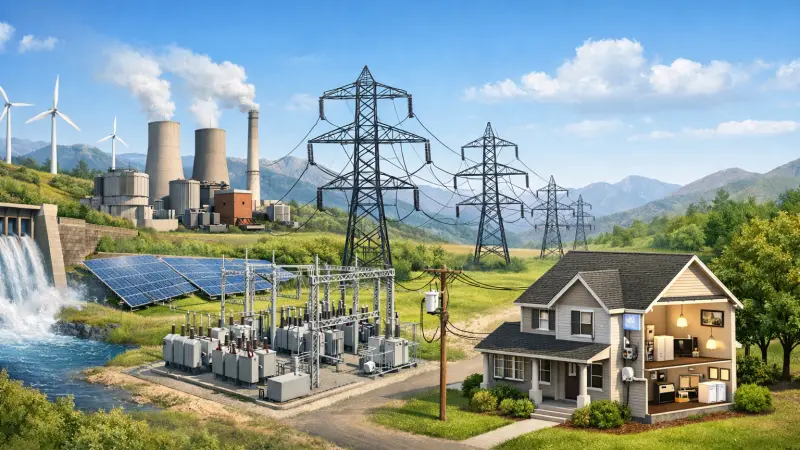
Have you ever paused to consider what actually happens behind your wallpaper when you flick a light switch or power up a commercial server? In the United Kingdom, we benefit from one of the most sophisticated and reliable power networks in the world, yet the journey from a North Sea wind farm or a thermal power station to your three-pin socket is a feat of engineering that spans hundreds of miles and involves complex physics. Understanding the mechanics of electricity generation and delivery is not just for electrical engineers; for UK businesses and homeowners, this knowledge is fundamental to managing energy efficiency and navigating the modern landscape of the National Grid.

The Fundamental Nature of Electricity: More Than Just a Current
Before examining the vast infrastructure of the UK’s energy network, we must establish a clear definition of what electricity actually is. In a professional context, it is helpful to use the "hydraulic analogy." Imagine a high-pressure water system. In this scenario, electricity is not the water itself, but the energy carried by the flow. The "water" is actually a stream of subatomic particles called electrons, which exist within the conductive atoms of metal wires—typically copper or aluminium.
When we speak of an electrical circuit, we are referring to the closed loop through which these electrons move. The force that pushes these electrons is known as Voltage (measured in Volts), while the actual flow rate is the Current (measured in Amperes). To complete the analogy, the electrical wire acts as the hose, and the insulation around it ensures the "water" doesn't leak out before reaching the intended appliance. For UK SMEs, understanding that electricity is a dynamic flow of energy—rather than a static commodity—is the first step toward appreciating the complexity of grid stability.
Static vs. Current Electricity
While most of our daily lives revolve around Current Electricity (the steady flow of electrons), it is worth noting Static Electricity. Static occurs when electrons gather on the surface of an object, creating an imbalance. While fascinating, static electricity cannot power a modern industrial unit or a domestic kitchen because it lacks the sustained pressure and flow required to do work. The National Grid focuses exclusively on delivering alternating current (AC), where electrons rapidly switch direction, allowing for efficient long-distance transmission.
Stage One: The Mechanics of Large-Scale Power Generation
How do we begin the process of moving billions of electrons simultaneously across the country? The vast majority of electricity in the UK is produced using Electromagnetic Induction. This principle, discovered by Michael Faraday, states that moving a magnet near a coil of wire causes an electric current to flow in that wire.
At the heart of every power station—whether it is nuclear, gas-fired, or wind-powered—is a Generator. Inside this machine, a massive rotor fitted with powerful magnets spins at high speeds inside a stationary cylinder lined with copper coils (the stator). The kinetic energy of the rotation is converted into electrical energy. The primary difference between different types of power stations is simply the method used to spin that rotor.
The Dominance of the Steam Turbine
For over a century, the steam turbine has been the workhorse of global power generation. In a thermal power station, a heat source is used to boil vast quantities of purified water into high-pressure steam. This steam is directed at the blades of a turbine, much like wind hitting a windmill, causing it to spin at roughly 3,000 RPM (revolutions per minute) to match the 50Hz frequency required by the UK grid.
- Combined Cycle Gas Turbines (CCGT): Currently a major source of UK power, these burn natural gas to drive a turbine, then use the exhaust heat to create steam for a second turbine, maximising efficiency.
- Nuclear Power: Instead of burning fuel, nuclear stations use the heat generated by splitting uranium atoms (fission) to create the necessary steam. This provides a steady "base load" of carbon-free electricity.
- Biomass: Facilities like Drax in North Yorkshire burn wood pellets or organic matter to generate steam, offering a renewable alternative to coal.
Stage Two: Stepping Up for Long-Distance Travel
Once the generator has produced electricity, it usually sits at a relatively low voltage (typically around 25,000 Volts). However, sending electricity at this voltage over long distances would result in massive
energy losses due to heat generated by resistance in the wires. To solve this, the electricity is passed through a Step-Up Transformer before it leaves the power station.
In the UK, these transformers increase the voltage to 275,000 or even 400,000 Volts. By increasing the voltage, the current (Amps) can be lowered while still delivering the same amount of power. Lower current means less heat loss, allowing the energy to travel hundreds of miles with over 90% efficiency. These high-voltage lines are what you see suspended from the large steel pylons that criss-cross the British countryside.
Stage Three: The National Grid and the Transmission Network
The National Grid is often described as the "central nervous system" of the UK. It is a high-voltage transmission network that connects all major power generators to the regional distribution networks. The beauty of the grid lies in its interconnectedness; if a power station in Scotland goes offline for maintenance, the grid can instantly reroute power from solar farms in Cornwall or gas stations in the Midlands to ensure the lights stay on in London.
The National Grid must maintain a constant balance between Supply and Demand. Because electricity is difficult to store on a national scale (though battery technology is improving), the amount being generated must exactly match the amount being used at any given second. If demand spikes—such as during the "TV pickup" when millions of people boil kettles during a cup final half-time—the Grid controllers must call for more power to be released into the system immediately.
Regional Distribution Networks (DNOs)
While the National Grid handles the "motorways" of electricity, Distribution Network Operators (DNOs) manage the "A-roads" and local streets. There are six main DNOs in the UK, including companies like Western Power Distribution, UK Power Networks, and SP Energy Networks. They take the high-voltage electricity from the National Grid and begin the process of "stepping it down" for safe use.
Stage Four: Delivering Power to the End User
As the electricity approaches a town or industrial estate, it enters a Primary Substation. Here, transformers reduce the voltage to 33,000 or 11,000 Volts. This level is suitable for heavy industry or large commercial complexes like hospitals or factories. However, for the average SME or domestic home, 11,000 Volts is still far too dangerous.
The final step occurs at a Local Transformer—often those green metal boxes you see on street corners or the grey cylinders mounted on wooden poles in rural areas. This transformer performs a "Step-Down" to the UK standard of 230 Volts (AC). From here, the electricity travels through underground cables or overhead lines directly into your property's service head.
The Consumer Unit: Your Property's Safety Hub
Inside your building, the electricity passes through a meter (which records usage for billing) and then into the Consumer Unit (formerly known as a fuse box).
This unit is the gatekeeper of your property's electrical safety. It contains:
- Circuit Breakers (MCBs): Switches that automatically flip "off" if a circuit is overloaded.
- RCDs (Residual Current Devices): Life-saving devices that disconnect the power instantly if they detect a leak of current (which could indicate someone is receiving an electric shock).
- Surge Protectors: Modern units often include protection against voltage spikes caused by lightning or grid switching.
The UK’s Transition to Green and Renewable Energy
The landscape of UK electricity generation is changing rapidly. As we strive toward "Net Zero," the reliance on fossil fuels is being replaced by a diverse mix of renewable sources. For UK businesses, this transition is significant as it affects both the price and the "carbon intensity" of the energy they consume.
Harnessing the Wind and Sun
The UK is uniquely positioned to be a global leader in wind energy. Offshore Wind Farms in the North Sea and Irish Sea consist of hundreds of turbines that can each power thousands of homes. Unlike thermal plants, these do not use steam; the wind directly turns the generator’s rotor. Similarly, Solar Photovoltaic (PV) arrays convert sunlight directly into electricity using the photoelectric effect, bypassing the need for turbines and magnets altogether.
Hydroelectric and Tidal Power
While solar and wind are intermittent, Hydroelectric Power provides a more predictable renewable source. In the Scottish Highlands and Wales, water stored in high-altitude reservoirs is released to flow through turbines. Furthermore, as an island nation, the UK is pioneering Tidal Stream technology, which uses the predictable movement of the tides to generate constant, reliable energy.
Commercial Realities: Deregulation and the Energy Market
In the UK, the energy market is "unbundled." This means that the company you pay your bill to (the Supplier) is rarely the same company that owns the wires (the DNO) or the power stations (the Generator). This deregulation was designed to foster competition and lower prices for consumers.
When an SME signs an energy contract, they are essentially paying for three things:
- Wholesale Costs: The price the supplier paid to buy the electricity from generators.
- Network Costs: Fees paid to the National Grid and DNOs to maintain the pylons and cables.
- Policy Costs: Levies used to fund renewable energy subsidies and social programmes.
Understanding this structure helps businesses realise that switching suppliers only changes the "billing and customer service" element; the physical delivery of electricity remains the responsibility of the regional DNO, regardless of which logo is on the invoice.
The Future: Smart Grids and Battery Storage
The traditional model of electricity—centralised power plants sending energy one-way to consumers—is evolving into a Smart Grid. In this new model, data flows alongside electricity. Smart meters allow the grid to "talk" to appliances, perhaps delaying a dishwasher cycle until wind power is abundant and prices are lower.
Battery Energy Storage Systems (BESS) are also becoming critical. Massive container-sized batteries are being installed across the UK to store excess renewable energy when it's windy/sunny and release it during peak demand. For industrial contractors and developers, integrating EV charging infrastructure and on-site storage is becoming a standard requirement for new UK builds.
Frequently Asked Questions (FAQ)
1. Why is the UK standard voltage 230V?
The UK voltage was historically 240V, while mainland Europe used 220V. In 1995, to "harmonise" with the EU, the standard was set at 230V with a tolerance of +10% / -6%. This means most appliances are designed to work safely within a range from 216V to 253V.
2. What happens during a power cut?
If the lights go out, it is usually due to a local fault (like a cable damaged by roadworks) or an automated safety trip at a substation. In the UK, you should call 105 to reach your local DNO, who is responsible for the physical repair of the lines.
3. Is 'Green Energy' actually different when it reaches my house?
No. Electricity on the grid is like water in a reservoir; once it’s in, you cannot distinguish one electron from another. When you buy a "100% Renewable" plan, your supplier is guaranteeing that for every unit of electricity you use, they have purchased a "Renewable Energy Guarantees of Origin" (REGO) certificate from a green generator.
4. How does the National Grid maintain a 50Hz frequency?
The frequency is directly linked to the speed at which generators spin. If demand exceeds supply, the generators slow down slightly, and the frequency drops.
The National Grid uses "Frequency Response" services, paying certain providers to quickly increase or decrease their output to keep the system at exactly 50Hz.
5. Can I make money by generating my own electricity in the UK?
Yes. Through the Smart Export Guarantee (SEG), UK homeowners and businesses with solar panels or wind turbines can receive payments from energy suppliers for the excess electricity they export back into the National Grid.

Disclaimer: The information provided in this article is for general informational and research purposes only. Company details, features, services, and market positions may change over time. Readers are advised to visit official company websites and conduct independent research before making any business decisions or purchasing services.
Most Searchable Keywords

Recent Blogs


Related Listings
-
Welton Renewables and Electrical
-
EV Home Charger UK
-

A1 Gas Force Nuneaton
-
A1 Gas Force Warwick
-

A1 Gas Force Solihull


Categories
- Accountants (295)
- Advertising Agencies (559)
- Architects (149)
- Automobiles (377)
- Beauty (300)
- Carpenters (146)
- Cleaning Services (386)
- Dentists (189)
- Driving (62)
- Electricians (215)
- Energy (8)
- Event Organiser (685)
- Finance (599)
- Guide (3365)
- Health (2207)
- Information technology (206)
- Legal Services (353)
- Logistics (6)
- Maintenance (65)
- Manufacturing (35)

Sponsored Listings in Electricians
Related Blogs

Gen Z Political Reporters and News Creators i...
Read this insightful article "Gen Z Political Reporters and News Creators in the UK" to expand your knowledge!

Famous Female Social Media Influencers Across...
Read this insightful article "Famous Female Social Media Influencers Across the UK" to expand your knowledge!

Your UK Sponsor Licence 2026 Step by Step Gui...
Read this insightful article "Your UK Sponsor Licence 2026 Step by Step Guide" to expand your knowledge!
Questions & Answers – Find What
You Need, Instantly!
How can I update my business listing?
Is it free to manage my business listing?
How long does it take for my updates to reflect?
Why is it important to keep my listing updated?
